
Table of Contents
Table of Contents
The search query cloud storage request budget kafka usually appears after a team learns that storage capacity is not the whole cost story. The storage line may look reasonable, and the architecture review may still miss the operational question that matters during replay, scaling, and recovery: how many cloud storage requests does the event stream create, and who owns that budget?
That question matters because object-backed streaming systems move durable data into cloud storage services that price capacity, request operations, retrieval behavior, and network paths as separate meters. For Kafka teams, this is useful and uncomfortable. The bill reveals workload behaviors, but a Kafka topic no longer maps neatly to broker disks and reserved instances. Writes, tail reads, catch-up reads, rebalances, cache misses, compaction, and migration tests can all touch different parts of the cloud invoice.
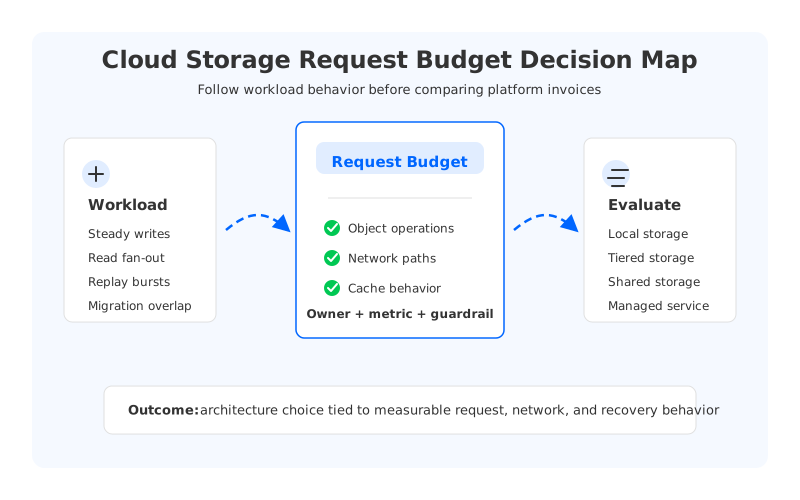
Traditional Kafka cost planning often starts with brokers: CPU, memory, disk, replication factor, and expected traffic. Object-backed event streams need the same rigor, but the worksheet has to follow data paths rather than server counts. A request budget means making request behavior observable, forecastable, and governed before it surprises FinOps, SRE, or procurement teams.
1Why Teams Search for cloud storage request budget kafka
The search intent is practical. A Kafka platform owner is evaluating a Kafka-compatible system that uses object storage, or a FinOps team is reviewing a cloud bill where object storage request lines are growing faster than expected. The team may already understand that object storage can change retention economics. What they need next is a way to connect application behavior to cloud meters without turning every developer into a storage pricing specialist.
The hard part is that Kafka workloads are not uniform. A payments topic with steady tail reads behaves differently from an observability topic with bursty writes and rare but massive replay. A CDC pipeline with snapshots behaves differently from a feature store pipeline that fans out to many consumers. Each pattern changes request volume in a different way.
Request budgets become useful when they separate four behaviors that are often blended together:
- Steady ingestion: producer writes, batching, segment formation, write-ahead logging, and object creation determine the baseline request rate.
- Normal consumption: tailing consumers may be served from broker memory, local cache, or object storage depending on the architecture and cache hit behavior.
- Exceptional reads: backfill, incident replay, consumer lag recovery, and analytics scans can create request bursts that do not appear during steady-state tests.
- Administrative movement: scaling, broker replacement, partition ownership changes, migration overlap, and rollback tests can generate storage and network activity outside application traffic.
This is where many budgets fail. They model average retained bytes, then use that number as a proxy for storage cost. Retained bytes matter, but request behavior is shaped by object size, batching policy, cache locality, read fan-out, replay frequency, and metadata design.
2The Cloud Cost Drivers Behind the Workload
Cloud providers publish separate pricing dimensions for object storage operations, storage capacity, retrieval, and network transfer. AWS S3, Google Cloud Storage, and Azure Blob Storage all expose request-related pricing categories in their public pricing pages. Unit prices vary by provider, region, storage class, and date, so the durable practice is to refresh the budget model from provider pricing pages during each architecture or renewal review.
For Kafka-compatible streaming, the model should begin with workload shape rather than vendor packaging. A retained GiB is not the same as a written GiB, and a written GiB is not the same as a read GiB. A cluster can have modest retained data and still create heavy request traffic if consumers repeatedly scan historical ranges. Another cluster can retain large volumes but create a predictable request profile because most reads are near-real-time and caches stay warm.
| Cost driver | What to measure | Why it affects the request budget |
|---|---|---|
| Write pattern | Produce rate, batch size, partition count, object creation cadence | Smaller or more fragmented writes can increase object operations and metadata pressure |
| Read fan-out | Number of consumers, fetch behavior, lag distribution | More independent readers can turn one retained stream into many storage access paths |
| Replay profile | Backfills, incident recovery, compliance reads, reprocessing jobs | Rare events can dominate request bursts and cloud operations alerts |
| Cache behavior | Hot read ratio, cache warmup after restart, ownership movement | Cache misses can move traffic from broker-local serving into object storage reads |
| Network placement | Availability Zone, region, private endpoints, NAT, egress paths | Request cost is only one line; transfer and private connectivity can be triggered by the same path |
| Governance boundary | Labels, chargeback ownership, approval workflow, alert routing | Teams cannot control request budgets they cannot attribute |
The table is vendor-neutral. It applies to self-managed Kafka with tiered storage, managed services that expose remote storage behavior, diskless systems, and Kafka-compatible platforms that separate compute from storage. The right comparison is not "disk versus object storage." It is "which architecture makes our dominant workload paths predictable under normal, burst, and recovery conditions?"
3Storage, Network, and Compute Trade-Offs
Traditional Kafka uses a shared-nothing broker model: brokers own partitions, store local log segments, replicate data to peer brokers, and serve consumers from broker-local storage. That design is proven, but it couples compute, storage, and data movement tightly. When retention grows, disks grow. When brokers are replaced or partitions move, data moves. When multi-zone durability is required, replication traffic follows the broker topology.
Object-backed event streams change that coupling, but they do not remove trade-offs. Moving durable data to object storage can reduce dependence on broker-local disks and long partition reassignments. It can also introduce request sensitivity, cache design questions, metadata correctness requirements, and additional operational signals. Object storage is not magic; it is a different failure and cost surface.
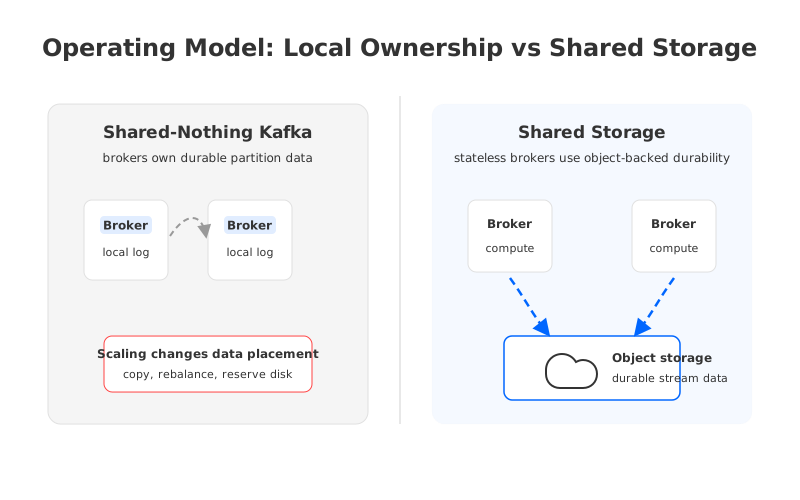
The most useful architecture review separates hot-path latency from durable storage economics. Producers still need predictable acknowledgments, consumers still care about p99 fetch latency and lag recovery, and operators still need clear recovery semantics. The storage layer should improve retention and elasticity economics without hiding the cost of request bursts.
This is also where tiered storage and shared storage should not be blurred. Apache Kafka's tiered storage work, described in KIP-405 and Kafka documentation, allows older log segments to move to remote storage while brokers continue to own local log behavior. Shared-storage systems go further by making durable stream storage a common backing layer and reducing the broker's role as the permanent owner of data.
The request budget has to reflect that difference. In a tiered model, remote storage requests may concentrate around older segment reads and retention movement. In a shared-storage model, request behavior is tied more directly to write batching, WAL design, cache policy, broker statelessness, and object layout.
4Evaluation Checklist for FinOps and Platform Teams
A cloud storage request budget should be reviewed with the same discipline as an SLO. It needs an owner, assumptions, measurement points, and a rollback path when reality disagrees with the estimate. FinOps can help with pricing inputs, but platform engineering has to define the workload events.
Start with the scenarios that usually break spreadsheet estimates. A proof of concept that tests only steady ingestion is too thin. Run peak writes, consumer lag recovery, cache-cold broker replacement, long replay, ownership movement, and migration overlap. Then compare object storage requests, network transfer, broker CPU, consumer lag, and operational steps.
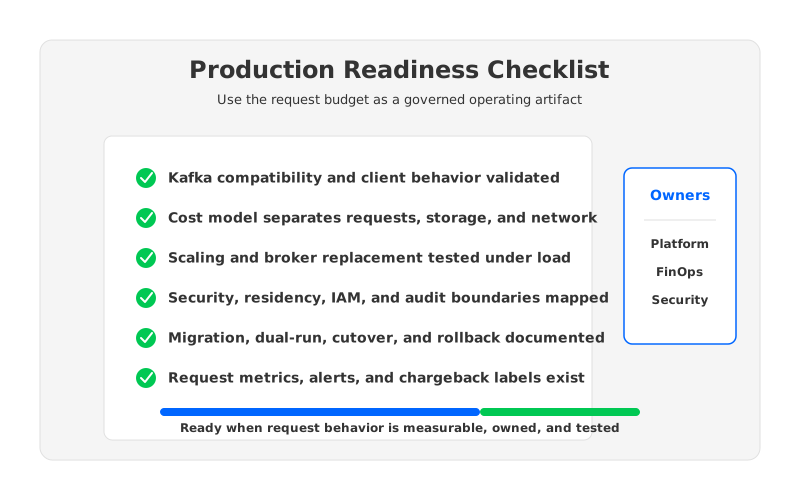
The review becomes clearer when the team uses a decision matrix rather than a yes-or-no checklist:
| Review area | Passing signal | Risk signal |
|---|---|---|
| Compatibility | Existing Kafka clients, security configuration, topic operations, and consumer behavior work without application rewrites | Client semantics or operational tooling require unexpected changes |
| Cost model | Compute, storage capacity, object requests, network transfer, private connectivity, observability, and support are modeled separately | The estimate is a blended monthly number with no path-level attribution |
| Elasticity | Scaling changes broker capacity without forcing large data movement or long maintenance windows | Scaling requires slow partition reassignment or creates cache/request storms |
| Governance | Topics, teams, environments, and request-heavy jobs have labels and chargeback ownership | Object storage requests appear as shared platform cost with no accountable workload |
| Failure recovery | Broker replacement, zone disruption, cache warmup, and replay behavior are tested under load | Recovery tests pass functionally but create unknown request or network spikes |
| Migration | Dual-run, offset validation, rollback, and cutover windows are documented | Migration assumes compatibility while ignoring request, cache, and replay behavior |
The point of the matrix is to make trade-offs explicit before the platform becomes the default. A workload with infrequent historical reads may accept a request profile that would be unacceptable for a replay-heavy analytics pipeline. A regulated workload may accept higher operating cost in exchange for clearer customer-controlled deployment boundaries.
5How AutoMQ Changes the Operating Model
Once the evaluation framework is clear, AutoMQ can be assessed as one concrete architecture option rather than as a generic "Kafka alternative." AutoMQ is a Kafka-compatible cloud-native streaming platform that separates broker compute from durable storage through a shared storage architecture.
The architectural shift is straightforward: brokers become more stateless, durable stream data is backed by object storage, and compute can scale more independently from retained data. That changes the request-budget conversation. Broker replacement and scaling are less tied to copying broker-local log data. Retention planning can lean on object storage economics instead of permanently sizing local disks for the full history. Request behavior becomes part of storage-layer evaluation rather than an accidental side effect of broker operations.
AutoMQ's public materials also discuss reducing cross-Availability Zone traffic through its shared-storage design and deployment controls. That claim should still be tested in the buyer's own cloud account because network paths depend on region, client placement, private connectivity, and workload shape. The credible evaluation is a workload replay that measures request volume, cross-zone transfer, latency, cache behavior, broker replacement time, and operational steps under the same assumptions used for traditional Kafka or another Kafka-compatible platform.
This is where AutoMQ changes what has to be budgeted. Traditional Kafka often forces teams to reserve compute and storage together because brokers own durable data. An object-backed shared-storage model lets teams reason about compute headroom, retained data, and request behavior separately. That separation does not remove the need for budgets; it makes each path easier to measure and govern.
For migration planning, compatibility is the first gate and operational predictability is the second. Validate producers, consumers, ACLs, authentication, topic configuration, offset behavior, transactions when used, connectors, and monitoring before cost claims matter. After that, baseline the current cluster, run a dual-write or replay test where appropriate, observe object storage requests and network transfer, then define cutover and rollback criteria.
6A Practical Request-Budget Worksheet
The worksheet below is not a pricing calculator; it is a forcing function for architecture review. Each row should have an owner and measurement source. If a row cannot be measured during proof of concept, mark it as a risk instead of hiding it in the estimate.
| Budget line | Questions to answer before production |
|---|---|
| Baseline writes | What request rate does normal ingestion create at expected batch size, partition count, and retention policy? |
| Tail reads | What percentage of consumer fetches are served from cache or hot broker state versus object storage? |
| Catch-up reads | How does request volume change when a major consumer group lags and then catches up? |
| Replay jobs | Which teams can trigger historical replay, and how is that work approved, rate-limited, and charged back? |
| Scaling events | What happens to request volume when brokers are added, removed, replaced, or moved across zones? |
| Failure recovery | Does the recovery runbook include object storage request rate, storage errors, network transfer, and cache warmup? |
| Migration overlap | During dual-run or backfill, which duplicate storage, network, and request costs are expected and time-boxed? |
This worksheet also changes team boundaries. Application teams own batching, message size, consumer behavior, and replay requests. Platform teams own storage architecture, broker scaling, cache policy, observability, and runbooks. FinOps owns pricing inputs and anomaly review. Security and compliance teams own residency, encryption, IAM, audit, and deployment boundaries.
The same structure helps during procurement. Ask each candidate platform how request behavior is measured, what metrics are exposed, how cache misses are surfaced, what happens during broker replacement, and how replay-heavy workloads are controlled. If a platform can discuss capacity but not request behavior, the cost model is incomplete.
The original search query was narrow: cloud storage request budget kafka. The production problem is broader. Object-backed event streams can improve retention, elasticity, and broker operations, but only when request behavior becomes part of the architecture review. Treat the budget as an SLO-adjacent artifact, test it under workload events that matter, and make the owner visible before the first surprise invoice arrives.
If you are evaluating Kafka-compatible shared storage and want to test request behavior, cross-zone traffic, and migration risk with your own workload assumptions, review the AutoMQ architecture documentation or contact the AutoMQ team through this verified link: discuss an AutoMQ evaluation.
7References
- Apache Kafka Documentation
- KIP-405: Kafka Tiered Storage
- AWS S3 Pricing
- AWS EC2 Data Transfer Pricing
- Google Cloud Storage Pricing
- Azure Blob Storage Pricing
- AutoMQ Architecture Overview
- AutoMQ Compatibility with Apache Kafka
- AutoMQ S3Stream Shared Storage
- AutoMQ: Difference with Tiered Storage
- AutoMQ Migration Overview
8FAQ
8.1Is a cloud storage request budget the same as a storage capacity estimate?
No. Capacity estimates focus on retained bytes and storage class. A request budget focuses on the operations created by writes, reads, replay, cache misses, scaling, and recovery. Both belong in the same cost model, but they answer different questions.
8.2Do object-backed Kafka systems always reduce cost?
No. They can reduce important cost drivers such as broker-local storage pressure and data movement, but the final result depends on workload shape, object storage requests, network placement, cache behavior, provider pricing, and operational ownership. The responsible answer is workload-specific.
8.3What should a proof of concept measure?
Measure steady ingestion, tail reads, consumer lag recovery, long replay, broker replacement, scaling, network transfer, object storage requests, latency, and observability signals. A test that measures only average produce throughput will miss the events that usually stress the budget.
8.4How does AutoMQ relate to this framework?
AutoMQ is one Kafka-compatible shared-storage option to evaluate with the framework. Its stateless broker and shared storage architecture can change how teams plan compute, retention, scaling, and cross-zone traffic, but the evaluation should still use production-shaped workload tests and cloud-account measurements.


