
Table of Contents
Table of Contents
Teams usually search for cluster replacement drill kafka after an incident review has exposed an uncomfortable dependency. The Kafka cluster recovered, but the recovery path depended on broker-local data, manual reassignment, extra capacity, and operator decisions that nobody wants to rediscover during a larger failure. The drill is not about whether a single broker can restart. It is about whether the organization can replace the streaming cluster without losing client compatibility, recovery confidence, cost control, or governance boundaries.
A cluster replacement drill is different from a failover test. Failover asks whether service can continue when a component or zone fails. Replacement asks whether the platform can build a clean cluster, move traffic, validate state, and retire the damaged or outdated cluster under production constraints. That distinction matters for Kafka because clients, consumer groups, offsets, connectors, ACLs, schemas, topic configuration, and monitoring all become part of the recovery surface.
Traditional Kafka makes broker identity and local storage operationally significant. When data durability is tied to broker disks, replacement drills become storage logistics. The team has to think about replica placement, reassignment throughput, controller state, partition leadership, network paths, and whether catch-up traffic will compete with live producers and consumers.
1Why Teams Search for cluster replacement drill kafka
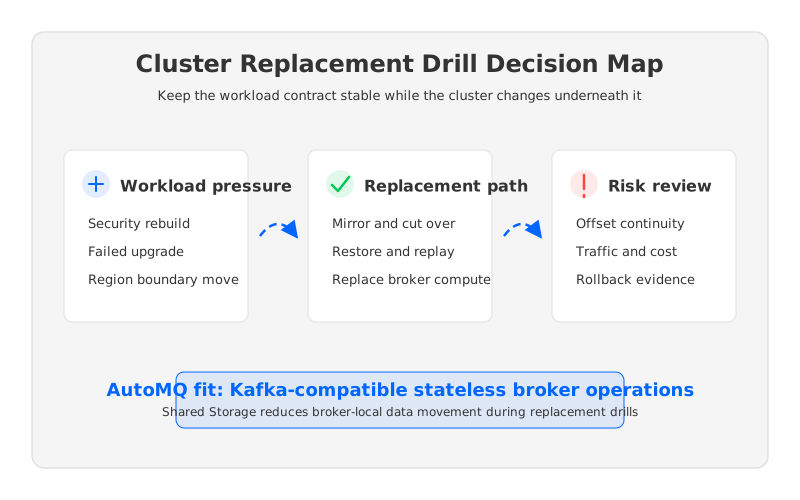
The search intent is practical. A platform team may be preparing for a region evacuation, a security rebuild, a failed upgrade, a cloud account boundary change, or a migration from one Kafka-compatible platform to another. In each case, the question is less "can Kafka survive a broker failure?" and more "can we replace the cluster and still know exactly where the system stands?"
That question is painful because Kafka sits between many owners. Application teams own producers and consumers. Platform teams own brokers, networking, identity, quotas, and observability. Data teams own connectors, schemas, and downstream sinks. Security teams own credentials, ACLs, encryption, and audit trails. A replacement drill crosses all of those boundaries at once, which means a technically healthy cluster can still fail the drill if the ownership model is unclear.
The useful way to frame the drill is to define what must remain stable while the cluster changes underneath it:
- Client contracts must stay predictable. Producers and consumers should keep their expected Kafka protocol behavior, authentication model, topic names, partitioning assumptions, and delivery semantics.
- Progress markers must be portable. Consumer group offsets, connector state, and downstream replay points need a documented source of truth.
- Operational evidence must be comparable. Lag, produce latency, fetch latency, controller health, storage growth, and error rates should be visible before, during, and after the replacement.
- Rollback must be designed before traffic moves. A drill without a rollback path is a migration rehearsal, not a replacement exercise.
These requirements expose a deeper architectural split. Some platforms make replacement a data movement problem. Others make it a traffic and metadata coordination problem. The difference determines how often the team can practice and how much risk each rehearsal introduces.
2The Production Constraint Behind the Problem
Kafka's Shared Nothing architecture was built around brokers that own partitions and persist logs locally. Replication spreads copies across brokers for durability, and the controller tracks partition leadership and cluster metadata. This model is well understood, battle-tested, and compatible with a huge ecosystem. It also means that replacing a cluster is rarely as clean as starting fresh compute and pointing clients at it.
Broker-local storage changes the replacement timeline. If the target cluster needs the same data, the data must be copied, mirrored, reassigned, or replayed from another source. If the team chooses mirroring, it has to track topic configuration, offsets, ACLs, consumer cutover, connector behavior, and lag between source and target. If it chooses backup and restore, it has to validate restore time, consistency, and how consumers resume. If it chooses application replay, it has to know which upstream systems can produce the same events again.
The cost model becomes part of the recovery design. Multi-AZ Kafka deployments can generate inter-zone traffic through replication, leadership placement, consumer reads, and maintenance activity. During a replacement drill, the cluster may run duplicate capacity while mirror traffic, catch-up reads, and validation jobs run beside production traffic. A drill that looks inexpensive on a whiteboard can become expensive when it moves large volumes across availability zones or holds duplicate broker storage for a long validation window.
Governance is another hidden constraint. Replacement changes where secrets, ACLs, audit logs, topic policies, network rules, and observability integrations are enforced. A team can move data and still fail the production review if the target cluster does not preserve the same control boundaries. The drill is complete when operators can prove that recovery, access, observability, cost, and rollback are all under control.
3Architecture Options and Trade-Offs
Cluster replacement planning usually starts with tooling, but the better starting point is the operating model. The platform team should decide what kind of state is being moved and what kind of state should disappear from the broker layer. That makes the trade-offs easier to compare.
| Operating model | What replacement means | Main risk | Good fit |
|---|---|---|---|
| Broker-local Kafka | Rebuild brokers and move or replay log data | Long data movement and capacity pressure | Stable clusters with infrequent replacement |
| Mirrored target cluster | Run source and target in parallel until cutover | Offset translation, lag, and dual operations | Planned migrations and staged validation |
| Tiered storage Kafka | Restore or hydrate from remote log segments plus local state | Coupling between local active data and remote tiers | Retention-heavy workloads that still rely on broker ownership |
| Shared Storage with stateless brokers | Replace compute while durable stream data stays outside broker disks | Metadata, WAL, and compatibility validation | Cloud operations that need repeatable replacement drills |
This table shows where the risk moves. Broker-local models make data placement and movement central. Mirrored target clusters make coordination and cutover central. Tiered storage can reduce local disk pressure, but the operator still has to understand which parts of the log are local, which parts are remote, and how active cluster state is reconstructed. Shared Storage changes the assumption: brokers are replaceable compute nodes, while durable stream data lives in shared cloud storage with a separate write-ahead path.
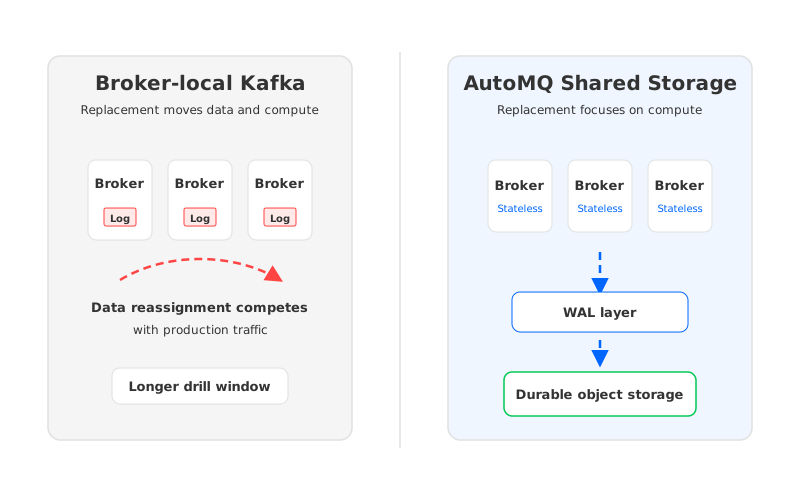
The architecture review should also separate replacement from disaster recovery. A disaster recovery plan defines how service continues after a major failure. A replacement drill tests whether the team can create the target state, compare it with the source state, move traffic, and roll back if validation fails. Disaster recovery is about survival under pressure. Replacement is about repeatability under control.
4Evaluation Checklist for Platform Teams
A good drill has a checklist that a skeptical operator would accept. It should not depend on a vendor slide, a heroic engineer, or a tool that nobody has run under load.
- Compatibility review: Verify client versions, producer settings, consumer group behavior, transactions if used, security mechanisms, topic configuration, quotas, and ecosystem tools.
- State review: Identify the authoritative source for topic metadata, consumer offsets, connector state, schema history, ACLs, secrets, and observability configuration.
- Traffic review: Define how producers and consumers move, how long dual-write or mirror periods last, and how clients discover the target cluster.
- Recovery review: Decide how much data must be available after replacement, where replay begins, how lag is measured, and how failed cutover attempts roll back.
- Cost review: Model duplicate capacity, storage growth, validation reads, mirror traffic, cross-zone paths, PrivateLink or gateway paths, and operational labor.
- Governance review: Confirm identity boundaries, audit logs, encryption settings, network policy, data residency, retention, and change approvals.
- Operations review: Run the drill from a written runbook, capture metrics, compare source and target behavior, and record the exact conditions that define success.
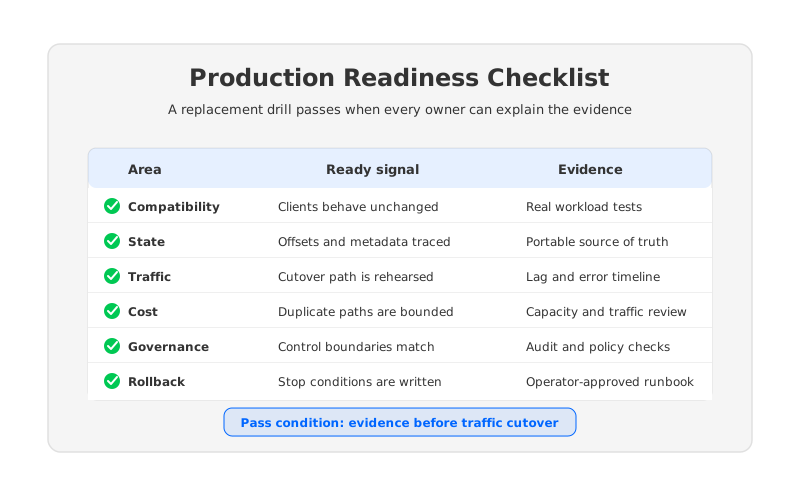
The checklist forces a useful conversation. If the target cluster is healthy but the team cannot explain offset continuity, it is not ready. If cost review ignores duplicate traffic during validation, the business case is incomplete. If rollback requires manual topic surgery, the drill is not repeatable enough for production pressure.
5How AutoMQ Changes the Operating Model
Once the neutral framework is clear, AutoMQ becomes relevant as a Kafka-compatible cloud-native streaming platform that separates broker compute from durable storage. AutoMQ keeps Kafka protocol compatibility while moving long-lived stream data out of broker-local disks and into a Shared Storage architecture backed by object storage and a write-ahead log. In this model, brokers are much closer to stateless compute from the operator's point of view.
That shift changes what a cluster replacement drill is testing. In a broker-local model, replacing the cluster often means moving the data plane and the compute plane together. In a Shared Storage model, the durable stream data is not anchored to individual broker disks, so the drill can focus more directly on metadata readiness, client routing, WAL health, authorization, observability, and traffic cutover. The risk does not vanish; it becomes easier to isolate and test.
AutoMQ's architecture also matters for cloud cost reviews. Because it is designed around shared object storage and zone-aware access patterns, it can reduce broker-to-broker replication traffic in multi-AZ Kafka operations. During replacement drills, validation, catch-up, and temporary duplicate capacity can amplify traffic that is normally hidden in daily operations.
For migration teams, the Kafka-compatible surface is the practical gate. Existing applications should be evaluated against the same API behavior, consumer group expectations, security requirements, and tool integrations they use today. The storage architecture can be different underneath, but the replacement drill succeeds only when the workload contract remains understandable to the teams that own producers, consumers, connectors, and incident response.
6A Drill Runbook That Operators Can Reuse
The runbook should be short enough to run under pressure and detailed enough to survive personnel changes. Start with a scope statement: which topics, clients, connectors, identities, and environments are part of the drill. Then define the target cluster readiness checks before any traffic moves. This includes broker health, topic metadata, access policy, monitoring, alert routing, network reachability, and workload-specific compatibility tests.
The next step is traffic rehearsal. Some teams mirror records into a target cluster and compare lag. Others test client cutover for a narrow topic set. Shared Storage operating models may rehearse broker replacement and client routing without copying the full historical log through broker-to-broker replication. The evidence should be the same: producers can write, consumers can resume, offsets are explainable, and downstream systems can tolerate the transition.
Validation needs hard stop conditions. A drill should name the metrics that block cutover, such as growing lag, authentication failures, topic configuration mismatch, unexpected consumer group resets, or missing observability signals. It should also name the signals that allow rollback. Rollback is not a failure of the drill. It is the reason the drill exists.
7Decision Matrix for Technical Buyers
The final decision should compare architectures against the replacement scenarios the team expects to face. A region evacuation has different constraints than a security rebuild. A platform migration has different constraints than a failed upgrade. The common mistake is to evaluate the happy path and then hope the recovery path will look similar.
| Scenario | Primary question | Strong signal |
|---|---|---|
| Security rebuild | Can the team rebuild clean infrastructure without reusing suspect compute state? | Broker replacement does not require ad hoc log movement from damaged nodes |
| Failed upgrade | Can the team return to a known working state quickly? | Rollback is documented and tested with client and offset behavior |
| Region or account boundary change | Can traffic move while governance boundaries stay intact? | Identity, audit, network, and retention policies are validated before cutover |
| Platform migration | Can applications move without client rewrites? | Kafka compatibility is tested with real producers, consumers, and tools |
| Capacity failure | Can replacement avoid competing with production traffic? | Catch-up and validation paths are measured separately from live workload paths |
This is where stateless broker models change the conversation. They do not remove the need for serious drills, and they do not excuse a weak runbook. They make replacement a normal operating exercise instead of an exceptional storage recovery project. For teams that run Kafka-compatible infrastructure as a platform service, that difference compounds over time because practice becomes safer and more frequent.
If your team is designing a Kafka cluster replacement drill and wants to compare broker-local operations with a Shared Storage model, start with your own workload contract: topics, offsets, identities, traffic paths, rollback conditions, and validation metrics. AutoMQ documents its Kafka compatibility and Shared Storage architecture, and you can use those materials as a starting point for a focused replacement-drill evaluation: explore AutoMQ for Kafka-compatible stateless broker operations.
8References
- Apache Kafka documentation
- Apache Kafka operations documentation
- AWS Regions and Availability Zones
- AWS EC2 on-demand pricing and data transfer reference
- AutoMQ Shared Storage architecture
- AutoMQ Kafka compatibility
- AutoMQ inter-zone traffic overview
9FAQ
9.1What is a Kafka cluster replacement drill?
A Kafka cluster replacement drill is a controlled exercise that proves whether a team can build or select a replacement cluster, validate workload state, move traffic, and roll back if needed. It is broader than broker restart testing because it includes clients, offsets, topic metadata, security, observability, cost, and downstream dependencies.
9.2How is cluster replacement different from disaster recovery?
Disaster recovery focuses on continuing service after a failure. Cluster replacement focuses on creating a clean target operating state and moving workloads into it with evidence. A strong disaster recovery plan may include replacement, but a replacement drill is more deliberate about compatibility, validation, rollback, and governance.
9.3Why do stateless brokers help replacement drills?
Stateless brokers help because durable stream data is not tied to individual broker disks in the same way as a broker-local model. The drill can focus on metadata, routing, authorization, observability, and workload behavior rather than treating every replacement as a large storage movement project.
9.4Does Kafka compatibility remove migration risk?
Kafka compatibility reduces client-side risk, but it does not remove the need for testing. Teams still need to verify producer behavior, consumer group offsets, transactions if used, security settings, connector behavior, monitoring, and rollback conditions with their real workloads.
9.5What should be measured during a replacement drill?
Measure produce and fetch behavior, consumer lag, offset continuity, authentication failures, topic configuration differences, connector health, controller health, storage growth, cross-zone traffic, alert quality, and rollback time. The drill is ready for production only when the team can explain each metric before and after cutover.


