
Table of Contents
Table of Contents
Cold replay looks harmless until the cluster is already under stress. A payments team needs to rebuild a ledger after a downstream bug. A data platform team needs to backfill a warehouse table after a schema mistake. An SRE team needs to replay several days of events into a clean environment after an incident. These requests are why teams retain event streams instead of treating Kafka as a transient queue.
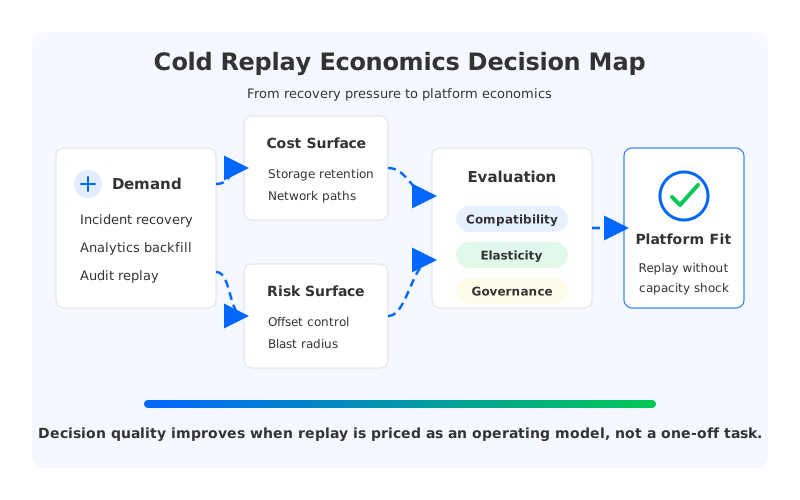
The economic problem appears when replay demand arrives on top of normal production traffic. The replay reader does not care that brokers are already serving producers, consumer groups, replication, connector workers, and monitoring. It asks the platform to read old data at high speed, often from storage paths colder than the steady-state tailing workload. That request turns recovery into capacity planning.
This is where “cold replay economics Kafka” becomes a real architecture question rather than a cost-accounting phrase. The bill is not limited to retained data storage. It includes extra compute for catch-up reads, network paths crossed during replay, idle headroom for rare incidents, and governance work required to replay production data without creating another incident.
1Why Cold Replay Becomes Expensive
Most Kafka sizing discussions start with write throughput, retention, partition count, and peak consumer fan-out. Cold replay cuts across those assumptions because it changes the read pattern. A normal consumer group tails recent offsets, benefits from hot caches, and advances at application speed. A backfill job may scan hours or days of historical data as fast as the sink can accept it. The workload shifts from “keep up” to “catch up,” and that difference matters.
Traditional Kafka also makes this workload feel physical. Partitions live on broker-local storage, replicas live on other brokers, and recovery often competes with the same disks, CPUs, and network interfaces that serve live traffic. Kafka’s consumer group and offset model gives teams precise control over where a replay starts, but the cluster still has to serve the bytes. Offsets are lightweight metadata; historical reads are not.
Three cost drivers usually dominate the conversation:
- Storage retention is priced before the incident happens. Teams keep more data because replay is valuable, but they pay for that retention every month even if recovery events are rare.
- Read amplification appears during the incident. A replay job can pull historical data through brokers, caches, connectors, and downstream systems at a rate that was never part of the steady-state baseline.
- Network paths decide whether replay is local or noisy. Cross-zone, cross-region, and private connectivity charges can turn a technical recovery plan into a finance surprise when the replay crosses the wrong boundary.
Cloud pricing pages make this important because storage, compute, and data transfer are billed differently. Amazon S3 pricing separates storage, requests, retrieval, and transfer, while EC2 pricing treats compute capacity as a different meter. A Kafka platform team cannot evaluate cold replay by looking at only one meter. The workload touches all of them.
2The Architecture Behind the Bill
Kafka was designed around a log abstraction, not a cost ledger. That abstraction is still the reason Kafka is useful for replay: topics retain ordered records, consumers track offsets, and teams can create additional consumers that scan old data without asking producers to resend events. Apache Kafka’s documentation describes the consumer and offset model in detail, and that model remains the operational foundation for recovery and backfill work.
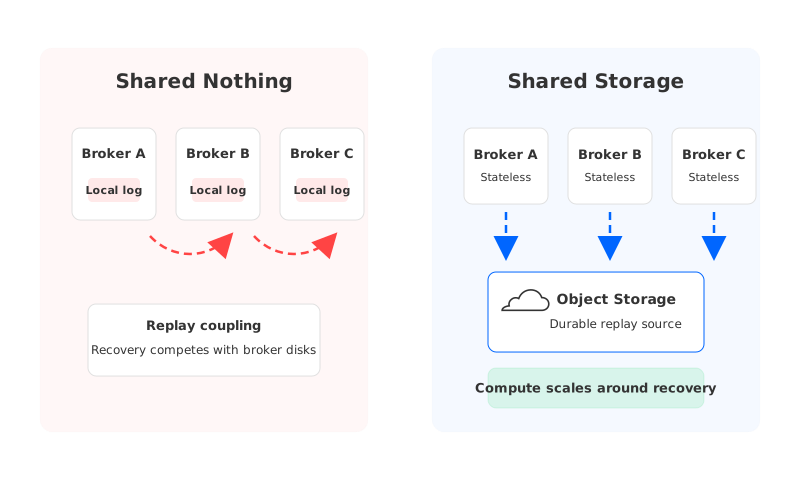
The cost question is shaped by how the storage layer implements that log. In a shared-nothing Kafka deployment, brokers own local disks or cloud volumes. Replication protects data by writing copies across brokers. This model is robust, but it binds retained data to broker capacity. When replay volume grows, teams add broker headroom, expand disk, widen network capacity, or throttle recovery jobs to protect production traffic.
Tiered storage changes part of the picture by moving older segments to a remote tier. It can reduce pressure on local disks and make long retention more affordable, depending on workload. But tiering is not the same as making brokers stateless. The broker still sits in the serving path, metadata and fetch behavior still matter, and replay capacity still has to be planned around live cluster behavior.
The practical distinction is simple:
| Design area | Shared-nothing Kafka | Shared storage / stateless broker model |
|---|---|---|
| Persistent data ownership | Broker-local disks or volumes | Shared durable storage such as object storage |
| Replay pressure | Competes with broker-local resources | Can be planned around independent compute and storage paths |
| Scaling response | Add or resize brokers, then rebalance data | Add compute capacity without moving retained data in the same way |
| Recovery planning | Strongly tied to broker placement and disk health | More focused on metadata, cache, network, and access boundaries |
This table is not a claim that one model removes every operational constraint. Object storage has its own request patterns, latency profile, lifecycle policies, and access-control requirements. The point is narrower: cold replay economics depends on what must scale when old data is read quickly. If storage and compute are coupled, replay capacity is usually reserved inside the broker fleet. If durable storage is shared, replay planning can separate the retained data footprint from the compute used for a recovery event.
3Incident Recovery Is Not the Same as Analytics Backfill
Incident recovery and analytics backfill both read old events, but they optimize for different failure modes. Treating them as the same workload leads to bad trade-offs. A recovery replay is judged by time-to-restore, correctness, blast radius, and whether production traffic survives. An analytics backfill is judged by completeness, downstream consistency, cost control, and whether the result can be audited.
The platform knobs are similar: consumer start offsets, consumer group isolation, fetch sizes, throttling, topic retention, connector capacity, and downstream write limits. The operating posture is different. During an incident, SREs may accept higher temporary cost to restore a service. During a planned backfill, FinOps teams may prefer a slower job inside a defined budget window.
That difference should show up in the runbook. A replay procedure that only says “start a consumer from offset X” is not enough. The runbook should define who approves access, how throughput is capped, where the replay runs, which metrics indicate harm to live traffic, and how the team stops or rolls back the job.
There is also a governance issue. Replaying old events can reintroduce data that downstream systems have already corrected, masked, deleted, or reclassified. For regulated workloads, the recovery path must respect the same data boundary as production. A replay cluster that exports data into an ad hoc environment may solve the immediate technical problem while creating a compliance problem.
4A Cost Model That Survives Production
A useful cold replay cost model starts with the replay unit. Pick a concrete scenario: “replay 24 hours of topic A into a clean analytics pipeline” or “replay the last committed offsets for service B after a bad deployment.” Then model the resources consumed by that scenario rather than averaging replay into monthly Kafka spend.
The model covers five layers:
- Retained bytes. How much historical data must remain available, and for how long? This includes topic retention, compaction behavior, replication, remote storage, and lifecycle policy.
- Replay read path. Which brokers, caches, remote storage services, connectors, and downstream sinks serve the replay? This is where cold reads differ from tailing reads.
- Network boundary. Does the replay stay inside an availability zone, cross zones, cross regions, or traverse private connectivity? The answer often matters more than the CPU used by the job.
- Temporary compute. Can the platform add replay capacity only when needed, or does it keep headroom in the steady-state cluster for an incident that may happen later?
- Operational labor. Who coordinates the replay, validates offsets, monitors lag, controls downstream writes, and proves that the result is correct?
The last layer is easy to ignore because it does not appear as a line item on a cloud bill. It still affects cost. If every backfill requires a senior Kafka operator, a data engineer, and an SRE to sit together for a maintenance window, the organization is paying with scarce engineering time. Good platform design reduces both cloud spend and coordination load.
5The Evaluation Checklist
The decision framework should be neutral before it becomes product-specific. A Kafka-compatible platform for cold replay needs to preserve the semantics teams depend on while changing the cost shape of the workload. Compatibility matters because replay workflows often involve existing producers, consumers, Kafka Connect jobs, Schema Registry integrations, and operational tooling. A lower-cost architecture that breaks the recovery ecosystem is not actually lower cost.
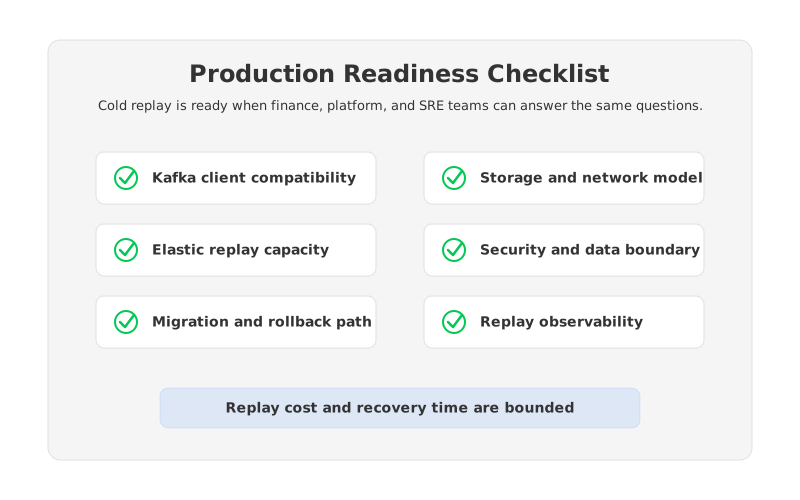
Use these questions as a readiness check before production:
| Area | Question to answer before production |
|---|---|
| Compatibility | Can existing Kafka clients, consumer groups, offsets, and tools run without rewriting replay logic? |
| Cost boundary | Can the team estimate retained bytes, replay reads, network paths, and temporary compute separately? |
| Elasticity | Can replay capacity expand for a recovery event without triggering large data movement first? |
| Governance | Does replay stay within the approved account, VPC, region, encryption, and access-control boundary? |
| Rollback | Can the team stop the replay, reset consumers, and restore downstream state without guessing? |
| Observability | Are lag, fetch throughput, broker pressure, storage reads, connector health, and sink errors visible together? |
The checklist is deliberately cross-functional. FinOps cares about the cost boundary. Platform engineers care about compatibility and elasticity. SREs care about rollback and observability. Security teams care about where old data flows. Cold replay fails when these groups optimize in isolation.
6How AutoMQ Changes the Operating Model
If the core requirement is to keep Kafka semantics while separating retained data economics from broker-local capacity planning, a cloud-native Kafka-compatible architecture becomes relevant. AutoMQ is one implementation of that category: it keeps compatibility with the Kafka protocol and ecosystem while moving storage to a shared-storage architecture backed by object storage.
The important idea is not “object storage is lower cost” in isolation. The architectural change is that brokers are no longer the long-term home of partition data in the same way. AutoMQ brokers handle Kafka protocol work, request routing, partition leadership, caching, and scheduling, while durable stream data is stored through AutoMQ’s S3Stream layer and shared storage design. That changes what has to move when the cluster scales or recovers.
For cold replay, this has several practical consequences. Retained data can be planned around object-storage economics rather than broker-local disk growth alone. Compute capacity can be reasoned about separately from the long-term data footprint. Recovery workflows can focus on access boundaries, metadata, cache behavior, and downstream limits instead of treating every large replay as a broker disk event.
AutoMQ’s documentation also describes a zero cross-AZ traffic design for supported deployment models. That point matters because network transfer is one of the least visible replay costs during architecture reviews. A platform can look efficient on storage and still become expensive if recovery traffic crosses availability-zone boundaries unnecessarily.
There are still engineering choices to make. Object storage request patterns, WAL configuration, cache sizing, replay concurrency, and downstream sink capacity all affect the outcome. A shared-storage architecture gives the team better separation of concerns; it does not remove the need for runbooks, load tests, and guardrails. Mature platforms make the hard parts explicit rather than hiding them inside broker overprovisioning.
7Migration Notes for Existing Kafka Teams
Teams moving from an existing Kafka estate should avoid turning cold replay into a big-bang migration test. Start with one replay scenario that already causes pain: a recurring analytics backfill, a fraud-model rebuild, an audit query, or a disaster-recovery drill. Measure the current process first. Time-to-complete, operator steps, broker impact, network path, and downstream error rate are more useful than a generic throughput number.
Test compatibility with the real replay stack. Use the same client libraries, serializers, schemas, connector settings, security model, and observability tools where possible. Kafka-compatible infrastructure earns trust when the boring parts continue to work.
A practical migration sequence looks like this:
- Define the replay scenario and success criteria in operational language.
- Confirm topic retention, offset strategy, and downstream idempotency.
- Run a bounded replay against non-critical data and record broker, storage, network, and sink metrics.
- Increase replay volume until the platform reaches an agreed guardrail rather than an accidental limit.
- Convert the procedure into a runbook with owners, approvals, stop conditions, and rollback steps.
The key is to make replay a repeatable operating mode, not a heroic recovery maneuver. Once a team can rehearse the backfill, bound the cost, and explain the data boundary, architecture decisions improve because the incident path is priced.
If your team is evaluating how Kafka-compatible shared storage changes replay economics, start with the AutoMQ architecture overview: https://docs.automq.com/automq/architecture/overview.md?utm_source=blog&utm_medium=cta&utm_campaign=rpb-0079
8References
- Apache Kafka Documentation: https://kafka.apache.org/documentation/
- Apache Kafka Consumer Configuration: https://kafka.apache.org/documentation/#consumerconfigs
- Apache Kafka Connect Documentation: https://kafka.apache.org/documentation/#connect
- Apache Kafka Tiered Storage Documentation: https://kafka.apache.org/documentation/#tiered_storage
- AWS Amazon S3 Pricing: https://aws.amazon.com/s3/pricing/
- AWS EC2 On-Demand Pricing: https://aws.amazon.com/ec2/pricing/on-demand/
- AutoMQ Architecture Overview: https://docs.automq.com/automq/architecture/overview.md
- AutoMQ Zero Cross-AZ Traffic Overview: https://docs.automq.com/automq/eliminate-inter-zone-traffics/overview.md
9FAQ
9.1What is cold replay in Kafka?
Cold replay is the process of reading historical Kafka records, often far behind the current tail of a topic, into a recovery, backfill, audit, or reprocessing workflow. It usually starts from a known offset or timestamp and reads retained data faster than a normal steady-state consumer.
9.2Why is cold replay different from normal consumer lag?
Consumer lag is often part of normal operations when an application temporarily falls behind. Cold replay is usually intentional and larger in scope. It may read old data that is no longer cached, involve separate consumer groups, and stress storage, network, and downstream sinks in ways that steady-state consumers do not.
9.3Does tiered storage solve cold replay economics?
Tiered storage can help with long retention and local disk pressure, but it does not automatically solve replay economics. Teams still need to understand broker involvement, remote-read behavior, network paths, cache efficiency, and downstream throughput limits.
9.4What should FinOps teams ask about Kafka replay?
FinOps teams should ask how retained bytes, replay reads, cross-zone or cross-region traffic, temporary compute, and operational labor are measured separately. A monthly Kafka bill that does not distinguish steady-state traffic from recovery traffic is hard to optimize.
9.5Where does AutoMQ fit in this decision?
AutoMQ fits when a team wants Kafka-compatible behavior with a shared-storage architecture that separates compute from durable stream storage. That can make cold replay planning more explicit because retained data, broker capacity, and recovery compute are no longer treated as one tightly coupled resource pool.


