
Table of Contents
Table of Contents
The search for kafka marketplace procurement controls usually starts after Kafka has already become important. A platform team needs more capacity, a security team wants clearer data boundaries, finance wants the purchase to count against a cloud commitment, and procurement wants the contract to fit the company's approved buying path. Nobody in that meeting is asking whether event streaming matters. The harder question is whether the next Kafka-compatible platform can be bought, governed, migrated, and operated without creating a long-term cost or control problem.
Marketplace procurement cannot be treated as a purchasing shortcut. A marketplace route can simplify billing and contract flow, but it does not decide the architecture for you. Kafka infrastructure buying still has to answer where durable data lives, who controls the network, how access is audited, how capacity grows, and how a migration can be reversed. A good buying process makes these questions visible before the order is accepted.
1Why teams search for kafka marketplace procurement controls
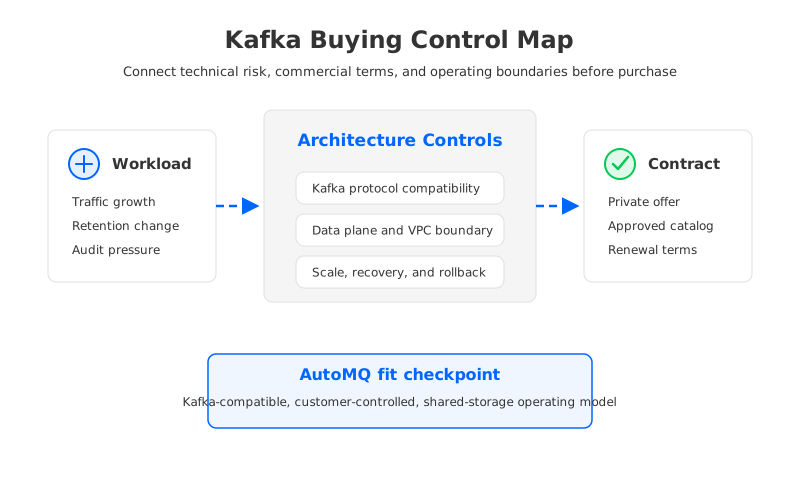
Kafka tends to sit between application teams, data platforms, security controls, and cloud finance. That makes the buying decision unusually crowded. Engineers may care most about protocol compatibility, partition behavior, consumer group semantics, and connector support. Security reviewers may care about VPC boundaries, encryption, identity integration, audit trails, and whether message data ever leaves the customer's environment. Finance and procurement may care about private offers, standard contract language, payment schedule, renewal terms, approved catalog controls, and cloud commitment drawdown.
Those priorities are not in conflict, but they become dangerous when they are reviewed in different rooms. A Kafka platform that looks efficient to engineering can fail procurement because the commercial route does not fit the approved marketplace catalog. A marketplace product that looks clean to procurement can fail architecture review because the data plane boundary is wrong for regulated workloads. A private offer can fit the annual budget while still locking the team into capacity assumptions that do not match traffic growth.
The practical control point is a shared evaluation model. Before comparing vendors, decide which decisions are architectural and which are contractual:
- Architectural controls define where the data plane runs, where storage lives, how clients connect, how authentication and authorization work, and how the system recovers from failure.
- Commercial controls define the buying channel, contract term, renewal behavior, committed spend, usage meter, discount model, and how the purchase maps to cloud budgets.
- Operational controls define who patches, who scales, who monitors, who handles incidents, how changes are rolled out, and how evidence is produced for audit or post-incident review.
This separation keeps the buying process honest. Marketplace approval is not a substitute for architecture approval. Architecture approval is not a substitute for contract review. Production Kafka needs both, because the wrong decision can show up as an outage, an unplanned bill, or a migration with no clean exit path.
2The production constraint behind the problem
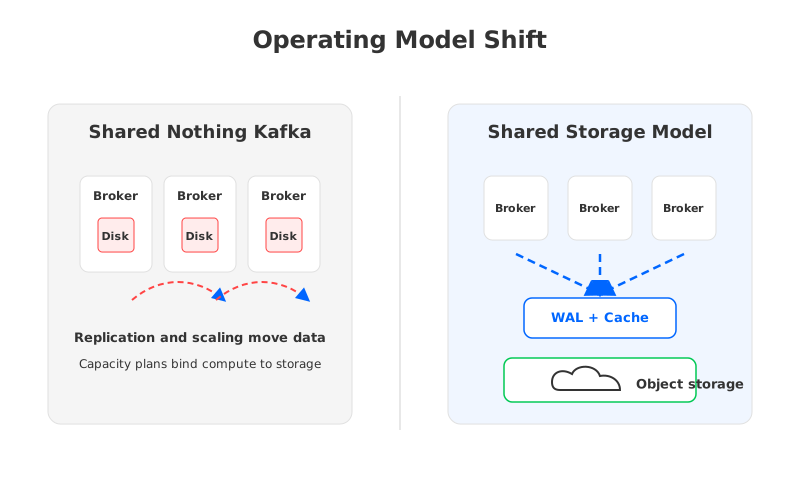
Traditional Apache Kafka was designed around brokers that own local log storage. Each broker is responsible for the partitions assigned to it, and durability is normally achieved through replicated partition data across brokers. This Shared Nothing architecture is well understood and battle-tested, but it turns several cloud operating tasks into data movement tasks. Adding brokers, replacing brokers, rebalancing partitions, changing storage assumptions, and recovering from infrastructure failure all have to respect the fact that data is tied to broker-local storage.
That detail matters in procurement because contracts often assume a stable consumption pattern while Kafka workloads rarely stay stable. A team may buy for peak ingest, high retention, or a projected number of clusters. Then traffic spikes, retention grows, or historical replay becomes common. In a broker-local model, capacity planning is not only about CPU and network. It also includes disk footprint, replica factor, rebalance time, inter-AZ traffic, and operational windows for moving partition data.
The problem is not that traditional Kafka is flawed. The problem is that a cloud contract can freeze assumptions that the architecture makes expensive to change. If storage and compute are tightly coupled, an annual commitment becomes a bet on future brokers and disks. If inter-broker replication creates meaningful cross-zone traffic, the commercial model has to account for network charges as well as software fees. If scaling requires partition reassignment, the buying decision should include that operational cost.
3Architecture options and trade-offs
Kafka-compatible buying conversations usually fall into four architecture patterns. The names vary by vendor, but the operating questions are consistent: who owns the infrastructure boundary, how much Kafka behavior remains compatible, how elastic the system is, and what the contract commits the buyer to operate or pay for.
| Option | What it controls well | What needs deeper review |
|---|---|---|
| Self-managed Kafka | Maximum infrastructure control and direct access to every operational layer | Team capacity, patching, scaling, storage planning, cross-zone replication cost, and incident ownership |
| Provider-managed Kafka | Lower day-to-day operational burden and a familiar service experience | Data-plane boundary, networking model, contractual exit path, and pricing exposure under growth |
| BYOC Kafka-compatible platform | Customer-owned cloud boundary with more automation than self-managed Kafka | IAM design, marketplace terms, support model, shared responsibilities, and migration rehearsal |
| Kafka-compatible shared-storage platform | Independent compute and storage scaling, less broker-local data movement, and cloud-native durability patterns | WAL type, object storage configuration, latency profile, compatibility validation, and failure-mode testing |
The table is deliberately architecture-first. A marketplace listing can exist for several of these patterns, and a private offer can be negotiated for more than one deployment model. The buying channel tells you how the purchase is executed. It does not tell you whether the data plane is in your VPC, whether the platform can scale without long partition movement, or whether your audit team can retrieve the evidence it expects.
For production buyers, the useful question is not "Can we buy this through a marketplace?" It is "Which operational commitments are we accepting when we buy this way?" A managed service can reduce patching burden while introducing stricter networking boundaries. A self-managed deployment can maximize control while making every upgrade and storage decision the customer's responsibility. A shared-storage design can reduce data movement, but it still needs workload-specific validation around latency, cache behavior, and recovery.
4Evaluation checklist for platform teams
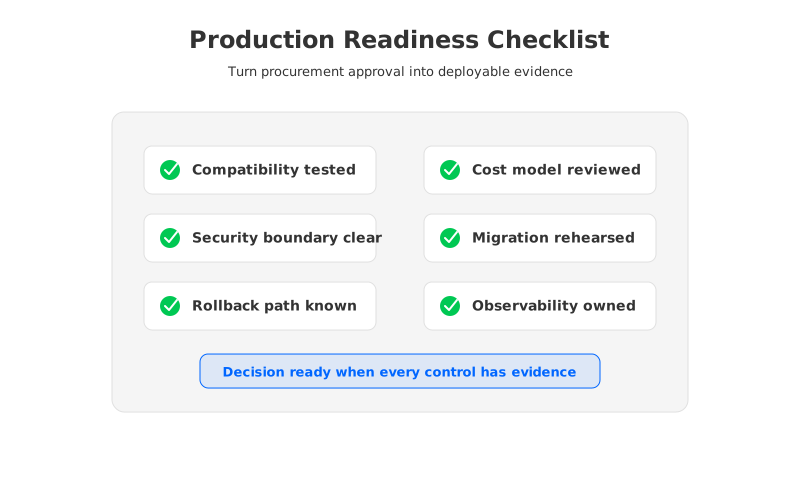
The cleanest procurement process starts with a checklist that both engineering and commercial teams can use. It should be short enough to drive a buying meeting, but concrete enough to prevent vague approvals.
1. Compatibility and migration. Validate the Kafka protocol surface, client versions, producer semantics, consumer group behavior, transactions if used, Kafka Connect dependencies, MirrorMaker or linking strategy, ACL mapping, and schema or connector integrations. A "Kafka-compatible" claim is useful only after the team proves its own clients, tools, monitoring, and failure procedures against the target.
2. Data boundary and security. Decide whether message data, metadata, logs, and metrics can leave the customer account or private environment. Review network paths, private connectivity, IAM roles, encryption keys, audit logs, and support access. This is where BYOC and private deployment models often matter: they let the buyer keep more of the operating boundary inside an approved cloud account or data center.
3. Cost model and commitment risk. Separate software fees from infrastructure cost. Kafka cost can include compute, storage, inter-AZ traffic, connector workers, observability, backup or replication, migration tooling, and operational labor. Commitments should be modeled against workload variability, not only current average throughput.
4. Elasticity and recovery. Ask what happens when a broker fails, when a traffic spike appears, when retention grows, and when a cluster must shrink. If the answer requires large data movement, schedule risk belongs in the buying decision. If the answer is a metadata or ownership change, test the limits rather than assuming every workload behaves the same way.
5. Contract and marketplace controls. Confirm which account accepts the offer, which payer account is charged, how private offer terms are applied, how renewals work, what contract terms govern the purchase, and whether the product is available through the approved marketplace experience. Procurement controls should also define who can subscribe, deploy, and approve exceptions.
6. Exit path. A strong buying process includes a reversible migration plan. Define what data must be copied, how consumer offsets are preserved, how client cutover is staged, how rollback works, and what contract dates create pressure. The exit plan is not pessimism. It is how platform teams keep future architecture choices open.
5How AutoMQ changes the operating model
Once the evaluation framework is clear, AutoMQ becomes relevant as an architecture category rather than a generic vendor option. AutoMQ is a Kafka-compatible, cloud-native streaming platform that keeps the Kafka protocol and ecosystem surface while replacing broker-local persistent storage with a Shared Storage architecture backed by object storage. Brokers handle compute and Kafka request processing, while durable stream data is stored outside the broker's local disk lifecycle.
That shift changes the controls a buyer should evaluate. In traditional Kafka, adding or replacing brokers often forces the team to think about where partition data lives and how much data must move. In AutoMQ's model, stateless brokers and object-storage-backed durability reduce the need to bind long-lived data to specific broker machines. The procurement implication is direct: scaling and recovery assumptions can be reviewed as cloud resource behavior, not only as broker disk planning.
AutoMQ BYOC and AutoMQ Software also map naturally to the boundary questions that appear in marketplace procurement. With BYOC, the deployment is designed for the customer's cloud account and network environment. With Software, platform teams can run the system in private cloud or data center environments where self-managed control is required. In both cases, the buyer should still validate IAM, storage, network, audit, support access, and marketplace or contract terms. The difference is that the architecture gives those controls a clearer place to attach.
This is also where cost review becomes more precise. A shared-storage design can reduce exposure to broker-local disk over-provisioning and traditional inter-broker replica movement, but the economic result depends on workload shape, cloud region, WAL type, object storage, cache behavior, and commercial terms. The right way to evaluate AutoMQ is to model a real workload, rehearse a migration, and compare the full operating model: infrastructure, operations, governance, and contract flexibility.
6A decision matrix for the buying meeting
Use the matrix below before approving a Kafka infrastructure purchase. The goal is not to pick the same answer for every company. The goal is to make hidden commitments visible while there is still time to negotiate terms or adjust architecture.
| Control area | Question to answer before purchase | Evidence to request |
|---|---|---|
| Data plane | Where do producers, consumers, brokers, storage, metadata, and support paths run? | Architecture diagram, network diagram, IAM policy outline, data residency statement |
| Kafka behavior | Which client, protocol, security, connector, transaction, and offset behaviors are required? | Compatibility matrix, test plan, migration rehearsal, rollback procedure |
| Spend commitment | What spend is fixed, what is usage-based, and what cloud resources remain outside the software fee? | Private offer terms, meter definition, infrastructure estimate, renewal language |
| Operations | Who owns scaling, patching, incident response, observability, and upgrade windows? | Shared responsibility model, SLO/SLA terms, runbook, escalation path |
| Governance | Who can subscribe, deploy, change plans, access data, or approve exceptions? | Marketplace catalog policy, account mapping, audit logs, access review workflow |
| Exit path | How would the team leave the platform at the end of term or after a failed pilot? | Data export plan, offset strategy, client cutover plan, contract dates |
This matrix often reveals the real blocker. Sometimes the architecture is acceptable, but the private offer is attached to the wrong payer account. Sometimes the contract is acceptable, but the platform cannot satisfy private networking requirements. Sometimes both are acceptable, but the migration plan has no tested rollback. Finding that mismatch before signing is the point of procurement controls.
7CTA: turn procurement review into an architecture review
If your Kafka purchase is driven by marketplace timing, annual commit planning, or contract renewal pressure, use the buying window to review the architecture too. For teams evaluating Kafka-compatible infrastructure with customer-controlled cloud boundaries, shared storage, and elastic operations, talk to AutoMQ about a BYOC or Software assessment. Bring your broker count, retention policy, traffic profile, migration constraints, and procurement route; the useful conversation starts with those facts, not with a generic product demo.
8References
- Apache Kafka Documentation - Kafka APIs, operations, security, Kafka Connect, and releases.
- AWS Marketplace: Preparing to accept a private offer - buyer-side private offer checks.
- AWS Marketplace: Buying products - subscription terms and product purchase behavior.
- AWS Marketplace: Private Marketplace - approved catalog controls.
- AWS Marketplace: Contracts for products sold in AWS Marketplace - buyer, seller, EULA, and contract structure.
- AutoMQ FAQ - AutoMQ architecture, Kafka compatibility, WAL, and billing.
- AutoMQ BYOC - customer-cloud deployment boundary.
- AutoMQ Terraform Provider - IaC management for AutoMQ BYOC environments.
9FAQ
9.1What are Kafka marketplace procurement controls?
They are the commercial, security, and operational checks used before buying Kafka-compatible infrastructure through a cloud marketplace or private offer. They include catalog access, payer account mapping, contract terms, data-plane review, IAM and network controls, usage-meter review, renewal behavior, and migration risk.
9.2Is marketplace procurement enough to approve a Kafka platform?
No. Marketplace procurement can simplify billing and contract execution, but it does not prove that the architecture fits the workload. Kafka buyers still need to validate protocol compatibility, data residency, network paths, operational ownership, cost exposure, and the migration plan.
9.3Why does Kafka architecture affect contract risk?
Architecture determines which assumptions become expensive to change. Broker-local storage can make scaling, recovery, and retention depend on data movement and disk planning. A contract that fixes spend or term length before those assumptions are tested can turn normal growth into an operational and financial constraint.
9.4When should BYOC be considered for Kafka infrastructure?
BYOC is worth evaluating when the team wants a managed or automated operating model but needs the data plane, storage, network, and governance controls to stay inside a customer-owned cloud account. It is especially relevant for regulated environments, private connectivity requirements, and marketplace buying without giving up cloud boundary control.
9.5Where does AutoMQ fit in a procurement review?
AutoMQ fits after the team has defined its technical and commercial controls. It should be evaluated when Kafka compatibility, customer-controlled deployment boundaries, Shared Storage architecture, stateless brokers, independent scaling, and contract flexibility are part of the decision.


