
Table of Contents
Table of Contents
Teams rarely search for cloud marketplace kafka procurement because they need a definition of a marketplace. They search for it when a Kafka decision has collided with a cloud commit, a renewal deadline, or a security review. The streaming platform is already important enough to deserve production funding, but the purchase path is no longer a simple engineering choice. Finance wants committed cloud spend to be used well. Security wants to know where event data, keys, logs, and support access live. Platform engineering wants Kafka compatibility without inheriting another operational trap.
That combination changes the question. The buyer is not only asking, "Which Kafka-compatible platform can we buy through a marketplace?" They are asking whether the procurement vehicle, deployment boundary, and operating model make sense together. A marketplace subscription can simplify contracting and billing, but it cannot fix an architecture that forces the team to overcommit compute, hide network costs, or move data across boundaries that security cannot approve.
The useful frame is therefore commit-based procurement planning: start with the production constraints that create Kafka cost and risk, then decide which commercial path can absorb them without turning the contract into the architecture.
1Why Teams Search for cloud marketplace kafka procurement
Marketplace procurement becomes attractive when the organization already has cloud commitments, centralized vendor approval, or a purchasing process that favors cloud-native offers. That can be good news for Kafka platform teams. A marketplace path may reduce legal cycles, align spend with an existing cloud provider relationship, and give procurement a familiar workflow for private offers, subscriptions, renewals, and billing allocation.
The danger is that "available through a marketplace" can become a shortcut for due diligence. Kafka is not a generic SaaS tool where the main question is seat count. It sits between application correctness and infrastructure economics. Producers, Consumers, Consumer groups, offsets, transactions, Kafka Connect jobs, retention policies, and replay workflows all depend on stable protocol behavior. At the same time, the infrastructure beneath Kafka determines how much compute is reserved, how much storage is provisioned, and how much data moves between Availability Zones.
A procurement team may see one line item. A platform team sees several coupled decisions:
- Commercial commitment: whether Kafka spend should draw down an existing cloud commitment, use a private offer, or remain a direct contract.
- Deployment boundary: whether the data plane runs as a hosted service, in the customer's cloud account, or in a private data center.
- Cost attribution: whether compute, storage, network, support, and migration overlap can be modeled separately.
- Operational ownership: who can scale, recover, observe, upgrade, and troubleshoot the platform during an incident.
- Exit and migration risk: whether the team can move workloads without breaking offsets, rewriting clients, or pausing producers.
Those decisions belong in the same room. If procurement optimizes the purchasing path while engineering evaluates only API compatibility, the team can approve a platform that looks clean on paper but creates a permanent mismatch between workload behavior and spend commitments.
2The Production Constraint Behind the Problem
Traditional Apache Kafka uses a Shared Nothing architecture. Each broker owns local log data, and Kafka maintains durability through replicated partitions across brokers. This design is well understood, battle-tested, and still reasonable for many deployments. The problem appears when cloud procurement asks the platform team to forecast Kafka as if it were a clean capacity unit.
Broker-local storage makes capacity planning sticky. If a broker is added, replaced, or removed, partition reassignment can involve moving log data between brokers. If a workload has long retention, historical replay, or bursty write traffic, the safe answer is often to reserve more broker capacity than the steady-state traffic needs. If the cluster spans multiple Availability Zones, replication and consumer placement can also create data transfer patterns that are hard to map back to a single application team.
This is why commit planning for Kafka is harder than buying a database license. The platform owner is not committing only to throughput. They are committing to an operating model that converts traffic shape, retention, replication, recovery, and migration into infrastructure spend. A busy launch week, an analytics replay, or a broker replacement drill can expose assumptions that were never visible in the procurement spreadsheet.
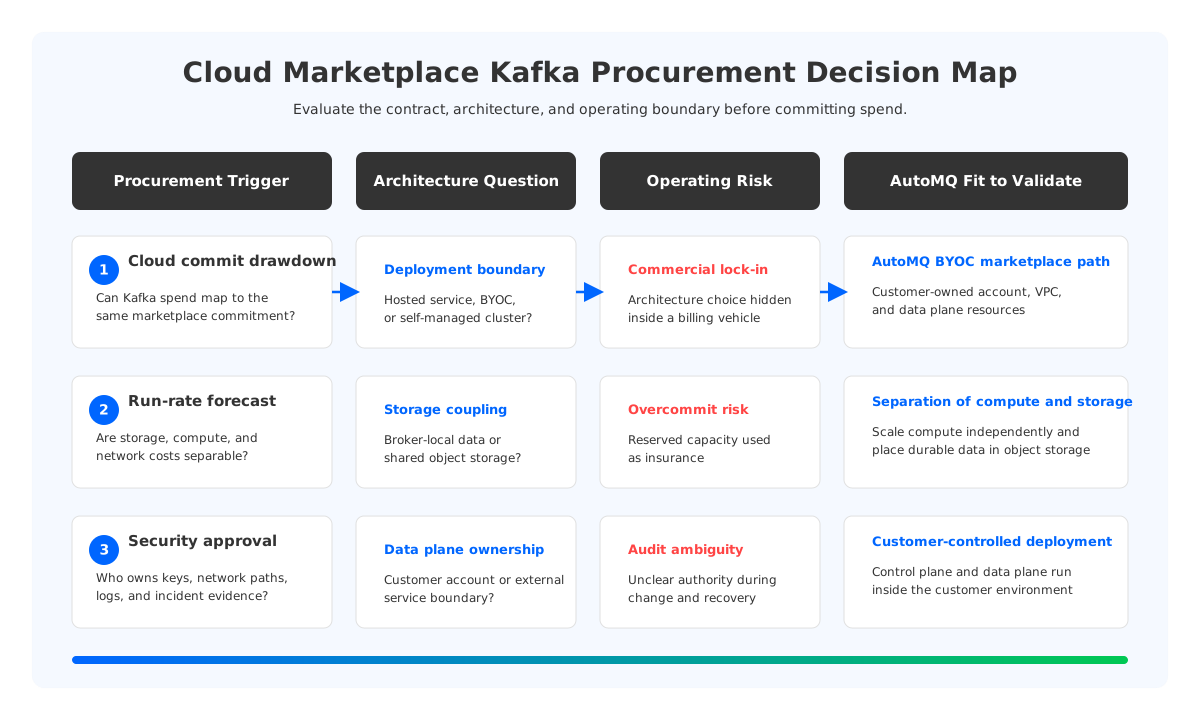
The decision map is intentionally blunt. Before choosing a commercial path, the team should be able to explain which constraints are being bought down and which are only being renamed. A commitment can be valuable when it maps to real demand. It becomes risky when it hides buffers for broker-local data movement, cross-zone replication, or untested migration overlap.
3Architecture Options and Trade-Offs
A practical evaluation should separate the purchasing path from the runtime architecture. A fully managed streaming service can reduce operational burden, but it may place the data plane, support workflow, and some operational evidence outside the customer's direct environment. A self-managed Kafka cluster gives maximum control, but it leaves the team responsible for broker operations, reassignment, upgrades, security hardening, monitoring, and capacity risk. A BYOC model sits between those extremes: the customer keeps the cloud account and network boundary, while the vendor supplies product automation and operational tooling.
The right answer depends on which constraint is binding. A small team with limited Kafka operations experience may value service abstraction above everything else. A regulated platform team may care more about customer-owned networking, IAM, audit trails, and data residency. A FinOps team may reject any model where storage, compute, and network costs are bundled so tightly that no one can tell what changed after a workload spike.
Use the same questions for every option:
| Evaluation area | What to ask before committing spend | Why it matters |
|---|---|---|
| Kafka compatibility | Which client versions, Consumer group behaviors, offset semantics, transactions, and Kafka Connect workloads are validated? | Compatibility gaps usually become application migration work. |
| Storage model | Does durable data live on broker-local disks, Tiered Storage, or shared object storage? | Storage placement determines scaling, recovery, retention, and cost attribution. |
| Network boundary | Which VPC, account, region, endpoint, and private connectivity paths carry data? | Network design affects security approval and recurring data transfer cost. |
| Elasticity | Can compute scale without moving durable log data? | Commit planning is cleaner when capacity follows demand instead of storage movement. |
| Governance | Who owns keys, logs, metrics, support access, and change approval? | Procurement approval often depends on evidence, not product claims. |
| Migration | How are topics, offsets, producers, consumers, and rollback handled? | Duplicate spend during migration should have a bounded timeline. |
The table does not rank vendors. It prevents a common mistake: treating the marketplace as the decision. The marketplace is a transaction layer. Kafka remains a distributed system with state, ordering, durability, and recovery requirements.
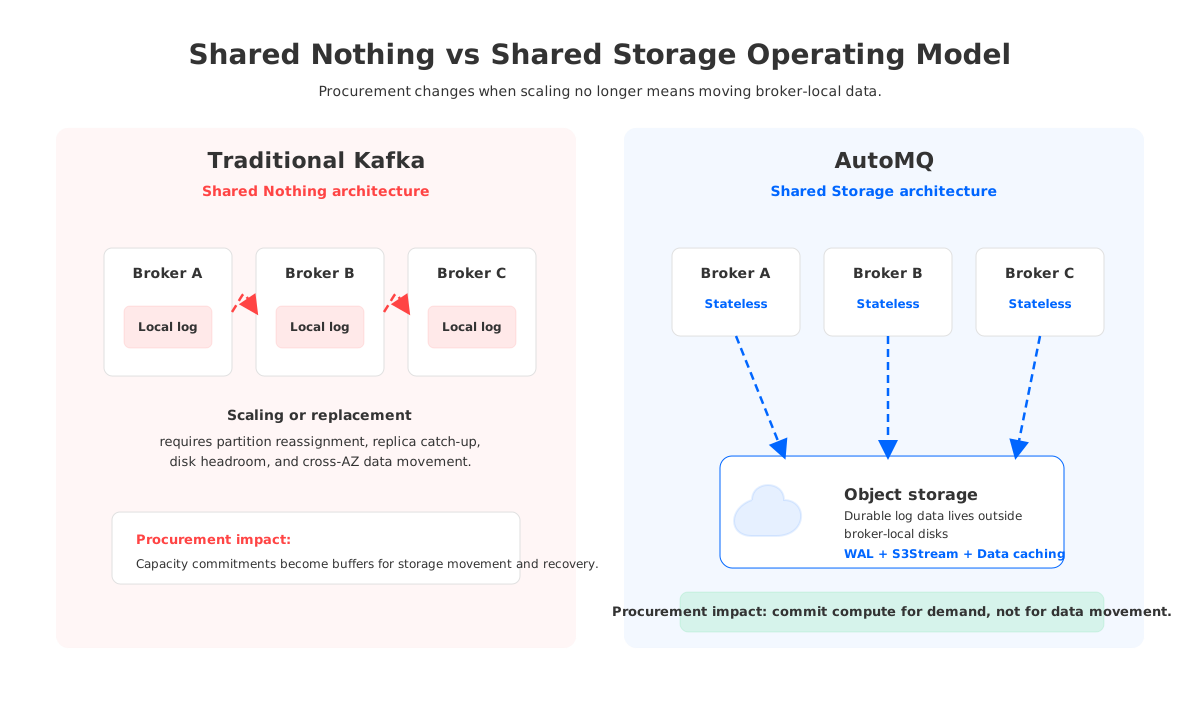
Shared Storage architecture changes the operating discussion because durable data is no longer tied to a broker's local disk. That does not make every problem disappear. Teams still need a WAL (Write-Ahead Log), cache behavior, object storage configuration, monitoring, security controls, and migration testing. But it changes the main scaling question from "How much data must we move when compute changes?" to "How much compute does the workload need right now?"
4Evaluation Checklist for Platform Teams
The strongest procurement package is not the one with the most slides. It is the one that lets security, finance, and engineering inspect the same assumptions. A platform team should enter procurement with a readiness file that describes the workload, the operating boundary, and the evidence required to approve the commitment.
Start with a representative workload rather than a theoretical average. Include one high-throughput topic, one long-retention topic, one consumer group with strict offset requirements, one Kafka Connect or integration path, one replay scenario, and one failure drill. If the target platform cannot handle that set cleanly, a larger contract will not make it cleaner.
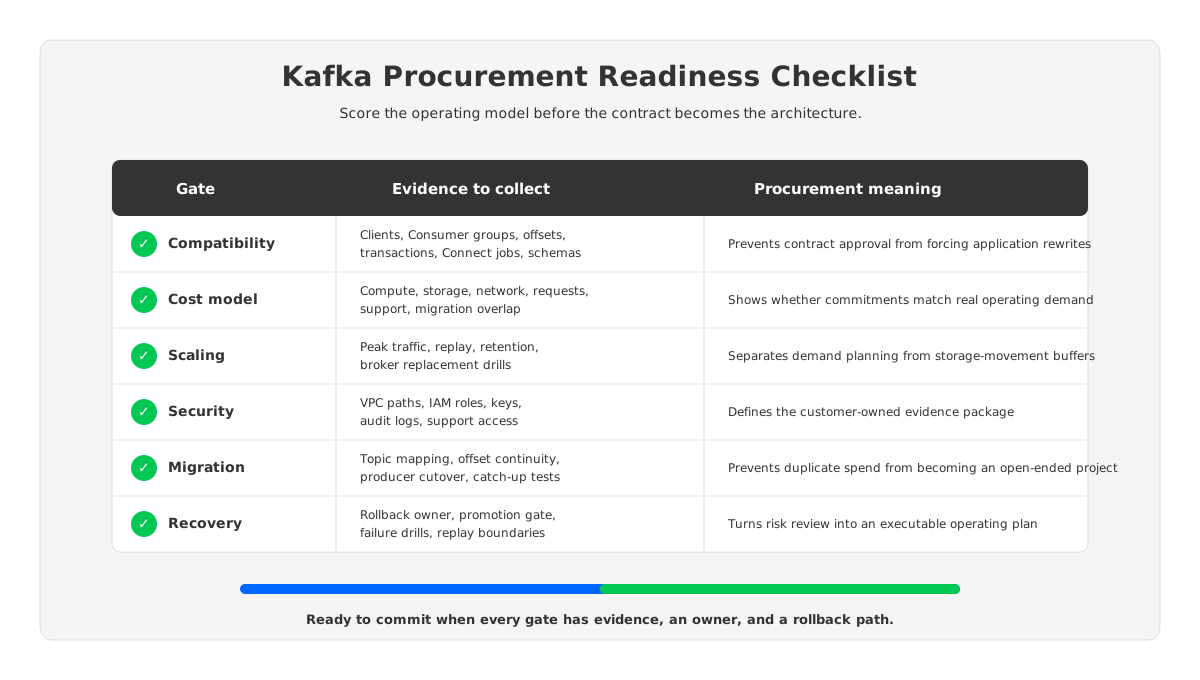
Then score each gate from 1 to 5, where 1 means "not documented" and 5 means "documented, tested, owned, and repeatable":
- Compatibility: Existing clients, serializers, ACLs, Consumer groups, transactions, offsets, and Connect jobs have a validation plan.
- Cost model: Compute, storage, network, private connectivity, object storage requests, monitoring, support, and migration overlap are modeled separately.
- Scaling: The team has tested the difference between steady-state traffic, burst traffic, historical replay, and broker replacement.
- Security: VPC paths, IAM roles, encryption keys, audit logs, support access, and operational data flows are mapped.
- Migration: Topic mapping, offset continuity, producer cutover, consumer promotion, and rollback are assigned to owners.
- Observability: Metrics, logs, alerts, SLOs, and incident runbooks are available before production traffic moves.
The score is less important than the weak row. A 5 in compatibility does not compensate for a 1 in rollback. A clean marketplace workflow does not compensate for missing network evidence. Procurement is ready only when the lowest-scoring gates have owners and a mitigation path.
5How AutoMQ Changes the Operating Model
After the neutral evaluation, the architectural pattern becomes easier to name: a procurement-friendly Kafka platform should preserve Kafka behavior while reducing the coupling between compute commitments and durable data placement. That is where AutoMQ fits as a Kafka-compatible cloud-native streaming platform built around Shared Storage architecture.
AutoMQ keeps Kafka protocol and API compatibility while replacing broker-local persistent storage with S3Stream, WAL storage, data caching, and S3-compatible object storage. Brokers become stateless in the operational sense: they process Kafka requests, maintain leadership, route traffic, and use cache, but durable log data is not bound to a local broker disk. When compute capacity changes, the platform can focus on leadership, metadata, and traffic rather than large broker-to-broker data copies.
For procurement planning, that architectural shift matters in three ways. First, compute commitments can be evaluated closer to traffic demand because persistent data placement is not tied to each broker's local disk. Second, storage and retention can be discussed as object storage and WAL design choices rather than as broker disk headroom. Third, recovery and replacement can be reviewed as a control-plane and metadata operation, not only as a storage migration event.
AutoMQ BYOC is especially relevant when marketplace procurement and customer-owned boundaries both matter. In AutoMQ BYOC, the control plane and data plane run in the customer's cloud account and VPC (Virtual Private Cloud), and customer business data remains in customer-owned infrastructure. That boundary gives procurement and security teams a clearer review package: the buyer can align subscription or marketplace purchasing with cloud account ownership, private networking, IAM review, operational evidence, and internal chargeback.
AutoMQ Software applies the same general idea to private data center or IDC deployments. The control plane and data plane run in the customer's private environment, which is useful when the procurement question is not only "Can we buy this through a cloud marketplace?" but "Can we keep the runtime inside our own operating boundary?" Different organizations will choose different commercial paths, but the same evaluation principle holds: the purchasing model should support the required architecture, not replace it.
Migration is part of the procurement model because duplicate spend has a clock. AutoMQ Kafka Linking is designed for migration scenarios that need topic replication, offset continuity, producer cutover support, and Consumer group progress synchronization. Teams should still validate their own source cluster version, authentication mode, workload shape, and rollback plan. The point is not to assume migration is automatic. The point is to make migration evidence part of the commercial approval instead of discovering it after the purchase order is signed.
6FAQ
6.1Is cloud marketplace Kafka procurement mainly a finance decision?
No. Finance may initiate the discussion because of cloud commitments, private offers, or billing allocation, but Kafka procurement is also an architecture decision. The deployment boundary, storage model, migration path, and security evidence determine whether the commercial plan is sustainable in production.
6.2Does BYOC mean the customer operates everything alone?
Not necessarily. BYOC means the deployment runs inside the customer's cloud account or VPC, but the product can still provide control-plane automation, lifecycle management, observability, and support workflows. The important distinction is the ownership boundary for infrastructure, network paths, and business data.
6.3What should be validated before committing marketplace spend?
Validate Kafka compatibility, data plane ownership, storage architecture, network paths, cost attribution, migration behavior, rollback, and observability. A marketplace subscription should come after those assumptions are documented, not before.
6.4How is Shared Storage architecture different from Tiered Storage?
Tiered Storage typically offloads older log segments while recent data remains tied to broker-local storage. Shared Storage architecture places durable log data in shared object storage as the core storage model, with brokers operating without local persistent data ownership. That difference changes scaling, recovery, and procurement planning.
7Closing the Procurement Loop
Return to the original search phrase: cloud marketplace kafka procurement. The useful answer is not a list of offers. It is a way to decide whether a Kafka-compatible platform can turn committed spend into a production operating model that finance, security, and engineering can all defend. Start with the workload, prove the boundary, test migration, and then choose the purchasing path.
If your team is evaluating Kafka-compatible streaming with customer-owned deployment boundaries, review AutoMQ BYOC and AutoMQ Software through the same checklist, then start a technical evaluation through AutoMQ Cloud.
8References
- Apache Kafka Documentation
- AutoMQ Documentation: Compatibility with Apache Kafka
- AutoMQ Documentation: Architecture Overview
- AutoMQ Documentation: S3Stream Shared Streaming Storage
- AutoMQ Documentation: Migrate to AutoMQ
- AWS Marketplace: Private Offers
- AWS PrivateLink Documentation
- AWS Data Transfer Pricing


