
Table of Contents
Table of Contents
Kafka platform teams rarely search for KIP-1150 because they want a glossary entry. They search because a familiar operating model has started to feel misaligned with cloud infrastructure. Broker disks are sized for retention, brokers are replaced with data movement in mind, and cross-zone traffic appears in the bill even when the application team only thinks it is producing and consuming events. KIP-1150 matters because it turns those complaints into a more serious question: should durable topic data remain centered on broker-local storage, or should Kafka evolve toward object-storage-backed disaggregation?
The useful signal is not that every team should adopt diskless topics immediately. The useful signal is that multiple parts of the Kafka ecosystem now agree on the pressure point. Apache Kafka's accepted KIP-1150 frames Diskless Topics as a response to cloud object storage, Tiered Storage limitations, replication cost, and operational scalability. That is community consensus around the problem space, even while the exact implementation still depends on follow-up work, workload testing, and product maturity.
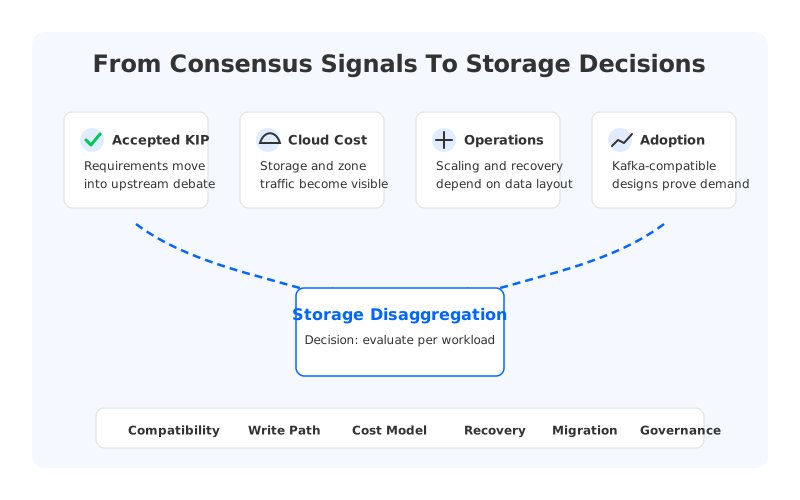
For buyers and platform owners, the right conclusion is narrower than the hype. KIP-1150 is not a replacement for due diligence. It is a forcing function for a better evaluation: separate the consensus signals from the production claims, then decide which storage architecture fits each workload.
1Why KIP-1150 Became A Consensus Signal
Traditional Kafka has a coherent design. Brokers own partition logs, write to local or attached block storage, replicate to other brokers, and serve consumers from the same ownership model. That design made excellent sense when Kafka was optimized around sequential disk I/O and commodity server failure. It still makes sense for many low-latency workloads where the hot path is more important than retention elasticity or storage independence.
Cloud deployments changed the accounting. Storage, inter-zone transfer, object requests, private networking, and compute headroom are billed and operated as separate resources. When Kafka keeps durable data tied to brokers, every scaling event has to respect data placement. A team can add compute, but retained data may still need to move. A team can extend retention, but broker storage may expand before consumer demand changes. A team can spread replicas across availability zones, but cloud network pricing makes the replication path visible.
KIP-1150 is important because it names this mismatch in upstream Kafka terms. The proposal describes Diskless Topics as a distinct topic type that uses object storage as the durable destination for user data while keeping Kafka semantics as the target. It also states a practical boundary: diskless does not mean no disk usage anywhere. Brokers may still use local storage for metadata, cache, temporary data, or other implementation details. That distinction prevents a common procurement mistake: treating "diskless" as a literal hardware claim instead of an operating model shift.
The consensus signal has three layers:
- Architecture signal. Tiered Storage helps with inactive segments, but it does not remove durable active-segment responsibility from broker storage. Diskless topics push the storage boundary further.
- Economic signal. Cloud operators care about block storage, object storage, and cross-zone transfer as separate cost drivers. A storage architecture that reduces broker-owned data movement can change the cost model.
- Operational signal. Broker replacement, scaling, rebalancing, and recovery become easier to reason about when durable topic data is not pinned to an individual broker's disk.
That is enough to justify a serious evaluation. It is not enough to approve a migration.
2What The Proposal Does Not Settle
An accepted KIP is a strong signal, but it is not the same thing as a production-ready implementation in every Kafka distribution. KIP-1150 explicitly points to follow-up design work for core implementation details. That means platform teams should avoid two extremes: dismissing storage disaggregation because it is not identical to classic Kafka, or assuming that the word "accepted" removes the need for latency, compatibility, and failure testing.
The first unresolved question is latency. Object storage is durable and elastic, but it is not a drop-in replacement for local sequential writes. A diskless architecture needs a write path that decides when a producer acknowledgment is safe, how batches are assigned offsets, how data is cached, and how recovery works when a broker fails before data is fully compacted or uploaded. The design can be excellent and still have different p99 behavior from broker-local Kafka.
The second unresolved question is workload fit. KIP-1150 explicitly preserves the idea that classic topics can remain appropriate for low-latency use cases. That matters. A payment authorization stream, an observability firehose, a CDC pipeline, and a machine learning feature backfill may all use Kafka APIs, but they do not deserve the same storage policy. Storage disaggregation should be evaluated per workload tier, not as a cluster-wide slogan.
The third unresolved question is operational ownership. Moving durable stream data toward object storage brings cloud-native controls into the critical path: buckets, IAM roles, encryption keys, network endpoints, request throttling, audit logs, and lifecycle configuration. Those controls are familiar to cloud platform teams, but they need runbooks. A Kafka team that has deep broker expertise but weak object-storage observability will trade one blind spot for another.
3A Decision Framework For Platform Teams
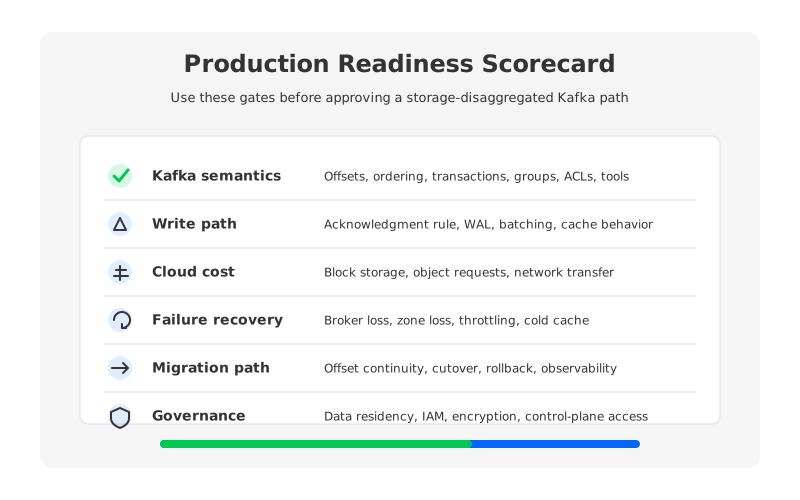
The most practical way to use KIP-1150 is to translate it into decision gates. Do not start with a vendor shortlist. Start with the constraints that would make storage disaggregation valuable or risky in your environment.
| Gate | What To Validate | Why It Matters |
|---|---|---|
| Kafka semantics | Ordering, offsets, consumer groups, transactions, idempotent producers, ACLs, quotas, and admin tooling. | Protocol compatibility is not enough if edge semantics or operational APIs differ from production expectations. |
| Write path | Producer acknowledgment rule, WAL behavior, batching, cache policy, and recovery from partial writes. | Object storage needs a durable write strategy that matches workload latency and durability requirements. |
| Cloud cost | Block storage, object storage, request cost, inter-zone transfer, private connectivity, and operational headroom. | A lower storage bill can be offset by request or network paths if topology is not modeled. |
| Failure recovery | Broker loss, zone loss, object storage throttling, cold cache, slow consumers, and metadata failover. | The real test is how quickly the platform returns to a known-good state. |
| Migration path | Topic coverage, offset continuity, producer cutover, consumer lag, rollback, and dual-write rules. | A storage engine change is not complete until application progress and rollback are controlled. |
| Governance | Data residency, IAM, encryption, audit logs, support boundaries, and control-plane access. | Shared storage moves more security responsibility into cloud-native primitives. |
This framework also clarifies the difference between Tiered Storage and diskless topics. Apache Kafka Tiered Storage moves older log segments to remote storage, which can reduce local retention pressure. It does not make brokers fully stateless, and it does not automatically remove active replication cost. Diskless topics aim at the primary durable path for topic data, so the validation burden moves closer to producer latency, recovery, and storage-path observability.
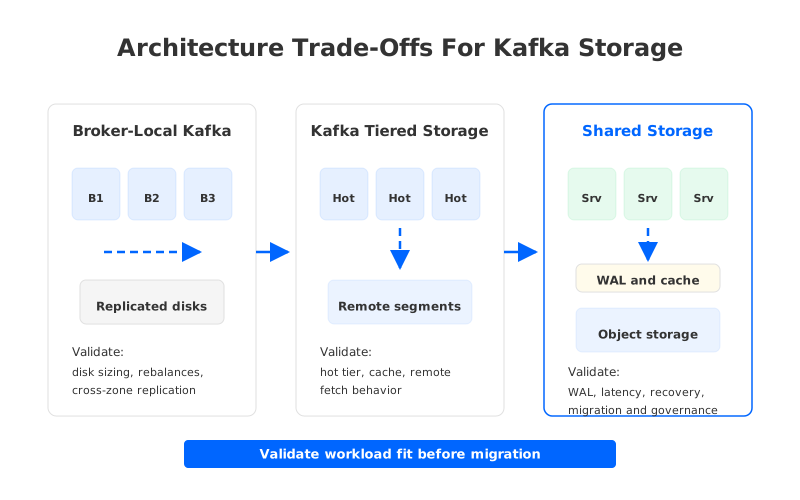
The test plan should mirror that distinction. For Tiered Storage, test historical reads, local hot-tier sizing, cache behavior, and remote fetch impact. For diskless or shared-storage Kafka, test producer latency, WAL persistence, object-store error handling, cold replay, broker replacement, and cross-zone traffic. The names sound adjacent, but the failure modes are not identical.
4Reading Market Signals Without Copying Market Claims
Community consensus does not mean vendor claims should be accepted at face value. It means the market has converged on a problem worth solving. Several Kafka-compatible systems have already explored object-storage-backed designs, and upstream Kafka is now formalizing its own path. That convergence is useful because it reduces the chance that storage disaggregation is a short-lived niche. It also increases the need for sharper evaluation, because similar labels can hide very different control planes, storage paths, and compatibility boundaries.
The buyer's question should be, "Which implementation fits our workload, operational model, and risk tolerance?" not "Which page says diskless most confidently?" A managed service may simplify ownership but constrain network boundaries. A self-managed or BYOC model may preserve data-plane control but require stronger internal platform discipline. A Kafka-compatible engine may keep clients stable while changing storage internals. A pure Apache Kafka roadmap may fit teams that prefer upstream governance and can wait for implementation maturity.
There is no single correct answer across all workloads. A latency-sensitive topic with tight p99 producer requirements may stay on classic Kafka or a low-latency WAL-backed path. A replay-heavy topic with long retention and bursty consumers may benefit strongly from object-storage-backed durability. A regulated environment may care less about headline cost and more about IAM boundaries, audit trails, and where the control plane runs. Consensus around the problem does not remove the need for segmentation.
5Where AutoMQ Fits After The Framework
AutoMQ becomes relevant after a team has reached a specific conclusion: the Kafka API is valuable, but broker-local durable storage is the constraint. AutoMQ is a Kafka-compatible streaming platform that uses a Shared Storage architecture, with S3Stream, WAL storage, object storage, and cache components replacing the traditional assumption that broker disks are the durable center of the system. In that model, brokers remain important serving and coordination components, but durable stream data is designed to live outside broker-local disks.
That architecture maps directly to several gates above. Compatibility matters because application rewrites are rarely acceptable for Kafka platform migrations; AutoMQ documentation describes compatibility with Apache Kafka versions and ecosystem clients. Write-path validation matters because shared storage needs a durable acknowledgment point; AutoMQ's WAL documentation describes WAL storage as the persistence path that confirms writes before later movement into object storage. Cost modeling matters because AutoMQ documents mechanisms related to reducing inter-zone traffic under specific deployment conditions, but teams still need to validate their own producer, consumer, and zone topology.
AutoMQ should not be treated as a magic answer to every KIP-1150 question. It is better understood as an implementation category: Kafka-compatible, shared-storage, cloud-native streaming. That category is attractive when the workload is constrained by storage elasticity, cross-zone data movement, long retention, or broker replacement windows. It still requires proof with real topics, real clients, and real failure drills.
The strongest proof of fit is a staged evaluation. Pick one retention-heavy topic, one latency-sensitive topic, and one replay-heavy consumer group. Measure producer latency, consumer lag, fetch behavior, object-storage errors, WAL latency, cache hit rate, broker replacement time, and cross-zone traffic before and after the test. If the shared-storage design improves the bottleneck without breaking the workload's semantic or operational expectations, the architecture has earned the next stage.
6Procurement Questions That Actually Matter
Procurement teams often receive storage-disaggregation proposals as cost comparisons. Cost matters, but a narrow spreadsheet can miss the mechanism. The right procurement review asks which cost line changes and why. Does the platform reduce replicated block storage? Does it reduce inter-zone replication? Does it shift spend toward object storage requests? Does private connectivity add another fixed cost? Does the operations team need a storage and IAM on-call boundary?
The same discipline applies to risk. A diskless or shared-storage platform should explain its failure model in concrete terms. What happens when a broker dies after accepting writes? What happens when object storage throttles requests? What happens when a consumer reads far behind the head of the log? What metrics prove the WAL is healthy? What is the rollback plan if a cutover exposes a compatibility issue?
These questions are not objections to KIP-1150. They are how a consensus signal becomes a production decision. The community is pointing toward storage disaggregation because the old coupling between broker compute and durable storage is increasingly expensive to operate in cloud environments. A platform team still has to prove that the chosen implementation solves its own bottleneck.
If your team is evaluating KIP-1150, diskless Kafka, or a Kafka-compatible shared-storage platform, use the consensus as the starting point and the scorecard as the guardrail. For a deeper technical look at how AutoMQ approaches this architecture, start with the AutoMQ overview and validate it against one representative workload before broad migration planning.
7References
- Apache Kafka KIP-1150: Diskless Topics
- Apache Kafka documentation: Tiered Storage
- Apache Kafka KIP-405: Kafka Tiered Storage
- AWS EC2 data transfer pricing
- AutoMQ compatibility with Apache Kafka
- AutoMQ S3Stream Shared Streaming Storage overview
- AutoMQ WAL Storage
- AutoMQ migration overview
- AutoMQ inter-zone traffic broker configuration
8FAQ
8.1Is KIP-1150 already part of production Apache Kafka?
KIP-1150 is marked accepted in the Apache Kafka KIP process, but the proposal also points to follow-up KIPs for implementation details. Treat it as a strong direction signal and requirements baseline, not as proof that every Kafka distribution already has the full feature.
8.2Is diskless Kafka the same as Tiered Storage?
No. Tiered Storage moves older segments to remote storage while broker-local storage remains central for the hot path. Diskless topics and shared-storage architectures move the durable topic-data path closer to object storage, which changes write-path, recovery, and observability requirements.
8.3Does diskless mean brokers use no disks at all?
No. In this context, diskless usually means broker disks are not the primary durable store for user topic data. Brokers may still use disks for cache, metadata, logs, temporary files, or implementation-specific coordination.
8.4Which workloads should be evaluated first?
Start with topics where broker storage, retention, replay, or cross-zone movement is already painful. Keep ultra-low-latency workloads in the test plan, but do not assume they should move first. Their p99 latency and recovery behavior need separate proof.
8.5How should AutoMQ be evaluated against KIP-1150?
Evaluate AutoMQ as a Kafka-compatible shared-storage implementation. Test Kafka semantics, WAL behavior, object-storage access, cache efficiency, migration tooling, failure recovery, and cloud traffic patterns against your own workloads rather than relying on a generic category label.


