
Table of Contents
Table of Contents
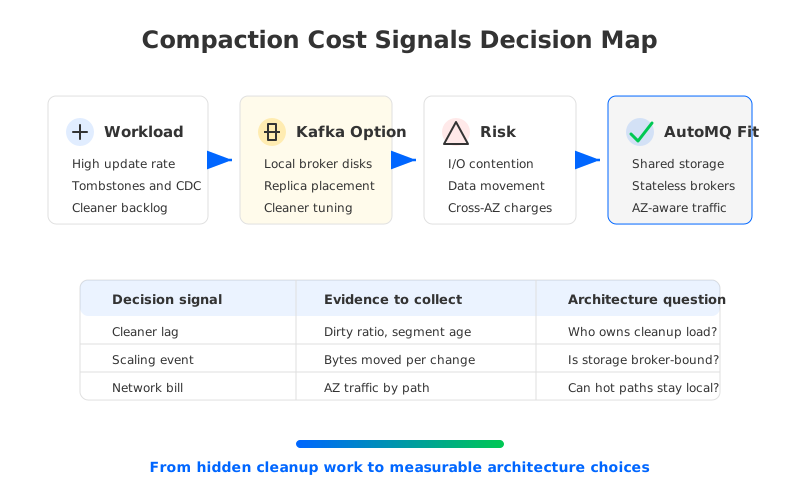
Teams usually search for compaction cost kafka after the cluster has already started sending signals. A compacted topic that looked small on a dashboard holds more segments than expected. Cleaner threads compete with produce and fetch traffic. Broker disks look uneven even though the partition count is balanced. The bill is also harder to explain, because the cost is not one line item called "compaction." It is storage, compute, replication, network movement, operational time, and the safety margin required to keep all of that from affecting production workloads.
Log compaction is valuable because it lets Kafka retain the latest value for each key rather than treating every topic as a pure append-only history. That makes compacted topics useful for changelog streams, metadata feeds, user profiles, inventory state, CDC projections, and other workloads where consumers need the current state without replaying an unbounded event trail. The trade-off is that compaction turns storage from a passive retention setting into an active background workload. The more write-heavy and key-dense the stream becomes, the more the platform team has to understand where that background work lands.
1Why teams search for compaction cost kafka
The first mistake is treating compaction as a topic-level feature with a topic-level cost. In Apache Kafka, compaction behavior is shaped by topic configuration such as cleanup.policy=compact, dirty-ratio thresholds, delete retention, segment size, and cleaner settings. Those settings are local to how Kafka organizes and rewrites log segments, but their impact appears at cluster level. A topic with aggressive compaction can create disk I/O pressure on the brokers that host its partitions; a topic with delayed compaction can accumulate more local storage and lengthen recovery paths.
That is why the search often starts from a symptom rather than a design question. The topic owner asks why a compacted topic is larger than expected. The SRE asks why disk utilization is rising after a CDC rollout. The FinOps team asks why a Kafka expansion produced a storage and network step-change when the business workload grew more smoothly. Each team is seeing the same mechanism from a different angle: compaction changes how often data is rewritten, where rewritten data must be stored, and how much spare capacity is needed during cleanup.
The cost becomes more visible in high-volume streams because compaction does not remove the need for durable ingestion. A message still lands in the log, is replicated according to the topic's durability settings, and remains eligible for reads until the cleaner can safely discard older values. If the workload has many updates per key, the cluster may ingest and replicate far more bytes than the final compacted state suggests. The storage footprint that matters for planning is not only the latest value set; it is the path from ingestion to compaction under real cleaner lag, segment rolling, and recovery constraints.
For platform teams, the practical question is not "Is compaction expensive?" The better question is: "Which parts of our architecture turn compaction pressure into a recurring bill or operational risk?"
2The cloud cost drivers behind the workload
Compaction cost is a bundle of signals. Some are direct cloud charges, and some are operational side effects that become cost through overprovisioning or incident work. A useful evaluation starts by separating these signals before choosing a Kafka-compatible platform.
- Write amplification before cleanup. Updates must be written and replicated before older values become removable. A small final keyspace can still generate a large write path when update frequency is high.
- Cleaner compute and I/O contention. Compaction rewrites log segments in the background. The work consumes CPU, disk bandwidth, page cache, and scheduler attention on the same brokers that serve producers and consumers.
- Broker-local storage margin. Shared-nothing Kafka brokers need local disk capacity for retained data, uncompacted segments, replication buffers, and operational headroom. A storage alarm during cleaner lag is still a production alarm.
- Data movement during scaling and recovery. When partitions move between brokers, the platform often has to move broker-local data with them. Compacted topics are not exempt from this movement.
- Multi-AZ replication and read paths. Highly available Kafka deployments often place replicas across availability zones. Cloud providers bill some cross-zone data transfer patterns separately, so replication topology and client placement matter.
The uncomfortable part is that these signals interact. A team can increase cleaner threads to reduce uncompacted backlog, but that may increase I/O contention. It can add brokers to reduce disk pressure, but that can trigger partition movement and higher baseline cost. It can lengthen retention or segment sizes to smooth compaction behavior, but that can increase recovery exposure. Kafka gives experienced operators many knobs; the cost question is whether the underlying architecture keeps those knobs local or turns every adjustment into a cluster-wide capacity exercise.
| Cost signal | What to measure | Why it matters for compacted streams |
|---|---|---|
| Dirty log accumulation | Dirty ratio, cleaner backlog, segment age | Shows whether cleanup keeps pace with update volume |
| Broker disk skew | Per-broker used bytes and partition placement | Reveals whether compacted topics are concentrating storage risk |
| Cleaner interference | Produce/fetch latency during cleaner activity | Captures when background cleanup competes with foreground traffic |
| Reassignment volume | Bytes moved during broker add/remove events | Converts scaling decisions into time, network, and risk |
| Cross-zone traffic | Replication and client traffic by AZ | Connects topology decisions to cloud network charges |
Before evaluating any product, the team needs an observability view that maps compaction to infrastructure behavior. Without it, a lower per-node price or a faster benchmark can hide the work that still has to happen somewhere.
3Storage, network, and compute trade-offs
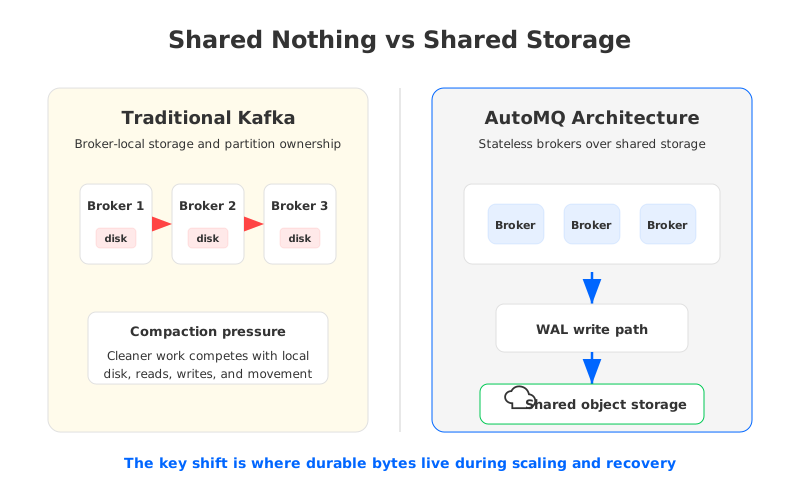
Traditional Kafka is a shared-nothing system: each broker owns local log data for the partitions assigned to it. That design is durable and well understood, and it has served the Kafka ecosystem for years. It also means that storage, compute, and partition ownership are tightly coupled. When a broker stores the data, serves the reads, runs compaction, and participates in replication, pressure in one dimension tends to spill into the others.
Compaction exposes this coupling because it is both a storage lifecycle process and a compute workload. A broker with hot compacted partitions may need more disk throughput even if its network looks fine. Another broker may have enough CPU but carry more retained bytes because its partitions have a slower cleaner cadence. Adding capacity can help, but in a shared-nothing architecture the added capacity is not useful until partitions and their data are redistributed. That redistribution is itself a workload.
Tiered Storage changes part of the equation by moving older log data to remote storage while keeping Kafka semantics at the topic level. It can reduce pressure on local disks for retained history. But tiering and compaction should not be collapsed into the same mental model. Tiering decides where log segments live across hot and remote tiers. Compaction decides which records remain necessary for a key over time. A compacted topic can still generate local cleaner work, hot-segment pressure, and operational coordination even when older data is tiered.
The more useful architectural question is where durable bytes live and how much broker identity matters. If durable data is bound to broker-local disks, then scaling, recovery, and compaction all have to respect data locality. If durable data is placed in shared storage with brokers acting more like stateless compute, the platform has more freedom to scale compute and storage separately. That shift does not make compaction free; it changes the operational shape of the cost.
4Evaluation checklist for FinOps and platform teams
A good compaction cost kafka review combines engineering and finance evidence. The platform team should not ask FinOps to reason from Kafka internals alone, and FinOps should not ask SREs to reduce a production design to a monthly line item. The review works better when both sides agree on the workload boundaries and the failure scenarios that matter.
Start with five questions:
- What is the update pattern? Measure bytes written, keys updated, duplicate values per key, tombstone rate, and burst behavior. Average throughput can hide compaction stress.
- Where does cleanup lag appear? Compare cleaner backlog, dirty ratio, and segment age against produce/fetch latency. The important signal is contention, not only backlog.
- How much capacity is reserved for safety? Separate useful retained state from local disk margin, temporary rewrite space, replication buffers, and recovery headroom.
- What happens during scaling? Record how many bytes move when brokers are added, removed, or replaced. The cost of elasticity is the work required to make capacity usable.
- Which network paths are billable? Map producer, broker, replica, consumer, connector, and recovery traffic by availability zone and account boundary.
The checklist should also include governance. Compacted topics often carry business state: user attributes, account status, device inventory, entitlement data, payment metadata, and CDC-derived records. Retention, deletion, encryption, access control, schema evolution, and auditability belong in the same discussion as storage cost.
5How AutoMQ changes the operating model
Once the evaluation reaches storage locality and data movement, AutoMQ becomes relevant as an architectural option rather than a product interruption. AutoMQ is a Kafka-compatible cloud-native streaming system that keeps Kafka protocol compatibility while moving the storage foundation toward shared object storage and stateless brokers. The important distinction for this topic is not a single compaction knob. It is the separation of compute and durable storage.
In a shared-storage model, brokers no longer have to be treated as the long-term home of a partition's bytes. Durable data can sit in object storage, while brokers provide the compute layer for Kafka-compatible reads, writes, coordination, and operational control. AutoMQ's architecture also uses a write-ahead log layer before data is organized in shared storage. This changes the planning unit: instead of asking how many broker disks are needed for the next retention and compaction cycle, teams can reason about compute capacity, write path behavior, and object-storage-backed durability separately.
For compacted streams, that separation can reduce several sources of operational friction:
- Elasticity is less tied to data copying. If broker identity is decoupled from durable bytes, adding or replacing compute does not require the same style of broker-local data migration.
- Storage economics follow object storage more closely. Long-lived retained state can be planned around object storage characteristics rather than local disk fleets sized for peak and headroom.
- Cross-AZ traffic can be designed out of the hot path. AutoMQ documents a zero cross-AZ traffic architecture for eligible deployments, which matters when high-volume replication and reads amplify network bills.
- Deployment boundaries stay under customer control. BYOC and software deployment models matter for teams that need to keep data, IAM, networking, and compliance controls inside their own cloud environment.
This does not remove the need to test compaction. Kafka-compatible behavior, tombstone handling, consumer catch-up, connector behavior, and recovery drills still need to be validated against the applications that matter. The difference is that the test plan can focus less on broker disk survival and more on end-to-end semantics, latency envelopes, object storage policy, and rollback.
6Migration and readiness scorecard
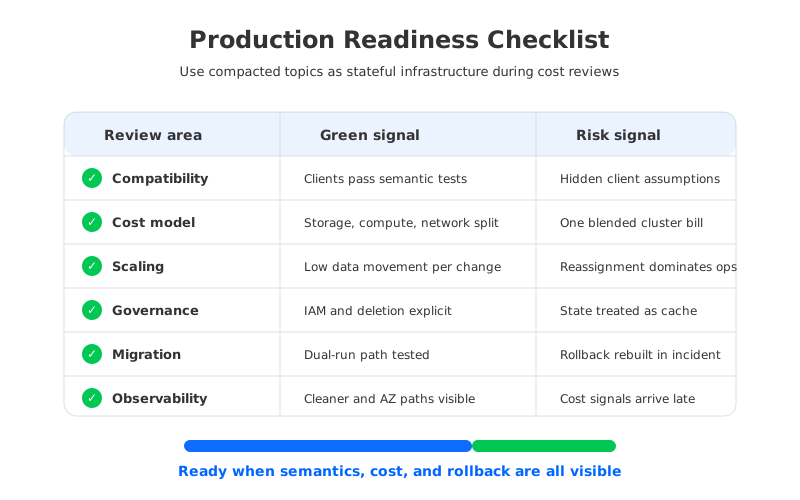
The safest migration plan treats compacted topics as stateful systems, not as "small topics." A topic that stores account state or CDC projections may have a modest byte size after compaction, but losing ordering, tombstones, or consumer position can break downstream services. The readiness score should therefore combine Kafka behavior, data governance, and infrastructure cost signals.
| Area | Green signal | Risk signal |
|---|---|---|
| Compatibility | Existing producers and consumers pass protocol and semantic tests | Custom clients depend on undocumented broker behavior |
| Compaction semantics | Tombstones, key updates, and restore reads match expectations | Consumers rely on timing assumptions around cleanup |
| Cost model | Storage, compute, and network paths are separately measured | One blended cluster cost hides the real driver |
| Scaling | Broker changes do not require disruptive data movement | Reassignment time grows with retained compacted data |
| Governance | Ownership, encryption, IAM, and deletion policy are explicit | Compacted state is treated as operational cache only |
| Rollback | Dual-run, mirror, or restore path is tested before cutover | Rollback depends on rebuilding state under incident pressure |
The scorecard is also a forcing function for procurement. A platform comparison that stops at "Kafka-compatible" is too shallow for high-volume compacted streams. Compatibility answers whether applications can talk to the system. Readiness answers whether the system can absorb the workload and operating model those applications create.
The teams that get compaction cost under control do not usually do it by finding one magic setting. They make the hidden work visible, decide which work belongs on brokers, and remove data movement from places where it does not create business value. If your review points toward shared storage and stateless broker operations, the AutoMQ pricing and architecture materials are a practical next stop: model your Kafka workload with AutoMQ.
7References
- Apache Kafka documentation: Log compaction
- Apache Kafka generated topic configuration
- Apache Kafka documentation: Tiered Storage
- AWS S3 pricing
- AWS Cost and Usage Report: understanding data transfer charges
- AutoMQ documentation: overview
- AutoMQ documentation: difference with Apache Kafka
- AutoMQ documentation: WAL storage
- AutoMQ documentation: eliminate inter-zone traffic
8FAQ
8.1Is Kafka log compaction mainly a storage cost problem?
No. Storage is the most visible part, but compaction also affects broker CPU, disk I/O, cleaner scheduling, replication, recovery, observability, and operational headroom. In cloud deployments, network topology can also become a material part of the cost model.
8.2Does Tiered Storage eliminate compaction cost?
Tiered Storage can reduce local disk pressure for retained log data, but it does not make compaction disappear. Compaction still has to preserve Kafka semantics for keys, tombstones, and eligible records. Teams should test how their platform handles compacted topics across hot storage, remote storage, reads, and recovery.
8.3Which Kafka metrics should I review first?
Start with dirty log ratio, cleaner backlog, cleaner throughput, per-broker disk utilization, produce/fetch latency during cleaner activity, partition skew, bytes moved during reassignment, and cross-zone traffic. The goal is to connect compaction behavior to infrastructure pressure.
8.4When should a team consider a shared-storage Kafka architecture?
Consider it when broker-local storage and data movement dominate scaling, recovery, and cost planning. Shared storage is especially relevant when retained state grows independently from compute needs, when broker replacement causes large data movement, or when multi-AZ network costs are a recurring concern.
8.5Is AutoMQ a replacement for Kafka clients and applications?
AutoMQ is designed as a Kafka-compatible streaming system, so the evaluation starts with existing Kafka clients, workloads, and semantics. A serious proof of concept should still validate the exact clients, connectors, compacted topics, security settings, observability hooks, and rollback process used in production.


