
Table of Contents
Table of Contents
Teams usually search for connector migration planning kafka after the easy part has already been solved. They know which databases, queues, warehouses, or object stores are connected to Kafka. They have a list of connectors, task counts, worker configurations, and owners. The uncomfortable part is that this inventory does not yet answer the production question: can the team move the streaming platform without changing application semantics, losing connector state, or creating a rollback path nobody trusts?
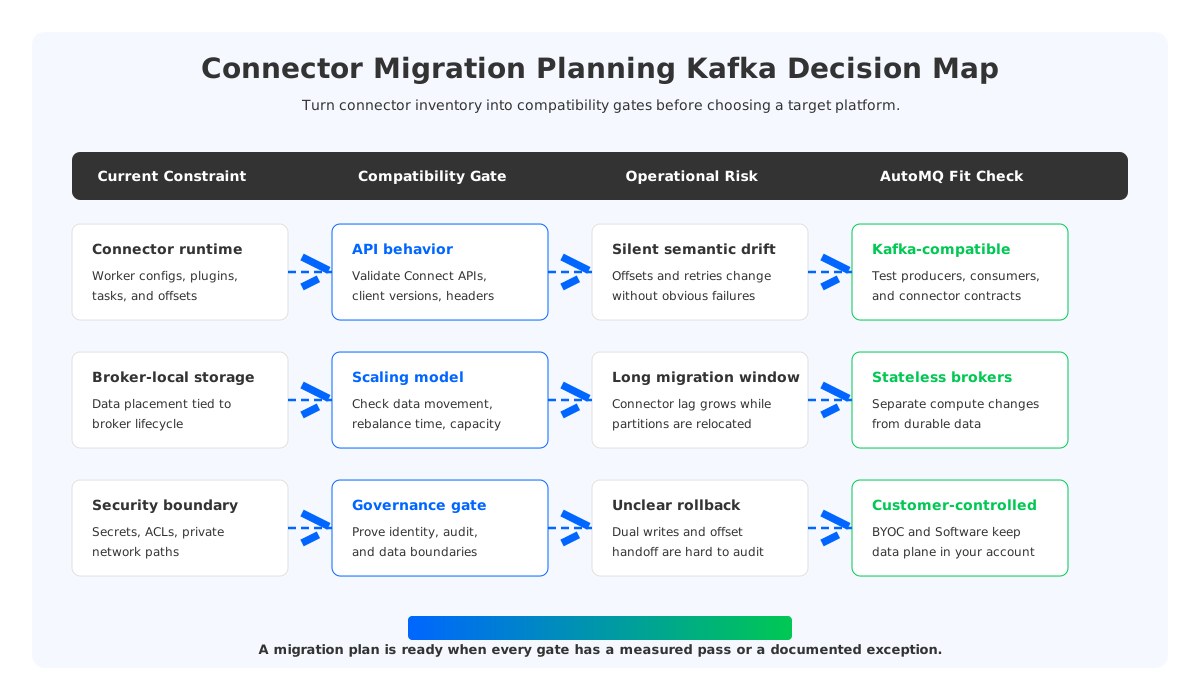
Kafka connector migration is rarely a connector-only project. A connector sits at the edge of Kafka, but its behavior depends on the platform beneath it: topic configuration, offset handling, producer retries, transactional writes, ACL (access control list) rules, private networking, schema handling, task rebalances, and the failure behavior of brokers under load. A migration plan that treats connectors as portable plugins will look clean in a spreadsheet and then fail in the first rehearsal.
The useful framing is a set of compatibility gates. Each gate asks whether the target platform preserves a behavior the workload already depends on. The gate can pass, fail, or pass with an explicit exception. What it cannot be is implied.
1Why Teams Search for connector migration planning kafka
Connector estates grow sideways. One team adds a Debezium source for operational data. Another adds an S3 sink for audit logs. A data platform team adds warehouse ingestion. Over time, the platform stops being a single Kafka cluster with some integrations and becomes a shared dependency graph where each connector represents a contract with another system.
That contract is more than "can the connector start?" It includes how the connector commits progress, how it retries after a transient failure, how it handles record ordering, whether it expects exactly-once behavior, how it maps secrets, and how quickly operators can identify lag. Apache Kafka's own documentation treats Kafka Connect as a framework for scalable and fault-tolerant data import and export, which is exactly why migration planning has to include worker runtime behavior, not only cluster endpoints.
The search usually comes from one of four pressures:
- A platform replacement is being evaluated. The team wants a Kafka-compatible target but must prove that existing connectors, clients, and downstream jobs do not need a rewrite.
- A cloud move changes the cost model. Cross-Availability Zone traffic, storage retention, NAT paths, and private endpoints can turn connector traffic into an infrastructure bill that was not visible on premises.
- A reliability project exposes weak runbooks. Connectors may restart cleanly during normal maintenance, but a broker replacement or partition reassignment can still create task failures, duplicate delivery, or lag spikes.
- A governance review tightens boundaries. Secrets, ACLs, audit logs, customer data location, and third-party access all become release blockers when a connector touches regulated systems.
Those pressures are different, but they lead to the same planning mistake. Teams ask whether the connector is compatible before defining the exact behavior that must remain compatible.
2The Production Constraint Behind the Problem
Traditional Kafka runs on a Shared Nothing architecture. Each broker owns local storage for the partitions it hosts, and durability is achieved through replication between brokers. That design is mature and well understood, but it couples compute operations to data placement. Replacing a broker, expanding capacity, or changing the balance of partitions can mean moving retained bytes before the cluster reaches its intended state.
For connector migration, that coupling matters because connectors are often the first components to reveal instability. A source connector might keep producing while the cluster is rebalancing. A sink connector might fall behind during a catch-up period and then pressure downstream systems when it recovers. A connector worker might rebalance tasks at the same time the Kafka cluster is moving partition leadership. None of these events is exotic. They are normal operational events stacked on top of a migration.
The storage model also shapes cost. In a multi-AZ cloud deployment, broker-to-broker replication and consumer fetch paths can create cross-zone traffic depending on placement and routing. The exact bill depends on the cloud provider, region, architecture, and traffic pattern, so it should be verified against official cloud pricing before a business case is signed. The engineering point is simpler: connector migration planning must include network topology and data movement, not only connector configuration.
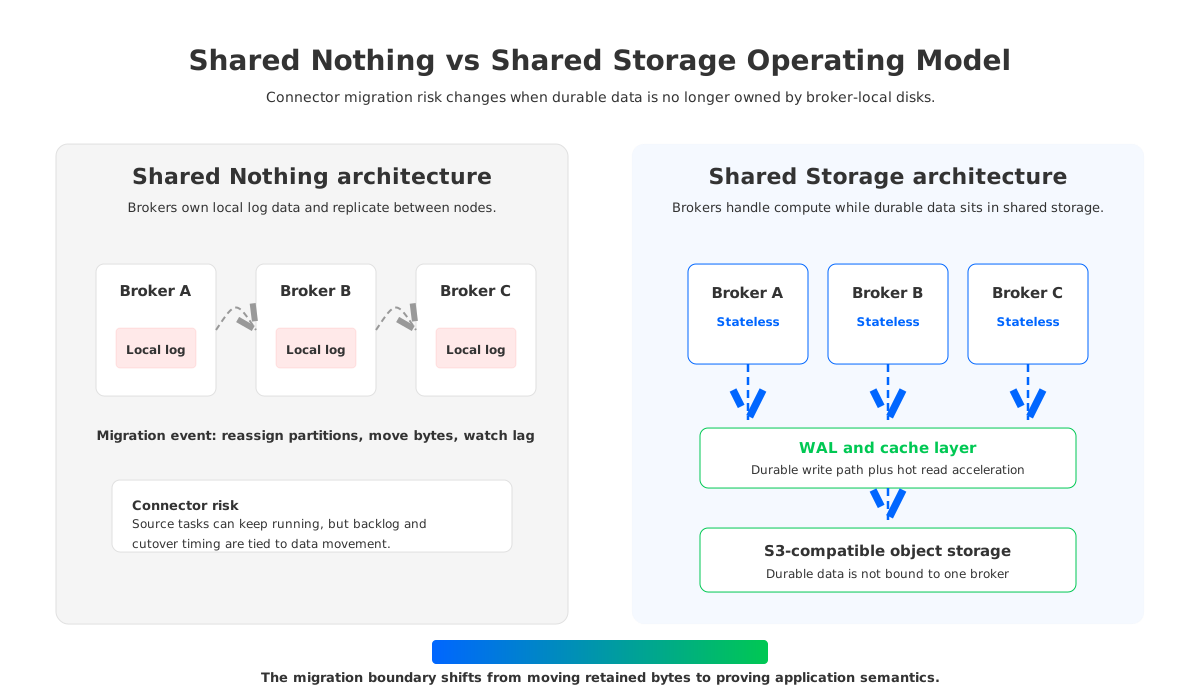
Tiered Storage does not remove this planning burden. Apache Kafka's Tiered Storage moves older log segments to remote storage, but the broker still participates in the hot write path and keeps operational responsibility for active partitions. That can reduce local storage pressure for long retention workloads, but it is not the same operating model as stateless brokers backed by shared storage. A connector migration plan should treat those architectures as different choices, not interchangeable labels.
3Architecture Options and Trade-Offs
A practical migration plan compares operating models before choosing tools. The target can be another self-managed Kafka cluster, a managed Kafka service, a Kafka-compatible platform with a different storage architecture, or a staged bridge that keeps the source cluster active while connector workloads move one group at a time. Each option can be valid when the constraints match the workload.
The evaluation should start with what must not change. Producers may rely on idempotent writes or transactions. Consumers may depend on Consumer group membership, committed offsets, and offset reset behavior. Kafka Connect workers may depend on internal topics for config, status, and offsets. Security may depend on mTLS, SASL, ACLs, private DNS, or service identity. Observability may depend on task-level metrics and broker-level metrics being correlated during an incident.
Use a matrix like this before arguing about vendors or migration tooling:
| Gate | What to Verify | Release Evidence |
|---|---|---|
| Client and protocol compatibility | Producer, Consumer, Admin, and Connect API behavior used by the workload | Test suite against representative apps and connectors |
| Offset and state continuity | Consumer group offsets, connector offset topics, replay boundaries, and restart behavior | Rehearsal with controlled stop, resume, and rollback |
| Security boundary | ACLs, auth mechanisms, secrets, private networking, and audit trails | Reviewed access map and validated connection paths |
| Capacity and cost | Migration headroom, retained data, connector backlog, network paths, and storage model | Load rehearsal and documented infrastructure assumptions |
| Failure recovery | Broker failure, worker failure, task rebalance, target outage, and source outage | Runbook drill with owners and rollback criteria |
| Team ownership | Who controls platform, connectors, cloud resources, incident response, and compliance evidence | RACI-style ownership map accepted before cutover |
The matrix forces a useful distinction. Compatibility is not a badge on a product page. It is the absence of behavioral surprises in the parts of Kafka your estate actually uses. A team running simple sink connectors may care most about throughput, cost, and restart behavior. A team running CDC sources into stream processing jobs may care more about offset consistency, ordering, schema evolution, and rollback windows.
4Evaluation Checklist for Platform Teams
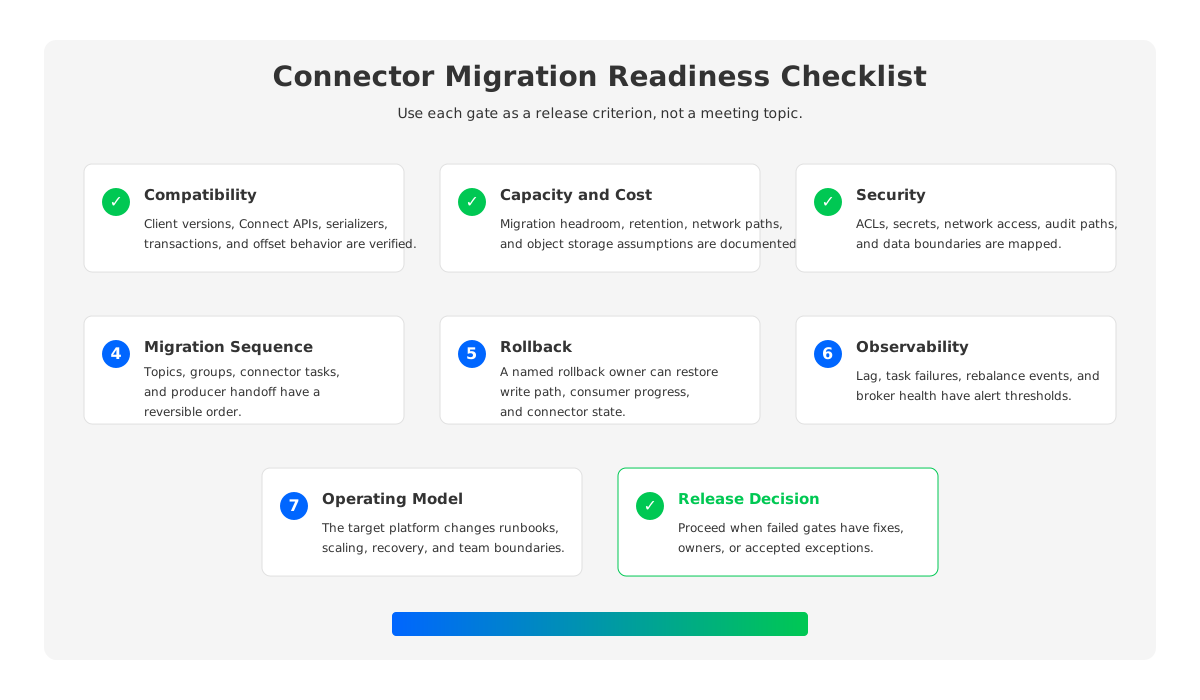
The checklist should be written as release criteria. If a gate fails, the project needs a fix, a narrower scope, or an accepted exception. That sounds bureaucratic, but it keeps migration risk out of Slack threads and puts it into a form a release owner can sign.
Start with connector inventory, then move outward:
- Connector runtime: Record connector class, version, plugin dependencies, task count, worker mode, internal topics, offset storage, and dead-letter behavior. Include nonstandard SMTs and custom plugins because they often carry the migration risk.
- Kafka semantics: Test producer retries, idempotence, transactions, partitioning behavior, Consumer group rebalancing, committed offsets, and admin operations used by automation.
- Data path: Map source systems, target systems, Kafka topics, private network paths, DNS, TLS, and any path that crosses an Availability Zone, region, VPC (Virtual Private Cloud), or cloud account.
- Backlog behavior: Measure how the connector behaves when the target is slow, when the source pauses, and when consumers resume from a known offset. A happy-path throughput test is not enough.
- Rollback: Define the latest point at which the team can return writes, reads, connector tasks, and consumer progress to the source side without manual data surgery.
- Operations: Validate metrics, logs, alert thresholds, owner handoff, incident routing, and the exact command or UI action used to stop, restart, or promote a connector.
The strongest migration rehearsals are deliberately boring. Pick one representative source connector and one representative sink connector. Run them through start, pause, catch-up, restart, broker failure, worker failure, and rollback. If the plan only works when every component behaves perfectly, it is not a migration plan. It is a demo script.
5How AutoMQ Changes the Operating Model
Once the neutral gates are defined, AutoMQ becomes relevant for a specific reason: it keeps Kafka protocol compatibility while changing the storage architecture underneath the brokers. AutoMQ uses a Shared Storage architecture in which durable log data is stored through S3Stream, with WAL storage and cache serving the low-latency write and read paths. Brokers are stateless compute nodes rather than long-term owners of local partition data.
That changes connector migration planning in three concrete ways. First, scaling and broker replacement are less tied to retained-data movement, so a migration rehearsal can focus more on application semantics and less on waiting for broker-local bytes to settle. Second, object-storage-backed durability changes the capacity discussion from "which broker owns this data?" to "what are the throughput, WAL, cache, and object storage assumptions for this workload?" Third, AutoMQ BYOC and AutoMQ Software keep the data plane inside the customer's environment, which matters when connector data paths cross regulated systems.
AutoMQ does not remove the need to test connector behavior. It changes which parts of the plan deserve the most attention. You still validate Connect workers, internal topics, task rebalances, offsets, schema handling, security, and rollback. The difference is that the target platform's broker lifecycle is not centered on local persistent disks, so scaling and recovery runbooks can be shorter and less data-movement-heavy.
Kafka Linking is also part of the migration discussion for AutoMQ commercial editions. It is designed for Kafka migration with byte-level data synchronization and Consumer group progress synchronization, so it belongs in the evaluation when the project needs a staged cutover rather than a stop-and-restart move. The important planning point is not the feature name. It is whether the migration mechanism can keep topic data, producer handoff, and consumer progress aligned well enough for the workload's rollback window.
For connector-heavy estates, AutoMQ is strongest when the migration is also an operating model decision. If the team only needs to move one low-volume connector and can tolerate a maintenance window, a simpler blue-green approach may be enough. If the team is using the migration to reduce broker-local storage constraints, improve elastic scaling, keep the data plane under customer control, and preserve Kafka compatibility, then AutoMQ deserves a workload-level test.
6A Readiness Scorecard You Can Use
A readiness scorecard should be blunt. Give each gate one of three states: pass, fail, or exception accepted. Avoid "in progress" for release decisions because it hides uncertainty. A connector can be migrated only when the remaining uncertainty is either removed or owned.
Use this scoring model in the final migration review:
| Score | Meaning | Action |
|---|---|---|
| Pass | Tested with representative connector workload and documented evidence | Eligible for cutover |
| Fail | Behavior does not match the source system or recovery requirement | Fix platform, connector config, or migration method |
| Exception accepted | Risk remains, but owner, blast radius, and rollback are documented | Cutover only with explicit approval |
This keeps the conversation grounded. A sink connector with known duplicate-tolerant semantics might accept a narrower rollback path. A CDC connector feeding a financial reconciliation job probably cannot. The same platform can pass one workload and fail another, which is why connector migration planning should be workload-specific rather than cluster-generic.
7FAQ
7.1Is Kafka connector migration only about Kafka Connect?
No. Kafka Connect is central when the workload uses source and sink connectors, but migration planning also covers broker behavior, topic configuration, Consumer group offsets, producer semantics, ACLs, networking, observability, and rollback. A connector can be compatible with Kafka Connect and still fail a production migration gate.
7.2What is the first gate to test?
Start with offset and state continuity. If the team cannot stop, restart, catch up, and roll back a representative connector without losing its place, the rest of the plan is premature. Throughput and cost tests matter, but they are easier to interpret after state behavior is known.
7.3Does a Kafka-compatible platform remove connector migration risk?
No. Kafka compatibility reduces application rewrite pressure, but connector correctness depends on the exact APIs, versions, auth mechanisms, internal topics, offsets, and failure patterns the workload uses. Treat compatibility as something to prove with a representative test, not something to assume.
7.4When should AutoMQ be evaluated?
Evaluate AutoMQ when connector migration is tied to a broader Kafka platform decision: cloud-native scaling, broker replacement behavior, long retention, customer-controlled deployment boundaries, and Kafka compatibility all matter at once. It is less relevant when the project is a small one-off connector move with a clear maintenance window.
8Closing the Gate
The point of connector migration planning is not to produce a bigger spreadsheet. It is to decide which behaviors must survive the move and to prove them before the production cutover. If your current plan lists connectors but does not name offset, rollback, security, and recovery gates, the plan is still missing the parts that decide whether the migration is safe.
If you are evaluating a Kafka-compatible target and want to test a shared-storage operating model, start an AutoMQ BYOC evaluation through the AutoMQ console and run the scorecard against one representative connector path before expanding the scope.


