
Table of Contents
Table of Contents
Teams search for multi region failover routing kafka when a routing decision has become a production risk. Application teams want a clear answer: if Region A fails, which bootstrap endpoint should clients use, which cluster accepts writes, and where do consumers resume? Platform teams know the harder part sits underneath that routing question. Kafka clients depend on offsets, Consumer group behavior, transactions, topic configuration, authentication, authorization, and operational tooling. A failover route that moves traffic but breaks one of those contracts is a different outage.
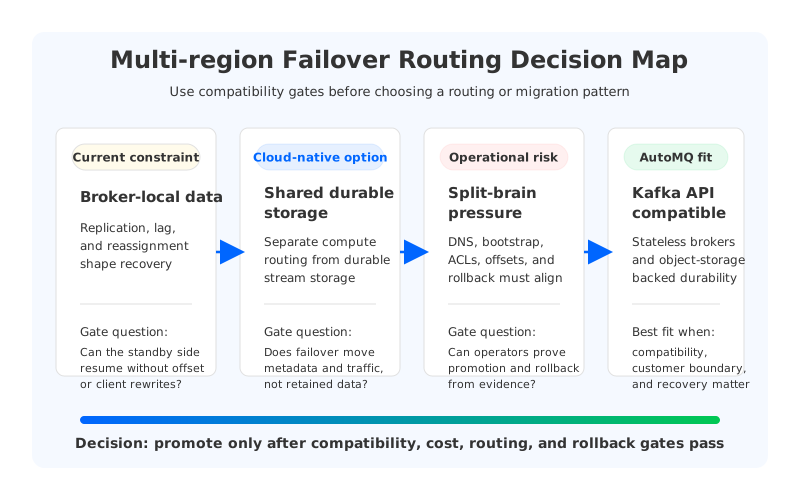
The practical way to evaluate multi-region failover routing is to treat it as a series of compatibility gates. Promote only when the target side can prove the same application contract, the same governance boundary, and a rollback path operators have rehearsed. That framing keeps the decision from collapsing into a debate about DNS, load balancers, or replication tools. Those pieces matter, but they are implementation details inside a larger operating model.
1Why Teams Search for multi region failover routing kafka
The search usually starts after a team discovers that "Kafka is replicated" does not automatically mean "Kafka can fail over cleanly." A secondary cluster may have topic data, but consumers may not have matching offsets. A standby endpoint may exist, but clients may cache metadata or need updated credentials. A replica may be close to caught up, but the platform team may not know whether it is safe to promote while the old primary is partially reachable.
The keyword also reveals a second concern: routing is visible to many teams. Network engineers may own DNS, private connectivity, or firewall policy. SREs may own the incident runbook. Kafka operators may own broker state and replication health. Application teams may own client retry settings and idempotency. A useful failover design gives each team a narrow contract instead of asking everyone to understand every Kafka internals decision during an incident.
The first question should not be "Which region should traffic point to?" It should be "What must be true before traffic is allowed to move?" Producers must avoid duplicate or out-of-order writes beyond what the application can tolerate. Consumers must resume from known offsets. Transactional producers, idempotent producers, admin tools, ACLs, quotas, topic configs, and observability must work well enough that operators can diagnose the promoted primary without improvising.
2The Production Constraint Behind the Problem
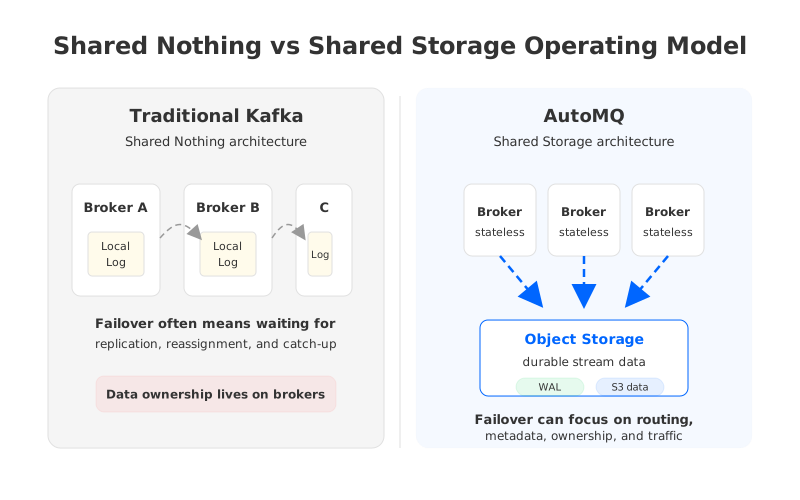
Traditional Kafka was designed around a Shared Nothing architecture. Each Broker owns local log storage for the partitions it leads or follows, and durability comes from replication across brokers. Kafka assigns offsets in partition logs, followers replicate from leaders, and clients interact with a well-defined cluster metadata model. For many single-region workloads, that model remains reliable and familiar.
Multi-region failover stretches the model because operators want to move traffic, while Kafka protects an ordered log tied to broker and partition state. A remote cluster can copy data, but it does not automatically inherit every runtime condition from the primary. Consumer group offsets, transaction state, topic configuration, authentication material, DNS behavior, client metadata refresh, and monitoring all become part of the recovery surface.
The cloud adds another layer of pressure. Cross-Availability Zone and cross-region paths are latency, billing, and governance paths. Storage replication, client traffic, PrivateLink-style connectivity, endpoint processing, and object storage requests can all affect the cost model depending on provider and region. Model the bytes that move during steady-state writes, replay, failover drills, and rollback, then validate that model against official cloud pricing pages.
3Architecture Options and Trade-offs
There are several legitimate architectures for multi-region Kafka failover routing. Active-passive replication is common when one region should own writes and another should remain ready for promotion. Active-active designs can reduce regional dependency for some workloads, but they push conflict handling, ordering, and application idempotency into the foreground. DNS or global load balancer routing can simplify endpoint movement, but it does not solve Kafka offset, transaction, or cluster metadata compatibility by itself.
A neutral evaluation should compare options by the contracts they preserve, not by the number of boxes in the diagram.
| Evaluation area | What to verify | Why it matters |
|---|---|---|
| Client compatibility | Producers, consumers, tools, transactions, and idempotency | Routing is unsafe if applications need code changes |
| Offset continuity | Consumer group offsets, lag, reset policy, and replay boundary | Consumers need a known resume point |
| Write ownership | Which region accepts writes during each phase | Ambiguity creates duplicates or ordering surprises |
| Cost model | Storage, replication, network paths, endpoints, and replay compute | A standby design can be correct but hard to sustain |
| Governance | ACLs, audit logs, encryption, IAM, and data residency | The standby path must satisfy primary controls |
| Rollback | Conditions for returning or continuing forward | Recovery is incomplete if rollback is guesswork |
The main trade-off is between steady-state simplicity and failure-time certainty. A passive secondary can be easier to reason about, but it needs evidence that it can catch up and promote. Active-active designs may expose problems earlier, but they require stricter ownership rules. The weak pattern is the one that leaves compatibility questions until the incident.
4Evaluation Checklist for Platform Teams
Start with a workload, not a cluster-wide abstraction. Choose one representative topic group with real producers, consumers, retention, and ownership. Then run the failover design against gates that can be tested before production promotion.
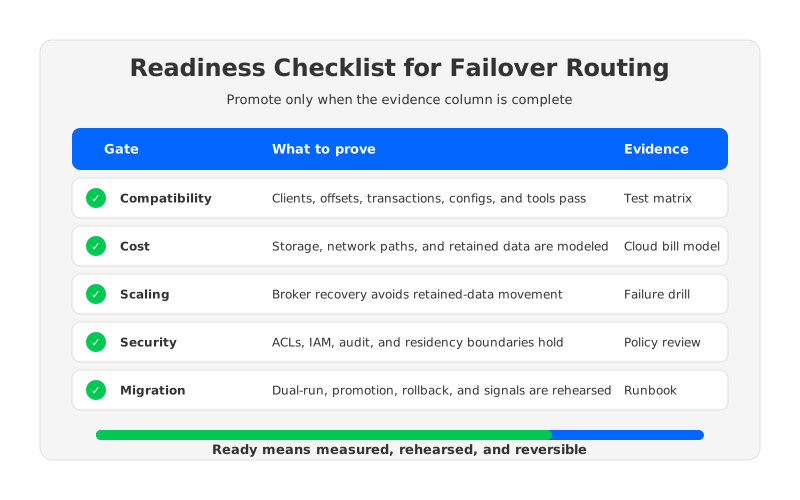
- Compatibility gate. Test client versions, serializers, topic configs, ACLs, Consumer group patterns, transactions, Kafka Connect jobs, and operational tools.
- Offset gate. Define how consumer progress moves to the target region and how the team verifies lag, offsets, and replay behavior.
- Routing gate. Decide whether bootstrap endpoints move by DNS, proxy, load balancer, service discovery, or application configuration, then test stale metadata and partial failure.
- Cost gate. Model steady-state replication, standby capacity, replay, rollback synchronization, and private connectivity against official cloud pricing pages.
- Governance gate. Confirm that the promoted path keeps the same network, IAM, ACL, encryption, audit, and region controls.
- Rollback gate. Write the stop, revert, and continue-forward criteria before promotion.
- Observability gate. Dashboards and alerts must follow the promoted service across offset, lag, producer error, broker health, storage, network, and routing signals.
A failover drill that depends on hidden assumptions is not a readiness test. The stronger signal is a runbook a second operator can execute from evidence already visible in the system.
5How AutoMQ Changes the Operating Model
Once the evaluation framework is clear, AutoMQ becomes relevant as a Kafka-compatible shared-storage option rather than as a shortcut around the gates. AutoMQ keeps the Kafka protocol and ecosystem surface while changing the storage layer underneath. In its Shared Storage architecture, durable stream data is stored in S3-compatible object storage through S3Stream, while AutoMQ Brokers handle protocol processing, partition leadership, caching, scheduling, and traffic serving as stateless brokers.
That distinction matters for failover routing because it changes broker recovery and scaling. In a broker-local storage model, replacing capacity can mean moving retained partition data or waiting for replicas to catch up. In a shared-storage model, persistent data is not owned by a particular broker's local disk. Recovery planning can focus more on metadata, ownership, routing, cache warm-up, WAL storage behavior, and the object storage durability boundary.
AutoMQ's migration path also matters when failover routing is part of a broader platform transition. Kafka Linking is designed to synchronize topic data and Consumer group progress while preserving offsets for migration scenarios. The safer evaluation is not "Can we copy bytes?" It is "Can consumers resume, can producers cut over without a forced rewrite, and can we roll back from known states?"
Deployment boundaries are part of the same decision. AutoMQ BYOC runs in the customer's cloud account, and AutoMQ Software targets private environments. For multi-region failover, the route is also a control boundary: where data flows, where credentials live, who can operate the system, and which region may hold durable state.
Shared storage does not automatically solve multi-region Kafka failover. The narrower point is more useful: when broker-local storage, replica catch-up, capacity reservation, and data movement are recurring sources of risk, a Kafka-compatible Shared Storage architecture deserves a place in the evaluation. The same gates still apply, but the operating model is different.
6A Migration and Readiness Scorecard
Use a scorecard after the architecture discussion. Scoring after the gates forces teams to attach evidence to each answer.
| Gate | 0 points | 1 point | 2 points |
|---|---|---|---|
| Compatibility | Untested assumptions | Basic producer and consumer tests | Full workload matrix, including tools and edge cases |
| Offsets | Manual reset plan | Partial Consumer group validation | Repeatable offset continuity and replay evidence |
| Routing | Static document only | DNS or proxy drill in staging | Tested client behavior under partial failure |
| Cost | No failover cost model | Steady-state estimate only | Steady-state, drill, promotion, and rollback model |
| Governance | Primary controls only | Secondary reviewed once | Same controls validated on promoted path |
| Rollback | Best-effort recovery | Written rollback steps | Rehearsed rollback with stop/continue criteria |
| Observability | Separate dashboards | Shared dashboards with gaps | Promotion-aware alerts and runbook evidence |
A production candidate should not need a perfect score to start staged adoption, but it should not have zeros in compatibility, offsets, routing, or rollback. Those are the gates most likely to turn a regional failure into a platform-wide incident.
Run the scorecard against both the existing architecture and the candidate architecture. If the current design passes compatibility but fails recovery and scaling gates, the problem is not the clients. If the candidate design improves recovery but fails a connector, transaction, or governance gate, the migration plan needs more work.
The search started with routing, but routing is the last visible action in a longer chain. By the time traffic moves, the team should already know which cluster owns writes, where consumers resume, which controls apply, how much the standby path costs, and how to reverse course. To evaluate that model with a Kafka-compatible shared-storage platform, run the gates above against one representative workload through the AutoMQ BYOC entry point.
7FAQ
7.1What is multi region failover routing Kafka?
It is the model for moving Kafka client traffic from one region or cluster to another during a failure, planned promotion, or migration event. A complete design covers bootstrap routing, write ownership, consumer offsets, controls, observability, and rollback.
7.2Is DNS enough for Kafka failover routing?
DNS can be part of the endpoint strategy, but Kafka clients also depend on broker metadata, offsets, credentials, topic configuration, and retry behavior. Test stale metadata and partial failure before relying on DNS.
7.3How should teams validate Consumer group offsets before promotion?
Validate offsets with the exact Consumer groups that will move. The runbook should show source offsets, target offsets, lag, expected replay, reset policy, and post-promotion consumption behavior.
7.4Does Shared Storage architecture remove the need for replication?
No. It changes where durable data lives and how brokers recover, but teams still need a reliability design for metadata, routing, WAL storage, object storage dependency, region boundaries, and promotion.
7.5Where does AutoMQ fit in a failover routing evaluation?
AutoMQ fits when the team wants Kafka compatibility with a different storage operating model: stateless brokers, S3-compatible object storage, customer-controlled deployment boundaries, and migration tooling focused on data and offset continuity.
8References
- Apache Kafka documentation
- Apache Kafka operations: geo-replication
- Apache Kafka KRaft documentation
- Apache Kafka Tiered Storage documentation
- AutoMQ compatibility with Apache Kafka
- AutoMQ architecture overview
- AutoMQ WAL storage documentation
- AutoMQ migration overview
- AutoMQ BYOC installation on AWS
- AWS data transfer pricing
- AWS PrivateLink pricing


