
Table of Contents
Table of Contents
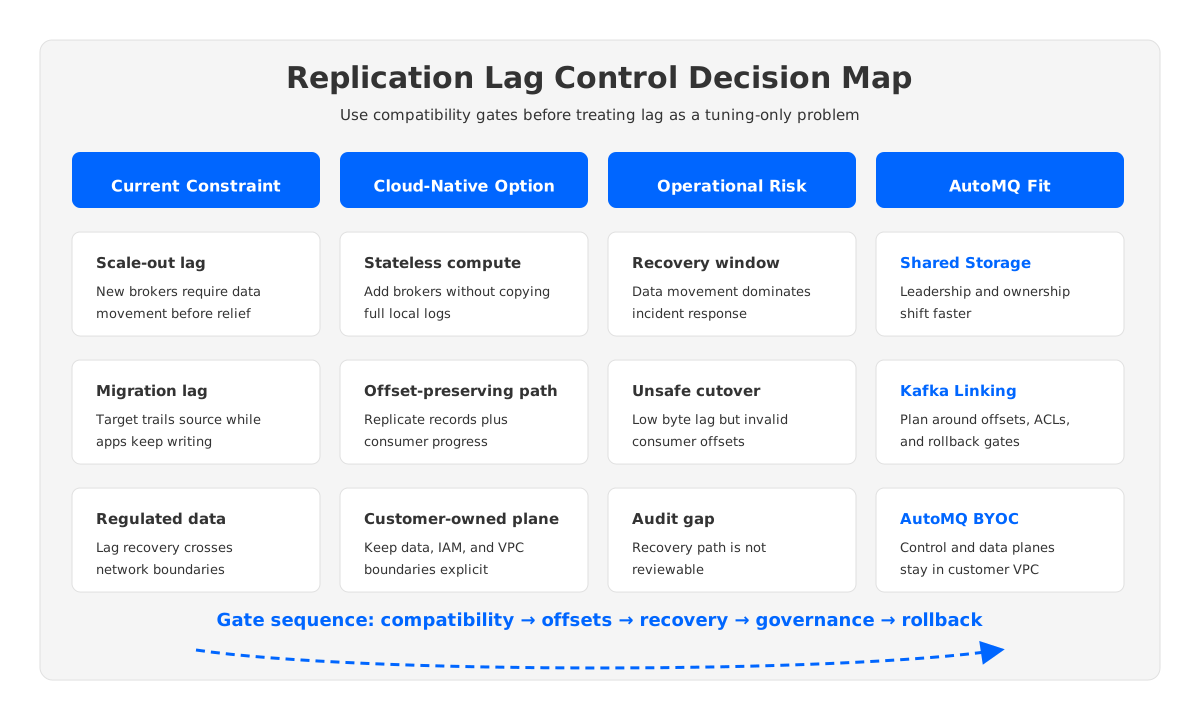
When a platform team searches for replication lag control kafka, the problem is rarely a single lagging consumer. Something has already made the usual Kafka runbook feel too small. A broker may be recovering after a failure, a follower may be falling behind during peak ingest, a consumer group may be replaying old data after a deployment, or a migration team may be trying to keep source and target clusters close enough for a clean cutover. The pressure point is the same: lag has stopped being a metric on a dashboard and has become a decision about architecture.
Replication lag control in Kafka is hard because it spans producer throughput, broker storage, follower fetch behavior, consumer offsets, and failure recovery. Treating it as tuning can work when the cluster shape is stable. It breaks down when the cluster is also being scaled, migrated, rebalanced, or split across cloud fault domains. The better question is not "which knob reduces lag?" It is "which compatibility gates must hold before this platform can control lag without creating a larger risk?"
1Why teams search for replication lag control kafka
Kafka exposes lag in several ways. Consumer lag measures the distance between the latest available offset in a partition and the offset a Consumer group has processed or committed. Replica lag measures whether follower replicas are keeping up with the leader so they can remain in the ISR (In-Sync Replicas). Migration lag measures how far a target cluster trails the source cluster before traffic moves. These are related, but they are not interchangeable.
That distinction matters during production incidents. A consumer group can show rising lag even though brokers are healthy, because downstream processing is slow. Followers can lag even though consumers are idle, because the leader is writing faster than the replication path can absorb. A migration target can be nearly caught up in bytes but still unsafe to cut over if offsets, ACLs, or client behavior do not remain compatible. The dashboard can show three green panels and still hide the one gate that makes rollback painful.
For platform teams, lag control is therefore a governance problem as much as a performance problem. The team needs to know which workloads tolerate replay, which consumers rely on exact offsets, which topics use transactional producers, which connectors need schema or ACL continuity, and which cloud boundaries affect data movement. Without that map, reducing one form of lag can move risk elsewhere.
2The production constraint behind the problem
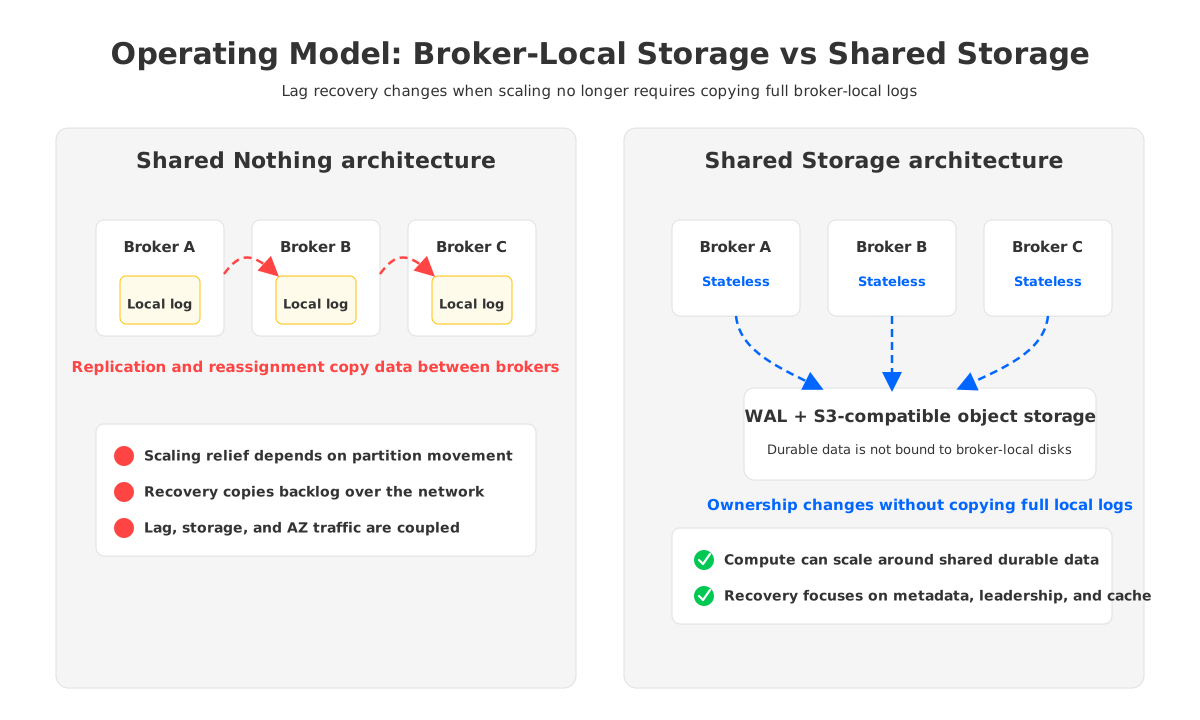
Traditional Kafka follows a Shared Nothing architecture. Each broker owns local log segments, each Partition has a leader, and durability comes from replicating data to follower replicas. This design fits many data center assumptions: disks are attached to servers, inter-node copying is part of durability, and scaling means adding brokers plus moving partition data until the cluster balances again.
Cloud infrastructure changes the economics and the recovery path. Broker-local storage has to be provisioned before the workload arrives. Replication traffic may cross Availability Zone (AZ) boundaries. Scaling out can require moving partition data, and scaling in can be blocked by the amount of data attached to brokers that need to leave. A lag incident then becomes tangled with storage placement, network cost, and reassignment time.
The familiar controls still matter:
- Producer admission and batching decide how fast incoming records enter the system. They can smooth spikes, but they do not solve a broker storage bottleneck.
- Follower fetch and ISR health protect durability. They can also amplify pressure when a recovering replica must copy a large backlog from another broker.
- Consumer group sizing and offset commits affect application-visible lag. They do not guarantee that a migration target has the same offset semantics as the source cluster.
- Partition reassignment and broker replacement help restore balance. In a Shared Nothing architecture, they usually involve moving data as well as moving ownership.
This is why lag control needs compatibility gates. A team can tune fetch sizes, add consumers, or expand brokers, but those actions are safe only when the surrounding assumptions hold. If storage movement dominates the recovery window, adding compute does not remove the backlog fast enough. If offsets are not preserved across a migration path, lowering replication lag in bytes does not make the cutover safe.
3Architecture options and trade-offs
There are three broad ways to approach replication lag control in a Kafka-compatible estate. The first is to stay with traditional Kafka and improve operational discipline. That can be the right answer when workloads are predictable, retention is modest, and the team has enough capacity to manage partition placement, broker storage, and failover drills. The trade-off is that lag control remains tied to local disk ownership.
The second option is to add tools around Kafka: MirrorMaker2 for replication, Kafka Connect for pipeline movement, autoscaling logic around broker fleets, and external monitoring to detect lag early. This can extend an existing platform, especially for teams avoiding a broader architecture change. The trade-off is coordination. Every tool has to preserve workload semantics, and ownership can scatter across SRE, data platform, application, and security teams.
The third option is to evaluate a Kafka-compatible platform that changes the storage model while keeping the Kafka API surface familiar. This is where the decision becomes more architectural. A Shared Storage architecture separates compute from durable storage, so brokers can handle protocol, routing, leadership, caching, and scheduling while persistent data lives in shared object storage with a WAL (Write-Ahead Log) path for durable writes. The goal is not to make lag disappear. The goal is to remove broker-local data movement from the critical path of scaling and recovery.
| Decision area | Traditional Kafka focus | Shared Storage focus | Gate to verify |
|---|---|---|---|
| Lag recovery | Add broker capacity, rebalance partitions, tune replicas | Add compute capacity and shift ownership without copying full local logs | Recovery time is not dominated by broker-local data movement |
| Migration | Replicate records and manage offset translation | Preserve Kafka behavior while moving workload boundaries | Consumers resume from expected offsets after cutover |
| Cost | Provision disks and network for peak plus replication | Use object storage and elastic brokers where supported | Network, storage, and idle capacity are modeled together |
| Governance | Secure each cluster and replication tool | Keep control and data boundaries explicit | Data plane, control plane, IAM, and VPC ownership are clear |
The table is intentionally neutral. A stable Kafka cluster with a skilled operations team may not need an architectural move. A platform team under repeated scaling, recovery, or migration pressure should at least test whether its current lag controls are fighting the storage model itself.
4Evaluation checklist for platform teams
The checklist below is a gate sequence, not a vendor scorecard. Each gate asks whether a platform can control lag while preserving Kafka application behavior. Teams should run it before a major migration, before adopting another Kafka-compatible service, and before declaring an existing cluster ready for higher throughput.
- API and client compatibility: Verify the Kafka client versions, protocol features, ACL behavior, idempotent producers, transactional producers, Kafka Connect workers, and monitoring tools that matter to your estate. Compatibility is not a logo; it is the set of client behaviors your workloads use.
- Offset and consumer group continuity: Map how offsets are stored, replicated, reset, and rolled back. A migration path that changes offset meaning can turn a low-lag cutover into duplicate processing or missed records.
- Storage recovery boundary: Identify whether failure recovery requires copying broker-local logs, replaying from shared storage, or reassigning ownership metadata. This gate tells you whether adding compute reduces lag quickly or mostly creates more data movement.
- Network and AZ model: Model replication traffic, producer placement, consumer reads, and cross-AZ paths. Lag control is incomplete when the recovery path works technically but creates unpredictable network cost.
- Governance and isolation: Confirm where the data plane runs, who owns the VPC or private network, how IAM permissions are scoped, and what telemetry leaves the environment. These boundaries matter for regulated workloads and incident response.
- Rollback design: Define the point at which you can still return to the source cluster, which offsets remain valid, and which clients need to be moved back together. A rollback plan written after the cutover is usually too late.
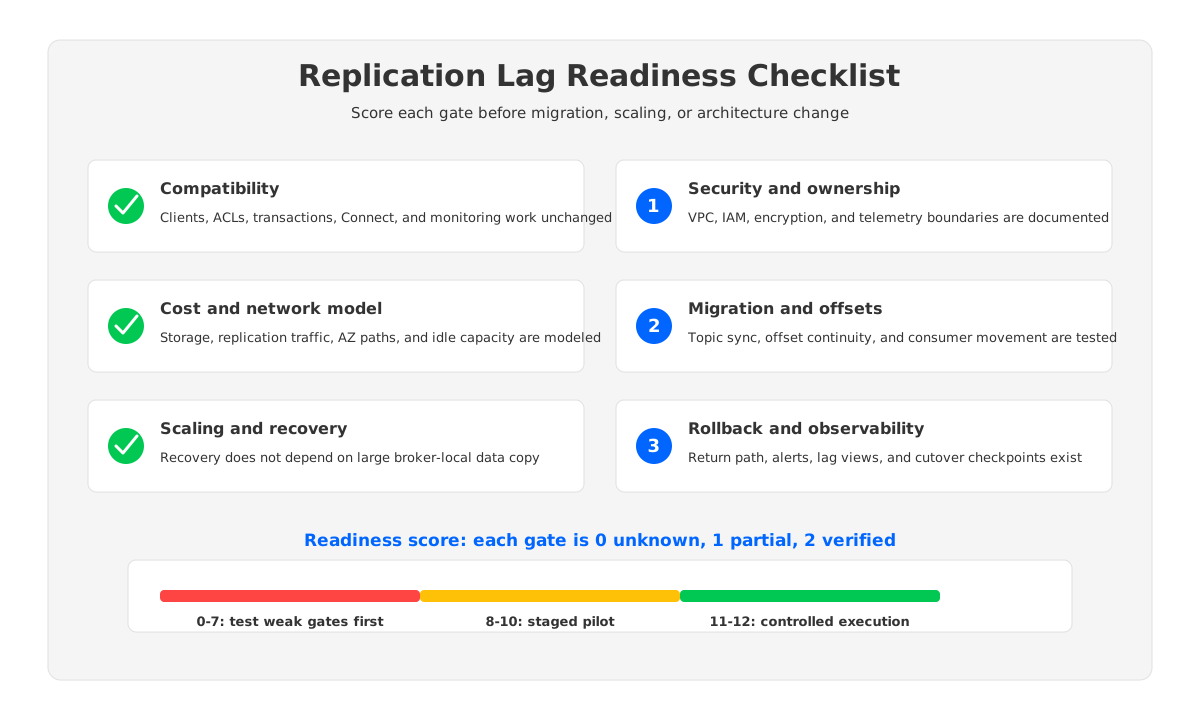
The score is less important than the failed gates. A platform can survive one weak area if the workload is narrow and the team knows the risk. Multiple weak gates usually mean lag control is being treated as a metric problem when the real issue is platform readiness.
5How AutoMQ changes the operating model
After those gates are clear, AutoMQ becomes relevant as a specific architectural answer: a Kafka-compatible streaming platform that keeps Kafka protocol and ecosystem compatibility while replacing broker-local persistent storage with a Shared Storage architecture. AutoMQ Brokers are stateless in the storage sense. Durable stream data is backed by S3-compatible object storage, while the WAL path handles immediate durable writes before data is organized into object storage.
That change matters because the broker is no longer the long-term owner of the data it serves. When compute capacity changes, the platform can focus on leadership, routing, cache, and metadata rather than copying full local logs between brokers. AutoMQ's documentation describes this as Separation of compute and storage, with S3Stream providing the streaming storage layer underneath Kafka-compatible brokers.
There is a useful distinction here: Shared Storage is not the same as Tiered Storage. Tiered Storage keeps Kafka's local log as the hot path and offloads older data to remote storage. A Shared Storage architecture changes the primary storage model so durable data is not bound to broker-local disks. For lag control, that difference shows up during recovery and scaling. The question is no longer only "how fast can a replica catch up?" It is also "how much data must move before the cluster can accept a different operating shape?"
AutoMQ also changes the migration discussion. AutoMQ commercial editions include Kafka Linking for migration scenarios, with support described in AutoMQ documentation for offset-consistent byte-to-byte message synchronization and rolling cutover. That does not remove the need for a migration plan. It changes what the plan can emphasize: compatibility assessment, target capacity during migration, consumer group behavior, rollback boundaries, and observability during the cutover.
For teams evaluating AutoMQ BYOC, the governance gate is part of the architecture rather than an afterthought. In BYOC (Bring Your Own Cloud), the control plane and data plane run inside the customer's cloud account and VPC. That boundary is important when replication lag control touches sensitive logs, regulated data, or private network paths. The platform team can evaluate operational automation without sending Kafka records through a third-party SaaS data plane.
6A practical readiness scorecard
Use this scorecard in a design review. Give each gate a score from 0 to 2: 0 means unknown, 1 means partially verified, and 2 means verified in a test or production-like environment. The goal is to find the gate that would fail first under pressure.
| Gate | What to test | Strong signal |
|---|---|---|
| Compatibility | Client versions, ACLs, transactions, Connect, and monitoring | Existing workloads run without code changes |
| Lag recovery | Broker failure, scale-out, catch-up read, and consumer replay | Recovery does not depend on large broker-local data copy |
| Migration | Topic sync, offset continuity, producer move, and consumer move | Consumers resume from expected offsets |
| Cost | Storage, network, retention, idle compute, and migration headroom | Cost model includes replication and AZ paths |
| Governance | VPC, IAM, encryption, telemetry, and control channel | Data ownership is documented and testable |
| Rollback | Cutover checkpoint, client routing, and offset state | Return path is written before migration starts |
A team scoring below 8 should delay a major migration or high-throughput rollout until the weak gates are tested. A team scoring 8 to 10 may be ready for a staged pilot. A score above 10 is not a guarantee; it only means the team has enough evidence to move from architecture debate to controlled execution.
7FAQ
7.1Is replication lag the same as consumer lag?
No. Consumer lag measures how far a Consumer group is behind the latest offsets in the partitions it reads. Replication lag usually refers to follower replicas or a migration target falling behind a leader or source cluster. They can affect each other, but they require different fixes.
7.2Can tuning Kafka eliminate replication lag?
Tuning can reduce lag when the root cause is batching, fetch behavior, insufficient consumer parallelism, or temporary capacity pressure. It cannot remove architectural constraints such as broker-local data movement, cross-AZ replication paths, or incompatible offset handling during migration.
7.3When should a team evaluate Shared Storage architecture?
Evaluate Shared Storage architecture when lag control is repeatedly tied to scaling, broker replacement, long retention, multi-AZ cost, or migration risk. The evaluation should include compatibility and rollback tests, not only throughput benchmarks.
7.4Does AutoMQ require application code changes?
AutoMQ is designed for Kafka-compatible workloads, so existing Kafka clients and ecosystem tools can usually remain in place. Teams should still validate client versions, security settings, transactional behavior, and operational tooling before production cutover.
8Closing the gate
Replication lag control starts as a metric problem, but it becomes an architecture problem when teams need to scale, recover, migrate, and govern the same Kafka estate at the same time. The safest path is to turn the problem into gates: compatibility, offsets, storage recovery, network cost, governance, and rollback. Once those gates are visible, the platform decision becomes much less emotional.
If you want to test whether a Kafka-compatible Shared Storage architecture changes your lag recovery and migration plan, start with the AutoMQ GitHub project and run the checklist against a workload that already gives your team trouble.
9References
- Apache Kafka Documentation
- Apache Kafka Consumer Group Protocol
- Apache Kafka KRaft Documentation
- Apache Kafka Transactions
- Apache Kafka Tiered Storage
- Kafka Connect Documentation
- AutoMQ Compatibility with Apache Kafka
- AutoMQ Shared Storage Architecture
- AutoMQ S3Stream and WAL storage
- AutoMQ Migration Prerequisites
- AutoMQ BYOC Environment


