
Table of Contents
Table of Contents
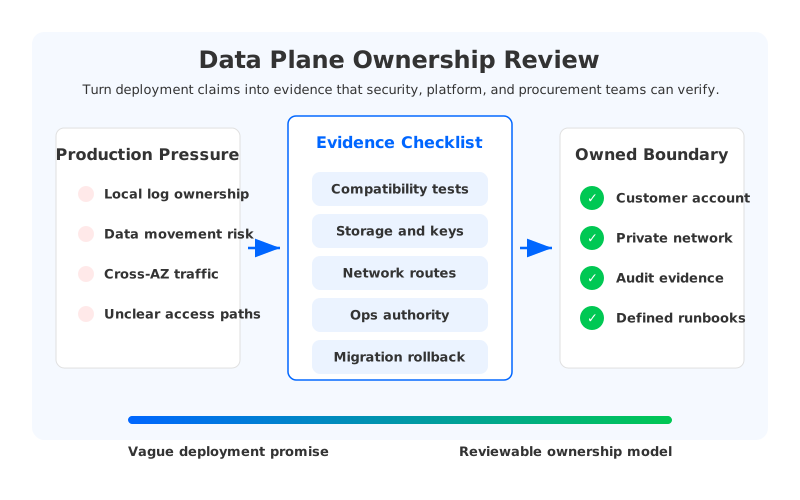
Teams search for data plane ownership checklist kafka when the Kafka conversation has escaped the platform backlog and entered the security review. The first questions are rarely about partitions per broker or producer batching. They are about where event data sits, who owns storage, who can reach the network path, which keys protect durable records, and what evidence the buyer can show during an audit.
That shift changes the buying motion. A service can be Kafka-compatible and still be hard to approve if the data plane boundary is vague. A self-managed cluster can satisfy strict ownership requirements and still create more operational risk than the team can absorb. The useful question is not whether the platform is "managed." It is whether the data-bearing resources, operational authority, and audit evidence can be described without hand-waving.
1Why teams search for data plane ownership checklist kafka
The phrase usually appears after a first architecture comparison has already happened. The organization knows why it needs Kafka semantics: ordered partitions, consumer group coordination, offsets, retention, transactional producers, Kafka Connect jobs, and a large client ecosystem. What remains unresolved is the ownership model around those semantics. Security wants a boundary diagram. Platform engineering wants runbooks. Procurement wants a support model. Finance wants to know whether compute, storage, network, and support costs can be inspected separately.
Those teams are asking the same question in different language. They want to know whether the platform's data plane can be governed like the rest of their cloud estate. That includes IAM roles, encryption keys, object storage policies, private connectivity, logs, metrics, incident access, and change approval. If a vendor or in-house platform team cannot answer those questions precisely, the review gets stuck even when the technical benchmark looks strong.
2The production constraint behind the problem
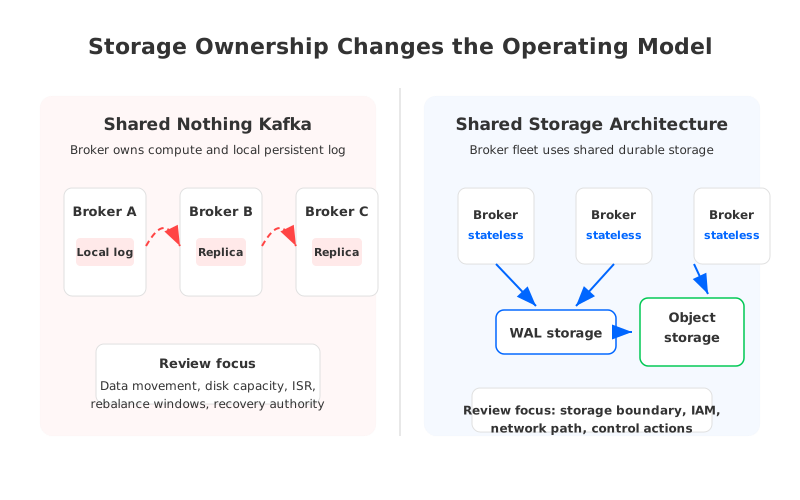
Traditional Kafka uses a Shared Nothing architecture. Each broker manages local persistent storage for the partitions assigned to it, and Kafka replication keeps copies on other brokers for availability. The model is reliable and familiar, but it binds compute, storage, and failure handling together. When the cluster scales, rebalances, replaces a failed broker, or changes disk capacity, the platform team is often moving partition data as part of the operation.
That coupling becomes visible in compliance review because data placement is not a static answer. A team can document that data starts in a particular region, account, or Availability Zone, but it also has to document what happens during failover, reassignment, retention expansion, and disaster recovery. Broker-local storage means the ownership question follows the broker lifecycle. A clean diagram on day one is not enough if the recovery path creates a different boundary on day two.
The compliance implication is simple: do not review Kafka storage as a single box. Review the lifecycle of a record. Where is it acknowledged? Where does it become durable? Where are replicas or remote objects stored? Which logs or metrics expose operational metadata? Which component can move or delete it? A data plane ownership checklist is useful only when it follows the record through normal operations and failure operations.
3Architecture options and trade-offs
There are several ways to run Kafka-compatible streaming, and none of them removes trade-offs. Self-managed Kafka gives the customer direct control over infrastructure, network, keys, storage, upgrades, and incidents. That control is valuable in strict environments, but the team also owns capacity planning, broker replacement, partition balancing, client compatibility testing, and recovery procedures. Ownership without operating maturity becomes a different kind of risk.
An external managed service changes the burden. The provider usually handles cluster mechanics, patching, scaling workflows, and day-to-day operations. That can be the right choice for teams that want fast adoption and accept the service boundary. The review question is whether the data-bearing resources, network path, logs, support access, and evidence trail meet the organization's requirements. A private endpoint is useful, but it is not the same thing as owning the data plane.
BYOC Kafka and customer-operated software models sit between those poles. The runtime resources can live inside the customer's cloud account, VPC, VNet, project, or private environment while the provider supplies software, automation, lifecycle management, or support. This model can make cloud controls more concrete because the customer can inspect storage, keys, network routes, and infrastructure logs with familiar tools. It also creates a shared-responsibility problem. The provider's permissions, control-plane communication, telemetry scope, upgrade process, and break-glass access must be explicit.
The first pass of the review should separate the options by boundary, not by marketing category. The table below gives reviewers a shared vocabulary before they inspect vendor-specific architecture diagrams or contract language.
| Operating model | Data-bearing resources | Primary benefit | Review risk |
|---|---|---|---|
| Self-managed Kafka | Customer account or data center | Maximum direct control | Operations, upgrades, balancing, and recovery remain fully in-house |
| External managed service | Provider service boundary | Lower cluster operations | Data plane placement and evidence may not match strict ownership needs |
| BYOC Kafka-compatible platform | Customer cloud environment | Customer-side infrastructure with provider automation | IAM, control-channel scope, telemetry, and support access need scrutiny |
| Customer-operated software | Customer cloud or private environment | Strongest infrastructure boundary | Customer still owns more day-two operational work |
4Evaluation checklist for platform teams
Start the checklist with compatibility because it protects the migration plan from wishful thinking. Kafka compatibility should be verified against real producers, consumers, serializers, ACLs, consumer groups, transactions, offset behavior, Kafka Connect jobs, monitoring tools, and failure cases. The Apache Kafka documentation is broad for a reason: the ecosystem is more than a wire protocol. If the target platform forces broad application rewrites, the data plane boundary may be clean but the migration risk may be unacceptable.
Then review the data boundary as a set of resources rather than a sentence. The checklist should name the account, region, VPC or VNet, subnets, object storage buckets, disks or WAL storage, encryption keys, secrets, audit logs, metrics, and backup paths. It should also distinguish business data from operational telemetry. Metrics and logs are often less sensitive than records, but they can still reveal topics, client names, throughput patterns, tenant identifiers, or incident details.
Network review deserves its own pass. Kafka clients, connectors, brokers, control services, object storage endpoints, observability exporters, and support paths may not follow the same route. If the platform uses private connectivity, document the endpoint policy and DNS behavior. If it crosses Availability Zones or regions, document why and under whose cost center. If a vendor service communicates with a customer-side operator or control component, document what crosses that path and what does not.
Cost review should stay practical. Avoid invented totals until the architecture is clear. Instead, ask whether the team can inspect the main drivers: compute, durable storage, WAL storage, private networking, inter-zone traffic, retention, observability, support, and marketplace fees. The strongest cost model is not necessarily the lowest estimate. It is the one where the team can explain why the bill changes when retention grows, traffic shifts, or the broker fleet scales.
Operations review is where many checklists become too soft. A production-ready answer names who can perform upgrades, isolate a bad node, rotate credentials, change network policy, restore service, roll back a release, and approve emergency access. It also names what evidence remains afterward. A support contract is not a runbook. The compliance team needs the runbook, the approval path, and the audit trail.
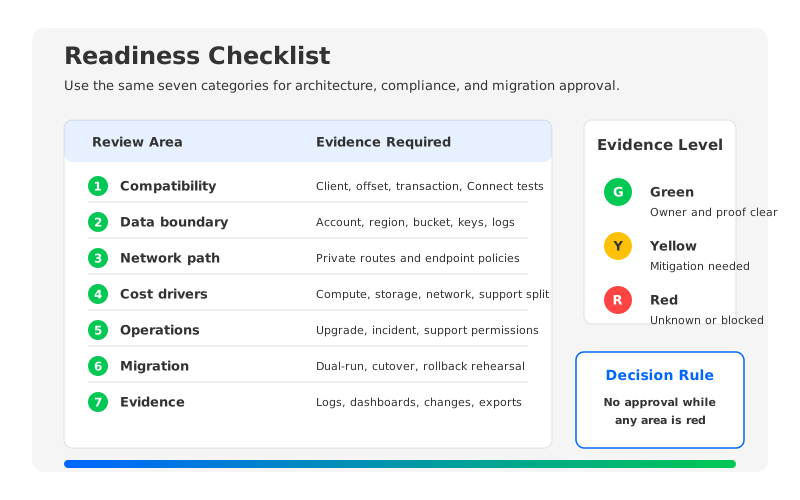
Use this readiness checklist before approving the platform:
- Compatibility: Test representative clients, offsets, consumer groups, transactions, Kafka Connect jobs, security settings, and monitoring integrations.
- Data boundary: Document where durable records, WAL data, logs, metrics, keys, and backups live, including account, region, and storage service.
- Network path: Draw every data, control, observability, and support route. Mark public, private, cross-zone, and cross-region paths separately.
- Cost drivers: Separate compute, storage, networking, retention, observability, and support so finance can model changes in workload shape.
- Operations: Assign owners for upgrade, scaling, credential rotation, failover, incident response, and emergency support access.
- Migration: Rehearse dual-run, cutover, offset validation, producer switching, consumer restart, and rollback criteria before production.
- Evidence: Decide which dashboards, cloud logs, audit events, configuration exports, and change records prove the above during review.
5How AutoMQ changes the operating model
Once the evaluation framework is clear, AutoMQ becomes relevant as a Kafka-compatible streaming platform built around Shared Storage architecture. AutoMQ preserves Kafka protocol semantics and ecosystem compatibility while replacing the broker-local storage model with S3Stream. Durable data is written through WAL storage and stored in S3-compatible object storage, while AutoMQ Brokers are designed as stateless compute nodes.
This changes the ownership review because durable storage is no longer treated as a broker-local side effect. The customer can evaluate the object storage boundary, IAM policy, encryption model, WAL storage choice, network path, and observability path as first-class resources. Broker replacement and scaling are less tied to moving local partition data, which makes the operational boundary easier to reason about. The platform still needs careful review, but the review shifts from "which broker owns which data" to "which customer-controlled storage and management boundaries govern the data plane."
AutoMQ BYOC and AutoMQ Software target different deployment boundaries. In AutoMQ BYOC, the control plane and data plane run in the customer's cloud environment, with customer-side cloud resources carrying the workload. In AutoMQ Software, the deployment runs in a customer-operated private environment with software and support from AutoMQ. Both models are useful for buyers who want Kafka compatibility while keeping data-bearing resources inside their own infrastructure boundary. Both still require a disciplined review of permissions, support access, telemetry, upgrade workflows, and rollback plans.
Migration should be treated as part of the ownership review rather than a separate project. AutoMQ commercial editions provide Kafka Linking for Kafka-to-AutoMQ migration scenarios, including offset consistency for supported source clusters. Other environments may use Kafka-native tools such as MirrorMaker2 depending on compatibility and operating constraints. The important rule is not which tool appears on the diagram. The important rule is that producers, consumers, offsets, rollback, and evidence are tested before the first critical workload moves.
6A practical scorecard for approval
The final approval meeting should not debate broad claims. It should assign each category a red, yellow, or green status. Red means the answer is unknown, unacceptable, or blocked. Yellow means the answer is known but needs a mitigation. Green means the resource owner, evidence, and operating action are clear enough for production.
| Category | Green signal | Red signal |
|---|---|---|
| Kafka compatibility | Representative workloads pass client, offset, transaction, and Connect validation | Compatibility is asserted without workload testing |
| Data boundary | Account, region, storage, keys, logs, and backups are documented | Data-bearing resources sit behind unclear service language |
| Network path | Client, broker, object storage, control, and observability routes are mapped | Private, public, or cross-zone paths are mixed together |
| Operations | Customer and provider actions are explicit for incidents and upgrades | Support access or remediation authority is ambiguous |
| Cost review | Main cost drivers are inspectable and tied to workload changes | The team cannot explain the largest line items |
| Migration | Dual-run, cutover, offset validation, and rollback are rehearsed | Migration is treated as a one-way endpoint switch |
This scorecard keeps the discussion honest. A strict team may accept only green results before production. A team with a lower-risk workload may accept a yellow item with a dated mitigation. The critical point is that every yellow or red item has an owner. A data plane ownership checklist is not a compliance ritual. It is a way to avoid discovering ownership gaps during an outage.
7FAQ
7.1Is data plane ownership the same as self-managed Kafka?
No. Self-managed Kafka means the customer operates the full cluster lifecycle. Data plane ownership means the data-bearing resources and runtime boundary are inside a customer-controlled environment. A provider may still supply software, automation, lifecycle management, monitoring, or support.
7.2Does BYOC Kafka automatically pass compliance review?
No. BYOC can make the ownership boundary easier to inspect, but the review still needs evidence for IAM, encryption, network paths, telemetry, support access, incident response, and upgrade authority.
7.3What should be tested first in a Kafka-compatible migration?
Start with representative producer and consumer behavior, consumer groups, offsets, transactions if used, security settings, Kafka Connect jobs, observability, and rollback. Compatibility should be verified with real workload patterns, not only a smoke test.
7.4How is Shared Storage architecture different from Tiered Storage?
Tiered Storage offloads older closed log segments to remote storage while brokers still retain important local storage responsibilities. Shared Storage architecture moves durable storage into a shared layer and makes brokers stateless, changing the operating model for scaling and recovery.
7.5When should teams evaluate AutoMQ BYOC or AutoMQ Software?
Evaluate them when Kafka compatibility matters, but the organization also needs customer-controlled data-bearing resources, clearer infrastructure boundaries, and an operating model that reduces dependence on broker-local data movement. They are especially relevant when a managed-service boundary is hard to approve but classic self-management would overload the platform team.
Return to the original search phrase: data plane ownership checklist kafka. The goal is not a longer spreadsheet. The goal is a Kafka platform decision that security, platform engineering, finance, and procurement can all explain under pressure. To evaluate this path with AutoMQ, start from the AutoMQ Cloud Console.


