
Table of Contents
Table of Contents
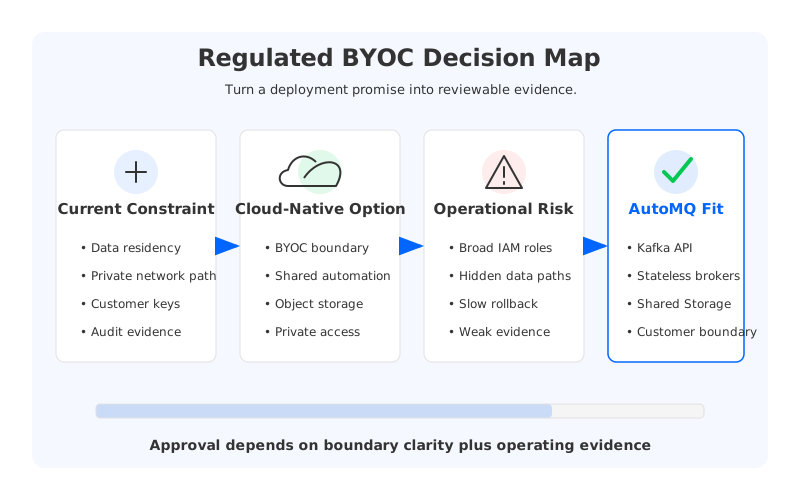
Teams search for regulated byoc deployment kafka when the Kafka decision has stopped being only a platform engineering question. The architecture review still includes partitions, throughput, client compatibility, and retention, but the final approval may come from security, risk, procurement, legal, and finance. Those reviewers ask different questions: where does event data live, which cloud account owns the network path, who can operate the cluster during an incident, and what evidence can the organization produce after the change?
That is why BYOC matters in regulated environments. It promises a middle path between an externally hosted streaming service and a fully self-managed Kafka estate: the data-bearing resources stay inside a customer-controlled environment, while the platform vendor supplies software, automation, lifecycle management, and support. The promise is attractive, but it is not self-proving. A regulated BYOC deployment Kafka review should turn that promise into evidence: architecture diagrams, IAM scopes, storage boundaries, migration tests, rollback criteria, and operating responsibilities that can survive a real incident.
1Why Teams Search for regulated byoc deployment kafka
The search phrase usually appears after the first round of product comparison. The team already knows it needs Kafka-compatible streaming because producers, consumers, Kafka Connect jobs, schema workflows, dashboards, and incident runbooks depend on Kafka semantics. Rewriting that ecosystem around a different streaming API would turn a platform decision into an application migration program.
The unresolved question is deployment boundary. A payments team may need event data to remain in a specific region. A healthcare or public sector team may need customer-controlled encryption keys and private connectivity. A financial services team may need to separate cloud infrastructure charges from vendor subscription charges. A central platform team may need to prove that vendor support can help operate the service without broad access to business data.
These requirements are easy to summarize and hard to implement. Kafka is not a passive database at the edge of the system. It sits between operational databases, stream processors, fraud pipelines, analytics jobs, AI feature pipelines, and customer-facing applications. It carries offsets, headers, transactional state, schemas, connector traffic, and operational telemetry. A compliance review that looks only at message storage will miss the paths that make a streaming platform production-critical.
2The Production Constraint Behind the Problem
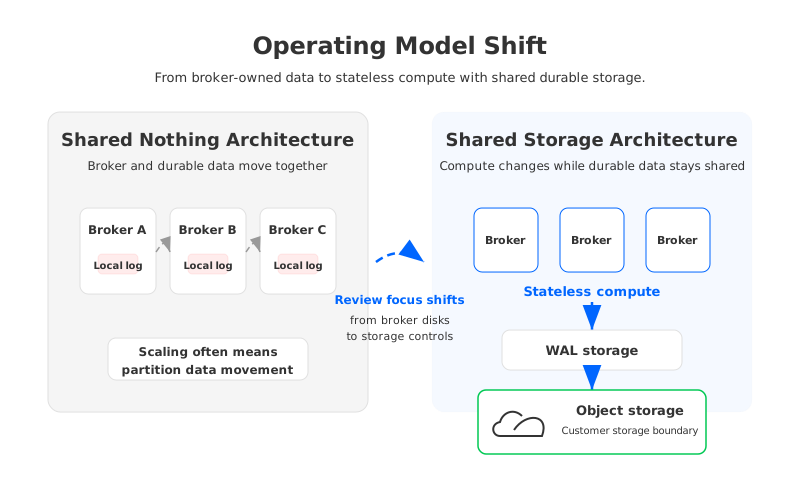
Traditional Kafka is built on Shared Nothing architecture. Each broker owns local storage for the partitions assigned to it, and replication across brokers provides durability and availability. This model is proven, but it binds compute, storage, and failure recovery together. When a broker is replaced, when partitions are rebalanced, or when capacity changes, the platform team often has to reason about data movement as well as compute placement.
That coupling becomes more visible in regulated cloud deployments. Local disks or cloud block volumes sit in specific fault domains. Replication traffic crosses brokers and, in multi-Availability Zone deployments, may cross zones. Retention expansion can require disk planning ahead of demand. Rebalancing can consume network, storage, and operator attention at the same time that the business wants a small, auditable change window.
Apache Kafka has evolved meaningfully. KRaft removes ZooKeeper from the metadata path, transactions support atomic writes across partitions, consumer groups coordinate partition assignment, and Tiered Storage can offload older log segments to remote storage. These capabilities are useful and should be part of any review. They do not automatically make brokers stateless. For regulated buyers, that distinction matters because the review is not only about where old data can be archived; it is about who controls the active data path when the cluster scales, fails, or migrates.
3Architecture Options and Trade-offs
A regulated BYOC deployment Kafka decision should start with neutral options before a vendor enters the conversation. The wrong first question is, "Which product has the longest feature list?" The better question is, "Which boundary can our organization approve, operate, and audit?" That framing makes the trade-offs visible earlier.
| Option | Data boundary | Operations model | Review pressure |
|---|---|---|---|
| Self-managed Kafka | Customer cloud account or data center | Customer owns nearly everything | Strong control, high operational burden |
| External managed service | Service provider boundary | Provider owns most cluster mechanics | Lower operations burden, harder data-plane review |
| BYOC streaming platform | Customer cloud account and network | Shared responsibility with vendor automation | Needs clear IAM, support, logging, and lifecycle evidence |
| Customer-operated software | Customer-controlled infrastructure | Customer operates with vendor-supported software | Strong boundary control, more local operations ownership |
No row is universally correct. Self-managed Kafka can satisfy strict boundary requirements, but it asks the customer to maintain deep Kafka operations expertise. A hosted service can reduce upgrade and recovery toil, but the service boundary may not fit regional, network, or evidence requirements. BYOC sits in the middle, and that is exactly why it needs a disciplined review. A vague shared-responsibility model can create the worst of both worlds: the customer carries compliance risk while the operating actions remain unclear.
The architectural check should cover three layers. The data plane is where brokers, storage, network paths, and customer event data live. The control plane is where lifecycle management, configuration, authentication, monitoring, and upgrade orchestration happen. The support plane is the human and automated path used during incidents, upgrades, and break-glass access. Regulated teams should draw all three separately because a clean data plane can still fail review if support access or telemetry export is poorly defined.
4Evaluation Checklist for Platform Teams
Start with compatibility because it is the easiest term to over-trust. Kafka compatibility should cover the wire protocol, producer behavior, consumer groups, offsets, transactions, ACLs, quotas, Admin APIs, Kafka Connect, and the monitoring integrations your teams already use. The useful test is not a brochure claim; it is a representative workload that proves clients can move without broad application rewrites.
Then examine cost and elasticity together. Exact cloud charges depend on region, traffic shape, retention, replication settings, private connectivity, and negotiated contracts, so a responsible checklist should avoid invented savings math. The practical question is whether the architecture lets your team separate the drivers: compute, durable storage, inter-zone networking, private endpoints, observability, and support. A single bundled line item may be acceptable for some buyers, but it is harder to explain in a regulated procurement review.
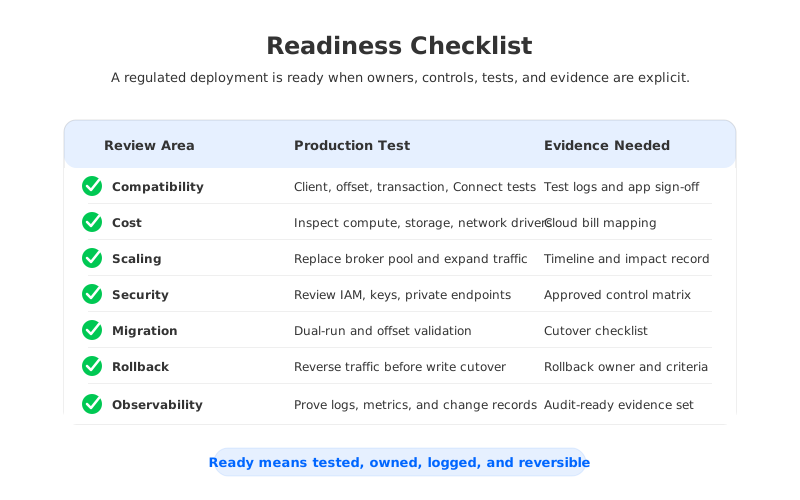
Use this checklist as a working review artifact:
- Compatibility gate: Validate producers, consumers, offsets, transactions, security settings, schema workflows, Kafka Connect jobs, and operational tooling against the target platform.
- Data residency gate: Identify the account, region, VPC or VNet, bucket, disk, key-management boundary, and log destination for data-bearing resources.
- Network gate: Document producer, consumer, connector, broker, control-plane, object-storage, private endpoint, and observability paths. A private client path is not enough if the storage or support path is public or cross-region.
- IAM gate: Review the exact roles, permissions, trust relationships, service accounts, and break-glass procedures required by the platform.
- Operations gate: Define who can scale, upgrade, isolate, restart, roll back, and restore each component, and where the action is recorded.
- Migration gate: Rehearse dual-run, offset validation, cutover order, and rollback criteria with a workload that resembles production.
- Evidence gate: Confirm that platform, security, finance, and audit teams can retrieve the evidence they need without granting broader access than the task requires.
The checklist is intentionally operational. Compliance language often collapses architecture into a binary label, but streaming systems do not fail in binary ways. A deployment can keep storage in the customer's account and still be hard to restore. A service can offer private connectivity and still leave cross-zone replication or telemetry paths under-explained. The review has passed only when the team can describe the expected behavior under scale-up, node loss, region constraint, vendor support, and rollback.
5How AutoMQ Changes the Operating Model
Once the neutral checklist is clear, AutoMQ becomes relevant as a Kafka-compatible cloud-native streaming platform built around Shared Storage architecture. AutoMQ keeps the Kafka protocol and ecosystem model that platform teams care about, but changes the storage layer underneath. Durable data is written through S3Stream to shared object storage, while AutoMQ Brokers are designed as stateless compute nodes rather than owners of broker-local persistent logs.
That architectural shift changes the evidence a regulated team can ask for. Storage ownership can align with the customer's object storage, IAM, encryption, lifecycle policy, and audit controls. Compute capacity can be changed with less dependence on broker-local data relocation. Failure recovery can focus on replacing or isolating compute while durable data remains in shared storage. The point is not that governance disappears; the point is that the governance surface becomes easier to separate into customer-owned storage, stateless compute, control actions, and observability evidence.
AutoMQ BYOC and AutoMQ Software address different deployment boundaries. In AutoMQ BYOC, the control plane and data plane run in the customer's cloud environment, and the customer retains cloud-account, network, and storage control over data-bearing resources. AutoMQ Software serves private or customer-operated environments where the organization wants the streaming platform inside its own infrastructure boundary. Both models still require review of IAM roles, support workflows, telemetry export, upgrade authority, and incident procedures. A BYOC model is not a shortcut around compliance work; it is a way to make the boundary concrete enough to review.
This is also where Shared Storage architecture differs from Tiered Storage. Tiered Storage can move older log segments to remote storage, which helps retention economics and catch-up reads. AutoMQ's Shared Storage architecture makes object storage the primary durable layer and treats brokers as stateless compute. That difference matters during scaling and recovery because the platform is no longer organized around each broker's local persistent data. For a regulated review, that is the architectural reason to ask fewer questions about partition data relocation and more questions about object storage controls, WAL storage type, metadata handling, and customer environment permissions.
6Decision Matrix for Approval
The final approval should not be a single "yes" from the platform team. It should be a matrix that assigns ownership and evidence to each risk. A red item means the answer is unknown or unacceptable. A yellow item means the answer exists but needs mitigation. A green item means the owner, control, test, and evidence are specific enough for production.
| Review area | Green signal | Red signal |
|---|---|---|
| Kafka compatibility | Representative clients pass protocol, offset, transaction, and Connect tests | "Kafka-compatible" is asserted without workload validation |
| Data boundary | Account, region, storage, keys, logs, and network paths are documented | Data-bearing resources are hidden behind a vague service boundary |
| IAM and support | Vendor and customer roles are scoped, logged, and reviewed | Support access depends on broad standing permissions |
| Elasticity | Scaling changes compute without large broker-local data relocation | Scaling depends on long partition movement or manual disk expansion |
| Cost governance | Compute, storage, network, endpoint, and support drivers are inspectable | The team cannot explain the largest cost drivers |
| Failure recovery | Node loss, storage impairment, upgrade rollback, and cutover reversal are rehearsed | Recovery exists only as an architecture diagram |
| Audit evidence | Logs, metrics, configuration, and change records are available to the right teams | Evidence requires privileged access or vendor-only systems |
This matrix also protects the team from over-correcting. Strict boundary control is valuable, but not if it forces the platform team to rebuild every Kafka operating primitive by hand. Automation is valuable, but not if it obscures data paths, permissions, or support actions. A regulated BYOC deployment is ready for approval when its trade-offs are visible before production traffic moves.
7FAQ
7.1Is BYOC the same as self-managed Kafka?
No. Self-managed Kafka means the customer operates the Kafka cluster directly. BYOC means the data-bearing resources run in a customer-controlled cloud environment, while the platform provider may still supply software, automation, lifecycle management, and support. The exact responsibility split should be reviewed in writing.
7.2Does BYOC automatically satisfy compliance requirements?
No. BYOC can make compliance evidence more concrete because storage, keys, network paths, logs, and cloud permissions can remain inside the customer's boundary. The team still has to validate access control, retention, encryption, private connectivity, observability, support access, and incident response.
7.3What should be tested before migrating production Kafka workloads?
Test the behavior your applications depend on: client compatibility, producer retries, consumer group rebalancing, offset continuity, transactions if used, ACLs, Kafka Connect jobs, monitoring, cutover order, and rollback criteria. A small synthetic workload is useful, but it should not serve as sufficient proof.
7.4How is AutoMQ different from traditional Kafka in this review?
Traditional Kafka binds brokers to local persistent data in a Shared Nothing architecture. AutoMQ uses Shared Storage architecture with stateless brokers and object-storage-backed durability, which changes the operational questions around scaling, recovery, storage ownership, and customer-controlled deployment boundaries.
If your review is stuck between managed-service convenience and infrastructure ownership, use the checklist above with the teams that will approve and operate the platform. To evaluate the customer-controlled deployment path with AutoMQ, start from the AutoMQ Cloud Console.


