
Table of Contents
Table of Contents
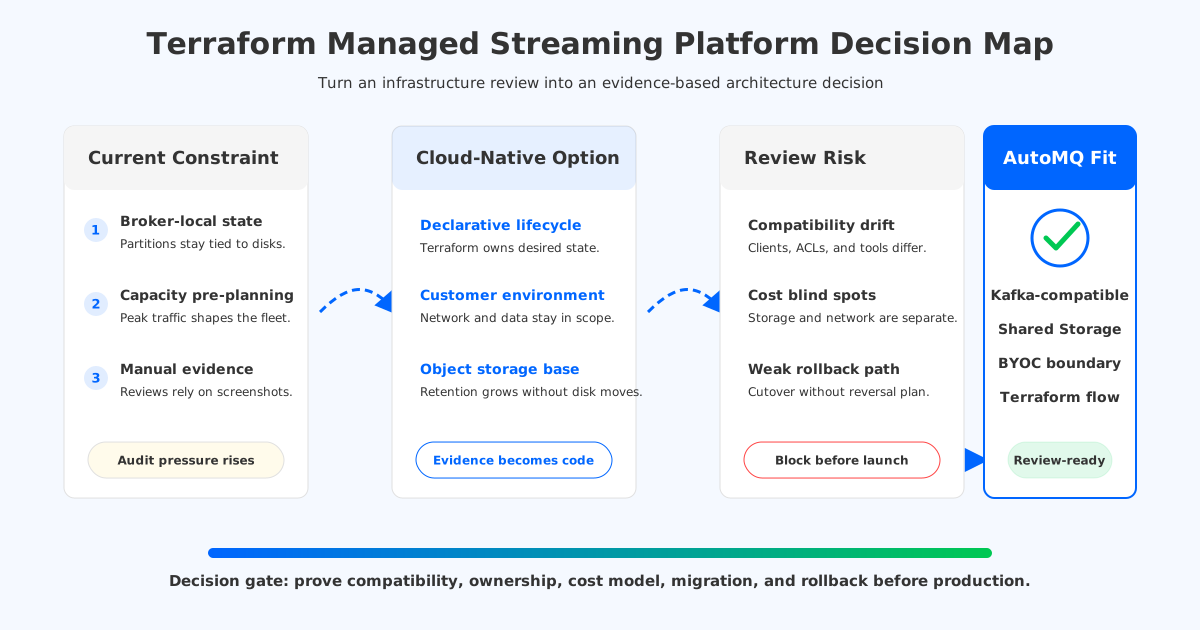
Searching for a terraform managed streaming platform usually means the Kafka conversation has moved past cluster creation. The team already knows it needs topics, access control, networking, connectors, monitoring, and repeatable deployment. What it lacks is an approval path that security, platform engineering, procurement, and application teams can all trust. Terraform turns infrastructure intent into code, but it also exposes a harder question: which parts of a streaming platform can be governed as desired state, and which still depend on manual recovery, broker-local storage, or emergency operator judgment?
That question matters more for streaming than for many infrastructure categories. A Kafka-compatible platform becomes a shared runtime for producers, consumers, stream processors, connectors, schema workflows, and incident response. A compliance review must cover more than whether a provider has a Terraform resource for a topic. It has to prove that lifecycle operations, data ownership, cost controls, failover behavior, and migration paths are reviewable before production traffic arrives.
The useful frame is not "managed or self-managed." It is whether the platform can make its operating model explicit enough to be reviewed. Terraform is the audit surface; architecture decides how much of that surface is real.
1Why teams search for terraform managed streaming platform
The search phrase often appears when a platform team is trying to eliminate an awkward split between application demand and infrastructure control. Developers want self-service Kafka resources. Security teams want least-privilege access, approved network paths, and traceable changes. Finance teams want cost forecasts that hold when retention or replay grows. Operations teams want pull requests instead of console clicks.
Terraform is attractive because it gives these groups a common artifact. A plan shows what will change, state represents what exists, modules standardize environments, and providers encode the platform resource model. Those are useful properties, but they do not automatically make a streaming system compliant or production-ready.
The gap appears when the review moves from resource creation to runtime behavior. A topic definition can be declarative while partition reassignment remains manual. An access control list can be codified while connector traffic crosses an unapproved network boundary. A cluster can be created from Terraform while retained data remains tied to broker disks that are hard to replace, resize, or rebalance.
That is why the compliance review should start with operating questions, not provider syntax:
- Who owns the data plane? The review should identify where records live, which account or VPC contains them, and which external services can reach them.
- Which operations are declarative? Cluster lifecycle, topics, users, connectors, and network dependencies should be distinguishable from manual runbooks.
- What breaks the cost model? Storage growth, cross-Availability Zone traffic, replay, connector movement, and over-provisioned brokers should be visible before approval.
- How does the platform recover? The team needs evidence for broker failure, scaling, rollback, and migration cutover, not only a Terraform
applylog.
These questions are not paperwork. They are the minimum set of signals that tell reviewers whether the platform behaves like governed infrastructure or a stateful system with a declarative wrapper.
2The production constraint behind the problem
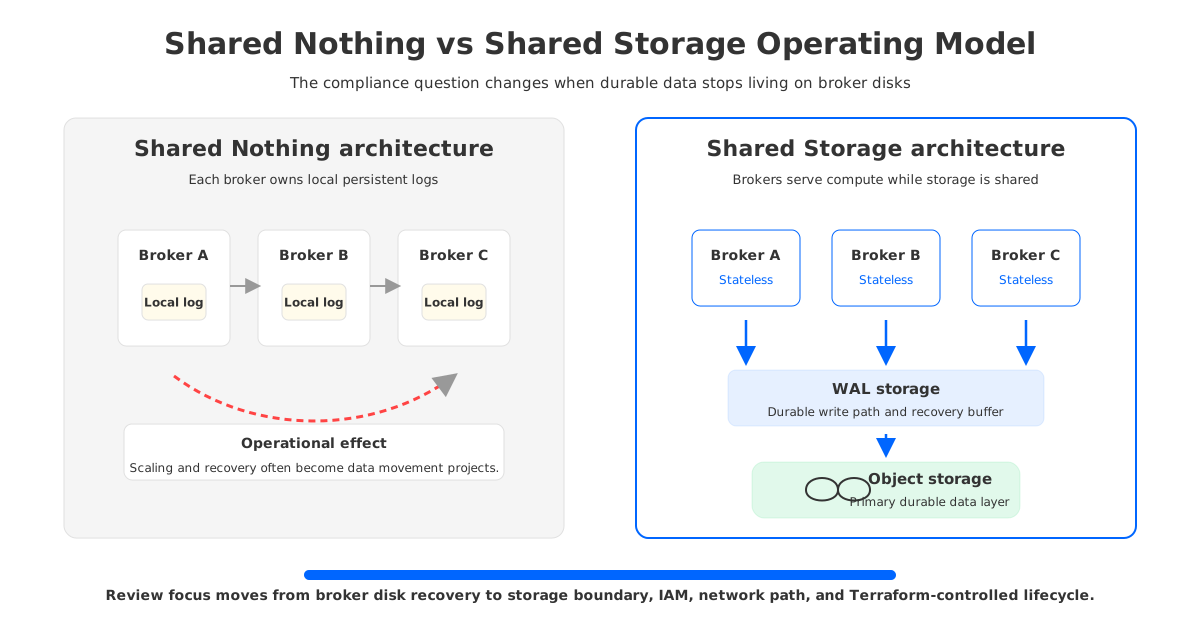
Apache Kafka®'s traditional operating model is shaped by Shared Nothing architecture. Each broker manages local persistent storage, and partitions are replicated through leader/follower relationships for durability and availability. This model has served many production environments well, and the Apache Kafka documentation still treats replication, consumer groups, offsets, transactions, KRaft metadata, and Kafka Connect as core parts of the platform contract. A Terraform review should respect that maturity rather than pretend Kafka is hard because operators lack automation.
The production constraint is more specific: broker-local storage turns many infrastructure changes into data movement. Scaling out requires partitions to be rebalanced. Replacing a node requires confidence that the cluster can recover the local state it owned. Changing storage capacity requires planning around retained log data. Multi-AZ durability usually means replicated bytes move across failure domains. Terraform can request these changes, but the underlying system still has to execute them.
That distinction is the reason compliance reviews often become slow. Security can approve an IAM policy and a subnet. Procurement can approve a subscription boundary. Platform engineering can approve a module. The hard approval is operational: whether the system can keep serving producers and consumers when the broker fleet changes, when retention grows, when a connector is added, or when a migration has to be reversed.
Tiered Storage changes part of this equation by moving older log segments to object storage, and it can be valuable for long retention. It does not remove the need to reason about the hot storage layer, partition ownership, and the broker-local operational path. For teams evaluating a Terraform managed streaming platform, the key question is whether object storage is an archive tier or the primary durable foundation of the platform.
3Architecture options and trade-offs
The neutral evaluation should compare operating models before feature lists. A self-managed Kafka deployment gives maximum control, but makes the platform team responsible for every broker, disk, rebalance, upgrade, and incident. A fully managed external service can reduce operational work, but may move the data plane, control plane, or network trust boundary outside the customer's environment. A BYOC model can bring management convenience into the customer's cloud account, but still has to prove how storage, scaling, and support access work.
The trade-off becomes clearer when you separate the review into four layers:
| Layer | What reviewers need to know | Failure mode if ignored |
|---|---|---|
| Kafka contract | Client compatibility, topic behavior, Consumer group handling, offset semantics, transactions, and Kafka Connect integration | Applications pass simple tests but fail under real client or ecosystem behavior |
| Infrastructure ownership | VPC or Virtual Private Cloud boundary, IAM roles, service accounts, object storage, network endpoints, and support access | Data or operational access crosses an unapproved boundary |
| Runtime elasticity | Broker replacement, scaling, partition movement, retained data growth, and replay behavior | Terraform can create resources, but production operations still require risky manual work |
| Migration and rollback | Topic inventory, offset preservation, producer cutover, consumer switchover, dual-run evidence, and reversal owner | The team can move forward but cannot safely move back |
The point is not to force one architecture on every team. It is to keep reviewers from treating all managed streaming platforms as equivalent. A Terraform provider can manage resources only after the platform exposes a stable resource model. A compliance review has to decide whether that model maps to what matters in production.
4Evaluation checklist for platform teams
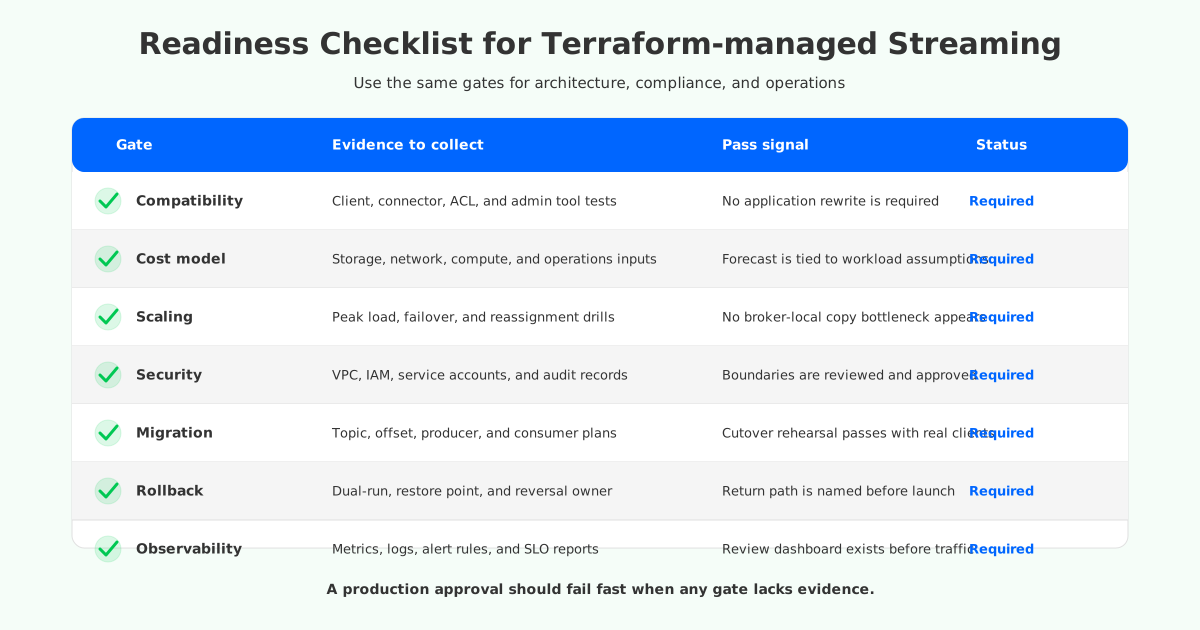
The first checklist item is Kafka compatibility. Do not stop at "Kafka-compatible" as a label. Test the client versions, authentication modes, admin tooling, serializers, schema workflows, connector tasks, stream processors, and monitoring integrations production uses. Apache Kafka concepts such as Consumer groups, offsets, transactions, KRaft, and Kafka Connect should become explicit test cases.
The second item is Terraform scope. Review which resources the provider can manage and which remain outside code. Topics, users, service accounts, connectors, clusters, and instance settings carry different blast radii. A mature module should include naming conventions, environment separation, state backend controls, secret handling, and drift detection. It should also document what Terraform must not own.
Cost review should come before procurement finalization, not after the first bill. Kafka cost is rarely one line. It includes compute, storage, object storage API behavior, cross-AZ or inter-zone traffic, PrivateLink or VPC endpoint usage, connector compute, observability, and operational labor. Avoid unsupported savings claims during approval. Instead, build a workload-specific model that names write throughput, read fanout, retention, peak traffic, replay patterns, number of partitions, and deployment region. When a number is not backed by official pricing or measured workload data, treat it as an assumption.
Security review should draw two diagrams: data path and management path. The data path shows producers, brokers, consumers, connectors, object storage, WAL storage, and application dependencies. The management path shows Terraform, service accounts, control plane services, support access, metrics, logs, and audit records. These diagrams should not be collapsed into a single "platform" box. The review has to show whether customer records stay in the customer's environment, which metadata or telemetry leaves that environment, and how temporary access is approved.
Migration review needs the same discipline. The team should inventory topics, partitions, retention settings, ACLs, connector tasks, schemas, client versions, and Consumer groups before choosing a cutover method. It should define how producers switch, how consumers resume from the intended offsets, how long dual-run validation lasts, and what event triggers rollback. A migration plan without rollback is not a plan; it is a bet with a change ticket attached.
Observability closes the loop. Terraform can create the infrastructure, but the platform still needs live signals: broker health, request latency, produce and fetch throughput, Consumer lag, object storage access, WAL health, connector task state, failed authentication, and quota pressure. The compliance review should require dashboards and alert rules before production traffic, because the first incident is a poor time to decide which metrics matter.
5How AutoMQ changes the operating model
Once the evaluation framework is clear, a shared-storage Kafka-compatible architecture becomes easier to judge on its merits. AutoMQ is a Kafka-compatible streaming platform that replaces Kafka's broker-local log storage with S3Stream, a storage layer built around WAL storage and S3-compatible object storage. The important review point is not that the word "managed" appears in the product description. It is that durable stream data is no longer bound to individual broker disks in the same way.
In AutoMQ's Shared Storage architecture, brokers are stateless with respect to persistent stream data. WAL storage provides the durable write path and recovery buffer, while object storage acts as the primary durable data layer. This changes the operating model behind Terraform-managed lifecycle actions. Scaling and broker replacement are less dependent on copying partition data from one broker's local disk to another. Partition reassignment becomes more about ownership, metadata, and traffic distribution than bulk log movement.
For compliance review, that architecture has several practical consequences. Data ownership can be evaluated against object storage buckets, VPC networking, WAL storage choices, and customer cloud boundaries. Operational access can be separated from business records, with metrics and logs treated differently from Kafka records. Cost review can focus on the actual workload drivers: compute, object storage, WAL storage, endpoint usage, and network routing. Migration review can test Kafka protocol behavior while also validating that the target runtime is not inheriting the same broker-local storage constraints.
AutoMQ BYOC is especially relevant when the procurement and security question is customer-owned deployment. In an AutoMQ BYOC environment, the console and data plane run inside the customer's cloud environment, and AutoMQ documentation describes using service accounts for API and Terraform access. On AWS, the BYOC setup requires VPC preparation, private networking components such as S3 gateway endpoints, and an environment console deployed in the customer's account before Terraform-managed usage. Those details give reviewers concrete artifacts: VPC design, IAM policies, service account handling, object storage boundaries, and operational authorization.
AutoMQ Software addresses a different boundary: private data centers or self-operated environments where the customer wants software and support rather than cloud BYOC. The compliance review should not blur these models. BYOC review asks how the platform runs inside a customer cloud account. Software review asks how the customer operates the platform in its own environment.
The product fit should still be tested rather than assumed. A serious proof of concept should include existing Kafka clients, topic administration, Consumer group behavior, connector workflows, planned authentication modes, replay, broker replacement, scaling, observability, and migration rehearsals. The value of a Terraform managed streaming platform is strongest when these tests become repeatable evidence instead of a one-time demo.
6FAQ
6.1What is a Terraform managed streaming platform?
A Terraform managed streaming platform is a Kafka-compatible or event streaming system whose infrastructure and platform resources can be managed through Terraform. The term should include more than cluster creation. A production review should include topics, identities, network dependencies, connectors, lifecycle operations, state management, drift detection, and the operational boundaries around data and support access.
6.2Is Terraform enough for Kafka compliance?
No. Terraform gives reviewers a declarative control surface, but compliance depends on the platform's architecture and operating evidence. You still need compatibility testing, network review, IAM review, cost modeling, migration planning, rollback design, observability, and incident runbooks.
6.3Why does broker-local storage matter in a Terraform review?
Broker-local storage matters because many lifecycle changes become data movement. Scaling, recovery, and reassignment can remain operationally heavy even when the desired change is declared in Terraform. A shared-storage design changes that review because persistent data is not tied to a specific broker's local disk in the same way.
6.4Where should AutoMQ enter the evaluation?
AutoMQ should enter after the team has defined the review gates. It is relevant when the team wants Kafka compatibility, Terraform-managed lifecycle operations, customer-controlled deployment boundaries, and Shared Storage architecture with stateless brokers. It should still be validated against the team's real clients, security model, workload shape, and migration plan.
6.5What should be in the first proof of concept?
Start with the hardest production path, not the easiest demo. Include one write-heavy workload, one replay or catch-up workload, the real authentication mode, at least one connector workflow, Terraform-driven resource creation, broker replacement, scaling, dashboard validation, and a documented rollback path.
7Closing checklist
The search that began with terraform managed streaming platform should end with a review packet, not a vendor comparison spreadsheet. That packet should show the desired state, the real runtime behavior, the ownership boundary, the cost assumptions, and the migration path. If those artifacts are missing, Terraform is only automating the front door.
If your team is evaluating a Kafka-compatible platform with customer-controlled deployment boundaries, review AutoMQ's architecture and run a proof of concept against your real workload. Start with the AutoMQ GitHub repository or discuss a BYOC evaluation path with the AutoMQ team at go.automq.com/home.


