
Table of Contents
Table of Contents
AWS-first teams often adopt Confluent Cloud for a good reason: it removes much of the undifferentiated Kafka work. Provisioning, broker operations, upgrades, and ecosystem services are no small burden when platform teams are already responsible for Kubernetes, IAM, data platforms, incident response, and audit requests. The tension appears later, when the same team has to explain where Kafka records live, which account owns the storage layer, how private connectivity is enforced, and why the monthly bill moves the way it does.
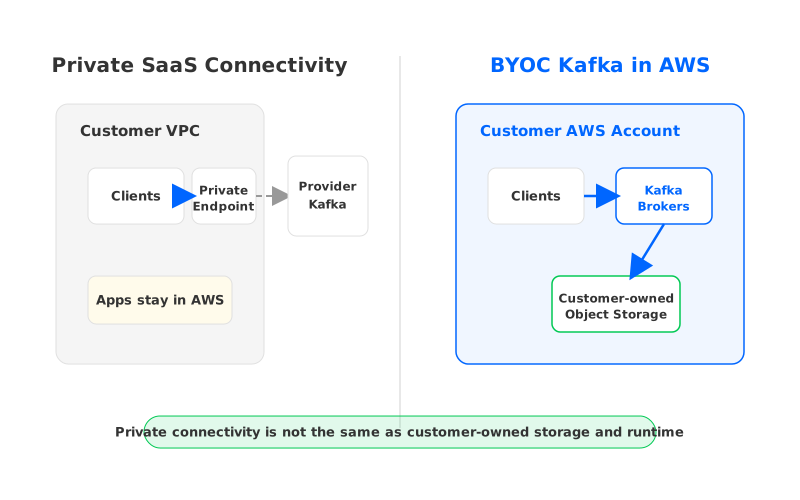
That tension is not a criticism of Confluent Cloud. Confluent documents several AWS networking options, including public connectivity, VPC peering, Transit Gateway, PrivateLink, and Private Network Interface depending on cluster type and service support. PrivateLink can keep client connectivity off public endpoints for supported configurations, but it does not make every part of the Kafka service run inside the customer's AWS account. For some enterprises, that distinction is the entire evaluation.
The search for a Confluent alternative in AWS usually starts with one of three constraints:
- Security architecture requires the Kafka data plane, storage buckets, keys, routes, and observability exports to stay under customer-owned AWS accounts.
- Platform engineering wants a managed Kafka operating model, but not a SaaS data plane that is separated from the rest of the workload VPCs by provider-managed infrastructure.
- Finance and SRE teams need to reason about infrastructure costs using familiar AWS primitives such as EC2, VPC endpoints, S3, IAM roles, CloudTrail, and private route tables.
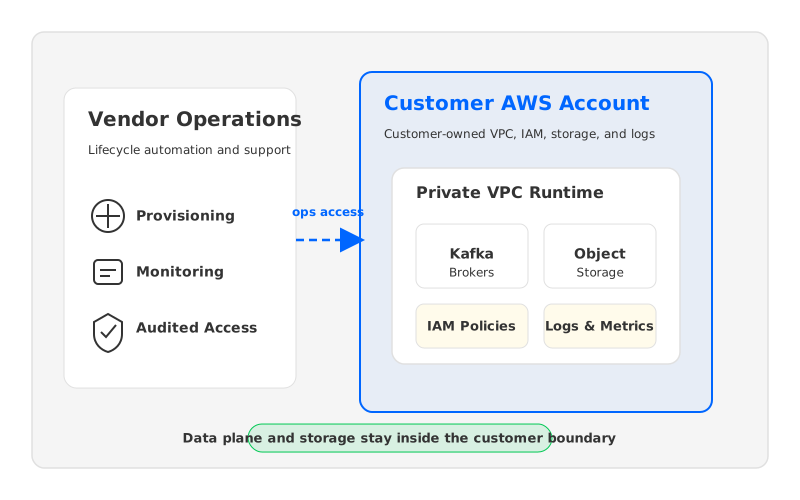
BYOC Kafka sits between fully managed SaaS and self-managed Kafka. It is not a magic phrase for "no operations." It is a responsibility model: the vendor automates deployment and lifecycle tasks, while the runtime infrastructure and data path remain in the customer's cloud environment.
1Why AWS Teams Look Beyond Confluent Cloud
The first question is rarely "Can Confluent Cloud be private?" Confluent Cloud has mature private networking options. Its AWS PrivateLink documentation describes a secure one-way connection from a customer VPC to Confluent Cloud for supported Dedicated clusters, including the need to create PrivateLink access, provision endpoints in AWS, configure DNS records, and test broker connectivity. Its broader networking overview also notes that private networking changes access patterns and requires teams to manage linked or peered networks.
The sharper question is: what does private mean in your risk model? A PrivateLink path can make connectivity private, while the service itself can still be operated in a provider account. A BYOC model changes the resource boundary. The Kafka brokers, storage, VPC endpoints, security groups, route tables, logs, and metrics collection points are evaluated as resources in your account, not as opaque provider-side infrastructure reached through private connectivity.
That matters when security review is organized around AWS-native control points. An architect can ask whether the Kafka service uses customer-owned S3 buckets, whether IAM policies follow least privilege, whether bucket policies restrict access by principal or VPC endpoint, whether KMS key usage is visible, and whether network traffic can be inspected through VPC Flow Logs. Those questions are easier to answer when the runtime resources are part of the same AWS estate as the applications producing and consuming Kafka records.
The same boundary matters for cost analysis. A SaaS Kafka bill may be understandable from a service perspective, but AWS teams often want to map spend back to the infrastructure mechanisms they already manage: endpoint hours, per-GB endpoint processing, inter-AZ traffic, object storage requests, compute scaling, and log retention. A BYOC deployment does not eliminate cost complexity; it makes more of that complexity visible in the customer's cloud bill and infrastructure telemetry.
2What BYOC Kafka Really Means
BYOC is often misunderstood as "managed Kafka, but installed in my account." That description is directionally useful, but too thin for a serious platform decision. The useful version separates the control plane, data plane, and resource ownership model.
The control plane is the management surface: cluster creation, version upgrades, configuration changes, observability views, alerting workflows, and support access. The data plane is where Kafka clients connect, where records are written and read, where broker processes run, and where durable storage is attached. A BYOC architecture should make the boundary between these two planes explicit, because every security and compliance review eventually asks who can reach each plane and under what conditions.
For AWS teams, the minimum BYOC evaluation should cover these concrete ownership questions:
- Network ownership: Which VPC hosts the Kafka endpoints, and are producers and consumers reaching those endpoints through private routes?
- Storage ownership: Which AWS account owns the buckets or volumes that hold Kafka records, logs, metadata, and diagnostic data?
- Identity ownership: Which IAM roles are assumed by the service, and can the policies be scoped to specific buckets, endpoints, and actions?
- Operations authorization: What access does the vendor need for monitoring, upgrade, and emergency support, and can that access be audited or revoked?
- Failure ownership: During an incident, which parts of the recovery path are automated by the vendor, and which parts remain under the customer's AWS operations team?
This is why BYOC is not equivalent to running vanilla Kafka on EC2. Self-managed Kafka gives you maximum infrastructure control, but it also hands you broker sizing, disk expansion, rebalancing, patching, controller health, security hardening, and on-call ownership. BYOC is useful when it preserves enough managed experience to reduce operational load while moving the right data and resource boundaries into your account.
3Evaluation Criteria for a BYOC Confluent Alternative
A Confluent Cloud alternative for AWS teams should be evaluated through architecture, not a feature checklist alone. Kafka compatibility is necessary, but compatibility is table stakes. The harder question is whether the platform behaves naturally inside AWS security, network, and cost models.
| Evaluation area | What to verify | Why it matters |
|---|---|---|
| Kafka compatibility | Kafka protocol support, client compatibility, Admin API behavior, topic operations, consumer group semantics | Migration risk concentrates at client behavior and operational APIs. |
| Private data path | Broker endpoints, storage access, VPC endpoints, DNS, routing, and security groups | Private connectivity should be visible and enforceable in your AWS network model. |
| IAM scope | Role trust policies, least-privilege permissions, bucket-level policies, and access review process | Over-broad IAM turns BYOC into shared risk rather than controlled delegation. |
| Storage model | Whether records live on broker-attached disks, cloud block storage, or customer-owned object storage | Storage ownership influences durability, scaling, cost, and audit evidence. |
| Observability | Logs, metrics, alert routing, diagnostic exports, and support access | SRE teams need enough signal without granting open-ended access to data. |
| Upgrade and rollback | Version management, maintenance windows, compatibility guarantees, and rollback path | Managed experience is measured during change, not during initial provisioning. |
This table should be read as a design review template. A platform can score well on one row and poorly on another. For example, a service may provide excellent PrivateLink connectivity but still keep storage in a provider account. Another platform may deploy in your VPC but require broad IAM permissions or create operational blind spots. The point is not to find a label that says BYOC; the point is to verify the boundary.
Compliance should be treated the same way. Do not start with certification labels. Start with evidence: where records are stored, how access is authorized, how encryption is configured, which logs exist, and how the environment is segmented. Certifications and attestations may support procurement, but they do not replace architecture review.
4How AutoMQ Runs Kafka-Compatible Workloads in Customer Cloud
Once the evaluation moves from labels to boundaries, AutoMQ becomes relevant as a Kafka-compatible BYOC option built around customer cloud deployment and object storage. In AutoMQ Cloud BYOC, the environment is deployed into the user's cloud account and VPC, with the Kafka data plane accessed privately. AutoMQ documentation describes BYOC environments where the control plane system and data plane system are deployed in the user-defined network environment, and AWS preparation guidance states that all components of the BYOC environment are deployed within the customer's AWS account.
The architectural difference is the storage model. Traditional Kafka couples broker compute with local or attached storage, so scaling, recovery, and rebalancing are tied to moving partitions across broker disks. AutoMQ redesigns the Kafka storage layer around cloud object storage while keeping Kafka protocol compatibility for clients. In an AWS BYOC deployment, that means customer-owned cloud resources can include the network, compute layer, object storage, IAM policies, and private endpoints that form the Kafka runtime.
For security architects, the interesting point is not that object storage is fashionable. The point is that object storage gives the organization a native AWS control surface for data ownership. S3 bucket policies, IAM conditions, encryption settings, VPC endpoints, CloudTrail events, and account-level controls become part of the Kafka architecture review. AutoMQ's BYOC model uses that cloud-native boundary rather than asking teams to treat Kafka durability as a black box behind provider-owned infrastructure.
For platform engineers, the practical benefit is different. They want Kafka clients to keep working, but they also want fewer broker-storage operations. Decoupling compute from durable storage changes how capacity planning feels: broker resources can be reasoned about more as compute and network capacity, while historical data lives in object storage. That does not remove the need for SRE practice, load testing, quota planning, or incident drills. It does make the operational surface more aligned with how AWS teams already manage elastic infrastructure.
This is the natural place to compare AutoMQ with Confluent Cloud. Confluent Cloud is a strong managed data streaming platform with its own ecosystem, managed connectors, Schema Registry, Flink, Cluster Linking, and mature private networking options. AutoMQ is more focused on Kafka-compatible streaming infrastructure where the runtime and data path can sit inside the customer's cloud environment. The right answer depends on which control boundary your organization values more.
5Decision Checklist for AWS Platform Teams
Before shortlisting any Confluent alternative, write down the non-negotiables. This keeps the evaluation from drifting into broad platform preference debates. A CTO may care about vendor concentration and migration risk. A security architect may care about data residency, access evidence, and IAM boundaries. An SRE may care about noisy operational ownership. A platform engineer may care about Kafka client behavior, Terraform workflows, and day-two upgrades.
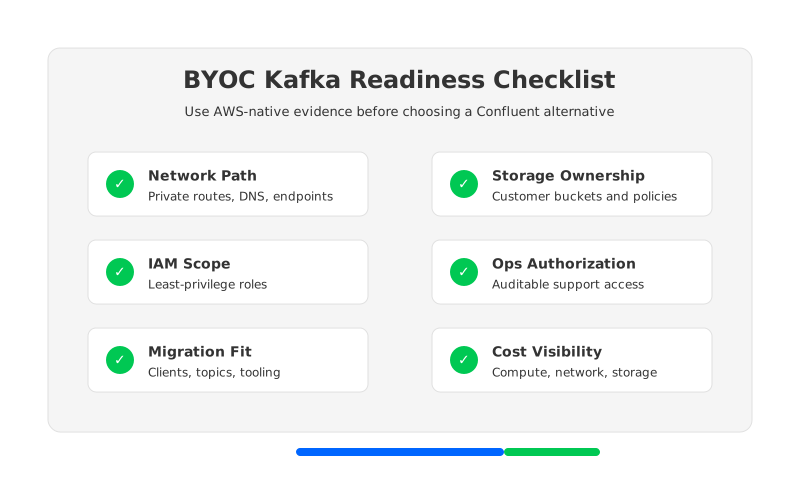
Use these questions as a working checklist:
- Can the Kafka data plane run in the AWS account and VPC selected by your platform team?
- Are Kafka records stored in resources owned by your organization, such as customer-controlled object storage?
- Does the network path avoid public broker endpoints for production clients?
- Can IAM permissions be constrained to specific resources and audited through AWS-native tooling?
- Are logs, metrics, and diagnostic data separated from application records and governed by explicit authorization?
- Does the vendor provide managed lifecycle operations without requiring unrestricted access to your environment?
- Can your existing Kafka clients, producer configurations, consumer groups, and operational tools migrate with limited change?
- Is the cost model visible enough to map spend back to compute, network, storage, and endpoint usage?
The checklist also tells you when BYOC may not be the right fit. If your team wants the broadest managed streaming ecosystem and is comfortable with provider-side data plane ownership, Confluent Cloud may remain the more complete platform. If your team has no appetite to own cloud account preparation, IAM review, VPC endpoint setup, and environment-level guardrails, a BYOC model may feel heavier than expected. If you need complete offline control in a private data center, BYOC in public cloud is not the same as self-managed software in an isolated environment.
The strongest BYOC cases tend to appear where AWS is already the center of gravity. Application VPCs, identity controls, security logging, key management, procurement, and FinOps processes already live there. In that setting, keeping Kafka records and runtime resources inside the same cloud boundary can reduce review friction and make incident response more concrete.
If your AWS review is already centered on VPC boundaries, IAM scope, and customer-owned storage, the next useful step is to test those assumptions against a real deployment model. You can review AutoMQ's BYOC approach through the AutoMQ technical materials and map it against your own network, identity, and storage controls.
6References
- Confluent Cloud networking overview
- Confluent Cloud AWS PrivateLink overview
- Use AWS PrivateLink for Dedicated clusters on Confluent Cloud
- AWS PrivateLink documentation
- What is AWS PrivateLink?
- Access AWS services through AWS PrivateLink
- AWS IAM policies and permissions
- Amazon S3 encryption documentation
- AutoMQ Cloud environment overview
- What is AutoMQ Cloud
- Prepare VPC for AutoMQ BYOC on AWS
- AutoMQ object storage configuration
7FAQ
7.1Is BYOC Kafka the same as self-managed Kafka?
No. Self-managed Kafka usually means your team owns the full operational lifecycle. BYOC Kafka means the runtime resources are deployed in your cloud account, while the vendor may still automate provisioning, monitoring, upgrades, and recovery workflows. The exact split must be verified for each provider.
7.2Does AWS PrivateLink mean Kafka data is stored in my AWS account?
No. PrivateLink is a networking mechanism. It can provide private connectivity between a VPC and a supported service, but it does not by itself define who owns the service runtime or storage layer. Storage ownership must be checked separately.
7.3When should an AWS team evaluate AutoMQ?
Evaluate AutoMQ when Kafka compatibility matters, but your security or platform architecture requires the data path, cloud resources, and object storage layer to run in your AWS account and VPC. It is especially relevant when the team wants managed operations without moving Kafka records into provider-owned infrastructure.
7.4Can BYOC replace compliance review?
No. BYOC is an architecture and responsibility model, not a compliance guarantee. Treat it as an input to review: network topology, IAM scope, encryption configuration, log access, support authorization, and evidence collection still need to be validated against your internal controls.


