
Table of Contents
Table of Contents
Teams rarely search for confluent alternatives because they have lost interest in Kafka. They search because Kafka has become too important to evaluate as a single product decision. A streaming platform now touches application SLAs, cloud networking, security controls, procurement terms, disaster recovery, and the operating model of the data team. Confluent Cloud is a mature managed streaming platform with a broad ecosystem, so an alternative search usually means the team is moving from vendor discovery into architecture due diligence.
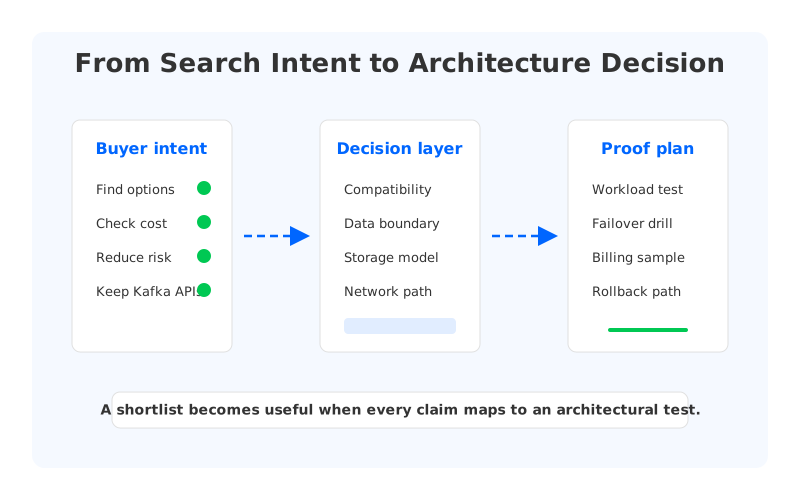
That distinction matters. A shortlist built from product names can help a buyer find the market, but it does not tell an architect whether a platform fits the workload. The real question is not "Which vendor looks closest to Confluent?" The harder question is "Which architecture gives us Kafka semantics, predictable cost, a migration path, and operational control under our failure model?"
1Why teams search for confluent alternatives
The search usually starts after the team has already accepted Kafka as the application interface. Producers, consumers, Kafka Connect jobs, stream processors, schema workflows, and operational playbooks are already built around Kafka APIs. Replacing that interface would be expensive, so the first filter is compatibility: can existing clients, tools, and workloads move without rewriting the application estate?
Once compatibility is on the table, the next pressure is usually ownership. A fully managed platform can reduce operational load, but it also defines where data flows, which network paths are billable, how private connectivity works, what features are packaged together, and which controls remain in the customer's cloud account. Those details become more visible as Kafka usage grows from a few teams into a shared production platform.
Cost is the third trigger, but it is often misunderstood. Kafka platform cost is not only broker runtime or a published service tier. It includes retained storage, replicated writes, consumer fan-out, private networking, cross-zone or cross-region transfer, observability, support, and the people needed to keep the platform balanced. A lower line item in one category can be offset by a higher cost in another.
Procurement also plays a role. Some teams want managed governance, connectors, stream processing, and commercial support in one platform. Others want a Kafka-compatible data plane that runs inside their own cloud boundary. Both positions can be valid. The mistake is evaluating them with the same scorecard.
2What shortlists cover and where they stay shallow
Most alternative shortlists are useful at the beginning of evaluation. They surface categories: managed Kafka services, cloud-provider services such as Amazon MSK, Kafka-compatible engines, self-managed Apache Kafka, and platforms that combine Kafka APIs with broader data-streaming capabilities. They also help non-specialists learn which names appear frequently in the market.
The shallow part is that product discovery compresses architecture into labels. "Managed" can mean different things depending on whether the control plane, data plane, and customer data run inside the vendor environment or the customer's VPC. "Kafka-compatible" can mean protocol-level compatibility, ecosystem compatibility, or a narrower implementation that works for common produce and consume paths but needs deeper validation for transactions, ACLs, quota behavior, compaction, connectors, and operational tooling.
The same issue appears in cost comparisons. A row for "pricing" rarely captures the mechanics that drive cost at scale. Traditional Kafka replication writes data across brokers for durability and availability. In a multi-AZ cloud deployment, that replication can create network transfer that the application team did not model during early adoption. Tiered storage can reduce long-retention disk pressure, but it does not automatically remove the primary storage and replication behavior that still serves hot data.
So a shortlist is a starting point, not a decision artifact. Platform teams need a second pass that translates each vendor or service into architectural properties.
3Architecture criteria behind the shortlist
A practical evaluation begins with the invariants. The team should decide which Kafka behaviors are non-negotiable before discussing feature packaging. Apache Kafka's public documentation is the baseline for semantics such as topics, partitions, producers, consumers, consumer groups, replication, authorization, and transactions. If an alternative keeps the Kafka API but changes operational behavior under failure, the team needs to know that before migration.
The next layer is storage architecture. This is where alternatives diverge most sharply:
| Evaluation axis | What to inspect | Why it changes the decision |
|---|---|---|
| Kafka semantics | Client versions, transactions, idempotent producers, consumer groups, ACLs, compaction, quotas, Connect and Streams behavior | Application compatibility depends on edge cases, not only basic produce and consume tests |
| Data ownership | Where the data plane runs, who owns the storage account, how keys and IAM are managed | Security and compliance teams care about the physical and administrative boundary |
| Storage model | Local disk, cloud block storage, tiered object storage, or object storage as primary storage | Storage model drives elasticity, recovery, and the amount of data moved during scaling |
| Network path | Client-to-broker routing, broker replication, private connectivity, cross-AZ and cross-region traffic | Network cost and fault isolation often become visible only after scale |
| Operations | Partition reassignment, broker replacement, balancing, upgrades, observability, support workflows | The platform's real cost includes human intervention and change windows |
This table is deliberately architectural rather than vendor-branded. Confluent Cloud, Amazon MSK, self-managed Kafka, Redpanda, Aiven, AutoMQ, and other choices can all be discussed respectfully inside these axes. The goal is not to declare a universal winner. It is to make the hidden trade-offs visible enough that the right option for one organization does not become a poor fit for another.
4Cost needs a data-plane model, not a pricing screenshot
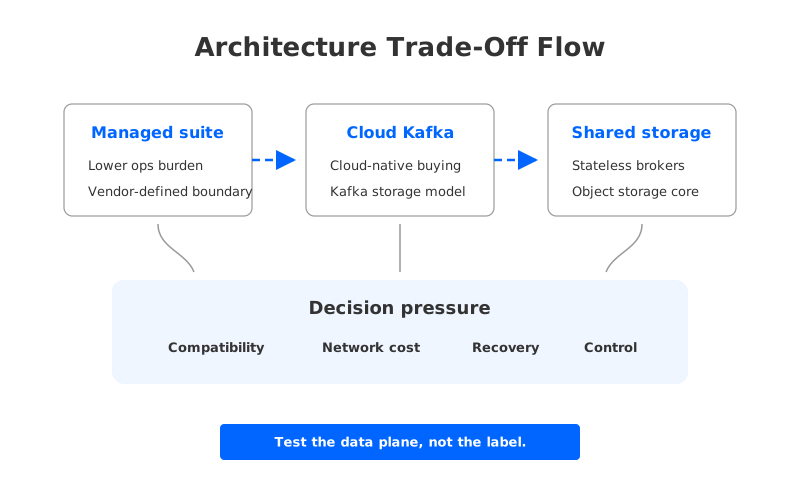
Kafka cost analysis breaks down when it treats all bytes as equal. A byte written by a producer can turn into several internal movements before it is durable, replicated, retained, and consumed. In traditional Kafka, replication and partition placement are part of the application-layer storage model. In a cloud environment, those movements may cross Availability Zones or interact with block storage pricing.
AWS publishes separate guidance for data transfer patterns, and Amazon MSK has its own pricing dimensions for broker instances, storage, provisioned throughput, and related networking choices. Those pages are necessary inputs, but they do not replace a workload model. A team should estimate at least four flows: producer ingress, broker-to-broker replication, consumer egress, and operational movement from reassignment, recovery, or migration.
Tiered storage deserves a specific note because it is easy to over-credit. Apache Kafka's KIP-405 introduced tiered storage to offload older log segments to remote storage. That is valuable for long retention and storage management, but it is different from making brokers stateless. Hot data, leader placement, replication, and operational behavior still need to be evaluated in the actual implementation and version the team will run. Diskless topics, discussed in KIP-1150, point to a different architectural direction: removing local disk dependence more directly.
The useful question is not "Does the platform use object storage?" It is "What role does object storage play?" Secondary remote storage, primary shared storage, and backup storage produce different failure recovery, latency, and cost profiles.
5Migration and ownership questions for platform teams
Migration risk is where broad shortlists become real. A Kafka platform migration touches client bootstrap configuration, authentication, authorization, topic configuration, consumer lag, connector offsets, monitoring, incident response, and rollback. The safest plan is boring on purpose: prove compatibility first, move traffic gradually, and keep an exit path until production behavior is measured.
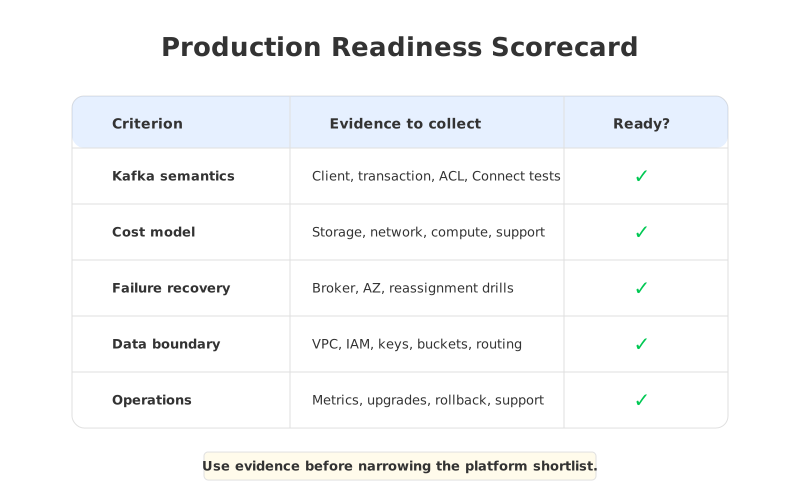
Before committing to a target platform, platform owners should answer a small set of ownership questions:
- Where does the data plane run, and who controls the account, VPC, buckets, disks, keys, and network paths?
- Which Kafka API versions and ecosystem components are validated for the workloads that matter, including Connect, Streams, MirrorMaker, Schema Registry, and transaction-heavy clients?
- What happens when a broker or AZ fails? Look for the actual recovery path, not only the availability claim.
- How long does partition reassignment take under expected data volume, and how much data has to move?
- Which metrics and logs are available to the operations team, and can they be exported into the existing observability stack?
- What is the rollback plan if consumer lag, authorization behavior, or connector offsets do not match expectations?
These questions often separate "compatible enough for a demo" from "compatible enough for a platform." They also help buyers compare managed convenience against infrastructure control without turning the discussion into a religious debate.
6How AutoMQ fits the evaluation
AutoMQ belongs in this conversation as a Kafka-compatible, cloud-native streaming platform built around shared storage. Its design keeps the Kafka protocol and upper-layer ecosystem as the interface while replacing the traditional broker-local log storage layer with S3Stream, a storage layer backed by object storage plus a WAL for write durability and recovery. In practical terms, the evaluation point is not "another Kafka-like API." It is a different data-plane architecture for teams that want Kafka compatibility with more elastic storage and broker operations.
This matters most when the shortlist is blocked by cloud operating costs or scaling windows. In a shared-storage architecture, brokers do not own durable partition data in the same way local-disk Kafka brokers do. Durable data is stored in shared object storage, while brokers handle compute, protocol processing, caching, and leadership. That changes the mechanics of broker replacement, partition reassignment, and balancing because the system can move ownership and traffic without copying the full retained log from one broker disk to another.
AutoMQ also addresses a common cloud cost concern: cross-AZ traffic. Its public documentation describes a design that avoids cross-AZ produce, replication, and consume traffic by combining S3-based shared storage with same-AZ client routing and read-only partitions. The important caveat is that teams should validate the required configuration and deployment model for their environment. Network cost claims should always be tested against cloud billing data, not accepted as a slogan.
The product fit is strongest when a team wants Kafka protocol compatibility, object-storage-backed durability, independent compute and storage scaling, and deployment options such as BYOC or software inside the customer's environment. It may not be the first answer for every team. If an organization wants a broad, fully hosted event-streaming suite with managed governance and stream processing packaged as one service, Confluent Cloud may remain a strong candidate. If the team wants a cloud-provider-managed Kafka service with AWS-native procurement and operational integration, Amazon MSK deserves serious evaluation. The architecture lens helps make that choice explicit.
7A practical shortlist worksheet
A useful final shortlist should be small enough to test. Three candidates are usually enough: the incumbent or default managed platform, a cloud-provider service, and one architecture-shifting option. For each candidate, create a one-page worksheet that maps claims to evidence.
The worksheet should include workload shape, Kafka features used, retention profile, peak and baseline throughput, consumer fan-out, network topology, private connectivity, operational staffing, and migration constraints. It should also include a small proof plan: one representative producer, one transaction or idempotence scenario if used, one connector, one consumer group with lag, one authorization policy, one failover test, and one cost sample from a real cloud bill.
This is slower than reading a list, but it is faster than choosing the wrong data plane. The strongest alternative is the one whose architecture still makes sense when the first incident, scale event, audit request, and renewal discussion arrive.
For teams evaluating whether shared-storage Kafka compatibility belongs on the shortlist, the next step is to review AutoMQ's architecture and compatibility details in the docs: Explore AutoMQ for Kafka-compatible cloud-native streaming.
8References
- Apache Kafka documentation: https://kafka.apache.org/documentation/
- Apache Kafka KIP-405: Kafka Tiered Storage: https://cwiki.apache.org/confluence/display/KAFKA/KIP-405%3A+Kafka+Tiered+Storage
- Apache Kafka KIP-1150: Diskless Topics: https://cwiki.apache.org/confluence/display/KAFKA/KIP-1150%3A+Diskless+Topics
- AWS Architecture Blog, Data Transfer Costs for Common Architectures: https://aws.amazon.com/blogs/architecture/overview-of-data-transfer-costs-for-common-architectures/
- Amazon MSK pricing: https://aws.amazon.com/msk/pricing/
- AWS documentation for multi-VPC private connectivity for Amazon MSK: https://docs.aws.amazon.com/msk/latest/developerguide/aws-access-mult-vpc.html
- Confluent Cloud documentation overview: https://docs.confluent.io/cloud/current/overview.html
- Confluent Cloud cluster types documentation: https://docs.confluent.io/cloud/current/clusters/cluster-types.html
- AutoMQ architecture overview: https://docs.automq.com/automq/architecture/overview?utm_source=blog&utm_medium=reference&utm_campaign=gs100-0021
- AutoMQ compatibility with Apache Kafka: https://docs.automq.com/automq/what-is-automq/compatibility-with-apache-kafka?utm_source=blog&utm_medium=reference&utm_campaign=gs100-0021
- AutoMQ WAL storage documentation: https://docs.automq.com/automq/architecture/s3stream-shared-streaming-storage/wal-storage?utm_source=blog&utm_medium=reference&utm_campaign=gs100-0021
- AutoMQ cross-AZ traffic documentation: https://docs.automq.com/automq-cloud/eliminate-inter-zone-traffics/overview?utm_source=blog&utm_medium=reference&utm_campaign=gs100-0021
9FAQ
9.1Is Confluent Cloud still a valid option if a team is searching for alternatives?
Yes. Searching for alternatives does not automatically mean Confluent Cloud is a poor fit. It usually means the team needs to compare architecture, cost boundaries, data ownership, migration risk, and operating model before committing to a platform direction.
9.2What is the first technical filter for a Confluent alternative?
Kafka compatibility should be the first filter for most existing Kafka estates. Validate client behavior, transactions if used, ACLs, consumer groups, compaction, Connect, Streams, monitoring, and operational workflows. Basic produce and consume tests are not enough for a platform migration.
9.3How should teams compare managed Kafka and Kafka-compatible engines?
Separate the control plane from the data plane. Managed Kafka may offer strong operational convenience and bundled services. A Kafka-compatible engine may offer a different storage or deployment architecture. The better fit depends on who must control the data boundary, how the workload scales, and how much operational responsibility the team wants to retain.
9.4Does tiered storage make Kafka diskless?
Not by itself. Tiered storage can move older log segments to remote storage, which helps retention economics. Diskless or shared-storage designs go further by reducing broker dependence on local durable partition data. The difference affects reassignment, recovery, scaling, and cost behavior.
9.5Where does AutoMQ fit among Confluent alternatives?
AutoMQ fits when the evaluation values Kafka compatibility, object-storage-backed shared storage, stateless broker operations, independent compute and storage scaling, and customer-controlled deployment models such as BYOC or software. It should be evaluated with the same workload tests, compatibility checks, and cloud billing validation as any other production platform.


