
Table of Contents
Table of Contents
Kafka is often treated as application infrastructure, but security teams usually see it as a data boundary. The cluster may carry payment events, identity updates, customer activity streams, fraud signals, or operational telemetry that becomes sensitive when joined with other systems. For these workloads, "managed Kafka" is not only a question of uptime and throughput; it is a question of where the data plane runs, who owns storage, which network path records traverse, and how access is audited.
That is why searches for a Confluent Cloud alternative often become searches for Kafka data residency and customer-owned storage. Confluent Cloud documentation exposes region availability, private networking, encryption controls, and audit capabilities. The evaluation becomes sharper when the requirement is not "run in a supported region" but "keep Kafka data, storage, and core network paths inside our cloud account."
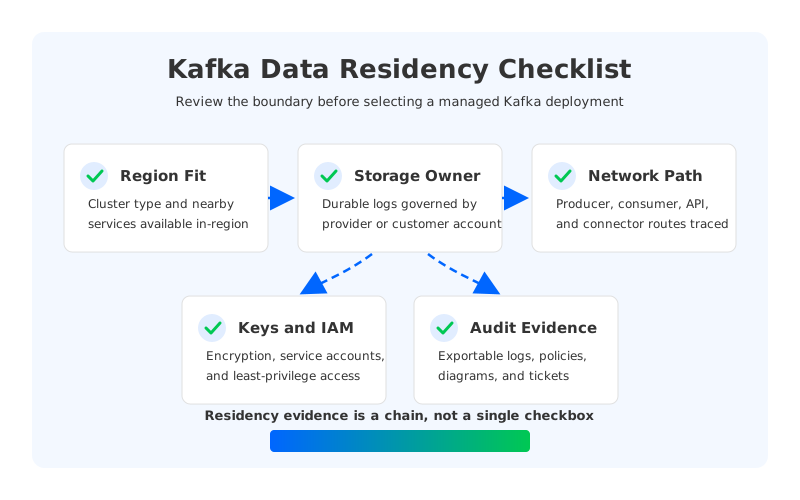
The careful answer is not that one deployment model is universally safer than another. SaaS managed Kafka and BYOC Kafka draw the responsibility boundary in different places: SaaS optimizes for operational delegation, while BYOC optimizes for control over the customer cloud account. Teams with data residency mandates or strict vendor access review need to make that boundary explicit.
1Why Data Residency Matters for Kafka Workloads
Data residency sounds simple until Kafka enters the picture. Kafka is fluid: producers write to brokers, brokers replicate and persist logs, consumers replay data, connectors move records into downstream systems, and security teams must reason about both stored data and data in motion. A compliant-looking region choice can still leave unanswered questions about object ownership, service operator access, cross-region integrations, and private network routing.
The first review question is usually geographic: can the cluster be created in the target region? Confluent documents Confluent Cloud availability across AWS, Azure, and Google Cloud, and the tables show that Kafka cluster types, Flink, networking options, connectors, and governance features vary by region. A residency decision is incomplete if the base Kafka cluster is in-region but an adjacent capability is not.
The second question is about control. Region placement answers "where is the managed service offered?" Customer-owned storage answers "whose cloud account owns the durable storage substrate?" Those are related, but they are not identical.
The third question is about evidence. Platform teams need artifacts they can show to auditors and internal risk committees: network diagrams, cloud account ownership, IAM policies, key management model, audit log destinations, and operational access procedures.
2What to Verify in Confluent Cloud Deployments
Confluent Cloud provides several controls that are relevant to data residency reviews. Its region documentation should be the starting point for checking whether the target cloud, region, cluster type, and dependent services are available. Its cluster creation docs also state that, for residency and sovereignty requirements, topic data transmitted through Kafka does not move out of the selected geographic region. Its networking documentation describes public and private connectivity options across AWS, Azure, and Google Cloud, including PrivateLink or Private Link-style connectivity, VPC or VNet peering, Transit Gateway on AWS, and Private Network Interface for selected AWS cases.
Those are important controls, but they do not replace a boundary review. Private networking can remove public endpoints from the client path, yet the service still operates according to the provider's managed-service model. Region support can place a cluster near the required jurisdiction, yet durable storage and service operations remain governed by that service's architecture and contracts.
For Confluent Cloud, a practical review should cover these points:
- Region and feature availability. Verify the cloud provider, region, cluster type, private networking option, Schema Registry, Connect, Flink, and governance features required by the workload.
- Network ingress and egress. Confirm whether client traffic uses public endpoints or private networking, and verify the routing path for producers, consumers, connectors, monitoring, and administrative APIs.
- Encryption and key model. Check the available encryption controls for the chosen cluster type, including whether self-managed encryption keys are supported for the deployment shape under review.
- Audit evidence. Decide where audit logs, access events, cloud logs, and operational tickets will live.
- Data movement by adjacent services. Include connectors, stream processing jobs, cluster links, and downstream sinks. Kafka residency is weakened when surrounding services move the same records through less controlled paths.
The Kafka service may satisfy the application team, while the storage ownership model remains too opaque for the security team. That gap is not a criticism of Confluent Cloud. It is the natural tension between a fully managed SaaS boundary and a customer-owned cloud boundary.
3Customer-Owned Storage and BYOC Kafka
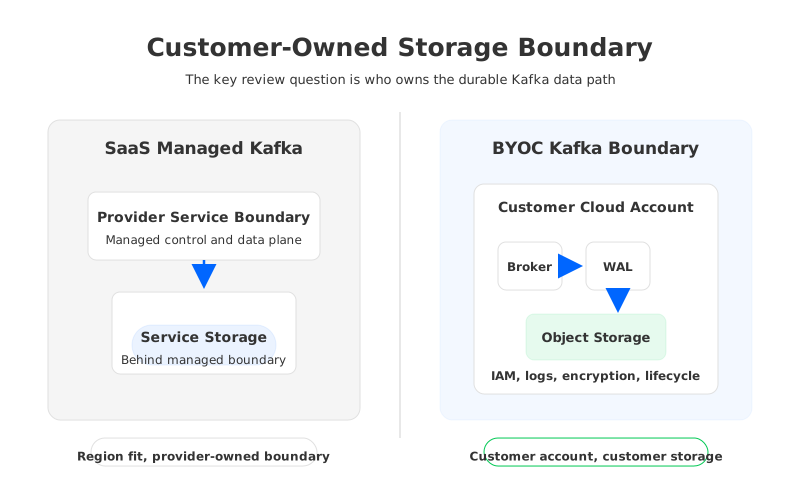
BYOC, or bring your own cloud, changes the starting point of the conversation. Instead of asking whether a provider's cloud-hosted Kafka service is available in the desired region, the customer asks whether the Kafka data plane can run in the customer's cloud account, VPC, subnets, IAM boundary, and object storage.
The most useful way to evaluate BYOC Kafka is to separate three layers that are often blended together in vendor diagrams.
| Review Area | SaaS Managed Kafka Question | BYOC Kafka Question |
|---|---|---|
| Data plane location | Which provider region hosts the managed Kafka cluster? | Which customer VPC, subnet, and account run the brokers and storage path? |
| Storage ownership | What storage model does the service use behind the managed boundary? | Which customer-owned bucket, volume, or storage account persists Kafka data? |
| Network and access control | Which private connectivity options are supported? | Which customer-controlled routes, security groups, IAM roles, and logs apply? |
| Operational responsibility | What does the provider operate for the customer? | What delegated permissions does the provider need, and how are they scoped? |
This table is phrased as questions, not claims. Data residency is not a badge that a vendor can apply uniformly to every workload. It is an architecture property that depends on cloud account structure, IAM design, region selection, encryption configuration, operational access, and the movement of records through adjacent systems.
3.1Data Plane Location
The data plane is where Kafka clients connect and where records are written, fetched, replicated, cached, and served. In a SaaS model, the provider operates that plane inside its managed service environment. In a BYOC model, the data plane should be deployed into the customer's cloud environment.
For platform engineering teams, this distinction affects more than compliance language. It determines whether Kafka brokers participate in the same network inspection model as other workloads and whether incident response can use existing VPC flow logs, security groups, route tables, and cloud-native policy tools. A region table answers availability. A data-plane diagram answers control.
3.2Storage Ownership
Apache Kafka's traditional storage model persists topic partitions as logs on broker-attached storage and uses replication for durability and availability. The official Kafka design describes topics as partitioned logs and explains how replication keeps copies across brokers. In cloud environments, that model ties durable Kafka data to broker storage and replica movement.
Customer-owned storage asks for a different property: the durable storage service itself should sit inside the customer's account boundary. In object-storage-based Kafka-compatible systems, Kafka data is written through a low-latency write path and then stored in cloud object storage, depending on the implementation. The important review point is whether the bucket or storage account is owned, governed, encrypted, logged, and lifecycle-managed by the customer.
3.3Network and Access Control
Networking is the part of residency that tends to get underestimated. A private endpoint to a managed Kafka service is useful, but it does not automatically mean every data path remains inside the same customer-controlled account. BYOC evaluation should trace producer writes, consumer reads, administrative APIs, metrics export, connector egress, object storage access, and emergency operator access.
The cleanest reviews produce two artifacts: a steady-state data path and an operational access path. The steady-state path shows where application data moves during normal Kafka reads and writes. The operational path shows what the vendor or internal platform team can access for upgrades, troubleshooting, and support.
4How AutoMQ Approaches Customer-Owned Kafka Storage
Once the requirement becomes "Kafka-compatible service with customer-owned cloud resources," the architecture needs compute and storage separation. AutoMQ is a Kafka-compatible cloud-native streaming system that reimplements Kafka's storage layer on shared object storage while preserving Kafka protocol compatibility for clients. In AutoMQ Cloud BYOC mode, the software services are deployed in the user's cloud account, and AutoMQ documentation describes the model as keeping data within the user's VPC.
The storage architecture is the key reason this model fits the customer-owned storage search intent. AutoMQ's S3Stream layer offloads Kafka's built-in ISR-based log storage layer to object storage and uses a Write-Ahead Log module to make object storage practical for stream storage. Data is first durably written to WAL storage and then uploaded to object storage. In a customer BYOC deployment, the data plane, WAL/storage resources, and object storage can be placed in the customer's cloud account, so the durable Kafka data path aligns with customer-owned cloud governance.
That does not remove the need for careful design. A BYOC deployment still needs explicit IAM scoping, network segmentation, encryption configuration, observability, upgrade procedure, and support-access governance. The difference is that those controls can be expressed in the customer's cloud-native primitives.
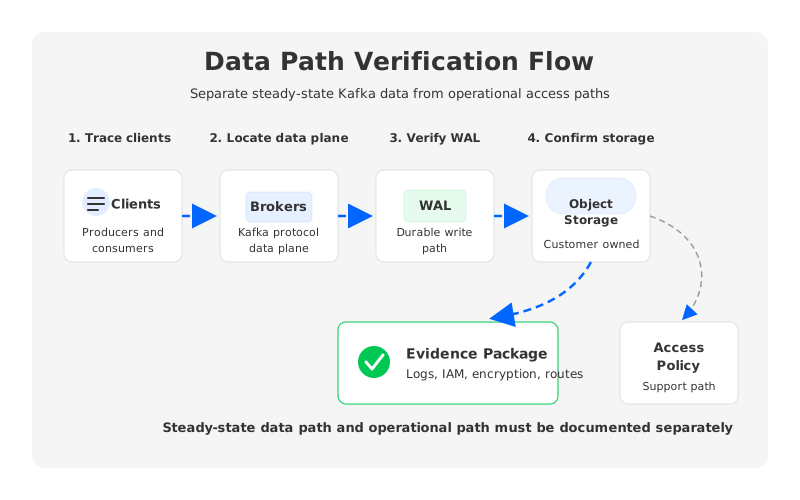
For security, compliance, platform, and cloud architecture teams, the evaluation looks like this:
- Map Kafka client traffic from producer and consumer VPCs to the broker endpoint.
- Map broker write paths to WAL and object storage.
- Confirm that durable Kafka data lands in customer-owned storage resources.
- Validate encryption, IAM, security group, logging, and retention policies in the customer cloud account.
- Document delegated operational access separately from steady-state data access.
This is also the right place to be precise about claims. AutoMQ BYOC can support a customer-owned storage architecture, but no Kafka vendor can make a blanket compliance promise for every organization or regulation. The credible claim is architectural: the data plane and storage path can be kept inside the customer's cloud boundary, which gives security teams more direct control over residency evidence.
5When an Alternative Makes Sense
Confluent Cloud remains a strong choice when the organization wants a mature SaaS Kafka experience and the documented region, networking, security, and operational model satisfy internal requirements. For many teams, that is the right trade-off.
A Confluent Cloud alternative becomes worth serious evaluation when the review questions keep returning to ownership rather than availability. If the requirement says "run Kafka in this region," a region table may be enough. If the requirement says "Kafka data must remain in cloud resources owned by our account," the architecture has to show where the brokers run, where WAL data lands, where object storage persists records, who can access those resources, and how every access path is logged.
The buying committee will usually include more than Kafka operators. Security wants control evidence, compliance wants careful language, cloud architecture wants account alignment, and platform engineering wants compatibility.
6Data Residency Review Questions
Use these questions before selecting any Kafka platform for regulated or security-sensitive workloads:
- Where is the Kafka data plane deployed? Identify the cloud account, region, VPC, subnet, and cluster boundary, not only the service endpoint.
- Who owns the durable storage? Confirm whether Kafka logs, WAL data, object storage, snapshots, and backups reside in provider-owned or customer-owned resources.
- Which paths can application data take? Trace producers, consumers, connectors, processors, replication, metrics, and support tooling.
- How is access governed? Review IAM roles, service accounts, mTLS or API key usage, key management, break-glass procedures, and audit log destinations.
- What evidence can be exported? Ensure the team can produce diagrams, policy exports, logs, configuration snapshots, and operational records for internal review.
- Which compliance statements are contractual, and which are architectural? Treat residency architecture and regulatory obligations as separate review tracks.
The last question prevents a common mistake. Architecture can make compliance easier to demonstrate, but architecture alone does not certify a workload. Customer-owned storage gives teams more direct control over the resources and evidence that their compliance program already understands.
7References
- Confluent Cloud Regions and Availability by Cloud Provider
- Manage Networking on Confluent Cloud
- Manage Kafka Clusters on Confluent Cloud
- Encrypt and Protect Data on Confluent Cloud
- Confluent Cloud Audit Logs
- What Is AutoMQ Cloud
- AutoMQ S3Stream Shared Streaming Storage
- AutoMQ Object Storage Configuration
- Apache Kafka Design: Replication
- Apache Kafka Implementation: Log
8FAQ
8.1Is Confluent Cloud a poor fit for data residency?
Not necessarily. Confluent Cloud documents region availability, private networking, encryption-related controls, and audit logging. It can be a good fit when those controls satisfy internal policies. The evaluation changes when policy requires Kafka data and durable storage to remain in customer-owned resources.
8.2What does customer-owned storage mean for Kafka?
Customer-owned storage means the durable storage resources used for Kafka data are created, governed, and logged inside the customer's cloud account or private environment. For object-storage-based Kafka systems, the bucket or storage account is under customer ownership.
8.3How is BYOC Kafka different from private networking to SaaS Kafka?
Private networking controls the connectivity path between customer applications and a managed service. BYOC changes the deployment boundary by placing the service data plane and cloud resources in the customer's account. Both can be useful, but they answer different risk questions.
8.4Does AutoMQ BYOC guarantee compliance with specific regulations?
No vendor architecture should be treated as a blanket regulatory guarantee. AutoMQ BYOC can place the data plane, WAL/storage path, and object storage in the customer's cloud account, which can help teams implement and evidence residency controls. Actual compliance depends on configuration, contracts, operating procedures, audit evidence, and customer obligations.
8.5Can existing Kafka clients work with AutoMQ?
AutoMQ is designed for Kafka protocol compatibility, so Kafka clients can generally connect without application rewrites. As with any platform change, teams should test client versions, security settings, topic configurations, consumer behavior, and operational tooling.
8.6What should security teams ask during a Kafka residency review?
Ask for the data-plane diagram, storage ownership model, network routing diagram, key management design, IAM policy scope, audit log destinations, support access procedure, and the list of adjacent services that can move Kafka records.


