
Table of Contents
Table of Contents
Most Kafka sizing exercises start with produce throughput, consume fan-out, partition count, and peak traffic. That works for real-time pipelines where consumers stay close to the head of the log. It is less useful for CDC archives, audit trails, security logs, data platform backfills, and replay-heavy systems where the question is also "What happens when a team re-reads last month?"
Long retention changes the center of gravity. The Kafka topic is no longer only a short-lived buffer between producers and consumers. It becomes an operational record that downstream teams expect to replay, validate, repair, and audit. A Confluent Cloud alternative for this category has to be evaluated on storage economics and read-path behavior together, because the costly part is often the retained byte that remains queryable and the old byte that becomes hot again during a replay.
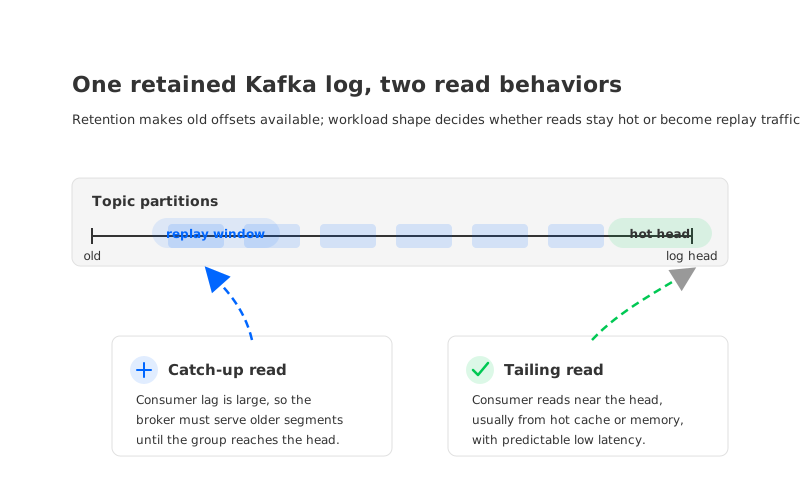
Kafka itself gives you the semantic foundation. Topic data is retained according to time and size policies such as log.retention.ms and log.retention.bytes; consumers track offsets; and when an offset no longer exists, auto.offset.reset determines whether a consumer starts from the earliest available offset, the latest offset, a duration-based point, or fails. Replay does not require a second archive API, but if retention removed the segment, the Kafka replay window has closed.
1Why Long Retention Is Different From Normal Kafka Traffic
In a tailing workload, most consumers read records soon after they are produced. Brokers benefit from hot cache, sequential access, and predictable lag. The working set is small relative to the full retained history, so tuning focuses on steady-state throughput and latency.
Replay-heavy workloads invert that assumption. A fraud analytics team may rerun a detector over 14 days of events after a rule change. A CDC platform may rebuild a downstream index from an older offset. A log platform may need to export retained security events for an investigation. These are not exotic edge cases; they are exactly why teams pay for longer Kafka retention in the first place.
The operational challenge is that replay is bursty and politically awkward. The team doing the replay may be different from the team producing the data, and the replay may start during business hours because an incident requires it. It may read far behind the log head, which means the broker is serving older data while still accepting writes and feeding tailing consumers. When this happens, the platform team needs isolation, not wishful thinking.
For a Confluent Cloud buyer, the first evaluation trap is treating retention as a storage checkbox. Confluent Cloud documents billing dimensions that include data transfer, storage, compute units, and add-on services. Its billing documentation also states that storage is charged on the total post-replication volume of data stored on a Kafka cluster, with a built-in replication factor of three. That makes the cost model explicit: long retention multiplies billable stored data, and replay multiplies data moved back through consumers.
The second trap is treating object storage as a magic answer. Object storage is durable, elastic, and cost-effective for large retained datasets. But Kafka workloads read ordered partitions through Kafka protocols, offsets, group coordination, quotas, and client expectations. A good alternative must preserve Kafka-native behavior while changing the storage economics underneath.
2Replay-Heavy Workload Requirements
The right evaluation starts with workload shape. A CDC team and a security audit team may both ask for 30-day retention, but they stress the system differently. CDC replay tends to be ordered and sensitive to duplicate processing. Audit replay may be sporadic, large, and governed by access controls. Log replay often has many consumers scanning overlapping time windows.
Use these questions before comparing vendors:
- How often do consumers fall behind by hours or days, and how many partitions do they replay at once?
- Can replay traffic be isolated from tailing reads and writes at the storage, network, and broker level?
- Is retained data billed as logical bytes, replicated bytes, object-storage bytes, or a service-specific unit?
- Can the team observe cold-read throughput, cache hit rate, consumer lag, and object-storage request pressure during replay?
These questions matter because retention and replay are linked but not identical. Retention answers whether the data still exists. Replay answers whether reading that data is operationally safe.
2.1Catch-Up Reads and Consumer Lag
The most important distinction is tailing read versus catch-up read. A tailing consumer reads near the log head. It is the happy path because the relevant data is likely in memory, page cache, local disk cache, or a dedicated hot-read path. Latency is usually predictable as long as producers and consumers are balanced.
A catch-up consumer starts behind. The lag might be a few minutes after a rolling restart, or days after a downstream outage. Once the consumer asks for older offsets, the broker must fetch retained segments that are no longer hot. In a local-disk Kafka design, this can compete with the same disks, page cache, and network paths used by active production traffic. In a tiered or object-storage-backed design, the broker may retrieve older data from remote storage, then serve it through Kafka.
That difference shows up in user experience. Tailing reads are judged by P99 latency and smoothness. Catch-up reads are judged by completion time, isolation, and how much damage they do to everyone else. A replay that finishes fast but spikes write latency is not a win; neither is a perfectly isolated replay that misses incident response timelines.
2.2Storage Cost and Isolation
Long retention makes storage the visible line item, but isolation is the hidden one. Teams often ask whether object storage lowers retained-byte cost. They should also ask whether the platform has a separate path for replay traffic.
There are several architectural patterns in the market:
| Pattern | Retention model | Replay implication | Evaluation risk |
|---|---|---|---|
| Traditional Kafka on local disks | Retained data lives on broker-attached storage | Catch-up reads compete with broker resources | Higher retained-byte footprint and operational tuning |
| Kafka with remote tier | Older segments can move to remote storage | Replay may fetch from remote tier through broker path | Check cache, fetch, and throttling behavior carefully |
| Kafka-compatible object-storage primary store | Object storage is the main durable data layer | Replay can be designed around object-store throughput and cache | Requires a Kafka-native write and read path, not a bolt-on archive |
The point is not that one row always wins. The point is that replay behavior must be tested in the same conversation as retention pricing. If a vendor only shows the storage tier, ask how a large replay affects tailing consumers. If a vendor only shows a throughput benchmark, ask what retained-byte cost and network egress assumptions were included.
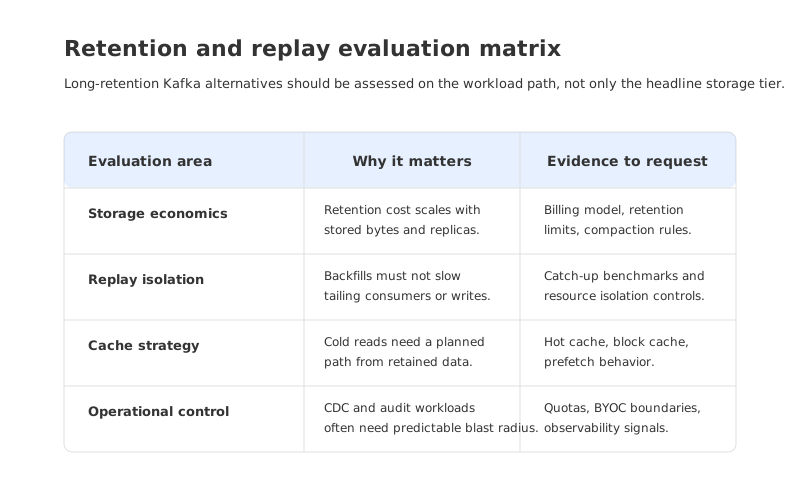
3Evaluating Confluent Alternatives for Retention Economics
Confluent Cloud is a strong managed Kafka service, and many teams choose it because they want Kafka without owning brokers. For long retention, the evaluation becomes more specific: does the service's storage model match the economics of keeping data online for weeks or months?
Start with the billing dimensions that are public and measurable. Confluent Cloud documents consumption-based billing across data transferred, storage, compute units, and related services. Its billing page says ingress and egress charges apply to data transfers, including produce and consume requests; it also says storage is based on post-replication volume and notes the built-in replication factor. For a replay-heavy workload, retained bytes and re-read bytes both deserve first-class cost modeling.
A practical model should include at least four rows:
- Logical ingest. How much data arrives per day after compression, and which topics need long retention?
- Retained footprint. How does the platform bill stored data after replication, compaction, tiering, or object-storage placement?
- Replay volume. How often do consumers re-read retained data, and where does that traffic appear in the bill?
- Isolation capacity. What compute, network, cache, or quota headroom is reserved for replay?
This is where "cost-effective Kafka retention" becomes a better phrase than "lower storage price." A low storage price is helpful, but a replay-heavy platform also needs a cost model that does not punish teams for using the retention they configured. CDC teams keep history for schema changes and downstream rebuilds. Audit teams keep history for investigations. Data platform teams keep history because derived tables and search indexes sometimes need repair. A retention platform that is economical only when no one replays the data is not solving the real problem.
4How AutoMQ Uses Object Storage for Kafka Retention
AutoMQ approaches the problem as a Kafka-compatible streaming storage system built around object storage as the primary durable layer. The important design choice is not "put old data somewhere else." AutoMQ's S3Stream storage layer uses S3-compatible object storage as the main storage foundation while preserving Kafka protocol compatibility above it.
That architecture needs an answer for the classic objection: writing directly to object storage can add latency, and Kafka clients expect low-latency acknowledgments. AutoMQ addresses this with a write-ahead log and cache path. Writes are acknowledged through WAL storage and later uploaded to object storage in batches. The WAL cache contains data not yet uploaded and data that has been uploaded but not evicted, so producer acknowledgments do not have to wait on an object-storage object lifecycle.
Reads are separated by behavior. Tailing reads can be served from the hot path near the broker. Catch-up reads use a block cache for cold data read from object storage; AutoMQ documentation describes s3.block.cache.size as the cache for cold data and recommends sizing it based on concurrent cold reads per partition. Replay is a workload path the architecture names and controls.
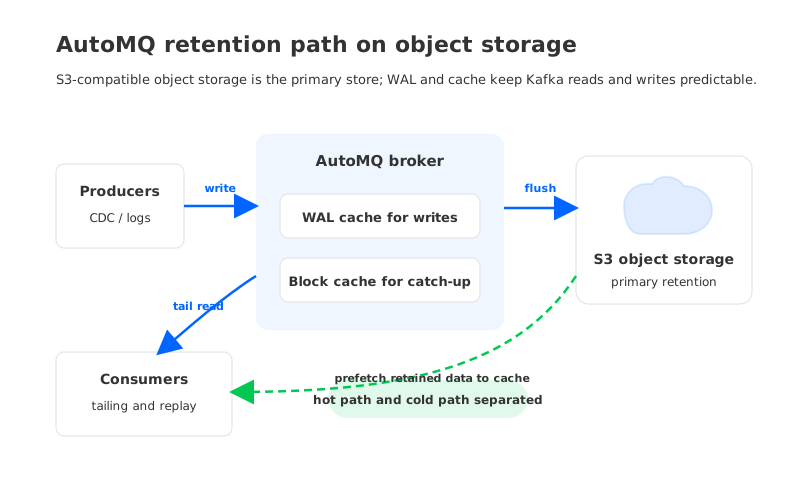
This distinction is why AutoMQ can be relevant in a Confluent Cloud alternative evaluation without turning the conversation into a feature checklist. The retention problem has three layers:
- Kafka semantics still matter: topics, offsets, consumer groups, and retention windows define what applications can replay.
- Storage economics matter: long-lived data should not require broker-attached replicated storage when object storage can serve as the durable foundation.
- Read-path isolation matters: catch-up reads need cache, prefetch, and resource controls so replay does not degrade tailing consumers and producers.
AutoMQ's object-storage primary model addresses the second layer directly. Its WAL and cache architecture keeps the Kafka-facing path recognizable to clients while giving the storage engine a different way to handle hot and cold data. That is the architectural shape to look for in any alternative: Kafka compatibility at the protocol layer, object-storage economics at the persistence layer, and explicit isolation between real-time reads and replay reads.
5A Practical Evaluation Checklist
A strong retention platform should be boring during the worst possible replay. The producer application should not notice that a data science job is backfilling. Tailing consumers should not see their latency profile change because an audit export is scanning old offsets. Platform engineers should be able to explain the bill afterward.
Use this checklist when evaluating Confluent Cloud alternatives for long-retention Kafka:
| Requirement | What to verify | Why it matters |
|---|---|---|
| Kafka retention semantics | Topic retention settings, offset reset behavior, compaction support | Applications depend on predictable replay windows |
| Storage billing basis | Logical bytes, replicated bytes, object-storage bytes, request costs | Long retention turns small pricing differences into large monthly deltas |
| Replay path | Cold-read cache, remote fetch behavior, prefetch, throttling | Replay should be a designed path, not a noisy accident |
| Tailing read protection | Latency during catch-up reads and backfills | Real-time consumers should stay stable |
| Observability | Consumer lag, cold-read throughput, cache pressure, object-store traffic | Teams need to diagnose replay before it becomes an incident |
| Operational boundary | BYOC, networking, IAM, quotas, cluster-level isolation | CDC and audit workloads often have compliance and blast-radius constraints |
The most useful proof is a benchmark that looks like your incident, not your average day. Pick a representative topic, retain enough history to exceed the hot working set, run normal producers and tailing consumers, then start a large catch-up consumer group. Measure write latency, tailing read latency, catch-up throughput, cache behavior, and transfer cost. If the platform cannot show those numbers, the retention conversation is still incomplete.
For teams already on Confluent Cloud, this does not require a dramatic rewrite. Kafka's client model gives you a clean way to test alternatives: mirror a subset of topics, preserve representative partitioning, and replay from known offsets. Long retention should be tested by reading old retained data while the cluster is under normal live traffic.
6References
- Apache Kafka broker configuration:
log.retention.ms - Apache Kafka consumer configuration:
auto.offset.reset - Confluent Cloud billing: ingress and egress
- Confluent Cloud billing: storage
- Confluent Cloud cluster types and storage limits
- AutoMQ documentation: 5x catch-up read efficiency
- AutoMQ documentation: broker and controller configuration
- AutoMQ documentation: object storage configuration
7FAQ
7.1What makes a Kafka workload replay-heavy?
A replay-heavy workload regularly reads data far behind the log head. Common examples include CDC rebuilds, audit exports, security investigations, search index rebuilds, and data quality repairs. The defining trait is frequent or business-critical use of older offsets.
7.2Is long Kafka retention the same as tiered storage?
No. Long retention is the application-level requirement that data remains available for a defined period or size window. Tiered storage is one implementation pattern for placing older segments on remote storage. A platform can support long retention with local disks, remote tiers, or an object-storage primary architecture, but each choice has different cost and replay behavior.
7.3Why does catch-up read performance matter if object storage is cost-effective?
Object storage can improve retention economics, but Kafka applications still read through Kafka clients and offsets. If catch-up reads are slow or interfere with producers and tailing consumers, the platform may look cost-effective on paper but fail during backfills. The storage layer and read path must be evaluated together.
7.4How should I compare Confluent Cloud retention cost with an alternative?
Model retained bytes and replay bytes separately. For Confluent Cloud, review the public billing dimensions for storage, ingress, egress, and compute units, then map them to your ingest rate, retention period, fan-out, and replay frequency. For any alternative, ask whether storage is billed as replicated broker storage, object-storage usage, service consumption units, or a combination.
7.5Where does AutoMQ fit in this evaluation?
AutoMQ is relevant when the workload needs Kafka compatibility, long retention, and replay isolation with object-storage economics. Its design uses S3-compatible object storage as the primary storage layer, WAL and cache for low-latency writes and recovery, and a block cache path for catch-up reads from object storage. That makes it worth testing for CDC, audit, logging, and data platform workloads where replay is part of normal operations.


