
Table of Contents
Table of Contents
A Kafka migration can look healthy until the first real cutover. Replication is running, target topics exist, and dashboards show bytes moving. Then a consumer group wakes up on the target cluster with the wrong offset posture, a connector writes duplicate rows downstream, or a client behaves differently against the new endpoint. At that moment the question is whether the team can return traffic without making the incident larger.
That is the uncomfortable part of moving from Confluent Cloud: rollback is not a button you discover during an outage. It is a design constraint that must shape replication direction, topic ownership, offset translation, schema compatibility, client release strategy, and observability before production traffic moves.
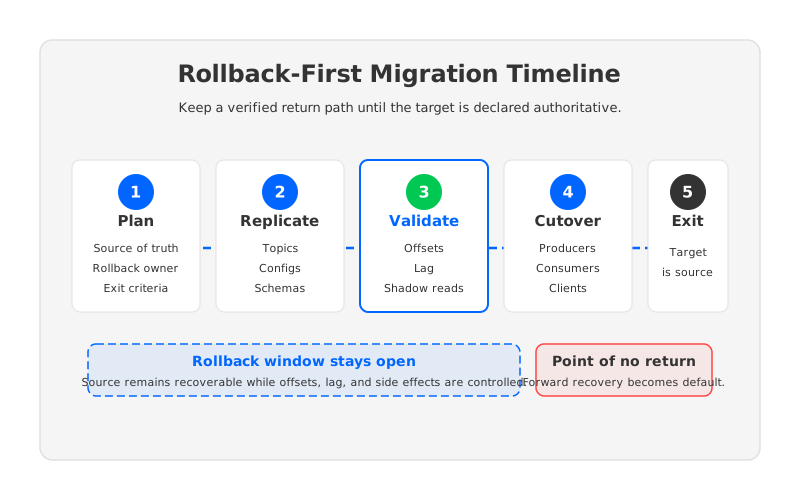
1Why Rollback Should Be Designed Before Cutover
The cleanest migration diagrams usually show a one-way arrow: source cluster, replication bridge, target cluster, then clients. Real systems are less tidy. Producers and consumers do not move at the same speed. Some consumers depend on committed offsets, others replay by timestamp, and a few applications persist their own checkpoints outside Kafka. Once traffic splits across those boundaries, "go back" becomes a set of technical questions rather than a project-management decision.
Rollback planning starts by naming the source of truth for each stage. Before producer cutover, the Confluent Cloud source cluster is usually still authoritative for writes. During a dual-write window, authority may be shared, which is dangerous if the two paths do not have identical serialization, partitioning, idempotence, and downstream side effects. After producer cutover, rollback requires reverse replication or a controlled decision to lose or replay target-only writes.
The same logic applies to consumers. A consumer group can only resume safely on the source cluster if its committed position there still represents a valid recovery point. If the group has already consumed from the target and committed progress with no source equivalent, the team needs a translation or replay strategy. The wrong committed offset can turn rollback into data loss, duplication, or a long manual reset.
For that reason, a rollback-first migration plan should define three boundaries before any client moves:
- Authority boundary: which cluster owns new writes at each phase, and when that ownership changes.
- Offset boundary: how consumer positions are mapped, validated, and protected from accidental commits.
- Side-effect boundary: which sinks, connectors, jobs, and external databases can tolerate replay or duplicate delivery.
These boundaries prevent a common failure mode: teams treat replication as the migration, then discover too late that operational state did not migrate with the same semantics as log data.
2The Migration Risks To Map
Migration risk is not evenly distributed. Topic bytes are visible and easy to count. Offset correctness, schema drift, connector side effects, and client behavior are harder to see, but they usually determine whether rollback is available.
| Risk area | What can fail | Rollback implication |
|---|---|---|
| Topic replication | Missing topics, mismatched configs, lag, partition-count differences, ordering assumptions | Rollback is safer while the source remains write-authoritative and the target is read-only. |
| Consumer offsets | Groups start too early, offset translation is stale, commits land on the wrong cluster | Rollback needs a known-good source offset or a documented replay window. |
| Schemas | Compatibility settings differ, subjects are missing, producers use unexpected schema versions | Rollback can fail even if Kafka records replicate cleanly. |
| Connectors | Duplicate writes, non-idempotent operations, target-only side effects | Rollback may require compensating actions outside Kafka. |
| Clients | Bootstrap endpoints, security config, DNS, retries, timeouts | Rollback depends on deploy automation and feature flags. |
2.1Topic Replication And Ordering
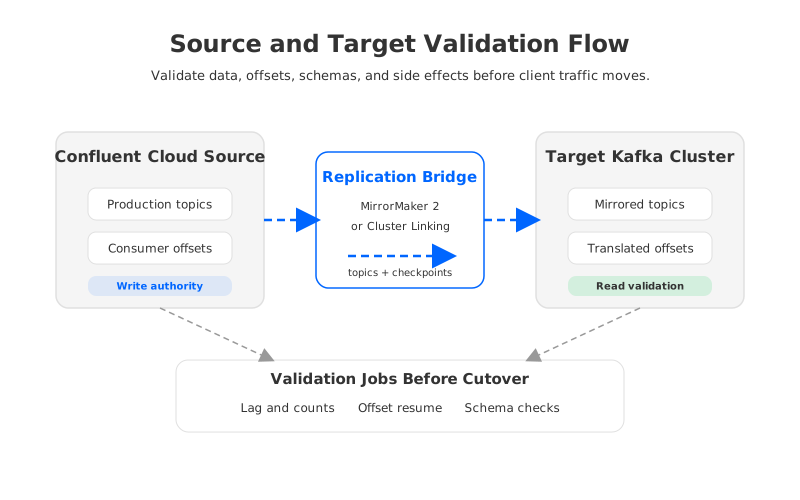
Topic replication is easy to overestimate. MirrorMaker 2, built on Kafka Connect, can replicate topics between Kafka clusters and uses internal topics for checkpoints, heartbeats, and offset sync information. Confluent Cluster Linking provides a broker-level linking model with mirror topics between clusters. Both are useful building blocks, but a replicated topic is not automatically a rollback-safe topic.
The first decision is whether the source remains the only write path until final cutover. That model is easier to reason about: producers keep writing to Confluent Cloud, replication feeds the target, validation compares lag, and rollback means clients continue using the old endpoint. Dual-write strategies exercise the target earlier, but records written only to the target must be reconciled before returning to source authority.
Kafka preserves order within a partition, not across a topic. If a migration changes partition counts, partitioner behavior, producer keys, or topic naming conventions, consumer-visible ordering can change even when every record arrives. Freeze partition counts for migrated topics unless the application owner has explicitly validated the change.
2.2Consumer Offsets And Lag
Consumer offsets are where many otherwise careful migrations become ambiguous. Kafka stores committed offsets for consumer groups so a group can resume from its last processed position. During a migration, that position must be preserved, translated, reset intentionally, or ignored because the application has its own checkpoint. Each option has a different rollback shape.
MirrorMaker 2 can emit offset-sync and checkpoint data that helps translate consumer group positions between clusters. Cluster Linking has its own consumer offset sync capabilities for supported failover and migration workflows. The translated offset is only meaningful if the target topic contains the corresponding records with compatible partitioning and retention. If the source has deleted the record range or the target is missing data, the offset is a number without a safe recovery story.
A rollback gate should require evidence for each critical consumer group:
- The group is stopped, paused, or otherwise prevented from committing surprise offsets during the cutover window.
- The source committed offset, target translated offset, and observed lag are captured before traffic moves.
- The group can resume on the target from the planned position.
- The rollback position on the source and maximum replay or duplication window are documented.
This is where rollback conditions must be explicit. If the consumer has already produced irreversible side effects from target-only data, rollback may still be possible for Kafka traffic but unsafe for the business process. "We can point clients back" is not the same as "the system can recover without duplicate downstream writes."
2.3Schemas, Connectors, And Clients
Schema Registry migration can look secondary until a producer fails because the subject naming strategy or compatibility level differs from the source environment. Confluent documents backward, forward, full, and transitive compatibility modes, which decide which schema evolutions are allowed. Treat subjects, versions, compatibility settings, references, credentials, and serializer configuration as migration state.
Connectors connect Kafka's replayable log to systems that may not be replay-friendly. A sink writing to an analytics database can tolerate duplicates if keys and upserts are configured correctly. A connector that triggers external actions may not. For non-idempotent sinks, rollback should include a stop condition and may require a forward-fix or compensating operation.
Client cutover is the last visible step, but the risk accumulates there. Bootstrap servers, authentication, TLS trust, ACLs, retries, timeouts, DNS TTLs, and consumer group behavior can all change together. Separate deploy from activation: ship both source and target configurations, activate the target endpoint through configuration, and keep the old path warm until rollback gates close.
3Rollback Gates And Observability
Rollback gates turn migration confidence into a checklist that can be run under pressure. They should be objective, short, and tied to named owners. A gate is weak if it says "monitor lag." A useful gate names the consumer groups, lag threshold, time window, dashboard, and decision owner.
The strongest gates combine source metrics, target metrics, and application-level evidence. Kafka-level health is necessary but not sufficient; a target cluster can have healthy brokers while a payment consumer is processing the wrong offset range. Define a small set of business invariants: record counts, end-to-end latency, error budget impact, sink row counts, or domain-specific reconciliation checks.
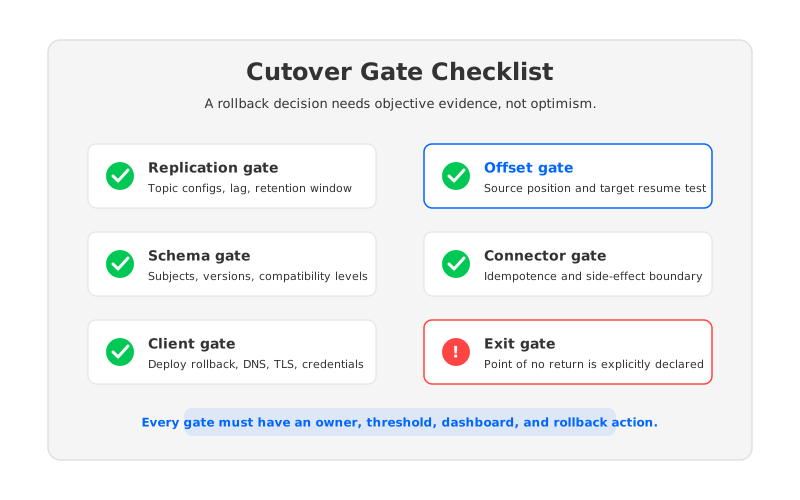
The gate sequence should usually look like this:
- Pre-replication gate: topics, configs, schemas, ACLs, quotas, and client credentials are present on the target; no production clients are writing there yet.
- Replication gate: source-to-target lag is inside the agreed threshold for critical topics, and retention on both sides covers the rollback window.
- Offset gate: critical consumer groups have captured source positions, validated target positions, and documented reset commands or operational procedures.
- Shadow-read gate: selected consumers or validation jobs read from the target without committing irreversible downstream side effects.
- Producer cutover gate: write authority moves only after rollback ownership, reverse-sync expectations, and target-only write handling are documented.
- Exit gate: rollback remains available until a defined point; after that point the team declares the target authoritative and switches to forward recovery.
That last gate is often skipped. Rollback is not available forever. Once producers write to the target, source retention expires, schemas evolve only on the target, or connectors create target-only side effects, the rollback cost rises quickly. The plan should name the point of no return instead of pretending it does not exist.
4Applying The Plan To An AutoMQ Migration
When AutoMQ is the target platform, the rollback-first plan still applies. AutoMQ is Kafka-compatible, so application teams can often reduce the migration surface at the protocol and client layer: producers, consumers, Kafka APIs, and common ecosystem tooling can be validated without rewriting the application around a different messaging model.
Compatibility, however, is not a waiver for validation. Topic configuration, partition counts, ACLs, schemas, connector behavior, consumer offset strategy, and client runtime settings still need gates. A Kafka-compatible target can accept Kafka clients, but it cannot infer whether a downstream sink is idempotent or whether a consumer group should resume from a translated offset, a timestamp reset, or an application checkpoint.
AutoMQ's architecture can change the operational economics of the target cluster for teams that want a Kafka-compatible system built around cloud object storage rather than traditional broker-local disk. But the migration itself should be judged by whether the target behaves correctly for the workload under production-like traffic. A good proof of concept is not only a throughput test; it is a rollback rehearsal with the same topics, offset policies, schema subjects, and client release process that production will use.
One useful pattern is to run a migration game day before final cutover. Pick a low-risk but representative service, replicate its topics, sync or translate offsets, start the consumer on the target, then force a rollback decision. Measure restore time, dashboard usefulness, and wrong assumptions.
5Conditions And Limits For Rollback
Rollback is safest before producer cutover, when the source cluster still owns all writes and the target is a validated replica. It is still manageable during shadow-read phases if consumers do not invalidate the source recovery point and connectors do not create irreversible side effects. It becomes much harder after target-only writes begin, when the team must replicate back, replay, accept a bounded data gap, or continue forward.
The plan should state these limits in plain language:
- Rollback does not guarantee zero data loss if producers have written records only to the target and those records have not been replicated or reconciled back to the source.
- Rollback does not guarantee exactly-once outcomes for external systems unless sinks, connectors, and applications are designed and tested for idempotence.
- Offset translation is only valid when the corresponding topic data, partitioning, retention, and replication state support it.
- Schema compatibility must be checked in both directions if producers may return to the source after writing with target-side schema versions.
- Client rollback depends on deploy automation, DNS/cache behavior, credentials, and the ability to switch endpoints quickly.
These limits do not make rollback less useful. They make it honest. Teams can still decide that after a certain point, forward recovery is safer than rollback, but that decision should be made before the incident call.
6A Rollback-First Runbook Template
A lightweight runbook is enough if it is specific. Record the write authority, critical topics, critical consumer groups, schema state, connector side effects, client switch command, and point of no return. Each field should have an owner plus a command, dashboard, or ticket. Test the runbook before the migration window with a stateful consumer, a schema-dependent producer, and a sink with observable side effects.
If your team is planning a Confluent Cloud migration and wants a second set of eyes on topic replication, offset strategy, or a rollback rehearsal, the AutoMQ team can help review the plan and map the validation gates against your workload before production cutover compresses them into an incident timeline.
7References
- Apache Kafka documentation: MirrorMaker 2 configuration
- Apache Kafka documentation: Consumer offsets and position
- Confluent documentation: Cluster Linking on Confluent Platform
- Confluent documentation: Consumer offset synchronization for Cluster Linking
- Confluent documentation: Schema Registry compatibility
- Confluent documentation: Test client applications with Confluent Cloud
- AutoMQ documentation: Migrating from Apache Kafka to AutoMQ
- AutoMQ documentation: Kafka Linking overview
- AutoMQ documentation: Compatibility with Apache Kafka
8FAQ
8.1Can a Confluent Cloud migration always be rolled back without data loss?
No. Rollback is most reliable before producer cutover. After target-only writes, schema changes, or connector side effects occur, rollback may require reverse replication, replay, reconciliation, or a forward-fix decision.
8.2Should MirrorMaker 2 or Cluster Linking be used for rollback?
Both can support migration designs, but they have different operational models. MirrorMaker 2 is Kafka Connect-based; Cluster Linking uses mirror topics and documented offset synchronization workflows. The right choice depends on cluster type, supported features, replication topology, and offset needs.
8.3What is the most important rollback gate?
The offset gate is usually the hardest to recover from if skipped. Consumer groups need a known source position, a validated target position, and a clear rule for replay or duplication before production cutover.
8.4Does Kafka compatibility remove migration risk?
No. Kafka compatibility reduces application rewrite risk because existing Kafka clients and APIs can often be preserved, but topics, offsets, schemas, connectors, ACLs, quotas, and client configuration still require validation.
8.5When should rollback stop being the default recovery plan?
Rollback should stop being the default once the target is the durable source of truth and returning to the source would create more risk than fixing forward. Name that point in the runbook.


