
Table of Contents
Table of Contents
Kafka bills become uncomfortable when the network diagram and the billing export tell different stories. A platform team may choose Confluent Cloud to remove broker operations, then find that the surrounding traffic path still behaves like a high-volume distributed system: producers write continuously, consumers multiply reads, connectors move data across service boundaries, and failover design pushes traffic through multiple zones or regions. The managed Kafka service is only part of the path. The bytes still move through cloud networks that have their own pricing model.
That is why a Confluent Cloud networking cost review should start with topology, not the subscription line item. Confluent documents public and private networking options across AWS, Azure, and Google Cloud, including AWS PrivateLink, Azure Private Link, Google Cloud Private Service Connect, VPC peering, Transit Gateway, and Private Network Interface options. Those choices decide where traffic is metered.
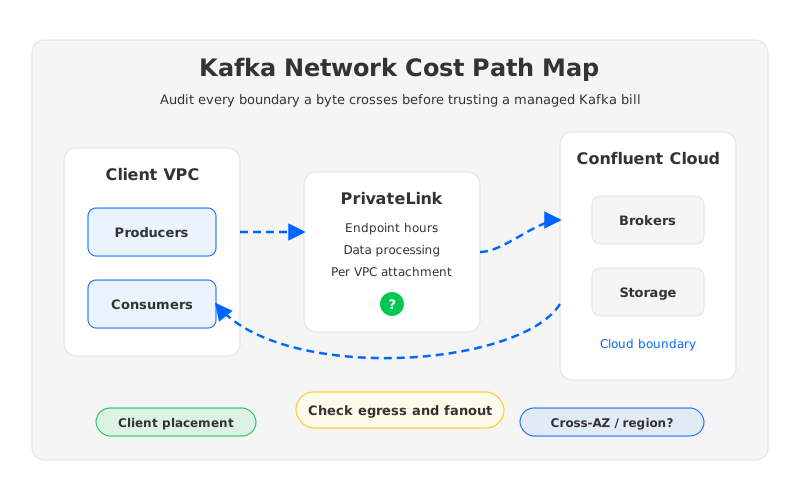
The useful question is not "What does PrivateLink cost?" It is "Which data path will carry my Kafka produce, consume, connector, replication, and administrative traffic, and which party will meter each segment?" Once the map is clear, you can ask for the right Confluent usage exports, cloud provider SKUs, and architecture changes before the bill arrives.
1Why Kafka Networking Costs Are Easy to Underestimate
Kafka is a network amplifier by design. A message enters once, then may be replicated, fetched by multiple consumer groups, mirrored to another cluster, indexed by a search pipeline, copied to a lake, and replayed during incident recovery. Apache Kafka's own design centers on partitions, brokers, producers, consumers, and replication; the network is not a side channel, it is how the log stays available and useful.
Managed Kafka changes who operates the brokers, but it does not remove the need to account for traffic. In Confluent Cloud, clients still connect over public or private network paths. Private connectivity can reduce exposure to the public internet, yet it introduces endpoint, attachment, data processing, routing, and DNS choices that need to be owned by someone. Public connectivity can be operationally direct, yet egress and internet-facing paths may be unacceptable for security or cost reasons.
For SREs and platform engineers, the risky pattern is treating all in-region traffic as harmless. AWS guidance is explicit that traffic within the same Availability Zone can be free in common EC2 patterns, while traffic crossing Availability Zone or Regional boundaries can create data transfer charges. AWS PrivateLink adds endpoint-hour and data-processing dimensions. Azure and Google Cloud use different words, but the same audit habit applies: identify the boundary, then check the current official pricing page for that boundary.
The multiplier comes from four Kafka-specific behaviors:
- Continuous write volume. A Kafka cluster does not move data in occasional batches. Producers may write all day, which makes small per-GB assumptions material over a full billing cycle.
- Read fanout. One topic can feed operational services, analytics jobs, machine learning features, monitoring, and replay tooling. Each consumer group can turn the same retained data into another network stream.
- Placement drift. Application teams add clients in different VPCs, accounts, subnets, zones, and regions over time. The original network model rarely stays intact.
- Recovery paths. Cluster linking, mirror pipelines, cross-region disaster recovery, and backfills move data when the organization is already under pressure, which makes cost surprises harder to challenge later.
FinOps teams often see this after the fact as "data transfer" or "networking" growth. Cloud network architects see it earlier as a routing problem. Those two views need one shared checklist.
2The Confluent Cloud Data Paths to Map
Confluent Cloud networking documentation separates public connectivity from private connectivity and lists private options by cloud provider. A cost review needs one more layer: which Kafka workload uses which path? A PrivateLink architecture for producers does not automatically answer how managed connectors reach a sink, how Schema Registry is accessed, or how a cross-region replication path is billed.
2.1Producers and Consumers
Start with producers and consumers because they dominate steady-state traffic. For each application, record the cloud provider, account or subscription, VPC or VNet, region, zone strategy, NAT path, endpoint type, and expected write or read rate. Then mark whether the application is in the same cloud and region as the Confluent Cloud cluster, connected through a private endpoint, using public endpoints, or crossing from on-premises.
This table is a practical starting point:
| Path to map | Cost question | Evidence to request |
|---|---|---|
| Producer to Kafka | Does traffic cross a VPC, AZ, region, internet, or PrivateLink boundary? | Client VPC route tables, Confluent network type, cloud data transfer SKUs |
| Kafka to consumer | How many consumer groups read the same bytes, and where are they placed? | Consumer inventory, throughput per group, VPC Flow Logs or cloud billing export |
| Kafka to sink | Do managed connectors egress to a private service, public IP, or another cloud? | Connector config, egress endpoint setup, destination region |
| Replication or linking | Is data copied across regions or clouds for DR, migration, or analytics? | Cluster Linking or mirror topology, inter-region transfer SKUs |
The goal is to replace vague phrases like "private traffic" with a path that can be priced and measured.
2.2PrivateLink and VPC Connectivity
Confluent's AWS PrivateLink documentation describes inbound PrivateLink from an AWS VPC to Confluent Cloud and outbound PrivateLink from Confluent Cloud to an AWS VPC. It also notes that PrivateLink clusters are accessed from registered accounts and private endpoints, and that existing network choices have constraints. That matters in a renewal review because PrivateLink is not a single switch. It is a set of endpoint, DNS, account, VPC, subnet, and service-access decisions.
On AWS, review both sides of the private connection. AWS PrivateLink pricing is based on endpoint resource time and data processed through VPC endpoints, with current rates varying by region and tier. The exact line item may appear under Confluent usage, cloud provider usage, or both depending on the architecture and commercial agreement, so do not assume that a private path is invisible to the bill.
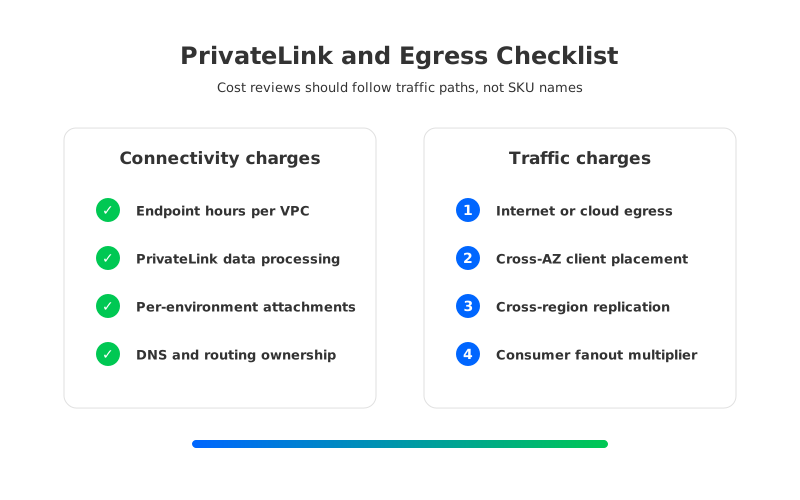
For each private connection, ask:
- Which VPCs, accounts, and environments have endpoints or attachments?
- Are endpoints deployed in every zone where clients run, or are clients hairpinning across zones to reach them?
- Does DNS resolve brokers to local private endpoints, or does it push clients through a less direct path?
- Which services still require internet access, public endpoints, or separate private networking configuration?
- Are managed connectors using public egress, egress PrivateLink, peering, Transit Gateway, or another path to reach sources and sinks?
These questions sound mechanical because they are mechanical. They turn "PrivateLink is secure" into "PrivateLink is secure, reachable, and costed along the intended path."
2.3Cross-AZ and Cross-Region Paths
The easiest Kafka network cost to miss is the one created by high availability. You place applications in multiple zones for resilience, then one zone becomes the source of most traffic while another zone becomes the consumer or endpoint location. That should be a deliberate trade-off.
AWS's architecture guidance states that data transfer charges are often overlooked and that traffic crossing an Availability Zone or Regional boundary typically incurs a charge. For Kafka, this maps cleanly to client and endpoint placement: keep high-volume producers and consumers near the network entry point they use, and avoid routing every fetch through a centralized shared-services hop unless the security model requires it.
Azure and Google Cloud should be checked separately rather than copied from AWS assumptions. Azure Bandwidth pricing distinguishes data moving in and out of Azure data centers and notes that transfer within the same Availability Zone is free, while Azure Private Link pricing is tied to private endpoints and processed data. Google Cloud VPC pricing distinguishes same-zone, different-zone, inter-region, and Private Service Connect traffic. The cloud terms differ, but the engineering practice is the same: do not model "same region" as a single cost zone until the pricing page confirms it.
3Questions to Ask Before Renewal
The best Confluent Cloud renewal packet is not only a discount request. It is a workload map with evidence. If your team can show which paths drive cost, you can discuss whether the right fix is a networking change, a cluster type change, a connectivity change, a connector redesign, a placement rule, or a different Kafka architecture for selected workloads.
Use these questions with SRE, networking, security, and FinOps in the same room:
- Which traffic is charged by Confluent, and which traffic is charged by the cloud provider? Separate Confluent usage units, network charges, PrivateLink-related charges, cloud data transfer, NAT, Transit Gateway, load balancer, and endpoint charges.
- Which client paths are public, private, peered, or routed through a hub? Public and private networking have different security properties and cost surfaces. The right answer depends on data classification, latency, and ownership.
- Where are the highest-volume consumers? A group that reads every event for analytics can cost more than a producer that writes the event once.
- Are endpoints and clients aligned by zone? A private endpoint in the wrong place can convert a clean architecture into a recurring cross-AZ path.
- Which connectors move data out of the Kafka boundary? Managed connectors, Flink jobs, Cluster Linking, and sink pipelines can be separate cost centers.
- What happens during replay? Backfills and incident replay can multiply traffic for hours or days. Model a realistic recovery scenario, not only the normal hour.
- Can noisy workloads be isolated? Observability, clickstream, CDC, and ML feature topics often have different latency and retention requirements than payment or order topics.
Do not ask for a universal network price. Ask for a billable path inventory. That inventory is harder to hand-wave and easier to improve.
4How BYOC Kafka Changes Network Cost Control
After the audit, some teams discover that the managed SaaS boundary is the real design constraint. They can tune PrivateLink, align endpoints, reduce cross-region flows, and clean up fanout, but the data plane still runs in a provider-managed environment. That model can work, but the customer must adapt its VPC, account, and routing design to an external Kafka boundary.
BYOC Kafka changes the control surface. In AutoMQ BYOC, the deployment model places the service environment in the customer's cloud account and VPC, with Kafka-compatible data-plane components and object storage designed around that cloud boundary. AutoMQ's AWS BYOC preparation documentation calls out VPC, EKS, S3, DNS, NAT, S3 Gateway Endpoint, and EC2 Interface Endpoint requirements. BYOC does not remove every network decision; it lets the data path be designed within the account, VPC, endpoint, and cost governance framework the platform team already operates.
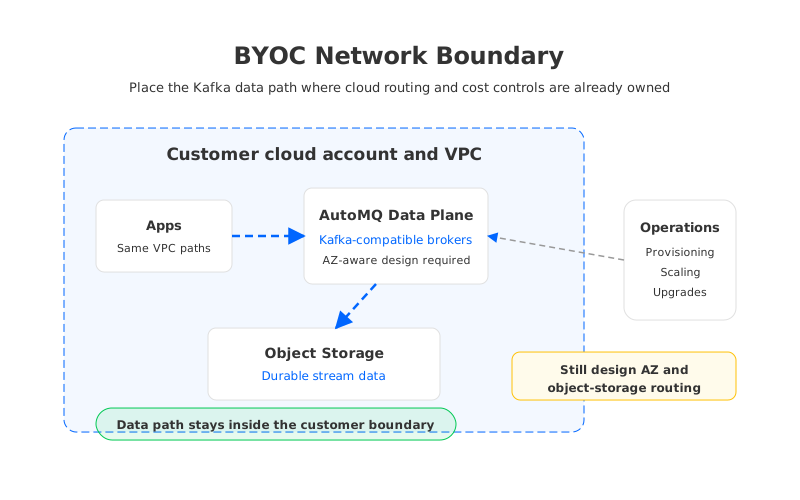
That matters for three reasons:
- Routing ownership is clearer. The same cloud networking team that owns application VPCs can design Kafka client placement, endpoint coverage, and route tables.
- Object storage becomes part of the planned path. Durable stream data can be stored in object storage within the customer's environment, so the team can explicitly design S3, GCS, Azure Blob, or S3-compatible access paths.
- FinOps can connect usage to infrastructure. Instead of treating networking as a vendor-side black box, teams can correlate Kafka traffic with their own flow logs, cloud billing export, endpoint configuration, and object-storage access patterns.
This is not a free pass. A BYOC deployment still needs careful AZ design, endpoint design, object-storage path design, and failure-mode testing. A single-AZ path may reduce some transfer cost but weaken availability. A three-AZ deployment may improve resilience but changes traffic patterns. The advantage is that these are now first-class infrastructure decisions under the customer's architecture process, rather than after-the-fact questions attached to an external service boundary.
For teams comparing Confluent Cloud and BYOC Kafka, the honest conclusion is practical: first fix the network map you already have. Then decide which workloads should remain on a SaaS boundary and which would benefit from a customer-owned data plane with object-storage-backed Kafka economics.
5Network Cost Checklist
Before the next contract review, build a two-page network cost packet:
- A data path map for producers, consumers, connectors, replication, and administrative access.
- A cloud billing export filtered to data transfer, PrivateLink or private endpoint, NAT, Transit Gateway, load balancer, and inter-region SKUs.
- A Confluent usage export or invoice breakdown that separates Kafka usage from networking-related dimensions where available.
- A top consumer-group fanout table by topic, bytes read, region, and VPC.
- A zone-alignment review for high-volume clients and private endpoints.
- A replay and DR scenario showing expected data movement during an incident.
- A decision table for which workloads need SaaS isolation, which need BYOC control, and which can be redesigned to reduce fanout.
The bill is the lagging indicator. The topology is the leading indicator. Once both teams look at the same map, Confluent Cloud networking cost becomes an engineering variable rather than a surprise line in the month-end report. If your audit points toward a customer-owned data plane, use the AutoMQ BYOC and VPC preparation references below to evaluate what would move inside your cloud boundary.
6References
- Confluent Cloud Networking Overview
- Confluent Cloud AWS PrivateLink Overview
- Confluent Cloud AWS PrivateLink for Dedicated Clusters
- Confluent Cloud Pricing
- AWS Architecture Blog: Overview of Data Transfer Costs for Common Architectures
- AWS PrivateLink Pricing
- Azure Bandwidth Pricing
- Azure Private Link Overview
- Google Cloud VPC Network Pricing
- Google Cloud Private Service Connect
- Apache Kafka Documentation
- AutoMQ Cloud Overview
- AutoMQ BYOC AWS VPC Preparation
7FAQ
7.1Does Confluent Cloud PrivateLink eliminate networking cost?
No. PrivateLink is primarily a private connectivity model. On AWS, PrivateLink has endpoint-hour and data-processing pricing dimensions according to AWS's pricing page, and Confluent networking choices can also affect service-side cost dimensions. Use PrivateLink for security and controlled access, then price the endpoint and data path explicitly.
7.2Is egress the same as cross-AZ traffic?
No. Egress usually means traffic leaving a defined boundary, such as a cloud region, provider network, or service. Cross-AZ traffic is traffic crossing Availability Zone boundaries inside a region. Cloud providers define and price these paths differently, so the audit should use the provider's current pricing page and the actual route taken by clients.
7.3Why does consumer fanout matter for Confluent Cloud networking cost?
Kafka lets multiple consumer groups read the same topic independently. That is useful, but every high-volume consumer group can create another stream of bytes from the Kafka cluster to client infrastructure. If those consumers are in different VPCs, zones, regions, or clouds, the read side can dominate the network bill.
7.4When should a team consider BYOC Kafka for network cost control?
Consider BYOC when the cost and governance issue is not only Kafka usage, but the location of the data plane. A BYOC model such as AutoMQ can place Kafka-compatible brokers and object storage in the customer's cloud environment, which gives platform and network teams more direct control over VPC, AZ, endpoint, and object-storage paths. It still requires careful design; it does not remove cloud networking physics.


