
Table of Contents
Table of Contents
You budgeted for Confluent Cloud based on the CKU calculator. Then the first real invoice arrived, and the number was 3× what you expected. If that sounds familiar, you're not alone — and the gap isn't a billing error. It's baked into how Confluent Cloud pricing actually works.
Most teams evaluate Confluent Cloud by looking at CKU costs: how many Confluent Kafka Units they need for their throughput. That's the number on the pricing page, and it's the number sales will walk you through. But CKUs are the tip of the iceberg. The real cost of running Confluent Cloud comes from a stack of fees that don't show up until you're in production — cross-AZ data transfer, ingress and egress charges, PrivateLink surcharges, partition fees, and add-on services that each carry their own billing meter.
So where does the money actually go?
1How Confluent Cloud Pricing Works
Confluent Cloud bills through a unit called the CKU (Confluent Kafka Unit). Each CKU bundles a fixed amount of compute, network, and storage capacity. You pick a tier (Basic, Standard, Dedicated, or Enterprise) and provision CKUs accordingly.
The tier choice matters more than it appears. Basic and Standard clusters share infrastructure and cap your throughput, partition count, and retention. Most production workloads land on Dedicated or Enterprise, where you get isolated compute but also unlock the full fee schedule. The upgrade path is a one-way door: once you need features like PrivateLink, custom networking, or RBAC, you're on Dedicated or Enterprise, and the per-CKU price jumps accordingly.
Here's the part that catches teams off guard: CKU pricing covers the compute slice of your cluster. Storage, network transfer, connectors, ksqlDB, and schema registry are all billed separately. A CKU estimate without these line items is like quoting a car price without fuel, insurance, or maintenance.
2The Hidden Costs Nobody Talks About
2.1Cross-AZ Replication: The Biggest Line Item You Didn't Budget For
Confluent Cloud replicates data across three availability zones for durability, the same approach as self-managed Apache Kafka. Every byte you produce gets copied twice more across AZ boundaries, and every byte your consumers read may also cross an AZ boundary. Cloud providers charge $0.01–$0.02 per GB for cross-AZ data transfer, and at streaming-scale throughput, this adds up fast.
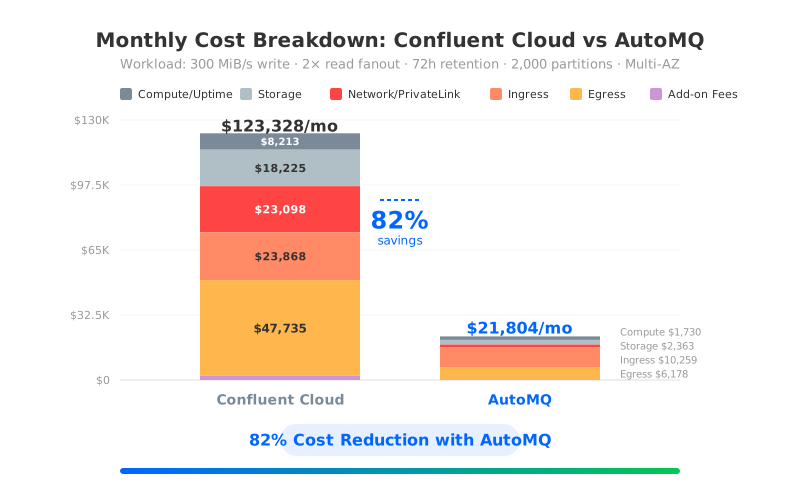
Take a real workload: 300 MiB/s sustained writes, 2× read fanout. That's roughly 770,000 GiB of ingress and 1,540,000 GiB of egress per month. The replication and cross-AZ transfer costs embedded in Confluent's pricing contribute significantly to the $47,735 egress fee and $23,098 PrivateLink cost that show up on the bill. You can't opt out. It's how three-replica, disk-based Kafka works.
2.2Ingress and Egress Fees
Cross-AZ replication drives the raw data volume, but the billing impact shows up in two separate line items: ingress and egress. Confluent Cloud charges separately for data flowing in and data flowing out, and at the 300 MiB/s workload above, ingress fees hit $23,868/mo while egress fees reach $47,735/mo, making egress the single largest line item at 39% of the total bill. Egress is particularly painful because it scales with your read fanout: every additional consumer group multiplies the egress charge.
| Cost Component | Monthly Amount |
|---|---|
| Cluster Uptime (CKU) | $8,212 |
| Data Ingress | $23,868 |
| Data Egress | $47,735 |
| Data Storage | $18,225 |
| Partition Fee (2,000) | $2,190 |
| PrivateLink | $23,098 |
| Total | $123,328 |
Scenario: 300 MiB/s write, 2× read fanout, 72h retention, 2,000 partitions, Multi-AZ (us-east-1). Calculated using the AutoMQ Pricing Calculator based on Confluent Cloud Enterprise published pricing, April 2026.
The CKU line — the number most teams budget around — accounts for just 6.7% of the total bill. Egress alone is nearly 6× the CKU cost.
2.3Connect, ksqlDB, and Add-on Services
Confluent's managed connectors and ksqlDB carry their own per-hour or per-CKU billing. A team running a handful of source and sink connectors alongside a few ksqlDB queries can add thousands per month on top of the base cluster cost. The exact amount depends on connector count and query complexity, but it's a separate billing meter that scales independently. Schema Registry, while cheaper per unit, adds yet another meter to track. None of these are included in the CKU price.
2.4The Over-Provisioning Tax
CKUs are provisioned in fixed increments. You can't scale down to zero during off-peak hours, and scaling up requires provisioning additional CKUs ahead of the traffic spike. So you end up paying for capacity you're not using, all the time.
For workloads with variable traffic patterns, event-driven architectures, batch processing windows, seasonal spikes, this over-provisioning tax means you're paying for peak capacity 24/7, even when your actual throughput is a fraction of that. Teams with bursty workloads routinely report that their average utilization sits well below 50% of provisioned capacity.
All of these costs trace back to one thing.
3Why It's Not a "Premium" — It's an Architecture Problem
The easy explanation is that you're paying a managed-service premium. Convenience, operational expertise, an SLA. That's partially true, but it doesn't explain why the infrastructure costs are so high.
The real driver is architectural. Confluent Cloud runs on the same storage model as self-managed Kafka: data lives on attached disks (EBS or equivalent), replicated three ways across availability zones. This design made perfect sense in the data center era, where cross-rack replication was essentially free. In the cloud, every byte of cross-AZ transfer has a price tag, and every gigabyte of EBS storage costs roughly 3.5× more than S3 (EBS gp3 at ~$0.08/GB-month vs. S3 at ~$0.023/GB-month in us-east-1).
Three architectural constraints drive the cost structure:
- Disk-based replication — Three copies of every byte on EBS, plus the cross-AZ transfer fees to keep them in sync. This is why cross-AZ and egress fees dominate the bill. Object storage (S3) provides 11 nines of durability natively, without application-level replication.
- Coupled compute and storage — Brokers own their data. You can't scale compute independently of storage, which means scaling for throughput also scales (and pays for) storage you may not need. This is the root of the storage and PrivateLink costs.
- No elastic scaling — CKUs are provisioned, not elastic. The architecture doesn't support scaling to zero or auto-scaling with traffic, so you pay for peak capacity around the clock — the over-provisioning tax from the previous section.
These constraints aren't implementation details that Confluent could optimize away with better engineering. They're fundamental to the Kafka storage model. Changing them requires rethinking how the storage layer works.
To put numbers on it: for the same 300 MiB/s workload, a platform built on S3-native storage, where data goes directly to object storage without disk replication, drops the monthly bill to $21,804. That's an 82% reduction from the $123K Confluent scenario, and the savings come almost entirely from eliminating cross-AZ replication, PrivateLink fees, and EBS storage costs.
4What an S3-Native Architecture Changes
If disk-based replication is the root cause, the fix is obvious: move the storage layer to object storage. When you do that, three things change: brokers become stateless, replication drops out of the application layer, and the cost structure shifts fundamentally. Instead of replicating data across three EBS volumes in three AZs, you write it once to S3, which handles durability and cross-AZ availability natively.
AutoMQ is one implementation of this S3-native approach, a Kafka-compatible streaming platform (Apache License 2.0) where brokers don't own data. They can scale up and down in seconds without rebalancing. The WAL (Write-Ahead Log) layer is pluggable, supporting S3, EBS, or NFS depending on your latency requirements.
The cost savings are a direct side effect:
- No cross-AZ replication fees — S3 handles durability natively. No application-level replication, no cross-AZ transfer costs.
- No PrivateLink surcharges — AutoMQ runs in your own VPC (BYOC model). Data stays in your account.
- No partition fees — Partitions are metadata, not a billing dimension.
- Elastic scaling — Stateless brokers scale with traffic, so you pay for what you use.
For the 300 MiB/s scenario, that's the difference between the $123K Confluent bill and $21,804 with AutoMQ — over $100,000 per month on a single cluster.
5Making an Informed Decision
Now you know where the money goes. The CKU number on the pricing page is real, but it's a small fraction of the total. The bulk sits in egress fees, cross-AZ replication, PrivateLink, and storage, all line items that are architectural in nature, not operational.
Whatever you do next, the question is the same: are you paying for infrastructure overhead that a different architecture would eliminate?
That first invoice that came in at 3× your CKU-based estimate? Now you know where the gap comes from. Run your own numbers with the AutoMQ Pricing Calculator and see where your workload lands.


