
Table of Contents
Table of Contents
Kafka budgets tend to fail in the same place: the team estimates the cluster, then the bill is shaped by everything around the cluster. Throughput grows faster than expected. Retention becomes a compliance requirement rather than a convenience. A private networking decision moves part of the cost into the cloud provider bill. An analytics team adds consumer fanout that looks harmless in a design review and very visible in a finance review.
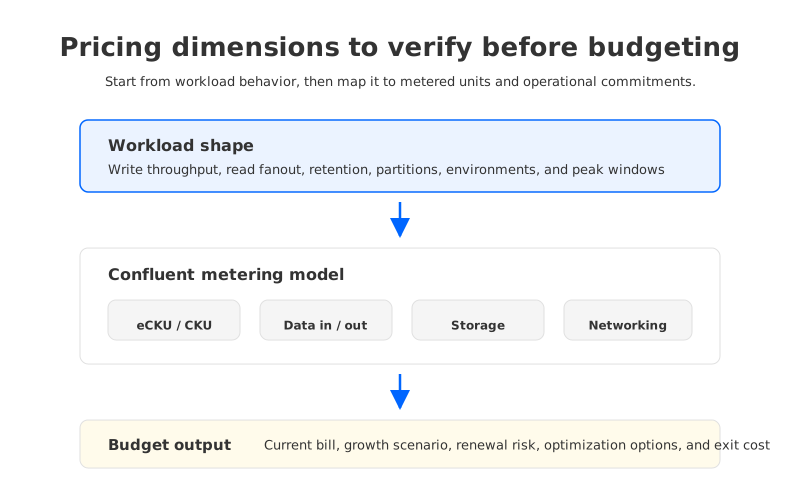
That is why Confluent Cloud pricing is better treated as a workload model than as a price lookup. Confluent publishes pricing pages and a cost estimator, and its own pricing FAQ describes Kafka clusters as being billed by eCKUs or CKUs per hour, networking per GB, and storage per GB-hour. Those units are useful, but they are not the budget by themselves. A 2026 plan needs to connect those units to engineering behavior: writes, reads, retention, network paths, environments, and growth scenarios.
The practical question is not "What does Confluent cost?" It is "Which parts of our Kafka workload will cause the next bill to diverge from the current one?" That framing matters before a renewal, because an annual commitment can improve predictability while also making weak assumptions harder to unwind.
1What teams usually miss when estimating Confluent Cloud pricing
Most Kafka teams start with the visible service line item. That is reasonable: Confluent Cloud is a managed data streaming platform, and the cluster type, capacity model, and feature set matter. The mistake is stopping there. Kafka is a traffic amplifier. One byte written by a producer can be retained for days, replicated or protected by the service architecture, read by multiple consumer groups, mirrored to another region, processed by stream applications, and exposed over private connectivity.
The missing items usually fall into four buckets:
- Read amplification. A workload with high write volume is easy to spot, but multiple consumer groups can make outbound data the dominant behavioral driver. A fraud pipeline, feature store, observability sink, and warehouse connector may all read the same topic.
- Retention drift. A topic that was designed for short operational replay can become an audit or recovery source. Longer retention changes storage exposure even when producer throughput is flat.
- Network placement. Private connectivity, cross-region movement, and cloud-to-cloud paths can create charges outside the Confluent invoice. On AWS, for example, data transferred across Availability Zones in the same Region is charged at \$0.01/GB in each direction for several EC2-adjacent paths, while AWS also notes that PrivateLink endpoint hours and per-GB processing charges apply.
- Environment multiplication. Production is rarely alone. Development, staging, disaster recovery, regional replicas, and temporary migration clusters all consume budget. Non-production clusters often avoid scrutiny until they become permanent.
The uncomfortable part is that none of these are edge cases. They are normal Kafka operating patterns. A pricing model that ignores them is not conservative; it is incomplete.
2The pricing dimensions to verify before budgeting
Confluent Cloud has several cluster types and service areas, and the exact price depends on cloud provider, region, cluster type, usage, and commercial terms. Public pages can change, so use the official pricing page and cost estimator as the live source when you build a quote. For architecture planning, the more durable exercise is to identify which dimensions can move independently.
| Dimension | What to collect | Why it changes the budget |
|---|---|---|
| Compute and capacity | Cluster type, eCKU or CKU usage, peak hours, partition count | Kafka capacity follows both throughput and operational limits, not only average MB/s. |
| Data movement | Ingress, egress, consumer fanout, cross-region replication | Data read patterns often grow after the platform becomes successful. |
| Storage | Retention by topic class, compaction, replay requirements | Long retention compounds with throughput and topic count. |
| Networking | Public internet, peering, PrivateLink, cross-AZ and cross-region paths | Some costs appear in the cloud provider bill rather than the Confluent bill. |
| Adjacent services | Connect, Flink, governance, support, environments | Kafka is usually bought as a platform, not as a broker-only service. |
This table is intentionally not a quote. It is a checklist for avoiding a quote that looks precise but omits the variables that actually move.
2.1Compute and throughput capacity
Confluent documents both elastic and dedicated capacity concepts. Its pricing FAQ describes Elastic CKUs, or eCKUs, as a horizontal scalability unit for Confluent Cloud that can autoscale with workload demand. Its cluster-type documentation also compares Basic, Standard, Enterprise, Dedicated, and Freight cluster types, and points readers to cluster limits, eCKU/CKU comparison, partition guidelines, and the Confluent Cost Estimator.
For a budget owner, the engineering question is not only which cluster type is available. It is how the workload behaves over time. A steady ingestion pipeline, a daily traffic spike, and a customer-facing event stream with unpredictable peaks can have the same monthly average and very different capacity exposure. If you model only the average, you hide the thing that usually triggers scale events.
Ask the platform team to provide:
- Producer ingress by hour, not only by month.
- Consumer egress by consumer group or application class.
- Partition count, topic count, and expected growth.
- Peak-to-average ratio for the busiest topics.
- Any known limits that affect cluster type selection.
This is where engineering and finance need the same language. "We write 100 TB per month" is useful, but it does not say whether the platform must absorb one smooth stream or a narrow peak window. Pricing discussions become much easier when the spreadsheet separates baseline consumption from peak risk.
2.2Storage retention and read patterns
Kafka storage planning has two separate questions: how long data remains available and how often it is read. Apache Kafka exposes retention through topic configuration, and platform teams commonly tune retention by topic class: operational topics, replay topics, compacted state topics, audit topics, and dead-letter topics. The budget problem appears when retention policy becomes a business policy. A team may start with seven days for operational replay, then extend selected topics for compliance, customer support, or backfill.
Read patterns deserve equal attention. A Kafka topic can become a shared source of truth for many downstream teams. That is the point of a streaming platform, but it means cost modeling should treat consumer growth as a first-class scenario. Another data product does not always increase writes; it may only add reads. If the worksheet tracks producer volume but not consumer fanout, it will miss one of the cleanest signs of platform adoption.
The safer approach is to group topics by behavior. Put high-throughput short-retention topics in one class, lower-throughput long-retention topics in another, and compacted or replay-heavy topics in a third. That gives finance a model they can audit and gives engineers a way to explain why a single blended retention number is misleading.
2.3Networking, PrivateLink, and cross-cloud traffic
Networking is where Kafka budgets become political. The platform team may see one managed service invoice. The cloud team may see NAT Gateway, PrivateLink, inter-AZ, inter-region, or internet egress charges. The application team may see none of it. A renewal review should bring these lines into the same conversation.
AWS pricing illustrates the problem well. AWS states that data transferred across Availability Zones in the same Region for EC2, RDS, Redshift, ElastiCache, Elastic Network Interfaces, and related paths is charged at \$0.01/GB in each direction. The same EC2 pricing page says data transferred between EC2 instances and several AWS services in the same Region is free when transferred directly, but other services in the path, including PrivateLink endpoints, NAT Gateway, and Transit Gateway, can add processing costs. AWS PrivateLink pricing also states that endpoint hours and data processing charges apply for traffic through VPC endpoints.
That does not mean every Confluent deployment has the same network cost. It means the topology must be explicit. Put the producer VPCs, consumer VPCs, cloud regions, private endpoint count, and cross-region replication paths into the worksheet. If traffic crosses cloud providers, also model the egress side from the source provider. The goal is to prevent "networking" from becoming a vague contingency line.
3How to build a Confluent Cloud TCO worksheet
A useful TCO worksheet is boring in a very specific way. Every row has an owner, a source, a unit, and a scenario. If an assumption cannot be owned, it should not drive a committed budget.
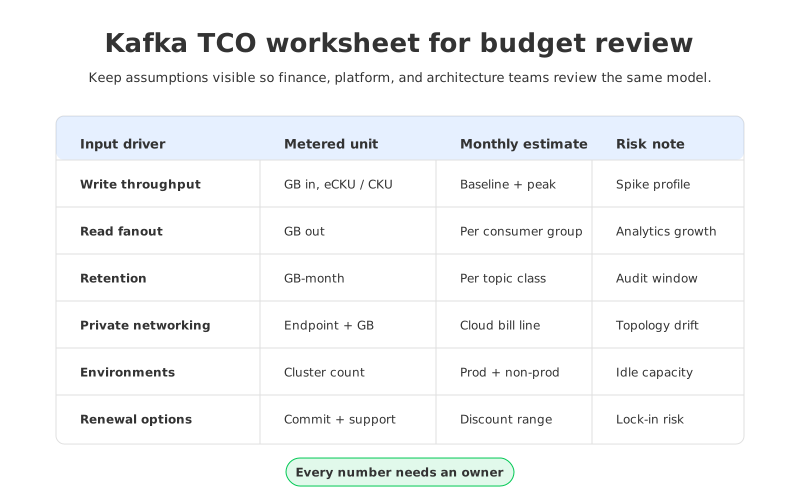
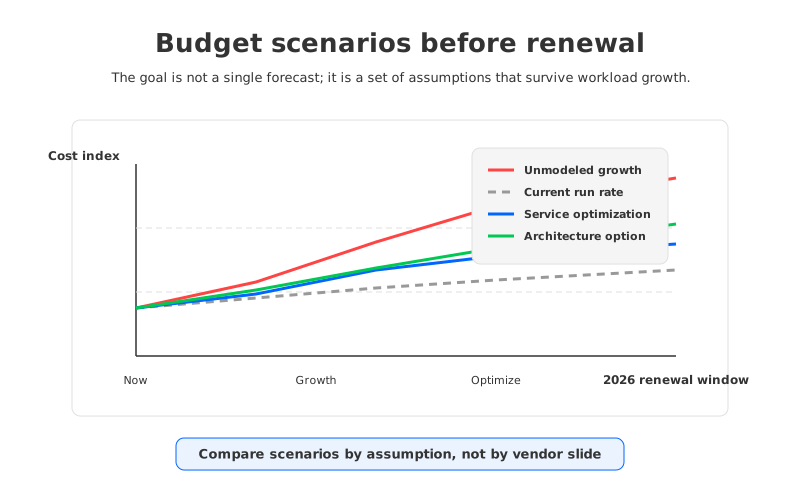
Start with the current bill, but do not let it become the forecast. The current bill only describes the current workload, topology, contract, and operational habits. A 2026 budget needs at least four scenarios:
- Current run rate. Use actual Confluent usage, cloud networking charges, support costs, and adjacent service usage. This anchors the model in reality.
- Committed growth. Add known product launches, added regions, additional consumer teams, retention changes, and migration windows that already have executive sponsorship.
- Stress growth. Model a less comfortable case: higher read fanout, longer retention, or a region expansion that arrives earlier than planned.
- Optimization or alternative architecture. Include service-level tuning, topic lifecycle changes, networking cleanup, and another Kafka-compatible architecture if the renewal risk is material.
The worksheet should separate service consumption from cloud infrastructure effects. For example, do not hide PrivateLink or cross-region movement inside a general "networking" note. Give it a row. The same applies to non-production clusters, support commitments, migration overlap, and data export paths. These items are small until they are not, and the moment they become material is usually after the purchase order has already been approved.
Add a confidence column. Mark each row as measured, estimated from metrics, estimated from architecture, or unknown. Instead of arguing over whether a forecast is right, the team can decide which assumptions are too weak for a budget commitment.
4When pricing signals the need for an alternative
Higher cost alone is not always a reason to change platforms. Managed services absorb operational work, reduce staffing burden, and provide capabilities that would be expensive to build. A platform team should be honest about that. The better trigger for evaluating alternatives is not "the bill is high"; it is "the bill grows in a way our architecture cannot explain or control."
Several signals are worth taking seriously:
- The budget is more sensitive to read fanout than to producer growth, and consumer teams are expanding.
- Retention keeps increasing because Kafka is becoming an operational recovery layer.
- Private networking or cross-region topology is now a large part of the total cost story.
- Non-production and migration overlap are no longer temporary.
- The renewal requires a commitment before the team has modeled exit cost and workload portability.
At that point, optimization inside the current service is still the first step. Right-size cluster choices, remove idle environments, review topic retention, and clean up network paths. If those steps do not change the slope of the forecast, test a different architecture assumption rather than only a different discount.
5How AutoMQ changes the Kafka budget conversation
After the TCO worksheet is built, AutoMQ enters the discussion as a different architecture assumption rather than as a line-item discount. AutoMQ is Kafka-compatible and uses object storage as shared storage, with stateless brokers that decouple compute from persistent data. In a BYOC deployment model, the cloud resources run in the customer's own cloud environment, so the budget conversation shifts from a fully managed consumption model to cloud infrastructure, operational model, and support model.
That distinction matters. Traditional Kafka budgeting often binds broker count, local storage, replication traffic, and scaling operations together. A shared-storage design changes the unit of analysis. Storage growth can be modeled against object storage. Compute can be scaled with less dependence on data movement because brokers do not own durable local partitions in the same way. Network assumptions can be reviewed as part of the customer's cloud topology rather than only as a managed service invoice.
This does not make the worksheet disappear. It makes the worksheet more explicit. A fair comparison should still include cloud compute, object storage, write and read paths, cross-AZ or cross-region traffic, observability, operations, migration effort, and support. The difference is that the model can test whether separating compute from storage improves the slope for high-throughput, long-retention, or elastic workloads.
The strongest use of an alternative architecture review is not to pressure a vendor. It is to give the architecture team a real option. If Confluent Cloud remains the right answer after the worksheet includes growth, networking, retention, and renewal risk, the team can renew with more confidence. If the model shows that the cost curve is tied to architectural coupling, then a Kafka-compatible shared-storage option deserves a proof of concept before the renewal window closes.
6References
- Confluent Pricing
- Confluent Cost Estimator
- Kafka Cluster Types in Confluent Cloud
- Confluent Cloud Billing Overview
- Confluent Cloud Networking Overview
- AWS EC2 On-Demand Pricing: Data Transfer
- AWS PrivateLink Pricing
- Apache Kafka Documentation
- AutoMQ Architecture Overview
- What Is AutoMQ
7FAQ
7.1How is Confluent Cloud pricing calculated?
Confluent's public pricing FAQ describes Confluent Cloud Kafka clusters as being billed by eCKUs or CKUs per hour, networking per GB, and storage per GB-hour. The actual estimate depends on cloud provider, region, cluster type, usage pattern, adjacent services, commercial terms, and current pricing. Use the official Confluent pricing page and Cost Estimator for live numbers.
7.2Is Confluent Cloud pricing only about Kafka cluster capacity?
No. Cluster capacity is important, but a Kafka budget should also include ingress, egress, storage retention, private networking, cross-region movement, non-production environments, support, Connect, Flink, governance, and migration overlap. Some network charges may appear in the cloud provider bill rather than the Confluent bill.
7.3What should Kafka teams model before a Confluent Cloud renewal?
Model the current run rate, committed growth, stress growth, optimization options, and exit cost. Each row should have an owner, source, unit, and confidence level. Renewal planning is much safer when the team knows which assumptions are measured and which are still guesses.
7.4When should a team evaluate an alternative Kafka architecture?
Evaluate alternatives when the cost curve is driven by workload growth that tuning cannot control: high read fanout, long retention, network-heavy topology, multi-region expansion, or recurring migration overlap. The goal is not to replace a managed service reflexively; it is to test whether another architecture changes the slope of the budget.
7.5How is AutoMQ different in a TCO model?
AutoMQ is Kafka-compatible and uses object storage as shared storage with stateless brokers. In a BYOC model, teams evaluate customer-owned cloud resources, object storage, compute scaling, network paths, operations, and support. That gives Kafka teams a different architecture assumption to compare against a managed consumption model.


