
Table of Contents
Table of Contents
Kafka bills do not come only from Kafka. For teams running a managed Kafka service behind private connectivity, part of the total cost sits in the cloud network: PrivateLink or Private Service Connect endpoints, data processed through those endpoints, cross-zone traffic, inter-region paths, internet egress, NAT gateways, peering routes, and connector traffic that moves data between systems that do not share the same network boundary.
That is why "Confluent Cloud PrivateLink cost" is a narrower question than "Confluent Cloud pricing." Confluent Cloud has its own pricing model and documentation, while the hyperscalers price private connectivity and data transfer separately. A platform team can choose private networking for good reasons and still discover that the topology creates meters the Kafka team did not own before.
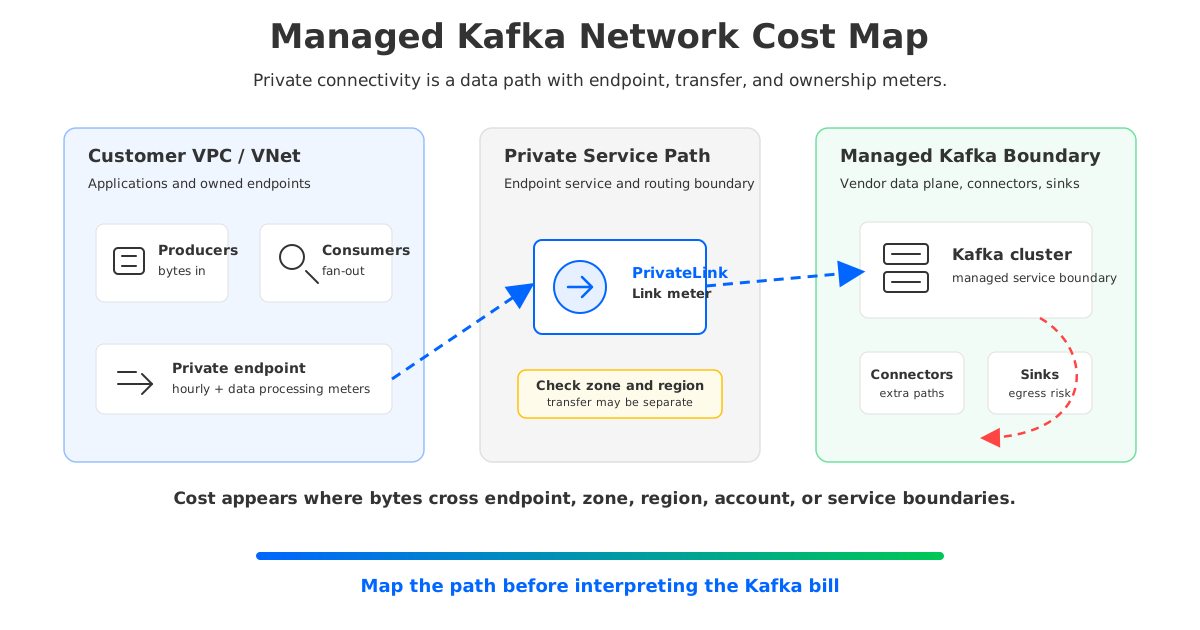
The trap is not PrivateLink itself. Private connectivity is often the right security choice. The trap is treating it as a checkbox instead of a data path with owners, hourly resources, per-GB processing, and cloud-specific transfer rules.
1Why Kafka Networking Costs Are Easy to Miss
Kafka traffic is repetitive by design. Producers write records continuously, brokers replicate and store them, consumers read at their own pace, and connectors may copy the same stream into databases, warehouses, search systems, or object storage. A small per-GB network charge can look harmless in a pricing table, but Kafka turns steady data movement into a recurring monthly line item.
Managed Kafka makes that harder to see because the service boundary is split. Your applications may run in your VPC or VNet. The Kafka service may run in a vendor-managed cloud environment. Your databases and sinks may sit in another account, another VPC, another region, or another cloud. Private connectivity can connect those pieces without public internet exposure, but it does not automatically make the path free.
Cost ownership also gets blurry. The platform team may own Kafka. The network team may own PrivateLink endpoints. The security team may require private connectivity. The application team may decide consumer fan-out. FinOps sees the bill after all of those decisions have already multiplied each other.
The result is a familiar audit problem: everyone optimized their local requirement, but nobody drew the full path from producer to Kafka to consumer to sink.
2Private Connectivity Options and Cost Triggers
Confluent Cloud documents several networking patterns, including public internet access, AWS PrivateLink, Azure Private Link, Google Cloud Private Service Connect, VPC or VNet peering in supported scenarios, and transit networking options. The right choice depends on cloud provider, cluster type, security posture, routing requirements, and operational constraints. It also depends on which bill will carry the network charges.
The common patterns are easier to compare when you separate access model from cost trigger:
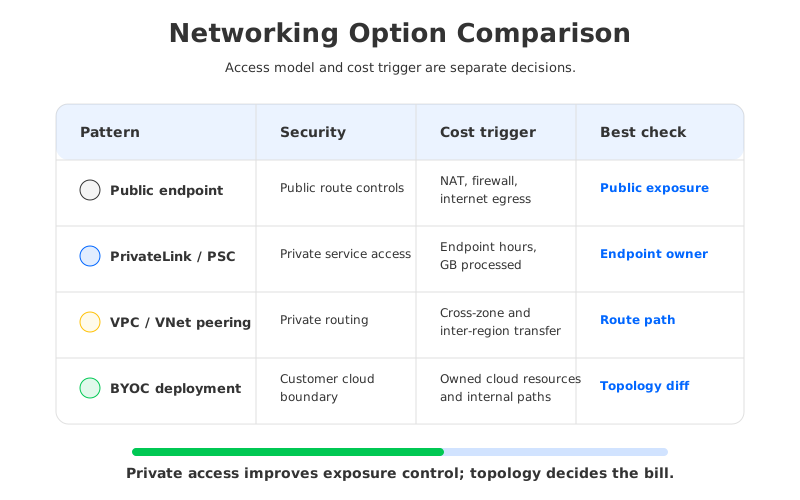
| Connectivity pattern | What it solves | Cost triggers to check |
|---|---|---|
| Public endpoint | Straightforward baseline connectivity when public access is acceptable | Internet egress, NAT gateway processing, firewall appliances, public IP controls |
| PrivateLink / Private Link / PSC | Private service access without exposing Kafka to the public internet | Endpoint hourly charges, endpoint data processing, cross-zone or cross-region paths, DNS and endpoint ownership |
| VPC or VNet peering | Private routing between networks where supported | Cross-zone transfer, inter-region transfer, route-table complexity, overlapping CIDR limits |
| BYOC Kafka deployment | Kafka data plane runs inside the customer's cloud boundary | Cloud resources in the customer account, internal network paths, object storage access, operational responsibility |
The exact numbers are cloud-, region-, and date-specific. As of May 20, 2026, AWS PrivateLink pricing describes hourly charges for each VPC endpoint per Availability Zone plus data processing by GB. Azure Private Link pricing describes private endpoint hourly charges plus inbound and outbound data processed. Google Cloud Private Service Connect pricing separates endpoint or forwarding-rule charges from data processing and producer-side networking considerations. Those pages are the pricing source of truth, not a Kafka vendor blog.
That last point matters. A managed Kafka provider may document the networking option, but the cloud provider often meters the endpoint resources. If the endpoint lives in your account, the charge may show up in your cloud bill rather than the Kafka invoice. If the data crosses zones or regions before or after it reaches Kafka, another meter may apply.
3Where Data Moves in a Managed Kafka Architecture
The expensive part of Kafka networking is rarely a single hop. It is the combination of steady write traffic, replicated or mirrored traffic, consumer fan-out, and downstream delivery. A single topic can generate several network paths:
- Producer to Kafka: application traffic leaves the producer subnet and reaches the managed Kafka endpoint.
- Kafka to consumer: every consumer group reads its own copy of the data, so fan-out multiplies read traffic.
- Kafka to connector or sink: managed connectors, self-managed connectors, databases, warehouses, and search systems may live behind different network boundaries.
- Migration or disaster recovery: cluster linking, mirroring, backup, or dual-running periods can duplicate traffic between clusters.
- Observability and operations: metrics, logs, audit data, and admin access may follow different network routes than application data.
Those paths do not all have the same price. Same-zone private traffic, cross-zone private traffic, inter-region transfer, and internet egress are different categories in cloud pricing. Even when two services are "on AWS," "on Azure," or "on GCP," the bill can change if the traffic crosses an Availability Zone, region, account boundary, endpoint service, NAT device, or managed service boundary.
This is where Kafka-specific behavior matters. A low-retention command topic with a few consumers has a different network profile from a high-throughput analytics topic consumed by a dozen downstream systems. The Kafka invoice may show one cluster, but the cloud network bill sees every copy of the bytes.
For Confluent Cloud specifically, private networking should be evaluated alongside cluster type, cloud provider, region, endpoint model, connector placement, and the documented limits of each networking option. Confluent's networking documentation is the starting point for what is supported. Your cloud pricing pages are the starting point for what is metered. The architecture diagram is where the two meet.
4How BYOC Changes the Network Boundary
BYOC does not make networking disappear. It changes where the data plane runs, which cloud account owns the resources, and which paths may stay inside the customer's network boundary. That can simplify cost analysis when most producers, consumers, storage, and downstream systems already live in the same cloud environment, because the Kafka platform is no longer a separate SaaS data plane reached through a vendor-managed service boundary.
AutoMQ Cloud is relevant in this discussion because it supports a BYOC model for Kafka-compatible streaming. AutoMQ's documentation describes a cloud-native Kafka-compatible platform with control-plane management and customer-cloud deployment. In that model, the evaluation question changes from "how do we privately reach the vendor's Kafka cluster?" to "what network paths remain inside our cloud environment, and which paths still leave it?"
That distinction is useful, but it should be handled carefully. BYOC can reduce or simplify certain private connectivity paths when applications, brokers, object storage, and sinks are co-located in the customer's VPC or VNet design. It can also expose the team more directly to cloud resource, storage, and network line items. The benefit is not a blanket promise that every network charge goes away. The benefit is that the boundary is more explicit and often easier for FinOps, security, and platform teams to inspect together.
For teams comparing Confluent Cloud with a BYOC Kafka-compatible platform such as AutoMQ, the useful test is a topology diff:
- Which producer and consumer paths currently cross a managed-service boundary?
- Which paths would stay within the same VPC, VNet, region, or cloud account after BYOC deployment?
- Which data still has to cross zones, regions, accounts, or clouds because of application placement?
- Which team owns the cloud resources and endpoint charges before and after the change?
- Which migration phase temporarily doubles traffic because both platforms run in parallel?
Those questions keep the analysis grounded. BYOC is not automatically the right answer for every Confluent Cloud user. It is worth evaluating when private networking cost, data-plane ownership, committed cloud spend, or network-path transparency has become part of the Kafka decision.
5Network Cost Audit Checklist
A good audit starts with traffic, not invoices. The invoice tells you what was charged; the topology tells you why it was charged. For each production workload, trace the path from source application to Kafka to every consumer and sink, then mark which organization owns each meter.
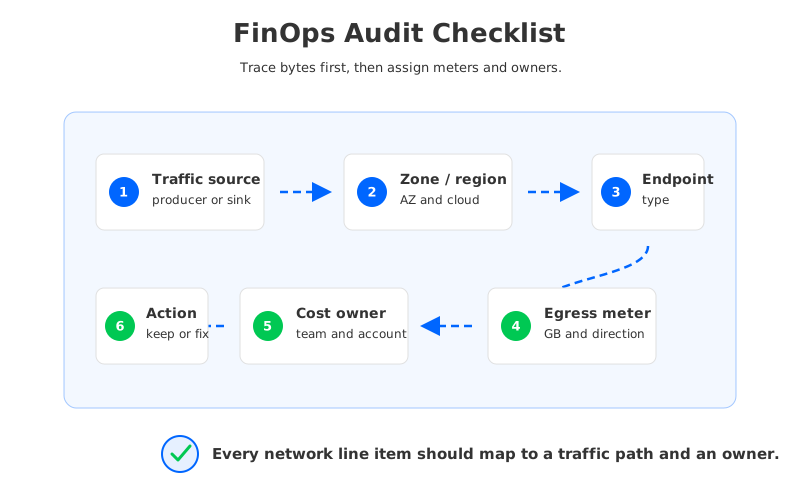
Use this checklist before a renewal, migration, or private networking redesign:
| Audit question | Evidence to collect | Owner to involve |
|---|---|---|
| Where are producers and consumers deployed? | VPC/VNet, subnet, AZ, region, account, cloud provider | Platform, application teams |
| How does each client reach Kafka? | Public endpoint, PrivateLink, Private Link, PSC, peering, transit gateway | Network, security |
| What traffic crosses zones or regions? | Flow logs, cloud billing dimensions, Kafka client placement | FinOps, cloud platform |
| Where do connectors and sinks run? | Managed connector location, self-managed worker subnet, database region | Data platform, app owners |
| How much fan-out exists? | Consumer group list, bytes out by topic, downstream pipelines | Kafka platform |
| What changes during migration? | Dual-write, mirroring, cluster linking, rollback window | Migration owner |
The audit should end with a simple map: traffic source, Kafka endpoint, network boundary, metered service, owner, and expected change. If a line item cannot be mapped to a path, the team does not yet understand the cost model.
Private connectivity is still a strong default for sensitive Kafka workloads. The point is to attach it to an operating model. When the data path is explicit, security can require private access, platform can choose the Kafka deployment model, and FinOps can see whether the private path is worth its recurring cost.
6Sources
- Confluent Cloud networking overview
- Confluent Cloud AWS PrivateLink networking
- Confluent Cloud pricing
- AWS PrivateLink pricing
- AWS EC2 data transfer pricing
- Azure Private Link pricing
- Google Cloud Private Service Connect pricing
- AutoMQ Cloud overview
- AutoMQ compatibility with Apache Kafka
7FAQ
7.1Does Confluent Cloud PrivateLink have a separate cost?
Private connectivity can create costs outside the Kafka service itself. Depending on cloud provider and topology, you may pay for endpoint hours, data processing, cross-zone transfer, inter-region transfer, NAT, or related networking resources. Use Confluent's networking documentation to confirm the supported model and the cloud provider's pricing page to confirm the current metering rules.
7.2Is PrivateLink always more expensive than a public endpoint?
No. A public endpoint can introduce its own costs through internet egress, NAT gateways, firewall appliances, and operational controls. PrivateLink-style connectivity adds endpoint and processing meters, but it may reduce security exposure and simplify access controls. The right comparison is a full-path cost model, not endpoint type alone.
7.3Does BYOC eliminate Kafka networking costs?
No. BYOC changes the deployment boundary; it does not suspend cloud networking rules. It may keep more Kafka traffic inside the customer's VPC, VNet, region, or account design, which can simplify or reduce certain paths. Exact costs still depend on cloud provider, region, AZ placement, endpoint design, consumer fan-out, and downstream systems.
7.4What should I check first if Confluent networking costs look high?
Start with bytes out by topic and consumer group, then map where each consumer runs. Read fan-out often explains more than the private endpoint itself. After that, check endpoint ownership, cross-zone or inter-region transfer, connector placement, NAT gateways, and any migration or replication traffic.
7.5Can AutoMQ replace Confluent Cloud for private Kafka workloads?
AutoMQ can be evaluated as a Kafka-compatible alternative when the requirement is to keep the Kafka protocol while changing the deployment and storage model. The fit depends on client compatibility, migration requirements, network topology, operational ownership, and whether BYOC aligns with the organization's security and FinOps goals.


