
Table of Contents
Table of Contents
A Confluent Cloud renewal is not only a procurement event. For a Kafka estate behind customer journeys, payment flows, telemetry, analytics pipelines, and AI features, renewal is where engineering assumptions become commercial obligations. The contract you sign will usually outlive the budget quarter and the growth forecast that justified last year's platform choice.
That makes renewal a useful forcing function. Before signing, a Kafka team should know what it is buying, how usage is changing, where cost exposure hides, and whether the organization still has a credible technical exit path. Even a renewal should leave the team with a cleaner usage baseline, a better growth forecast, and stronger leverage.
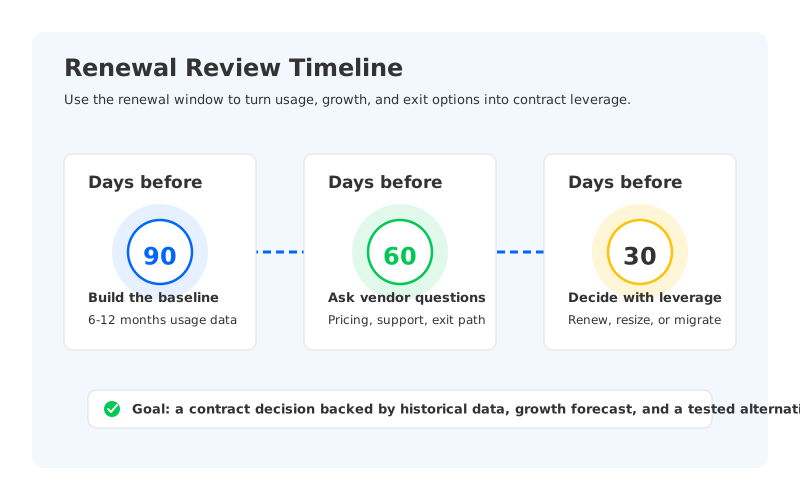
The strongest renewal reviews start 90 days before the commercial deadline. At 90 days, build the usage baseline. At 60 days, send structured questions to the vendor and alternative providers. At 30 days, decide with evidence instead of urgency. Teams that start earlier can negotiate architecture, support, data control, and migration optionality, not only price.
1Why Renewal Should Trigger a Kafka Platform Review
Kafka contracts are unusual because the commercial unit is tied to a living system. Throughput grows, retention policies drift, new consumer groups appear, connectors multiply, and "temporary" environments become part of the operating model. A renewal based on last year's workload can be accurate on the signature date and wrong six months later.
Confluent's public pricing material shows that Confluent Cloud pricing varies by cloud provider, region, cluster type, and usage dimensions such as ingress, egress, storage, partitions, and cluster capacity units for Dedicated clusters. Its documentation also distinguishes Basic, Standard, Enterprise, Freight, and Dedicated cluster types, with Dedicated clusters sized using CKUs or eCKUs depending on the cluster family. Renewal analysis has to map technical behavior to those commercial units before procurement can judge whether the offer matches the workload.
The review should not start with "is Confluent expensive?" A better starting point is whether the contract gives the organization predictable cost, enough operational headroom, acceptable support response, clear data-control terms, and a workable path if the platform direction changes.
| Renewal area | What to verify | Why it matters |
|---|---|---|
| Usage baseline | Ingress, egress, retained storage, partitions, connectors, environments, and cluster sizing | Prevents renewal pricing from being based on stale or partial data |
| Growth forecast | 6-12 months of historical growth, upcoming workloads, fan-out, retention, and regional expansion | Exposes the next cost step before it arrives |
| Commercial exposure | Commit level, overage treatment, support package, SLA, renewal uplift, and termination language | Converts platform risk into contract questions |
| Technical optionality | Client compatibility, migration path, networking, data export, and rollback plan | Keeps renewal from becoming a lock-in event |
The purpose is to make sure the platform still matches the business shape. A company with predictable event volume and modest retention has a different risk profile from a company whose data roadmap will triple fan-out and extend retention from days to months.
2Usage and Growth Questions
Start with usage because every renewal discussion gets vague when usage is vague. Pull the last 6-12 months of Confluent Cloud metrics, invoices, cloud network charges, connector inventory, topic inventory, and incident history. Then split the data into production, staging, development, and experimental environments. Many Kafka bills are shaped by dozens of small decisions that accumulate quietly.
The first question is whether the team understands current Kafka demand in operational terms. Average throughput is not enough. Peak ingress, burst duration, consumer fan-out, retained bytes, partition count, and cross-region traffic all matter because sharp peaks can price differently under different models.
Ask these questions before accepting a renewal quote:
- What were the monthly ingress, egress, retained storage, partition count, and connector usage trends during the last 6-12 months?
- Which clusters or environments drove the largest changes in spend, and were those changes caused by business growth, architecture changes, temporary projects, or misconfiguration?
- Which topics have retention policies that no longer match business requirements?
- Which consumer groups create the most fan-out, and are they expected to grow with new analytics, AI, or customer-facing features?
- Which workloads are planned for the next contract period, and do they change throughput, retention, region count, or availability requirements?
Growth forecasting deserves more rigor than a single percentage. Use historical monthly data to build a base case, high-growth case, and constrained-growth case. The point is not to predict the future perfectly; it is to know which assumption breaks the contract economics.
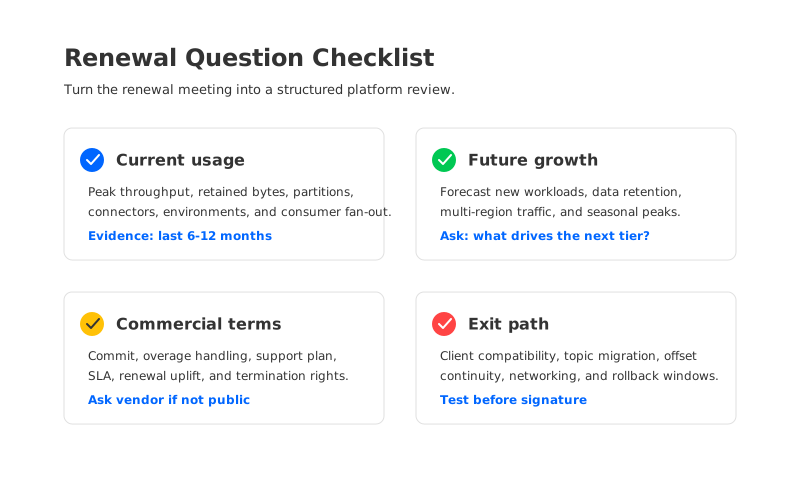
Once the usage baseline is clean, convert it into vendor questions. Ask how the renewal offer behaves if retained data doubles, egress grows faster than ingress, or the team adds a new region. For Dedicated clusters, ask how CKU or eCKU sizing is expected to change. For non-Dedicated cluster types, ask which usage dimensions are most likely to dominate the next invoice.
3Pricing and Commercial Questions
Confluent publishes useful pricing pages, but a renewal is governed by the actual order form, support terms, service descriptions, and negotiated commitments. Public pages can tell you the pricing model; they usually cannot tell you every commercial consequence of your specific contract. Treat that gap as normal and turn it into a written question list.
Ask practical commercial questions:
- What is included in the committed spend, and which services or usage dimensions can consume it?
- What happens if actual usage exceeds the committed amount or the expected cluster capacity?
- Are support packages, private networking, connectors, stream processing services, or governance features priced separately?
- What service credits, SLA remedies, renewal uplift limits, termination rights, and data-return obligations appear in the order form or governing terms?
- Which price protections survive expansion, region changes, new environments, or a move between cluster types?
Support is worth isolating from platform price. Confluent's public support documentation explains that support packages and entitlements are visible in the Cloud Console. Renewal teams should still ask what response times, escalation paths, production-severity definitions, and named support options apply to their account. If a detail is not public, ask your vendor to put the answer in writing.
The same discipline applies to networking. Kafka's value often comes from moving events between many systems, which means private connectivity, public egress, inter-region flows, and cloud-provider data transfer can become part of the real TCO. Confluent's price page and billing documentation identify network traffic as a pricing dimension, but your cloud bill may also contain provider-side networking charges depending on topology.
Build a "renewal shadow invoice" for the next contract year. Take the last 6-12 months of usage, apply the base-case and high-growth forecast, then annotate which line items are covered by the proposed commitment. If a line item cannot be mapped from public documentation, mark it as "vendor confirmation required."
4Technical Exit-Path Questions
Exit-path review is not an anti-renewal exercise. It is the technical equivalent of disaster recovery: you hope you do not need it, but the plan changes the risk profile of every decision. A Kafka platform with no tested migration path can turn a one-year renewal into a multi-year dependency.
Apache Kafka's documentation gives the baseline concepts that make migration planning possible: topics are partitioned logs, consumers track offsets, clients use Kafka protocols, and Kafka Connect moves data between Kafka and external systems. Migration still requires choices about topic copying, offset continuity, ordering validation, and rollback under load.
4.1Compatibility and Migration
The first compatibility question is whether applications use standard Kafka clients and APIs or depend on vendor-specific services around the broker. Standard producers and consumers create a different migration surface from proprietary governance, stream processing, connector, or managed networking features.
Ask the platform team to classify every workload:
- Standard Kafka clients with ordinary producer and consumer behavior.
- Kafka Connect or connector-heavy workloads with source and sink dependencies.
- Workloads using schema governance, stream processing, private networking, or managed integrations that require vendor-specific review.
- Workloads with strict ordering, exactly-once processing assumptions, long retention, or sensitive rollback requirements.
Test the migration plan on a representative workload, not a toy topic. Copy traffic, validate consumer lag, compare message counts, test failback, and document the runbook. If the team cannot test before renewal, the contract should reflect that uncertainty.
4.2Networking and Data Control
Networking questions often expose hidden lock-in earlier than application compatibility questions. Where does the data plane run? Which VPCs, private endpoints, DNS names, and firewall rules are required? Who controls encryption keys, audit logs, and data residency? What happens to retained data when the subscription ends?
These questions are important because the answers are not interchangeable across managed Kafka models. A fully managed SaaS model optimizes for operational delegation. A bring-your-own-cloud model keeps the data plane closer to the customer's cloud account. A self-managed Kafka estate gives more control but more operational burden. Renewal is the right time to decide which boundary still matches the company.
5Benchmarking Confluent Against AutoMQ
Benchmarking an incumbent against an alternative does not require a full migration commitment. It requires a credible reference point. AutoMQ is useful in that role because it is Kafka-compatible, runs with a BYOC deployment model, and uses an object-storage-centered architecture to change the cost structure of Kafka storage. That lets teams separate managed-service convenience, unavoidable Kafka workload cost, and architecture or contract effects.
The comparison should be framed around decision criteria, not vendor slogans.
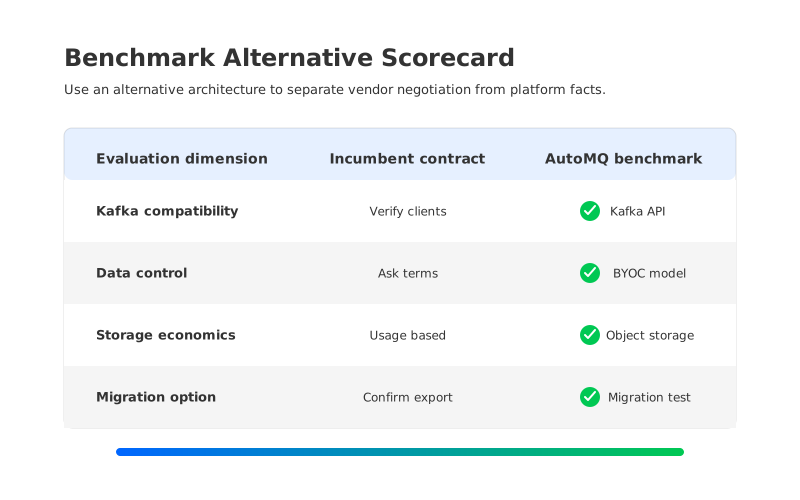
For compatibility, test representative producers, consumers, admin tooling, and observability workflows. For data control, compare where the data plane runs and who owns the cloud resources. For storage economics, compare the incumbent usage model with AutoMQ's object-storage cost model using the same throughput, retention, and fan-out assumptions. For migration, compare topic replication, offset handling, validation, cutover, and rollback.
AutoMQ should not appear in the renewal process as a magic discount button. It should appear as a benchmark alternative that forces better questions. If the Confluent renewal is still the right choice, the benchmark clarifies why. If the benchmark exposes a material cost or control gap, leadership has a second path before the signature date closes.
The most useful evaluation output is a scorecard with evidence attached:
| Dimension | Renewal question | Evidence to collect |
|---|---|---|
| Kafka compatibility | Can key clients and tools run without application redesign? | Client matrix, integration test results, producer/consumer behavior |
| Cost model | Which line items scale with throughput, storage, retention, and network traffic? | Historical usage, forecast model, pricing calculator output |
| Operational control | Where does the data plane run, and who controls networking and cloud resources? | Architecture diagram, VPC design, IAM and encryption review |
| Migration confidence | Can the team move a representative workload and roll back safely? | Pilot runbook, validation metrics, rollback test |
This scorecard turns an emotional renewal debate into a fact pattern. Instead of asking for a generic discount, the buyer can ask for pricing, terms, or support commitments that match the real alternatives on the table.
6A 30/60/90-Day Renewal Operating Rhythm
At 90 days, build the baseline and assign owners. FinOps should own invoice normalization and forecast scenarios. Platform engineering should own workload inventory, cluster sizing, and migration risk. Security and networking teams should own data-control questions. Procurement should own the commercial question log.
At 60 days, run the comparative work. Send the structured question list to Confluent. Run a benchmark exercise with AutoMQ or another Kafka-compatible alternative using the same workload assumptions. Test a representative migration path if optionality is strategically important.
At 30 days, narrow the decision. Do not let unresolved technical unknowns hide inside a legal sprint. If the team is renewing, confirm usage assumptions, overage treatment, support coverage, SLA remedies, and data-exit terms. If the team is migrating or keeping optionality open, confirm timeline, rollback, interim commit size, and first workloads.
The renewal signature should never be the first time the organization learns what its Kafka platform costs under growth. It should be the point where engineering, finance, and procurement agree on the next operating period. If AutoMQ is part of the benchmark, use it to sharpen that agreement: same Kafka-facing expectations, different deployment and storage economics, measured against the same workload history.
Before the next renewal calendar invite appears, pull the last 6-12 months of Kafka usage and build the first forecast. AutoMQ's Kafka compatibility, BYOC model, and object-storage architecture make it a practical benchmark; Confluent's public documentation gives you the renewal questions to ask the incumbent. The stronger move is not to threaten migration. It is to make renewal a choice, not a deadline.
7References
- Confluent Cloud pricing
- Confluent Cloud billing overview
- Confluent Cloud cluster types
- Confluent support plans and support portal documentation
- Confluent legal terms
- AutoMQ pricing
- AutoMQ BYOC documentation
- AutoMQ migration overview
- Apache Kafka documentation
8FAQ
8.1When should a team start a Confluent Cloud renewal review?
Start 90 days before the signature deadline. That leaves time to collect 6-12 months of usage, model the next period, ask vendor questions, and test a benchmark alternative.
8.2What Confluent Cloud renewal questions should procurement ask?
Ask what is included in the commitment, how overages work, which services consume committed spend, what support package applies, what SLA remedies exist, and how data return or termination is handled. If a detail is not public, ask the vendor to confirm it in writing.
8.3What technical questions should platform teams ask before renewing?
Platform teams should verify current and forecasted throughput, retained storage, partition counts, connector usage, networking topology, client compatibility, migration path, and rollback plan.
8.4Is AutoMQ a direct replacement for Confluent Cloud?
AutoMQ is best evaluated as a Kafka-compatible benchmark alternative with a BYOC deployment model and object-storage-based cost structure. Whether it is a replacement depends on surrounding Confluent services, operational requirements, migration constraints, and data-control goals.
8.5Should we renew if we are not ready to migrate?
Possibly. Many teams renew because the incumbent remains the right operational choice. A clean baseline, written vendor answers, and a scoped exit path can preserve leverage for the next cycle.


