
Table of Contents
Table of Contents
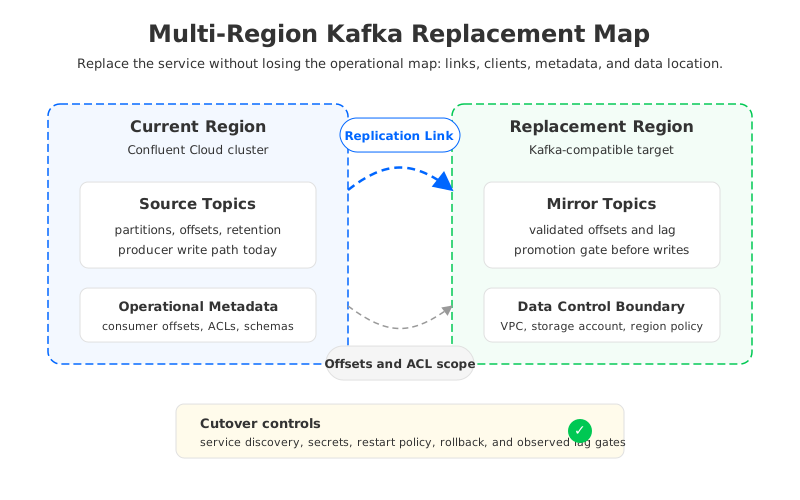
Replacing a single Kafka cluster is mostly a compatibility exercise. Replacing Confluent Cloud in a multi-region Kafka architecture is a control-plane, network design, and failure-mode exercise. The hard part is not proving that another service can accept Kafka protocol traffic. The hard part is preserving replicated topics, offsets, schema access, bootstrap behavior, private connectivity, and the runbook that decides when a standby region becomes active.
That distinction matters because Confluent Cloud often sits in the middle of a larger operating model. Teams use Cluster Linking to copy data across regions or clouds, networking features to keep traffic private, and managed services around Kafka to reduce platform burden. A Confluent Cloud replacement for multi-region Kafka has to answer the same operational questions without pretending that failover is automatic. If the evaluation starts with broker price, it will miss the paths where risk and cost accumulate.
1Why Multi-Region Kafka Changes Replacement Planning
Multi-region Kafka is rarely one pattern. Some teams run active-passive disaster recovery, where a primary region accepts writes and a secondary region receives replicated data. Others run regional read replicas so local consumers avoid long-distance fetches. A smaller group runs active-active patterns, usually with strict topic ownership rules, because Kafka does not make conflicting writes to the same logical stream safe. Each pattern changes what "replacement" means.
In a single-region migration, you can often reason in a sequence: copy topics, move producers, move consumers, validate lag, retire the source. In a multi-region replacement, that sequence branches. A source topic might feed a mirror topic in another region, a consumer group might depend on state outside Kafka, and a network path might be private inside one cloud provider but public or proxied across a cloud boundary.
This is why the first artifact should be a dependency map, not a vendor comparison spreadsheet. For each Confluent cluster, document:
- Which topics are authoritative in that region, and which are mirrored copies.
- Which consumer groups must resume after failover, and whether they tolerate duplicates.
- Which applications can restart during a failover, and which need an external wrapper or operator.
- Which schemas, connectors, ACLs, and service accounts are part of the cutover.
- Which traffic paths cross regions, clouds, accounts, VPCs, or private endpoints.
Confluent's Cluster Linking documentation frames the feature as a managed service for replicating data between Confluent clusters, including multi-cloud, data sharing, disaster recovery, and migration use cases. Its mirror topics, offset sync, ACL sync, supported cluster combinations, and limitations show what a replacement must preserve or deliberately redesign.
2Replication and Failover Questions
The first question is not "does the replacement replicate data?" It is "what exactly is being replicated, and what does that imply for failover?" Topic bytes, topic configuration, consumer offsets, ACLs, schemas, and connector state do not all share semantics. Some systems copy records but rename topics. Some preserve offsets. Some sync consumer group checkpoints asynchronously. Some make mirror topics read-only until promotion.
Confluent's disaster recovery documentation is explicit that RTO depends on tooling and procedures because application failover remains the user's responsibility. It also defines RPO in relation to mirroring lag: records acknowledged by the primary before they are replicated may be at risk during an outage. Treat RPO and RTO as measured properties of a tested architecture, not as universal properties of a product name.
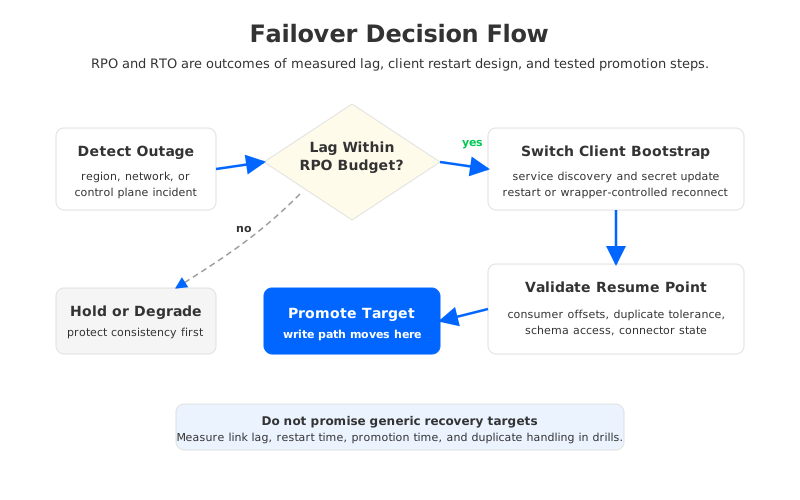
A practical replacement review should separate replication from promotion:
| Decision area | What to verify before replacing Confluent Cloud |
|---|---|
| Topic mapping | Whether mirrored topics keep the same names, partition counts, offsets, and retention behavior expected by consumers. |
| Offset continuity | Whether consumer offsets are copied, translated, or reset, and how duplicate processing is handled after failover. |
| Write authority | Which cluster is allowed to accept writes for each topic during normal operation and during failover. |
| Promotion behavior | Whether a mirror topic or target topic needs an explicit promotion step before writes move to the target. |
| Metadata scope | Whether ACLs, schemas, quotas, and service accounts move with data or require separate automation. |
| Rollback path | Whether rollback would create divergent writes, and how the team detects that condition before acting. |
The table is intentionally operational. It avoids the vague phrase "multi-region ready." A replacement architecture is multi-region ready only after you know what happens when the primary region is unavailable, the replication link is behind, service discovery changes, and clients do not restart together.
MirrorMaker 2 is still a relevant reference point because Apache Kafka documents it as the native cross-cluster mirroring mechanism. It supports replication flows, source and target aliases, topic and group selection, and metrics such as record age, replication latency, byte rate, and checkpoint latency. It also exposes production concerns: replicated topic naming, configuration conflicts, target-side placement to reduce producer lag, and process restarts for configuration changes.
That does not make MirrorMaker 2 the preferred path for every Confluent replacement. It means the replacement must be judged against the operational facts MirrorMaker exposes: lag, checkpoint behavior, topic naming, and target-side production. A managed linking feature, a BYOC migration feature, or a custom pipeline should make those facts easier to control.
3Networking and Cross-Region Cost Questions
Multi-region Kafka cost is a path problem. A workload can look cost-effective inside one cluster and become expensive when producers, consumers, replication jobs, managed connectors, and storage cross different boundaries. Confluent Cloud networking documentation distinguishes public connectivity from private options such as VPC peering, VNet peering, AWS Transit Gateway, PrivateLink, Azure Private Link, Google Cloud Private Service Connect, and Private Network Interface. It also notes trade-offs around access, DNS, transitive routing, and management overhead.
Those choices determine who owns the route, whether traffic stays private, how many VPCs can reach the cluster, and where per-GB processing or data transfer charges may appear. A Confluent Cloud replacement should model the network as part of the service.
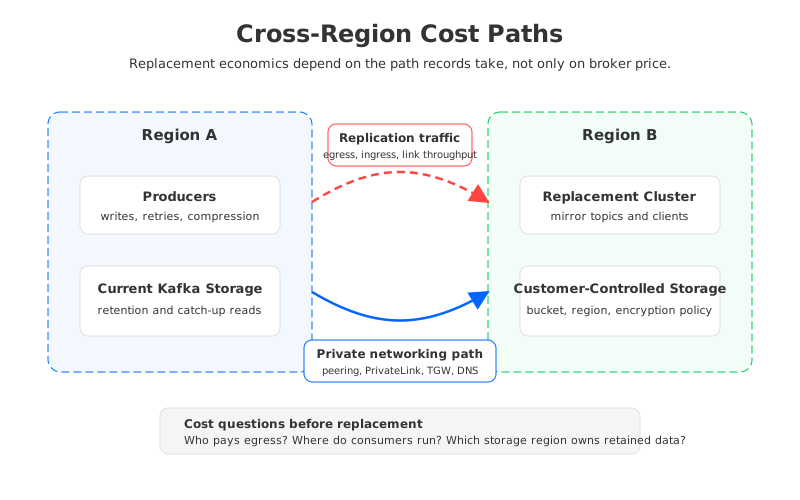
The cost review should include four traffic classes:
- Replication traffic. Cross-region or cross-cloud mirroring throughput can be charged by the streaming service, by the cloud provider, or by both depending on architecture. Measure sustained throughput, peak catch-up throughput, and replay volume.
- Client traffic. Producers and consumers may live in different accounts, VPCs, Kubernetes clusters, or cloud providers. A replacement that changes endpoint placement can move traffic from private intra-region paths to cross-region egress paths.
- Connector and processing traffic. Managed connectors, Flink jobs, stream processors, and CDC pipelines may have their own networking model. Replacing Kafka without replacing these surrounding services can create extra hairpins.
- Storage and retention traffic. Multi-region retention is not free because brokers are smaller. Ask where retained data lives, who owns the storage account or bucket, how encryption is managed, and what happens during catch-up reads.
This is where BYOC architectures become relevant. AutoMQ Cloud BYOC, for example, is documented as deploying software services in the user's cloud account, with data staying in the user's VPC. In a multi-region replacement discussion, that is not a generic "lower cost" claim. It is a control question: can the platform team decide the VPC topology, storage location, encryption policy, cloud discount model, and private route design using its own cloud architecture standards?
The answer may matter more than a line-item service discount. If the team already has strict region residency requirements, centralized networking, cloud account guardrails, or negotiated storage pricing, a replacement that runs inside the customer cloud account can align Kafka with those controls. BYOC gives more control over data paths and storage placement; it does not remove the need for a failover runbook.
4Data Control and Compliance Questions
Confluent Cloud replacement becomes a data control project when the event stream contains regulated, regional, or customer-sensitive data. The architecture team has to prove where data is written, where it is copied, who can access it, and which provider-level controls apply. In a multi-region design, this includes primary topics, mirrored topics, backup regions, connector destinations, monitoring exports, and dead-letter topics.
Ask these questions before narrowing the vendor list:
- Can the replacement run in the required cloud account, region, VPC, and storage service?
- Can data residency be enforced by architecture, not only by policy language?
- Are encryption keys, IAM roles, private endpoints, and audit logs customer-controlled?
- Can topic filters keep unnecessary data from crossing regional boundaries?
- Can schema and connector metadata be handled without silently creating another sensitive copy?
AutoMQ should appear in this evaluation as one possible Kafka-compatible, cloud-native architecture option, not as a bypass around compliance work. Its documentation states that AutoMQ Cloud is compatible with Apache Kafka and that BYOC deploys resources in the user's VPC. Its migration docs describe Kafka Linking into AutoMQ, including byte-to-byte replication, synchronized consumption progress, producer proxying, and mirror topic promotion. Those capabilities are relevant because they target application migration risks that often block replacement.
The careful wording matters. AutoMQ's documented Kafka Linking flow is a migration mechanism into AutoMQ, not a blanket statement that every active-active, multi-cloud DR topology works the same way. Use the docs to validate migration semantics, then validate the target multi-region design with solution architecture and failure drills. Kafka compatibility can reduce application migration risk, but it does not automatically resolve surrounding dependencies such as managed connectors, schema governance, or application-specific idempotency.
5How AutoMQ Can Fit Into a Multi-Region Migration Plan
The strongest place to evaluate AutoMQ is the controlled migration path, not a broad promise that one architecture solves every DR pattern. If the team wants control over where Kafka data sits and how cloud resources are owned, BYOC changes the operating boundary. If the team wants to reduce rewrite risk, Kafka compatibility and migration tooling become central.
AutoMQ Kafka Linking is relevant because it addresses three migration concerns that tend to be painful in Confluent exits:
- Offset continuity. AutoMQ documentation describes byte-to-byte copy and synchronized consumer progress so computation engines and consumers can resume with consistent position information after migration.
- Producer cutover. The documented producer proxy path is designed to support phased producer access-point migration, with rollback considerations before final promotion.
- Promotion discipline. The migration flow keeps mirror topics under a controlled state until producers and consumers have moved, then promotes mirror topics after validation.
These are replacement mechanics, not slogans. A platform team should still run a batch migration plan, define which topics and consumer groups are in each wave, monitor lag, test rollback while the source remains authoritative, and promote only when producers and consumers have moved. For workloads with strict DR objectives, extend the same discipline to regional failure drills: simulate source unavailability, measure link lag, update client bootstrap configuration, restart consumers, verify duplicates, and document when rollback becomes unsafe because writes have diverged.
A sensible evaluation sequence:
- Map the current Confluent Cloud multi-region topology, including Cluster Linking, networking, schemas, connectors, and consumers.
- Classify topics as authoritative, mirrored, internal, or deprecated, then decide which ones belong in the replacement scope.
- Define RPO/RTO per workload, tied to measured lag and restart procedures rather than a generic platform statement.
- Build a pilot target in the desired ownership model, such as BYOC when customer-controlled VPC and storage placement are required.
- Migrate a low-risk topic set and validate offsets, consumer behavior, producer switching, and rollback.
- Run a regional failover exercise before moving critical workloads.
The point is to avoid a false finish line. A Confluent Cloud replacement is not complete when producers can write to another bootstrap address. It is complete when the team can explain what happens to each critical stream during normal replication, planned migration, unplanned failover, and recovery after the failed region returns.
6Multi-Region Replacement Checklist
Use this checklist before approval:
- Inventory every Cluster Link or replication flow: source, target, topic filters, offset behavior, and lag metrics.
- Confirm Kafka API compatibility against real producer, consumer, admin, and stream-processing clients.
- Decide whether topic names and offsets must remain identical or can be translated.
- Validate schema, ACL, service account, and connector migration separately.
- Model cross-region traffic paths for steady state, catch-up, failover, and rollback.
- Define RPO as the maximum acceptable unreplicated data window for each workload, measured through observed lag.
- Define RTO as the time to detect, decide, update bootstrap configuration, restart clients, and validate processing.
- Document duplicate-handling expectations for each consumer group.
- Test promotion and rollback before critical topics move.
- Require solution review for any active-active pattern with writes in more than one region.
If your team is evaluating AutoMQ, start with the migration documentation and the BYOC architecture boundary. The useful question is not "can this replace Confluent?" in the abstract. It is "can this replace our specific multi-region Confluent operating model while giving us the data path, storage ownership, failover behavior, and migration mechanics we need?"
7References
- Confluent documentation: Cluster Linking on Confluent Cloud
- Confluent documentation: Cluster Linking Disaster Recovery and Failover on Confluent Cloud
- Confluent documentation: Manage Networking on Confluent Cloud
- Apache Kafka documentation: Geo-Replication with MirrorMaker 2
- AutoMQ documentation: What Is AutoMQ Cloud
- AutoMQ documentation: Migrate to AutoMQ Overview
- AutoMQ documentation: Executing Migration
8FAQ
8.1Is a Confluent Cloud replacement for multi-region Kafka mostly a cost decision?
No. Cost matters, but multi-region replacement is primarily about replication semantics, failover behavior, networking paths, data control, and migration risk. A lower broker bill can be erased by cross-region egress, duplicate pipelines, connector hairpins, or a failed cutover.
8.2Can any Kafka-compatible service replace Confluent Cloud in a DR architecture?
Kafka compatibility helps producers and consumers move with fewer application changes, but DR depends on topic mapping, offset handling, schema and ACL migration, client restart behavior, lag monitoring, and tested failover procedures.
8.3What determines RPO and RTO in a multi-region Kafka replacement?
RPO depends on how much acknowledged data may not yet be replicated when the source fails. In asynchronous replication designs, that is tied to observed replication lag and workload tolerance. RTO depends on detection, decision time, bootstrap and secret updates, client restart or reconnect behavior, promotion steps, and validation. Both should be measured in drills.
8.4Where does AutoMQ fit in a Confluent migration?
AutoMQ can fit when teams want Kafka compatibility plus more control over deployment boundaries through BYOC. Its documented Kafka Linking migration flow is relevant for byte-to-byte replication, consumer progress synchronization, producer cutover, and mirror topic promotion. For multi-region DR, teams should still validate the exact target architecture and failure procedures.
8.5Should we use MirrorMaker 2 for a Confluent Cloud replacement?
MirrorMaker 2 remains a useful Apache Kafka reference for cross-cluster replication, especially for understanding replication flows, topic naming, group synchronization, and lag metrics. Whether it is the right tool depends on your migration requirements, operational capacity, offset expectations, and whether a managed linking path can reduce cutover risk.


