
Table of Contents
Table of Contents
A Confluent Cloud renewal can look deceptively simple: take last year's bill, add traffic growth, negotiate the commitment, and move on. That works only when the workload is stable. Many Kafka estates are not. Retention grows as teams discover replay use cases. Consumer fan-out grows as real-time data becomes a shared platform. Private networking becomes mandatory after security review. By renewal time, the prior invoice is useful evidence, but it is not a TCO model.
The sharper question is not whether Confluent Cloud is "expensive." Confluent Cloud bundles real operational value: managed Kafka clusters, scaling options, connectors, governance services, security controls, upgrades, and commercial support. Those benefits should be counted. So should the cost drivers that sit outside the headline service rate: committed spend, storage and retention, network paths, migration work, platform team time, vendor risk, and the option value of being able to change direction later.
Renewal is the right moment to compare three futures: renew as-is, optimize the estate, or migrate selected workloads. A useful Confluent Cloud TCO worksheet makes the economics auditable enough that CTO, procurement, FinOps, architecture, and platform leaders can argue about assumptions instead of impressions.
1Why Renewal Is the Best Time to Revisit Kafka TCO
Renewal creates a decision window before the next surprise. You can use actual usage, support history, incident data, network design, and team ownership as inputs. That is stronger than a generic Kafka cost calculator because it reflects the estate you already run.
It also forces a distinction between price and cost. Price is what Confluent publishes or quotes: cluster model, usage dimensions, committed spend, support packages, and contract terms. Cost is the total system impact: cloud networking, client migration work, duplicated data during cutover, internal governance, security reviews, and the risk of building around capabilities that are hard to move. Price can be negotiated. Architecture cost compounds.
Linear forecasting breaks down when retention, read fan-out, private connectivity, or replication requirements change. Kafka economics are sensitive to where bytes move, how long they stay, how many times they are copied, and who owns the operational boundary.
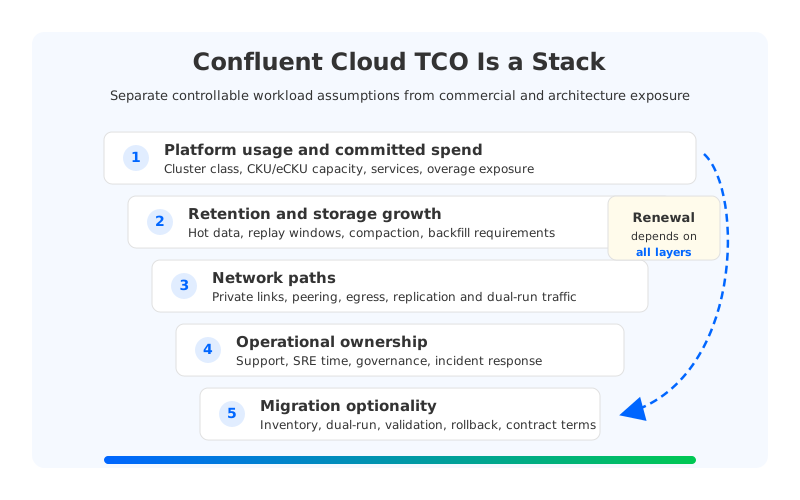
2The Five Layers of Confluent Cloud TCO
An auditable TCO model separates the cost layers instead of compressing them into one annual number. The goal is to identify which assumptions are controllable, which depend on Confluent's commercial model, and which come from the way Kafka itself moves data.
| TCO layer | What to include | Why it matters |
|---|---|---|
| Platform usage | Cluster type, CKU or eCKU capacity, throughput, partitions, services, committed spend | Shows whether the contract matches actual workload shape |
| Data retention | Hot retention, replay windows, topic growth, compaction, restore needs | Long retention turns Kafka into a storage-heavy platform |
| Network paths | Public access, private links, peering, egress, inter-region replication | The same byte can cross multiple billable boundaries |
| Operations | Support tier, incidents, upgrades, governance, monitoring, compliance | Managed value should be mapped to avoided internal work |
| Optionality | Inventory, dual-run, validation, rollback, contract terms | The ability to change architecture later has value now |
Every Kafka platform has these layers. Confluent Cloud makes some easier to operate and some more important to model. The renewal task is to decide whether the managed value and the cost shape still match the workloads you plan to keep there.
2.1Platform Usage and Committed Spend
Confluent's public pricing materials describe serverless and dedicated models and capacity concepts such as Confluent Kafka Units and elastic Confluent Kafka Units. Your enterprise contract may differ from public examples, but the worksheet should preserve the same structure: committed spend, actual consumption, overage exposure, and the workload assumptions behind each.
Treat commitment as a utilization decision, not only a procurement artifact. A commitment works when stable workloads cover it. It becomes fragile when the platform team is unsure which workloads will remain on Confluent Cloud. Split the estate into baseline production, growth, volatile evaluation, and platform-service workloads. That gives procurement a better negotiating surface and architecture a better optimization surface.
2.2Data Retention and Network Paths
Apache Kafka exposes retention through broker and topic configuration, including time-based and size-based retention. Every extra day of retained data increases what the platform must hold, replicate, recover, and possibly migrate. When teams use Kafka as a replayable operational log, storage becomes a first-order design choice.
Network paths deserve the same treatment. Confluent documents public internet access, private networking, peering, and cloud-provider-specific private connectivity patterns. Each pattern changes security posture, routing complexity, and sometimes the bill outside Confluent. Write the byte path before assigning dollars: where producers write from, where consumers read to, where replication runs, and what changes during disaster recovery or migration.
The expensive unit is often not "Kafka." It is a byte crossing the wrong boundary several times. A managed service can reduce operational burden while leaving the customer responsible for the surrounding cloud network design. That is shared responsibility in practice, and it belongs in the renewal spreadsheet.
2.3Operational Ownership and Migration Optionality
Operations is where simplistic TCO models undercount Confluent Cloud's value. Running Kafka well requires upgrades, capacity planning, partition management, incident response, security patching, client compatibility testing, and change control. Confluent Cloud offloads a meaningful share of that work, and a fair model should credit that.
The same model should count the work that remains with the customer. Client teams still own producer and consumer behavior. Platform teams still own topic governance, quota policy, security integration, observability conventions, and data contracts. FinOps still has to explain spend trends. Procurement still has to understand renewal exposure.
Migration optionality turns those responsibilities into financial inputs. Inventory topics, ACLs, schemas, connectors, quotas, clients, and retention policies. Budget for dual-run, validate offsets and failure behavior, and keep a rollback window. A team that knows the migration cost may still renew, but it renews with leverage.
3TCO Questions for SRE, FinOps, and Procurement
Strong renewal reviews are cross-functional because no single team sees the whole cost. SRE understands operational risk. FinOps sees spend drift. Procurement understands commercial leverage. Architecture understands which workloads require Confluent-specific services and which mainly need Kafka compatibility.
| Function | Questions to answer before renewal |
|---|---|
| SRE and platform | Which clusters have the highest operational risk? Which topics have unusual partitions, retention, or fan-out? Which incidents did managed support help resolve? |
| Architecture | Which workloads depend on Confluent services? Which could run on a Kafka-compatible alternative with less architectural coupling? |
| FinOps | Which cost drivers grew faster than business traffic? Which network paths appear in the cloud bill rather than the Confluent bill? |
| Security and compliance | Which private connectivity, encryption, identity, audit, and residency requirements are mandatory? |
| Procurement | What happens if usage grows, shrinks, or moves? What renewal notice periods, support terms, and exit terms affect optionality? |
These questions turn renewal from a commercial event into an architecture review. Even if the answer is to stay with Confluent Cloud, the outcome may be a cleaner commitment, shorter retention on some topics, better network design, or a deliberate decision to keep managed services where they matter most.
4How a BYOC Shared-Storage Kafka Model Changes the Equation
Once full TCO is visible, the architecture question becomes clearer: which costs are intrinsic to Kafka, and which come from the deployment model? Traditional Kafka couples compute and storage inside brokers. Brokers serve client traffic, own local disks, replicate partitions, and carry data during reassignment or recovery. That model is proven, but elasticity can become expensive because storage follows broker capacity and replication moves data through broker fleets.
A shared-storage Kafka model changes the unit of scaling. The durable log lives in cloud object storage, while brokers become more stateless compute. Storage can grow independently from traffic-serving capacity. In a BYOC deployment, the data plane runs in the customer's cloud account or VPC, so the organization keeps stronger control over network placement, security boundaries, and data residency.
AutoMQ fits into this category as a Kafka-compatible cloud-native streaming system built around object storage. Its BYOC model is designed to run in the customer's cloud account, use object storage as the persistence foundation through the S3Stream architecture, and keep brokers stateless enough to make elasticity less tied to local disk movement. The point is not that every Confluent workload should move. The point is that some Kafka workloads have a cost shape better served by separating compute from storage.
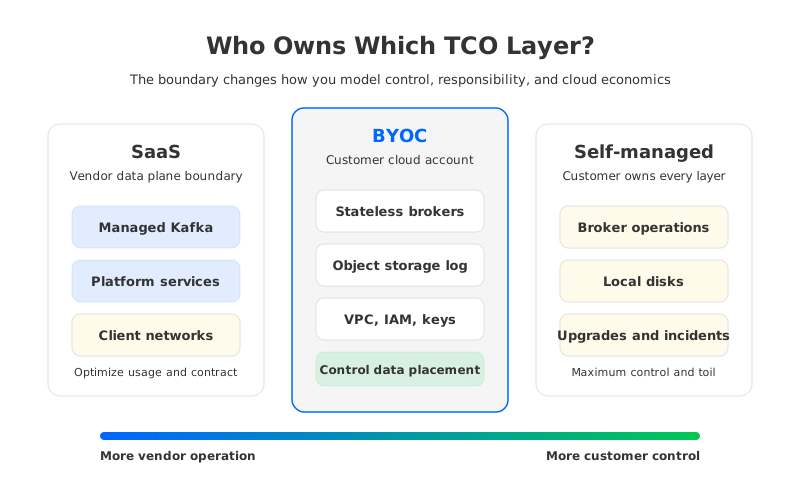
This matters most for workloads with long retention, bursty traffic, large replay windows, or strong data-control requirements. Object storage economics can be attractive because it is built for durable elastic capacity rather than broker-local disk provisioning. Stateless brokers can reduce scaling friction because adding or removing compute does not require moving the durable log in the same way.
There are trade-offs. BYOC still requires cloud-account integration, IAM design, network planning, observability, and a clear support boundary. Shared-storage Kafka architecture also requires careful engineering around write latency, metadata, recovery, and compatibility. Those trade-offs belong beside Confluent Cloud's managed-service benefits in the TCO worksheet.
5Should You Renew, Optimize, or Migrate?
A good TCO model should end with a decision framework, not a spreadsheet nobody wants to defend. Renew the workloads where Confluent Cloud's managed platform value clearly exceeds the premium. Optimize workloads where the answer is better commitment sizing, retention cleanup, topic consolidation, network redesign, or cluster-class changes. Migrate workloads where the cost structure is misaligned with the architecture requirement.
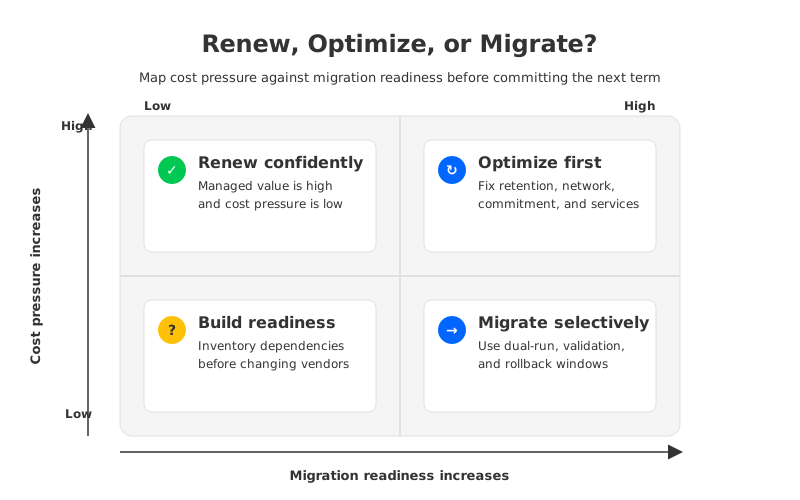
Use a 4-part test before committing:
- Value fit. Are you actively using managed platform capabilities, or mainly consuming Kafka-compatible storage and throughput?
- Cost fit. Do the largest cost drivers come from business traffic, or from retention, fan-out, networking, and architectural coupling?
- Control fit. Do security, residency, networking, or procurement requirements favor SaaS, BYOC, or self-managed control?
- Change fit. Can your teams migrate safely within the contract window, including dual-run, validation, and rollback?
The answer may differ by workload. Many teams keep strategic workloads on Confluent Cloud while moving cost-sensitive or storage-heavy workloads to a Kafka-compatible alternative. That is not a failure of standardization. It is a sign that the platform team has separated product value from protocol compatibility.
6Vendor Questions Before You Sign
Ask Confluent, your cloud provider, and any alternative vendor questions that can change a number in the model or a risk in the architecture plan.
For Confluent Cloud, clarify how committed spend, overages, cluster capacity, storage, networking features, support tier, connectors, governance, and stream processing are charged. Ask which dimensions grow if retention, read fan-out, or private networking expands.
For cloud networking, clarify which producer and consumer paths cross VPC, region, zone, NAT, private endpoint, or transit boundaries. Ask which data transfer charges appear in the cloud bill rather than the Confluent bill.
For alternatives, including BYOC shared-storage Kafka options, clarify where the data plane runs, who controls the cloud account, VPC, encryption keys, IAM roles, and object storage buckets, and which Kafka APIs and operational procedures remain compatible.
The point is not to corner a vendor. It is to prevent hidden assumptions from becoming next year's renewal problem.
7Closing the TCO Loop
The most useful Confluent Cloud TCO model is not anti-Confluent and not pro-migration. It is pro-clarity. Confluent Cloud can be the right answer when managed platform value and ecosystem services matter more than infrastructure-level cost control. A BYOC shared-storage Kafka platform can be the right answer when data control, object storage economics, and stateless broker elasticity matter more. Self-managed Kafka can still be the right answer for teams with deep operational maturity and a strong reason to own every layer.
Go back to the renewal packet and look for the assumptions behind the annual number. Which workloads are stable enough to commit? Which bytes cross network boundaries more than once? Which topics are becoming long-retention storage systems? Once those answers are visible, the renewal decision becomes calmer: renew what deserves renewal, optimize what is wasteful, and migrate only where the architecture case is strong enough to survive implementation.
If a Kafka-compatible BYOC architecture belongs in that comparison, review the AutoMQ BYOC and architecture documentation to understand how customer-account deployment, object storage, and stateless brokers change the operating model before you put numbers into the worksheet.
8References
- Confluent Cloud pricing
- Confluent Cloud billing overview
- Confluent Cloud networking overview
- Confluent Cloud private networking
- Confluent Cloud support plans
- Apache Kafka documentation
- Apache Kafka broker configuration reference
- AWS data transfer pricing
- AWS S3 pricing
- AutoMQ BYOC documentation
- AutoMQ architecture overview
- AutoMQ S3Stream shared streaming storage
9FAQ
9.1What is Confluent Cloud TCO?
Confluent Cloud TCO is the total cost of running Kafka and related streaming services on Confluent Cloud, including platform usage, committed spend, storage, retention, networking, support, operational ownership, migration effort, and commercial optionality. It is broader than the Confluent invoice because some costs appear in cloud bills or internal engineering time.
9.2Is Confluent Cloud more expensive than self-managed Kafka?
Not always. Confluent Cloud can reduce operational work, accelerate provisioning, and provide managed services that are expensive to build internally. The comparison depends on workload shape, team maturity, support needs, retention, networking, and how much of the broader Confluent platform you use.
9.3What should I review before a Confluent Cloud renewal?
Review committed spend coverage, cluster utilization, storage and retention growth, private networking design, read fan-out, support tier, connector and governance usage, incident history, migration optionality, and contract terms. The goal is to decide which workloads should renew, optimize, or migrate.
9.4When does BYOC shared-storage Kafka make sense?
BYOC shared-storage Kafka is worth evaluating when long retention, bursty traffic, data-control requirements, object storage economics, or independent compute and storage scaling are important. It also changes cloud-account ownership, security boundaries, and operational responsibility.
9.5Should I migrate everything at once?
Usually no. A workload-by-workload approach is safer. Keep workloads where Confluent Cloud's managed platform value is high, optimize workloads with fixable usage or networking issues, and migrate workloads where the architecture case justifies dual-run, validation, rollback planning, and team coordination.


