
Table of Contents
Table of Contents
Most AWS teams do not start a Kafka platform decision with a blank page. The first fork is usually Confluent Cloud vs Amazon MSK: one gives you a mature SaaS streaming platform; the other keeps Kafka inside the AWS operating model your platform team already uses. That is a real choice, but it is not the whole choice.
The harder question is what you want to own. Do you want Confluent to own most of the Kafka platform experience? Do you want AWS to own the managed broker service while your team owns more design and capacity decisions? Or do you want Kafka compatibility while changing the storage model that makes cloud Kafka expensive and slow to reshape? That third path is where AutoMQ enters the comparison: Kafka-compatible, BYOC-oriented, and built around shared object storage rather than broker-local disks.
The useful comparison starts with where each platform draws the line between SaaS convenience, AWS-native control, and architecture-level elasticity.
1Quick Answer by Workload
If you need the shortest possible version, use the ownership model as the first filter.
- Choose Confluent Cloud when your team wants a full SaaS streaming platform, beyond managed Kafka brokers. Confluent's public docs describe Basic, Standard, Enterprise, Dedicated, and Freight cluster types, with elastic eCKU-based capacity for several cluster types and CKU-based capacity for Dedicated clusters. It fits teams that value managed connectors, Flink, governance, and platform features as much as the brokers themselves.
- Choose Amazon MSK when AWS-native procurement, IAM/VPC integration, and direct alignment with AWS operations are the main priorities. As of May 18, 2026, MSK Provisioned includes Standard and Express brokers, while MSK Serverless uses a separate cluster, partition, data-in, data-out, and storage model. It fits teams that want Kafka managed by AWS but still accept Kafka-style capacity planning tradeoffs.
- Consider AutoMQ when the AWS team wants to keep Kafka clients and ecosystem compatibility, keep resources in its own cloud account or VPC, and reduce the architectural cost of broker-local storage. AutoMQ's docs describe a Kafka-compatible platform built on object storage, with stateless brokers and BYOC deployment options for AWS teams.
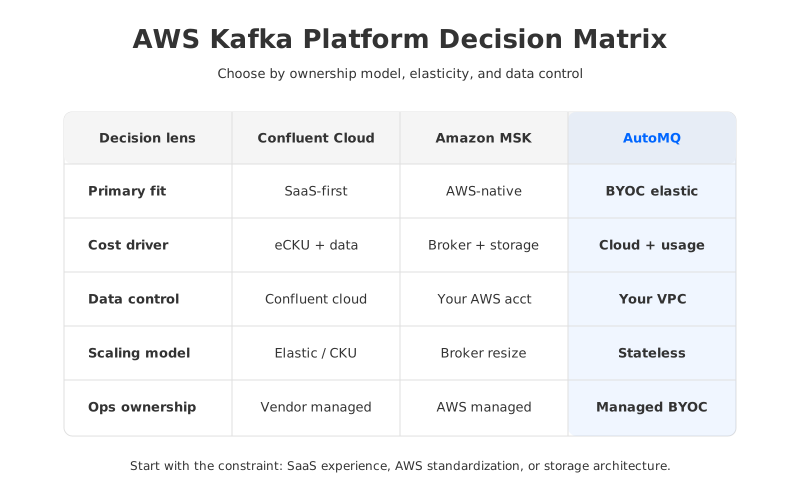
That split matters because "managed Kafka on AWS" can mean three different things: changing who operates the service, changing who provisions the brokers, or changing what brokers are responsible for in the first place.
2Cost Model Comparison
No team should compare these platforms by looking for a single headline price. Kafka cost comes from compute or capacity units, broker storage, retained data, data ingress and egress, private networking, cross-AZ paths, connectors, replication, and support. The lowest-cost option for a development cluster can be the wrong answer for a high-throughput, multi-AZ, long-retention workload.
Confluent Cloud prices Kafka through resource consumption. Its pricing page lists eCKU-hour pricing for elastic cluster types, data in/out rates, data stored rates, and starting monthly costs by tier. That model is attractive when you want a SaaS bill tied to a complete streaming platform, but it means FinOps teams need to model more than broker size.
Amazon MSK exposes more AWS-shaped cost components. For MSK Provisioned Standard brokers, AWS lists broker instance hours, provisioned storage, optional provisioned storage throughput, and standard AWS data transfer charges. For Express brokers, AWS lists broker instance usage, storage used, data written to Express brokers, and standard transfer charges; AWS also states that Express brokers can provide up to 3x more throughput per broker and scale up to 20x faster than Standard brokers, depending on instance size and workload. MSK Serverless is different again: AWS charges cluster-hours, partition-hours, data-in, data-out, and storage.
AutoMQ moves the cost model toward BYOC infrastructure plus usage-based service fees. AutoMQ BYOC billing docs describe data ingress, data egress, data retention, and cluster uptime as billing items, while the underlying compute and object storage are paid to the cloud provider. That distinction matters for AWS teams with Savings Plans, private pricing, Marketplace procurement, or strict data-location rules.
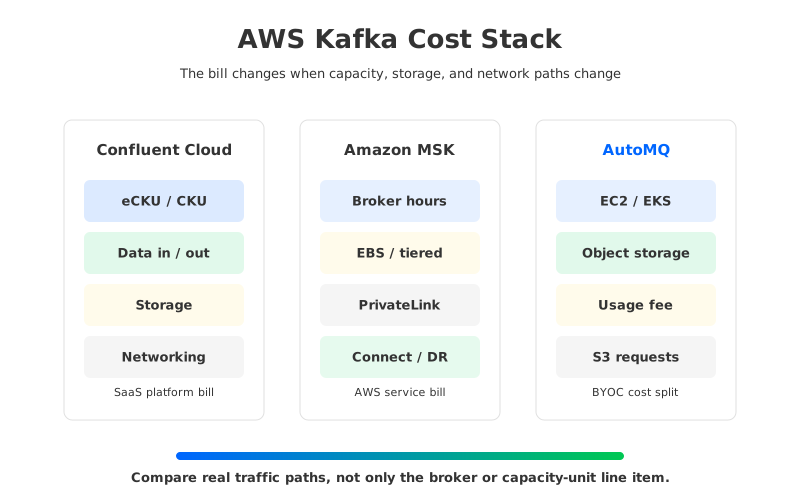
The cost detail that deserves special attention on AWS is networking. AWS's global infrastructure FAQ says cross-Availability Zone data transfer charges apply for traffic involving EC2, RDS, ENIs, and several other services, while transfer directly between Amazon S3 and EC2 in the same Region is free unless another charged service sits in the path. Kafka's traditional multi-AZ replication and client placement can make those paths hard to reason about. A shared object storage design changes which traffic paths dominate the bill.
3Data Control and Networking
Confluent Cloud is a strong option when the organization wants a SaaS streaming platform and is comfortable connecting AWS applications to a Confluent-managed service. Confluent supports public and private connectivity options on AWS, including PrivateLink, VPC peering, Transit Gateway, and Private Network Interface depending on cluster type. Its networking docs also call out a practical constraint: after a cluster is provisioned, you cannot switch the networking solution type between public and private.
MSK keeps the Kafka service inside the AWS account and region model. That tends to simplify procurement, security review, CloudWatch visibility, and access patterns for teams that already standardize on AWS. The tradeoff is that your team still makes Kafka design decisions: broker type, broker count, storage mode, topic partitioning, client placement, and multi-VPC connectivity.
AutoMQ BYOC draws the boundary differently. Its cloud docs describe a BYOC model where resources are deployed in the user's cloud account and data remains in the user's VPC. For teams that want managed operations but need AWS-account ownership, that is a meaningful middle ground. The operational trust model differs from MSK, but the data plane and infrastructure boundary are closer to the customer's environment than a classic external SaaS cluster.
The real decision is which control plane, data plane, and billing plane your organization is willing to separate.
4Scaling and Partition Movement
Scaling is where the three platforms feel most different to the people on call. Confluent Cloud abstracts much of the work through elastic clusters or CKU-based Dedicated clusters. For many teams, that is the point: they want to consume capacity from a service boundary and avoid directly operating Kafka brokers. Limits still depend on cluster type, capacity ceilings, networking choices, and feature requirements.
MSK improves the managed Kafka experience without fully erasing Kafka's storage mechanics. Standard brokers still involve broker sizing, storage provisioning, and partition movement. Express brokers reduce some of that burden: AWS says they remove storage management, use pay-as-you-go storage, and move partitions up to 20x faster than Standard brokers. Tiered storage for Standard brokers also helps long retention by moving older data to a low-cost tier, though AWS documents limitations such as provisioned-only availability, no compacted-topic support, and a minimum retention period in the low-cost tier.
AutoMQ's scaling argument starts from a different premise: if persistent stream data is in object storage rather than broker-local disks, adding or removing brokers does not require copying retained data from one broker disk to another. AutoMQ docs describe stateless brokers, seconds-level scale-out/in, and partition reassignment without traditional data migration. That is especially relevant when the workload has spiky traffic, large retained data sets, or a history of painful rebalancing windows.
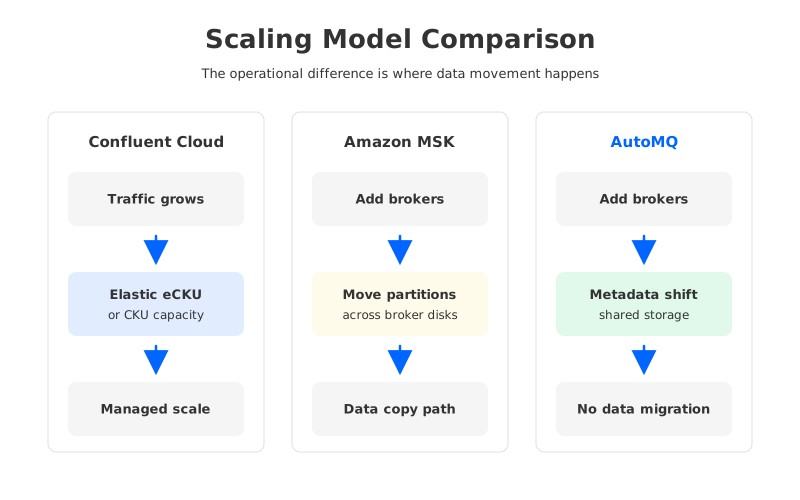
This does not mean every AWS team should avoid MSK or Confluent. It means you should ask whether your bottleneck is operational ownership or storage architecture. If every scaling event becomes a storage movement event, a stateless broker model deserves a closer look.
5Migration and Ecosystem Compatibility
Confluent Cloud has a broad managed ecosystem around Kafka. Teams already using Confluent connectors, Schema Registry, governance, Flink, or Cluster Linking may value continuity more than infrastructure-level control. A migration away from Confluent is not only a broker migration; it can also be a connector, schema, monitoring, networking, and billing-process migration.
MSK is familiar to Kafka teams because it exposes Apache Kafka as an AWS service. That helps teams keep Kafka clients and many existing operational habits, but it does not automatically remove migration work. Moving from Confluent Cloud to MSK, or from self-managed Kafka to MSK, still requires a replication plan, offset strategy, client cutover, ACL/security mapping, connector plan, and rollback design.
AutoMQ aims to keep the Kafka-facing surface stable while changing the storage layer underneath. Its overview docs describe Kafka API and ecosystem compatibility, and its migration docs describe Kafka Linking for migrations from Apache Kafka distributions, AWS MSK, and Confluent Platform. That makes AutoMQ most interesting when the team wants to preserve Kafka clients and operational contracts, but not preserve the old broker-local-disk cost model.
Migration risk rarely comes from the happy path. It comes from the things wrapped around Kafka: private networking, IAM or ACL mode, schema compatibility, consumer offsets, connector ownership, and rollback authority. Treat those as first-class evaluation criteria, not afterthoughts.
6Decision Table for AWS Teams
Use this table as a starting point, then replace the generic labels with your workload numbers.
| Evaluation question | Confluent Cloud | Amazon MSK | AutoMQ |
|---|---|---|---|
| Who owns the platform experience? | Confluent owns the SaaS platform and managed ecosystem. | AWS owns the managed Kafka service; your team owns more AWS/Kafka design. | AutoMQ BYOC provides a managed Kafka-compatible platform in a BYOC model. |
| Where does the data plane live? | In Confluent Cloud, connected to AWS through public or private networking. | In your AWS environment as an AWS managed service. | In your cloud account or VPC for BYOC deployments. |
| Main cost drivers | eCKU/CKU, ingress/egress, storage, networking, connectors, processing, governance. | Broker hours, storage, storage throughput, data-in/out or transfer, PrivateLink, Connect, Replicator. | Cloud compute/storage paid to AWS plus usage-based AutoMQ service fees. |
| Scaling model | Elastic clusters or CKU-based capacity, depending on cluster type. | Serverless, Standard brokers, or Express brokers with faster scaling than Standard. | Stateless brokers with object-storage-backed stream data. |
| Primary buyer | Teams that want a complete data streaming SaaS. | Teams standardized on AWS operations and procurement. | Teams that want Kafka compatibility, BYOC control, and architecture-level elasticity. |
The table is deliberately not a scorecard. The same feature can help or hurt depending on whether the bottleneck is procurement, staffing, data control, elasticity, or long-retention cost.
7FAQ
7.1Is Confluent Cloud better than Amazon MSK?
It depends on what you are buying. Confluent Cloud is usually stronger when the goal is a managed streaming platform with connectors, governance, stream processing, and Kafka capacity behind a SaaS boundary. Amazon MSK is usually stronger when the goal is to keep Kafka inside AWS-native procurement, networking, monitoring, and security patterns.
7.2Where does AutoMQ fit if AWS already has MSK Express?
MSK Express improves the MSK broker experience by reducing storage management and speeding scaling compared with Standard brokers. AutoMQ changes the storage architecture by keeping persistent stream data in object storage and making brokers stateless. AWS teams should compare both when scaling speed, retained data volume, and cross-AZ cost are central to the decision.
7.3Can I migrate without rewriting Kafka applications?
Kafka-compatible platforms can reduce application rewrite risk, but they do not remove migration planning. You still need to validate client versions, authentication, ACLs, topic configs, offsets, connectors, networking, and rollback. AutoMQ's migration docs describe Kafka Linking as a migration mechanism; Confluent and AWS also provide migration and replication tooling for their ecosystems.
The original fork, Confluent Cloud vs Amazon MSK, is still valid. It is just incomplete. AWS teams now have to decide whether they want SaaS convenience, AWS-native managed Kafka, or Kafka compatibility with a different storage architecture. The right answer is the one that matches the constraint you are actually trying to remove.
8Sources Checked
- Confluent Cloud cluster types
- Confluent pricing
- Confluent Cloud networking overview
- Amazon MSK pricing
- Amazon MSK Express brokers
- Amazon MSK tiered storage
- AWS global network data transfer FAQ
- AutoMQ overview
- AutoMQ stateless broker
- AutoMQ BYOC usage-based billing
- AutoMQ Cloud overview
- AutoMQ AWS EKS deployment
- AutoMQ migration overview


