
Table of Contents
Table of Contents
When an AWS platform team searches for serverless Kafka, the real question is rarely "which service has the word serverless on the page?" The pressure usually comes from provisioned brokers sitting idle overnight, topic growth forcing another sizing exercise, retention expanding faster than the compute plan, and FinOps asking why a streaming platform that should absorb bursts still needs a peak-capacity budget. Kafka can be managed, elastic, or cloud-native in very different ways, and those differences show up in the bill as much as in the runbook.
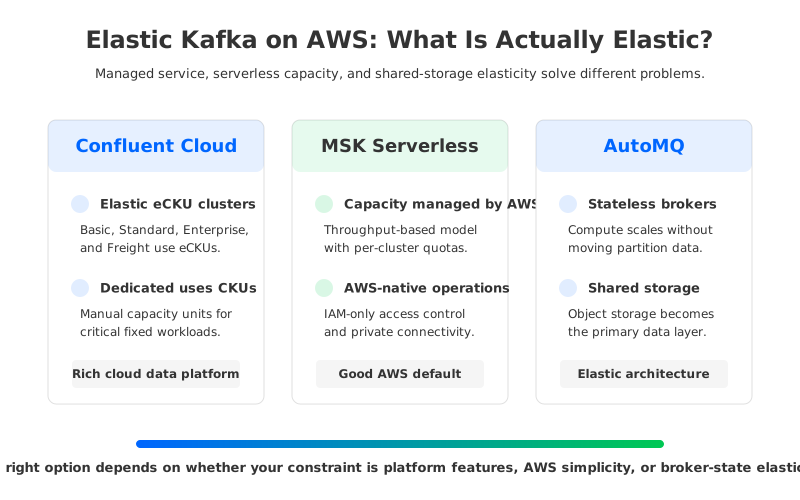
Confluent Cloud, Amazon MSK Serverless, and AutoMQ all reduce Kafka infrastructure work through different control points. Confluent Cloud gives you a broad managed data streaming platform with elastic and dedicated cluster types. MSK Serverless gives AWS-native Kafka capacity that automatically provisions and scales within documented service quotas. AutoMQ approaches the same problem at the storage architecture layer: it keeps Kafka protocol compatibility while moving durable log storage into shared object storage and making brokers stateless compute.
That distinction matters because Kafka elasticity is not one thing. It includes how fast capacity appears, how much idle capacity you pay for, whether scaling triggers partition movement, what happens to long-retention topics, and who controls networking and data placement. A service can remove broker management yet still leave capacity ceilings; another can scale usage-based capacity while changing the cloud account boundary.
1What AWS Teams Mean by Elastic Kafka
Elastic Kafka should be judged by workload behavior, not product category. A dev/test workload wants low operational friction and no idle spend. A steady high-throughput workload wants predictable unit economics and headroom. A bursty workload wants capacity before producers time out. A long-retention workload wants storage growth to stop dragging compute growth behind it.
Four questions expose the real trade-off quickly:
- What is the practical capacity boundary before you need a quota increase, a cluster type change, or a vendor conversation?
- Does cost follow actual traffic, provisioned capacity, retained data, or a combination of all three?
- When you scale, does Kafka need to move partition data between brokers, or can compute capacity change without bulk log copying?
- Does the service live in your AWS account and network model, or inside a vendor-operated cloud service with private connectivity back to your workloads?
These questions are less tidy than a feature matrix, but platform teams live with the messy version. A producer spike arrives during an incident, not during a benchmark. A topic that retained 7 days quietly becomes 30 days because analytics wants replay. "Managed Kafka" helps, but it does not answer all of that by itself.
2Confluent Cloud, MSK Serverless, and AutoMQ at a Glance
Confluent Cloud is the most platform-shaped option here. Its official cluster documentation lists Basic, Standard, Enterprise, Dedicated, and Freight cluster types. Basic through Enterprise and Freight use Elastic Confluent Units for Kafka, or eCKUs, while Dedicated clusters use CKUs. Confluent's elasticity depends on cluster type: elastic tiers adjust capacity within fixed minimums and maximums, while Dedicated capacity is managed through preallocated CKUs.
MSK Serverless is narrower and more AWS-native. AWS describes it as an Amazon MSK cluster type that runs Apache Kafka without requiring you to manage and scale cluster capacity. It automatically provisions and scales capacity and uses a throughput-based pricing model. It also requires IAM access control and does not support Apache Kafka ACLs.
AutoMQ sits in a different category. It is Kafka-compatible streaming infrastructure designed around stateless brokers and shared storage. Instead of treating local broker disks as the durable source of truth, AutoMQ stores Kafka log data in shared object storage such as S3 and keeps brokers as a replaceable compute layer. The result is not "serverless" as a label; it is an attempt to remove the painful part of Kafka scaling on cloud infrastructure.
| Dimension | Confluent Cloud | MSK Serverless | AutoMQ |
|---|---|---|---|
| Primary model | Managed data streaming platform | AWS-managed serverless Kafka cluster type | Kafka-compatible shared-storage architecture |
| Capacity abstraction | eCKU for elastic clusters, CKU for Dedicated | AWS-managed capacity with documented quotas | Stateless brokers over shared storage |
| Operational control | Vendor-operated cloud service | AWS service in supported Regions | Designed for cloud-native deployment with data plane control |
| Best first fit | Teams that want managed Kafka plus ecosystem services | AWS teams that want minimal Kafka capacity management | High-throughput, long-retention, or bursty workloads where broker-state movement is the bottleneck |
Confluent Cloud fits teams that value managed connectors, governance, Flink, and a mature cloud data streaming platform. MSK Serverless fits workloads inside its quotas where AWS-native procurement, IAM, and networking matter. AutoMQ becomes interesting when your main concern is not only who operates Kafka, but whether Kafka's traditional coupling of broker compute and local storage is still the right architecture on AWS.
3Cost Comparison by Workload Pattern
Pricing pages change, and exact cost depends on Region, networking, retention, client behavior, discounts, and Marketplace contracts. A durable comparison starts with billing shape. Confluent Cloud documents consumption-based billing across data transferred, storage, compute units, and add-on services. AWS MSK pricing separates serverless dimensions such as cluster time, partition time, storage, and throughput. AutoMQ cost modeling depends on the cloud resources you run it on, especially compute and object storage.
3.1Steady High Throughput
For steady high throughput, elasticity is less about scaling down and more about sustained capacity. Confluent Cloud elastic cluster types can be convenient if traffic sits inside the eCKU limits for the selected tier. A single eCKU has different ingress, egress, partition, connection, and request limits depending on cluster type.
MSK Serverless publishes per-cluster quotas that are easy to reason about before a proof of concept. As of the AWS MSK quota documentation checked on May 28, 2026, MSK Serverless lists 200 MBps maximum ingress throughput, 400 MBps maximum egress throughput, 2,400 leader partitions for non-compacted topics, 120 leader partitions for compacted topics, 5 MBps ingress per partition, and 10 MBps egress per partition. A workload near those limits needs quota planning or another MSK mode.
AutoMQ's angle is different. If the workload is high-throughput and long-running, the cost question becomes whether brokers must be sized and retained as storage-bearing nodes. Stateless brokers let compute scale for traffic while shared object storage holds the log. That changes what cloud costs are attached to.
3.2Bursty Workloads
Bursty workloads expose a hidden cost: you either pay for capacity that waits for the burst, or you scale late and accept throttling, lag, or intervention. Confluent's documentation says Enterprise clusters support fast scaling up to 10 eCKUs, while on-demand scaling beyond that may be limited to roughly 20 minutes per eCKU. Freight clusters may scale more slowly, with a general growth rate of 4 eCKUs every 10 minutes.
MSK Serverless is attractive here because it removes broker sizing from the user's workflow. The trade-off is that the cluster still has service quotas. If a spike crosses a documented ingress, egress, request, connection, or partition boundary, the failure mode becomes throttling or request failure.
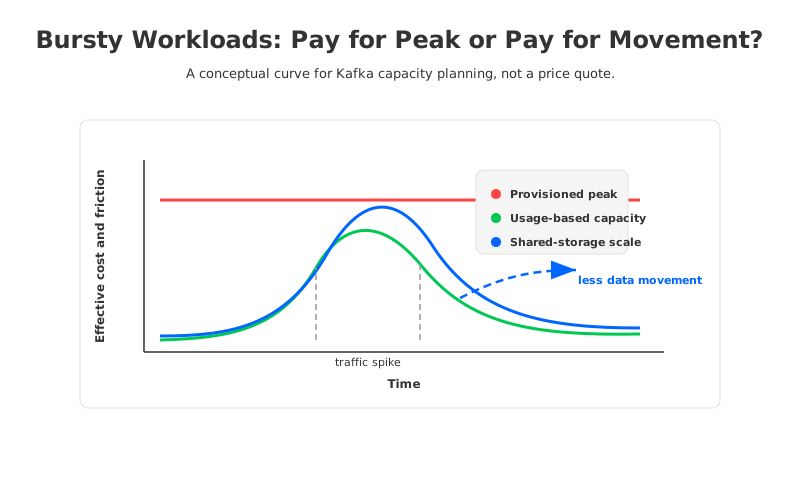
AutoMQ's claim to relevance is not that it magically predicts bursts. It is that scaling brokers does not have to mean moving large local logs between brokers. With shared storage, the broker layer can behave more like elastic compute: add capacity, route traffic, and avoid bulk partition-log copying as the dominant scaling event.
3.3Long Retention Workloads
Long retention is where "managed" and "elastic" often drift apart. Retention may not increase peak ingress, but it increases the durable data Kafka must keep available for replay. In a local-disk Kafka architecture, retained data tends to keep brokers heavy even when compute needs are modest.
MSK Serverless lists unlimited maximum retention duration in its quota table, which is useful for workloads that need replay without managing broker disks. The same table still has other limits, including partition counts and throughput ceilings. That means long retention alone may fit well, while long retention plus high partition count or high fan-out needs closer testing.
Confluent Cloud also supports storage as part of its managed service model, with billing that includes storage and data transfer. AutoMQ is relevant when long retention and elastic compute collide: shared storage makes retained data a storage-layer problem instead of a reason for every broker to carry more local state.
4Data Control and Networking Differences
The most practical difference may be where the data plane lives. Confluent Cloud is a vendor-operated cloud service with public or private networking depending on cluster type. Enterprise, Freight, and Dedicated tiers matter if private networking, BYOK, mTLS, client quotas, or stronger SLA requirements are part of the decision.
MSK Serverless stays inside the AWS service boundary. It integrates naturally with AWS identity and networking patterns, but it is opinionated: IAM access control is required, and Kafka ACLs are not supported for MSK Serverless clusters. Region availability also deserves a live check. The AWS Developer Guide page lists supported Regions, while AWS has also published 2026 expansion announcements for additional Regions.
AutoMQ is usually evaluated by teams that want Kafka compatibility and cloud-native economics without giving up data-plane control. Because the durable log is built on shared storage such as S3, the architecture fits naturally with BYOC and cloud-account ownership discussions. The responsibility boundary is different from a fully vendor-operated Kafka service: you gain more control over where data sits and how cloud resources are accounted for.
5How Shared Storage Changes Kafka Elasticity
Traditional Kafka elasticity is constrained by a simple fact: brokers are both compute nodes and storage owners. When you add capacity, replace a broker, or rebalance partitions, the cluster has to reason about where data lives. That becomes expensive when partitions are large, retention is long, and traffic cannot pause while the cluster rearranges itself.
Shared storage changes the center of gravity. If the durable log lives in object storage and brokers are stateless compute nodes, then scaling the broker layer no longer requires treating every broker as a heavy data-bearing machine. The broker still matters for request handling, caching, metadata coordination, and client traffic. It stops being the place where durable history is trapped.
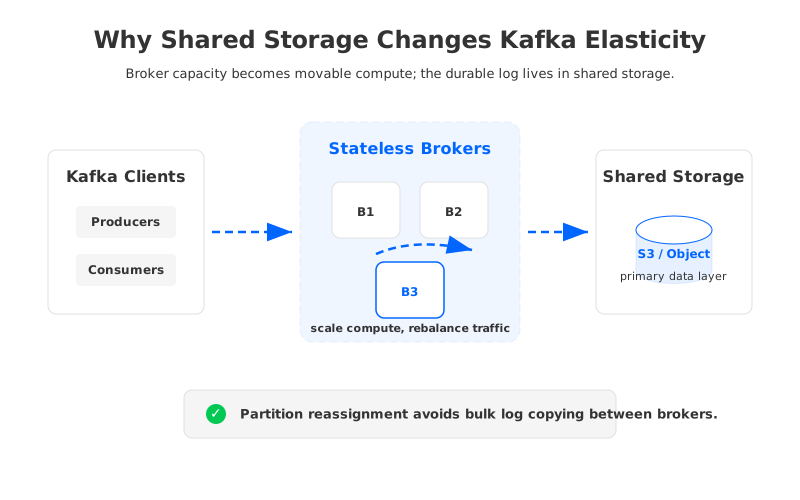
This is why AutoMQ should not be described as serverless branding. The point is architectural: stateless brokers plus shared storage change the mechanics of Kafka elasticity. A bursty workload can add broker capacity with less data movement. A long-retention workload can keep history in object storage without forcing compute to scale in lockstep.
You should still test producer latency, consumer catch-up, partition count, controller behavior, failure recovery, and network paths under your own workload. The point is not that every AWS Kafka workload should choose AutoMQ. The point is that high-throughput, long-retention, peak-to-valley workloads deserve an architecture comparison, not only a managed-service comparison.
6Decision Guide
Choose Confluent Cloud when the platform layer is the main value. If your roadmap includes managed connectors, governance, Flink, multi-cloud operations, and a mature managed Kafka experience, Confluent Cloud belongs on the shortlist. The cost review should focus on cluster type, capacity units, storage, data transfer, and add-ons.
Choose MSK Serverless when your workload fits AWS's serverless Kafka envelope and your organization wants AWS-native procurement, IAM, PrivateLink, and operations. It is a strong default for teams that want to stop sizing brokers and stay inside documented quotas.
Choose AutoMQ for evaluation when Kafka compatibility is required but the painful part of Kafka is broker-storage coupling. High sustained throughput, long retention, spiky traffic, and FinOps pressure are the signals.
The cleanest evaluation is a short workload matrix:
| Workload signal | What to verify | Likely pressure point |
|---|---|---|
| Moderate AWS-native stream | MSK Serverless quotas, IAM model, Region support | Quota boundaries |
| Platform-wide streaming program | Confluent cluster type, networking, governance, add-ons | Platform cost and vendor boundary |
| High-throughput long-retention stream | Compute/storage separation, replay, recovery, TCO | Broker-state movement and storage cost |
| Large unpredictable bursts | Scale rate, throttling behavior, partition strategy | Peak capacity and lag recovery |
Back at the original search query, "Confluent Cloud vs MSK Serverless" is too narrow if the workload is already stressing Kafka's storage model. Compare the managed services, but add one more axis: whether elastic Kafka for your AWS environment means managed capacity, or whether it means removing durable state from brokers. To test that path, review the AutoMQ shared-storage and autoscaling documentation, then run a proof of concept with your own traffic shape.
7References
- Confluent Cloud Kafka cluster types
- Confluent Cloud billing overview
- Amazon MSK Serverless overview
- Amazon MSK quotas
- Amazon MSK pricing
- AWS Regional Services List for Amazon MSK
- AutoMQ architecture overview
- AutoMQ documentation
8FAQ
8.1Is MSK Serverless the same type of service as Confluent Cloud?
No. MSK Serverless is an Amazon MSK cluster type focused on AWS-managed Kafka capacity. Confluent Cloud is a broader managed data streaming platform with multiple Kafka cluster types plus ecosystem services such as connectors, governance, and Flink.
8.2Is AutoMQ serverless Kafka?
AutoMQ is better understood as Kafka-compatible shared-storage streaming infrastructure. Its elasticity comes from stateless brokers and shared object storage rather than from only hiding servers behind a service label.
8.3What is the biggest MSK Serverless limit to check first?
Start with throughput and partitions. AWS currently documents 200 MBps maximum ingress, 400 MBps maximum egress, 2,400 leader partitions for non-compacted topics, and 120 leader partitions for compacted topics per MSK Serverless cluster. Also check per-partition throughput, message size, connection, request, and Region limits.
8.4When is Confluent Cloud likely to be the stronger choice?
Confluent Cloud is often stronger when the team wants a managed streaming platform rather than only Kafka brokers. If managed connectors, governance, Flink, private networking options, multi-cloud consistency, and vendor-operated operations are central requirements, it deserves serious evaluation.
8.5When should AutoMQ be evaluated?
Evaluate AutoMQ when the workload is high-throughput, long-retention, or sharply bursty, and when broker-local state makes scaling, recovery, or cost control difficult. The key question is whether separating broker compute from durable storage improves the workload's economics and operations.


