
Table of Contents
Table of Contents
Confluent plus Databricks is appealing because it gives enterprises a packaged answer to a messy platform question. Confluent owns the Kafka side: managed streams, schemas, connectors, governance, Flink, and Tableflow. Databricks owns much of the analytical side: jobs, SQL warehouses, ML workflows, and AI-facing data products. For a team that wants fewer integration arguments, the combination is easy to defend.
The problem starts when "easy to defend" becomes "hard to leave." Streaming and lakehouse platforms are both consumption-driven systems. Ingestion grows, retention grows, fan-out grows, query workloads grow, and every managed feature that removes toil also adds another billing dimension. That can be excellent value, but it should be evaluated as a deliberate architecture and budget decision.
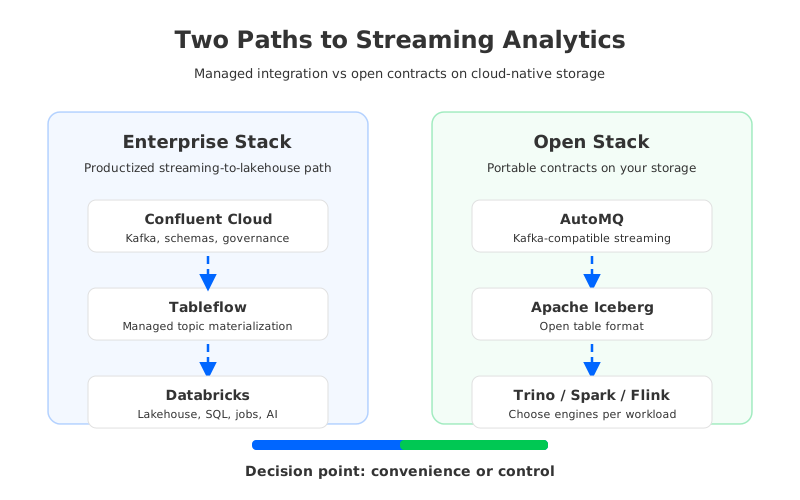
For many platform teams, the alternative is not a fragile collection of scripts. It is a Kafka-compatible streaming layer such as AutoMQ, Apache Iceberg as the open table format, and engines such as Trino, Spark, Flink, and Kafka Connect. That stack asks you to own more architectural choices. In return, it separates the durable data contract from the vendor bundle.
This is where the "$500K/year decision" framing comes from. It is not a claim that any vendor line item always costs exactly half a million dollars. It means the architecture can become a six-figure annual budget surface once streaming, table materialization, storage, networking, query compute, governance, and support are counted together. The useful question is which parts are worth buying as a managed product, and which parts should remain open and portable.
1Why the Enterprise Stack Is Attractive
The strongest argument for Confluent plus Databricks is not marketing polish. It is operational compression. Confluent Cloud gives teams a managed Kafka-compatible platform with higher-level services around schemas, connectors, stream processing, governance, and Tableflow. Confluent's Tableflow documentation describes a managed path to materialize Kafka topics into Apache Iceberg or Delta Lake tables. Databricks gives data teams a broad lakehouse environment for Spark, SQL, catalogs, jobs, and downstream analytics.
That matters because the streaming-to-analytics boundary is full of work that nobody wants to own in fragments:
- Schema and contract management: Event streams are not automatically table-ready. Fields evolve, CDC records contain updates and deletes, and analysts expect stable table semantics.
- Table materialization: A stream-to-table pipeline must coordinate commits, avoid partial visibility, manage small files, and recover after job failures.
- Governance and discovery: Data teams need catalogs, lineage, access control, and consistent naming more than they need another one-off sink job.
- Compute isolation: Streaming workloads, batch jobs, BI queries, and ML feature pipelines have different failure modes. A managed enterprise stack can package those operational boundaries.
Buying those capabilities can be rational. A team with strict governance, a small platform staff, and an existing Databricks estate may prefer a higher managed-platform bill over a long integration project. A company already standardized on Confluent Cloud may find Tableflow valuable because the source, schema system, and materialization feature live in one product boundary.
The trap is assuming that integration convenience answers the architectural question. It answers who operates the integration. The deeper question is where your streaming log lives, where your table format lives, who controls object storage, and how portable your processing layer is.
2Where Cost and Lock-In Enter
Streaming analytics budgets usually grow by multiplication, not addition. A topic that starts as an operational event stream becomes a lakehouse source. The same records are retained in Kafka, written into object storage, compacted into tables, queried by dashboards, and replayed by jobs. Each copy and read path can be justified alone. The annual budget only looks surprising when the platform team sees all layers at once.
There are five cost surfaces to model before choosing the enterprise stack:
| Cost Surface | Why It Grows | What to Ask |
|---|---|---|
| Streaming runtime | Ingress, egress, retention, partitions, and capacity all scale with workload. | Can you predict fan-out and retention growth? |
| Stream-to-table materialization | Managed table features and connector jobs often charge by processed data, topic-hours, compute, or storage operations. | Is materialization a convenience feature or a core platform path for dozens of topics? |
| Lakehouse compute | SQL warehouses, Spark jobs, and ML pipelines consume compute independently from the streaming layer. | Which workloads run continuously? |
| Storage and networking | Replication, multi-AZ traffic, object storage, table maintenance, and scans create cloud-provider charges. | Who owns the bucket, lifecycle policy, encryption, and traffic model? |
| Platform and governance fees | Enterprise features are often bundled into higher editions or negotiated contracts. | Are you buying a needed control plane, or duplicating capabilities your data platform already has? |
This is why open table formats matter. Apache Iceberg is designed as a high-performance table format for large analytic tables, with engine support across systems such as Spark, Flink, Trino, Presto, and Hive. Once events are represented as Iceberg tables in your object storage and catalog, query compute becomes replaceable. The table is the contract. The engine is a choice.
Confluent and Databricks can still be the right choice. The concern is concentration. If the stream, materialization path, catalog integration, governance layer, query environment, and operational controls all sit behind commercial product boundaries, your cost model becomes a stack of vendor-specific assumptions. Replacing one layer later can mean renegotiating the architecture.
3The Open Reference Architecture
An open Kafka-plus-Iceberg architecture starts with a different premise: keep the real-time contract and the analytical contract separate, but put both on infrastructure you can reason about. Kafka remains the operational stream. Iceberg becomes the analytical table. Object storage becomes the durable substrate. Processing and query engines can change as workload needs change.
AutoMQ fits this pattern because it is Kafka-compatible while moving persistent stream storage to object storage. The open-source AutoMQ repository is Apache 2.0 licensed, and the product documentation describes a cloud-native streaming platform with storage-compute separation and stateless brokers. That differs from traditional Kafka operations, where broker-local disks make scaling, maintenance, rebalancing, and multi-AZ replication part of the cost model.
The open stack has six layers:
- Kafka-compatible streaming: AutoMQ provides Kafka protocol compatibility, so existing producers, consumers, Kafka Connect jobs, and Kafka ecosystem tools can continue to speak Kafka while the storage architecture changes underneath.
- Schema discipline: Use Schema Registry-compatible tooling, application-level schemas, or CDC contracts to make topics table-ready before they become analytics assets.
- Materialization: Apache Iceberg's Kafka Connect sink and Flink integration are credible paths for writing streams into Iceberg tables. Connect fits table-shaped records; Flink is stronger for enrichment, deduplication, joins, or CDC normalization.
- Open table format: Iceberg stores table metadata and data files on object storage and gives engines a consistent table abstraction.
- Catalog: AWS Glue, REST catalogs, Hive Metastore, Nessie, Polaris-compatible catalogs, and other catalog choices can be matched to the broader data platform.
- Query and processing: Trino, Spark, Flink, and other engines can use the same table contract without forcing one vendor to own every downstream workload.
This architecture is not "free" in the operational sense. You still own connector upgrades, table maintenance, snapshot retention, file sizing, catalog permissions, incident recovery, and data-quality checks. But the ownership is visible. You can replace the writer without replacing Kafka, change query engines without changing producers, and move query workloads without rewriting the stream.
That visibility is the main advantage. The enterprise stack compresses decisions into a product relationship. The open stack exposes decisions as platform boundaries and keeps control close to the data.
4A Practical $500K/Year Cost Model
The only honest way to compare these stacks is to model your own workload. Public pricing pages and documentation tell you the billing dimensions, but actual cost can depend on cloud, region, edition, discounts, private networking, support tier, query shape, and negotiated terms. Treat the numbers below as a budgeting worksheet, not a quote.
Here is a realistic scenario to test the architecture:
- Sustained event workload that feeds operational consumers and analytical tables.
- Multi-AZ deployment because the stream is part of the production control plane.
- Dozens of topics materialized into Iceberg or Delta-style analytical tables.
- BI, batch enrichment, feature generation, and ad hoc investigation running on lakehouse compute.
- Platform requirement for private networking, access control, observability, and controlled data ownership.
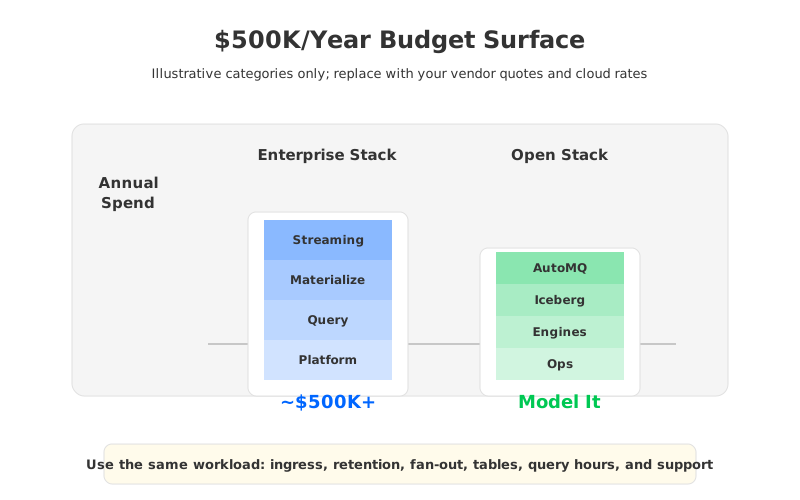
In a half-million annual budget model, the enterprise path often concentrates spend into managed streaming, materialization, lakehouse compute, governance, and subscriptions. The open path shifts more spend into cloud infrastructure, object storage, query compute, and platform engineering. That does not automatically make the open path lower cost. It makes the knobs more visible.
| Budget Category | Enterprise Stack Question | Open Stack Question |
|---|---|---|
| Streaming | What are the throughput, retention, networking, and governance dimensions? | What does Kafka-compatible compute plus object storage cost under the same workload? |
| Table materialization | Are topic-hours, processed GB, managed storage, or connector capacity separate billing dimensions? | How many Connect or Flink workers are needed, and who owns table maintenance failures? |
| Query compute | Which Databricks workloads run continuously versus on demand? | Which workloads need Spark, Trino, or scheduled jobs? |
| Storage | Are lakehouse files, managed storage, metadata, and stream retention charged separately? | Can stream retention and analytical history share object-storage economics? |
| Operations | Which managed features reduce headcount or incident risk enough to justify their cost? | Which engineering responsibilities are acceptable because they preserve portability and control? |
The more important calculation is sensitivity. If ingestion doubles, does your bill double? If retention expands from days to weeks, does the streaming layer become the expensive archive? If a new analytics team scans the same tables heavily, can query compute scale independently? If a vendor feature becomes central to your data contract, what would it take to move?
AutoMQ changes one part of that sensitivity curve. Because persistent stream data is backed by object storage and brokers are stateless, the streaming layer is less tied to broker-local disk capacity and partition movement. AutoMQ's published benchmark compares AutoMQ with Apache Kafka under stated workload assumptions and shows materially lower TCO in that scenario. The exact result is workload-specific, but the mechanism is architectural.
The open stack still needs a budget for engineering time. A team that underprices operations will fool itself. The difference is that engineering time creates reusable platform knowledge: table contracts, catalog standards, infrastructure modules, observability, and recovery playbooks. A managed stack buys that work. An open stack internalizes it.
5Functional Coverage: Where Each Stack Wins
Cost is only half the decision. A lower-cost stack that misses governance, security, or operational maturity is not a bargain. The comparison should be explicit about functional coverage, because the enterprise path wins in some situations.
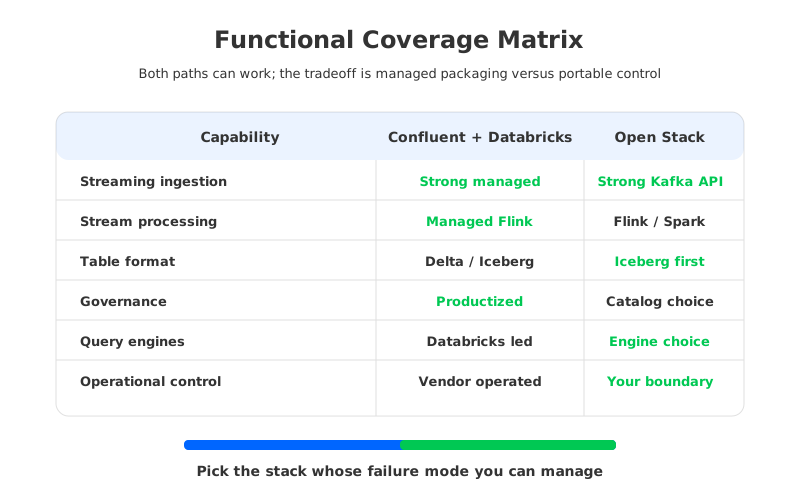
Choose Confluent plus Databricks when your main constraint is integration velocity. If the business needs governed real-time analytics quickly, the team is already committed to those vendors, and platform engineering capacity is scarce, managed integration has clear value. It reduces the number of systems your team must assemble.
Choose the open Kafka-plus-Iceberg path when your main constraint is long-term control. That usually means you care about bucket ownership, multi-cloud optionality, open table contracts, predictable exit paths, and the ability to mix query engines. It also means your team is willing to operate connectors, catalogs, file maintenance, access policies, and incident response.
The decision gets easier when you map it by capability:
| Capability | Confluent + Databricks | AutoMQ + Iceberg + Open Engines |
|---|---|---|
| Managed experience | Strong. Many responsibilities are productized. | Mixed. You can use managed services, but integration ownership remains yours. |
| Kafka compatibility | Strong through Confluent's Kafka ecosystem. | Strong when AutoMQ is used as the Kafka-compatible streaming layer. |
| Open table format | Available through Iceberg and Delta-related integrations. | Central design principle, with Iceberg as the table contract. |
| Query flexibility | Strong inside Databricks; broader access depends on catalog and sharing design. | Strong across Trino, Spark, Flink, and other Iceberg-compatible engines. |
| Cost visibility | Depends on contract, product usage, and cloud-provider charges. | More visible at the infrastructure layer, but operations must be counted. |
| Portability | Convenient inside the vendor boundary; migration requires planning. | Higher, because storage, tables, and engines are more loosely coupled. |
Neither side should be caricatured. Open source does not eliminate cost. Managed platforms do not eliminate architecture. The serious comparison is about which failure mode you prefer: paying too much for convenience you no longer need, or underinvesting in operations you do need.
6Which Stack Should You Choose?
Use the enterprise stack when speed, packaged governance, and vendor accountability matter more than infrastructure portability. This is common when the organization already has a Databricks center of gravity, Confluent Cloud is the approved streaming platform, and the business wants a supported path from events to analytical tables.
Use the open stack when data architecture is becoming a strategic control point. If Kafka topics feed AI, fraud, observability, product analytics, or customer-facing data products, the table format and storage boundary should not be incidental. AutoMQ can provide the Kafka-compatible streaming foundation, Iceberg can provide the open analytical contract, and engines can be chosen per workload.
A good decision process looks like this:
- Define the workload: ingress, egress, retention, materialized topics, query concurrency, latency targets, and recovery objectives.
- Price the enterprise path using your actual Confluent and Databricks terms, including private networking, support, governance, materialization, storage, and query compute.
- Price the open path using cloud infrastructure, AutoMQ deployment model, object storage, catalog, Connect or Flink workers, query engines, observability, and engineering time.
- Run a sensitivity check for 2x ingestion, longer retention, more table consumers, and regional expansion.
- Decide which boundaries must remain portable: Kafka API, object storage, table format, catalog, query engine, or governance layer.
The first answer may still be Confluent plus Databricks. That is fine. The point is to choose it because the managed integration is worth the premium, not because the team never modeled the alternative. Once the stream becomes the lakehouse front door, the architecture becomes a long-term budget commitment.
The open alternative is credible because the core contracts are mature. Kafka APIs are the operational interface. Iceberg is the analytical table contract. Object storage is the durable substrate. AutoMQ makes the Kafka-compatible streaming layer fit that substrate by removing much of the disk-heavy, stateful-broker assumption from the design.
Return to the half-million-dollar question: what exactly are you buying? If you are buying speed, reduced operational burden, and a supported enterprise platform, the managed stack can be the right call. If you are buying a durable data foundation that should outlive one vendor relationship, open Kafka-compatible streaming plus Iceberg deserves a serious line in the budget model.
7FAQ
7.1Is Confluent plus Databricks always more expensive than an open-source Kafka plus Iceberg stack?
No. Actual cost depends on workload, discounts, cloud region, support terms, operational staffing, and query behavior. The open stack can lower infrastructure and lock-in pressure, but it still needs engineering time, observability, upgrades, and incident response. The only useful comparison is a workload-specific model.
7.2Can open source really replace Confluent Tableflow?
It depends on what you mean by replace. Apache Iceberg provides Kafka Connect and Flink integration paths for writing streams into Iceberg tables, so the data architecture does not require Tableflow. Tableflow may still be attractive if you want a managed Confluent Cloud feature with productized operations.
7.3Where does AutoMQ fit in the open stack?
AutoMQ is the Kafka-compatible streaming layer. Its role is not to replace Iceberg, Trino, Spark, or Flink. Its role is to provide a cloud-native Kafka-compatible runtime with object-storage-backed persistence and stateless brokers, making the streaming layer align better with an object-storage lakehouse architecture.
7.4Does Iceberg eliminate the need for Databricks?
No. Iceberg is a table format, not a complete analytics platform. Teams still need query engines, job orchestration, governance, notebooks or development workflows, and operational controls. Databricks can be one of those engines and platforms. The open-stack argument is that the table contract should remain portable.
7.5What is the biggest risk in the open stack?
The biggest risk is underestimating operations. Connector failures, schema drift, small files, catalog permissions, backfills, and table maintenance all become your responsibility. Teams that choose the open path should treat these as platform features, not cleanup tasks.
7.6When is the enterprise stack worth the premium?
It is worth the premium when managed integration, vendor support, governance packaging, and time-to-value outweigh portability and infrastructure control. That is often true for smaller platform teams, regulated organizations with approved vendor standards, or companies deeply invested in both Confluent and Databricks.
8Sources
- Confluent Tableflow overview
- Confluent Tableflow billing
- Confluent Cloud billing
- Databricks pricing
- Apache Iceberg documentation
- Apache Iceberg Kafka Connect sink
- Apache Iceberg Flink writes
- Trino Iceberg connector
- AWS S3 pricing
- AWS EBS pricing
- AWS EC2 On-Demand pricing
- AutoMQ overview
- AutoMQ benchmark and cost comparison
- AutoMQ GitHub repository


