
Table of Contents
Table of Contents
Kafka pricing conversations usually start in the wrong place. A buyer sees a managed service quote, an engineering leader says Apache Kafka is open source, and a platform team is asked to explain why a system with no software license still needs a serious budget. The useful question is where the cost moves when you choose a managed platform, a self-managed open-source deployment, or a Kafka-compatible shared-storage architecture.
Confluent Cloud, open-source Apache Kafka, and AutoMQ can all serve Kafka clients, but they place the financial and operational burden in different places. Confluent wraps Kafka with a managed data streaming platform. Open-source Kafka gives you direct control over the cluster, but you still pay for cloud infrastructure, operations, and failure handling. AutoMQ keeps Kafka protocol compatibility while changing the storage and scaling model underneath.
A low line item in one column can reappear as headcount, reserved capacity, cross-AZ traffic, migration work, or incident risk in another column.
1Kafka Pricing Is Not Just Software Pricing
Apache Kafka is licensed under the Apache License 2.0, which is why teams can download, run, modify, and redistribute it without buying a Kafka software license from the Apache Software Foundation. That legal fact is important, but it does not make a production Kafka platform cost zero. A production cluster still needs compute, storage, networking, monitoring, upgrades, security controls, backup and recovery practices.
Kafka's original storage model also matters. In classic Kafka, partitions are stored on broker-local disks, and durability is achieved through broker-level replication. A common production setup uses a replication factor of 3, so the platform writes multiple copies across brokers. In a cloud environment, that interacts with block storage prices, inter-zone transfer, and retention growth.
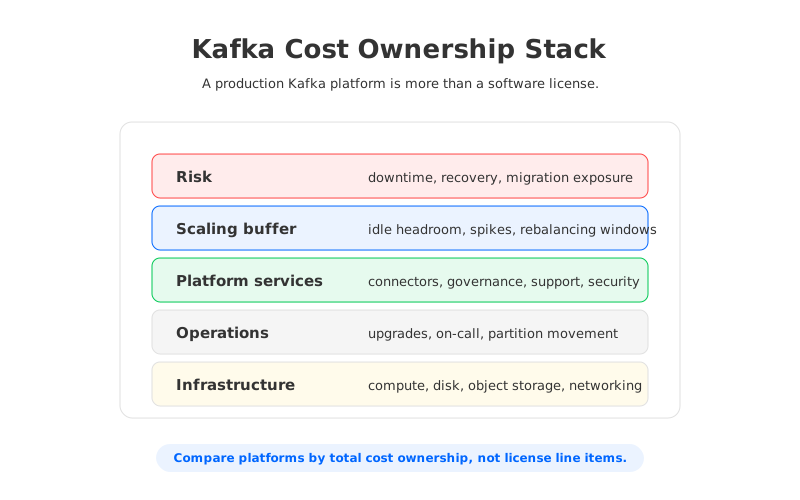
Kafka TCO has at least five layers:
- Infrastructure: broker instances, disks, object storage, load balancers, private networking, and data transfer.
- Operations: on-call coverage, upgrades, partition reassignment, capacity planning, incident response, and observability.
- Platform services: connectors, schema governance, stream processing, RBAC, audit logs, private networking, and support.
- Scaling buffer: idle capacity held for traffic spikes, retention growth, broker replacement, and rebalancing windows.
- Risk: downtime exposure, migration complexity, compliance gaps, and the engineering cost of slow recovery.
Once you price those layers, the comparison becomes more useful. Confluent is not merely "Kafka with a price." Open-source Kafka is not a no-cost platform. AutoMQ is not a lower-priced copy of self-managed Kafka. They allocate responsibility differently.
2What Confluent Pricing Includes
Confluent Cloud is a managed data streaming platform built around Apache Kafka. Its official billing documentation describes a consumption-based model that includes data transfer, storage, compute units, and add-on services such as connectors, ksqlDB, and Flink SQL. Its cluster documentation also separates cluster types such as Basic, Standard, Enterprise, Dedicated, and Freight, with elastic eCKUs for several cluster types and CKUs for Dedicated clusters.
That structure tells you what Confluent is selling. You are paying for more than broker capacity: a large part of Kafka platform ownership moves to a vendor-operated service. The invoice may include eCKU or CKU usage, networking, storage, connectors, stream governance, and other services, but the broader commercial value is managed operations.
For many teams, that trade is rational. Kafka expertise is scarce, and a failed upgrade or poorly handled traffic spike can exceed the monthly platform bill. Confluent can be attractive when a team needs a managed ecosystem rather than only a Kafka cluster:
- Managed Kafka operations reduce the need to staff deep broker operations internally.
- Built-in services such as connectors, governance, Flink, and monitoring can shorten platform delivery time.
- Enterprise features such as private networking, RBAC, audit logs, and support can map directly to procurement and compliance requirements.
- Consumption billing gives finance a visible vendor line item instead of a scattered mix of cloud resources and labor.
Visibility and convenience do not remove cost governance. Usage-based bills can grow with ingress, egress, storage, cluster capacity, connectors, and higher-tier features. Elastic models reduce manual resizing, but high-retention or always-on workloads still deserve careful modeling.
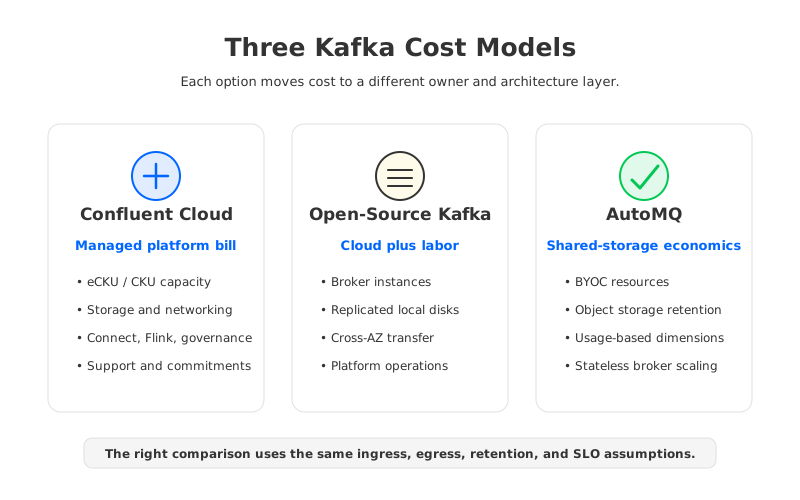
Procurement should read Confluent pricing as a platform bundle, not as a broker-only rate card. If managed operations, ecosystem services, and a single commercial relationship matter, Confluent may justify the premium. If the workload is primarily high-volume Kafka storage, the bundle can include capabilities you do not fully use.
3What Open-Source Kafka Really Costs
Open-source Kafka gives engineering teams maximum architectural control. You decide the cloud provider, instance family, disk type, replication factor, retention policy, security model, monitoring stack, deployment toolchain, and upgrade cadence. That control is valuable for teams with strong platform engineering practices or strict infrastructure requirements.
The cost appears in a different shape. Instead of a Confluent invoice, you get cloud infrastructure line items and internal labor. A self-managed Kafka deployment on AWS may use EC2 instances, EBS gp3 volumes, private networking, cross-AZ data transfer, observability, and disaster recovery tooling. AWS prices those services separately, so the Kafka bill is distributed across categories.
Consider a simplified storage example using public AWS pricing pages as a reference point. If a workload retains 1 TiB of logical Kafka data with a replication factor of 3 on broker-attached EBS, the storage footprint is roughly 3 TiB before filesystem overhead, compaction behavior, and headroom. Kafka's replication and disk model multiplies the cloud resources behind the application-level data.
Network economics add another layer. In a multi-AZ Kafka deployment, follower replication and client traffic may cross availability zones depending on placement and routing. For a write-heavy workload, broker replication can turn each GiB written by producers into additional replicated traffic. These costs are easy to miss because Kafka engineers think in partitions and replicas, while finance sees data transfer categories.
Operations are the cost that rarely shows up in the first spreadsheet. A mature self-managed Kafka platform needs people and processes for:
- Version upgrades and security patching without breaking producers and consumers.
- Partition reassignment, broker replacement, and capacity expansion under live traffic.
- Quota management, ACLs, certificate rotation, and audit evidence.
- Lag monitoring, disk pressure handling, under-replicated partition response, and disaster recovery tests.
- Cost allocation by tenant, topic, application, or business unit.
There is nothing wrong with choosing that model. Many excellent platform teams do it well. The mistake is calling it "free Kafka" and comparing it against a managed-service invoice. The license line may be zero, but production still consumes budget through infrastructure, headcount, and risk.
4How AutoMQ Changes Infrastructure and Operations Cost
The economic pressure in self-managed Kafka comes from a specific architecture: brokers combine compute and local persistent storage. In the cloud, that model can duplicate capabilities already sold as managed primitives: durable storage, elastic capacity, and pay-as-you-go object storage.
AutoMQ approaches the problem as a Kafka-compatible shared-storage system. It keeps Kafka protocol and semantics compatibility for clients, but replaces Kafka's local log storage with S3Stream, a storage layer that uses object storage as the primary data repository and a write-ahead log layer to handle low-latency writes. AutoMQ documentation describes this as a shared-storage architecture that makes brokers stateless and enables second-level partition reassignment, automatic scaling, and continuous traffic rebalancing.
That is a different cost lever from running open-source Kafka at a lower service fee. The goal is to change what must be provisioned. When object storage becomes the primary repository, retained data is no longer tied to broker-local disks in the same way. When brokers are more stateless, scaling a broker fleet does not require the same long data movement cycle that traditional partition reassignment can trigger.
AutoMQ BYOC pricing also follows a different responsibility model. In a bring-your-own-cloud environment, cloud resources run in the customer's cloud account while AutoMQ provides the control plane and product layer. Its AWS usage-based billing documentation lists data ingress, data egress, data retention, and cluster uptime, with no partition fees.
The operational effect is as important as the storage line item. Traditional Kafka scaling often requires planning around broker disk capacity, partition count, reassignment throughput, and recovery windows. Shared storage changes the workflow because a broker is less of a unique storage owner.
5Which Model Fits Which Team?
The best choice depends on which constraint is binding: operating maturity, platform feature needs, cloud economics, compliance, or workload shape. A small team without Kafka specialists may pay for Confluent to avoid building a streaming platform organization. A large infrastructure team with deep Kafka expertise may prefer open-source Kafka because control matters more than vendor abstraction. A cloud-native platform team with high retention, elastic workloads, or frequent scaling pressure may evaluate AutoMQ because shared storage changes the cost drivers that traditional Kafka inherits.
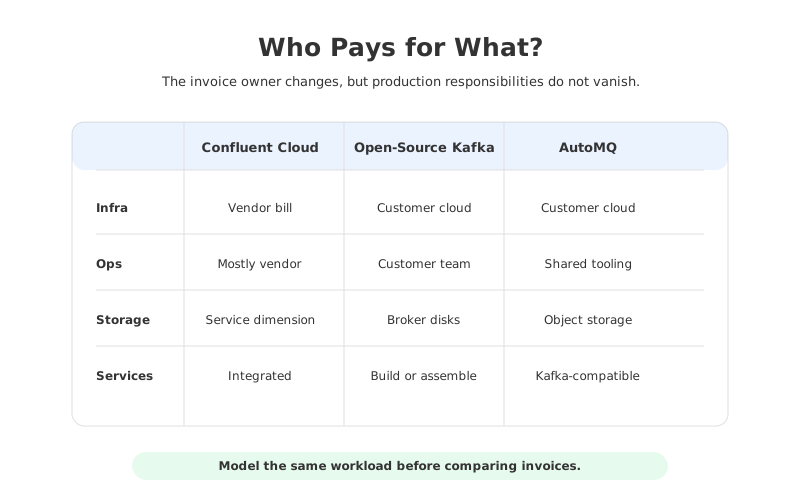
| Decision factor | Confluent Cloud | Open-source Kafka | AutoMQ |
|---|---|---|---|
| Primary value | Managed platform and ecosystem | Maximum control | Kafka-compatible cloud economics |
| Main cost surface | Vendor usage bill plus selected add-ons | Cloud resources plus platform labor | Cloud resources plus AutoMQ usage or subscription |
| Storage model | Managed by Confluent, priced through service dimensions | Broker-local disks, often replicated across brokers | Shared object storage with WAL layer |
| Scaling burden | Mostly service-managed, with tier and capacity considerations | Owned by the platform team | Designed around stateless brokers and shared storage |
| Best fit | Teams prioritizing managed operations and ecosystem services | Teams with strong Kafka operations capability | Teams optimizing cloud storage, scaling, and Kafka compatibility |
The table explains why price comparisons often go sideways. If you compare Confluent's full platform bill against only the EC2 and disk cost of self-managed Kafka, the self-managed option looks artificially attractive. If you compare open-source Kafka's software license against AutoMQ's product pricing, you ignore the infrastructure architecture.
For a serious evaluation, model one workload across all three options. Use the same ingress, egress, retention, partition count, availability target, cloud region, private networking requirement, and operational SLO. Include growth and failure scenarios because Kafka platforms are often most expensive during recovery and rebalancing.
6A Practical Evaluation Checklist
Start with workload facts rather than vendor categories. Record compressed ingress and egress, retention by topic class, peak-to-average traffic ratio, consumer fan-out, partition count, availability target, region and AZ placement, and migration constraints. Then ask where each platform makes you reserve capacity and where usage can follow demand.
For Confluent, estimate cluster type, eCKU or CKU behavior, storage, networking, connectors, governance, Flink, support, and commitment assumptions. For open-source Kafka, estimate EC2, disk, cross-AZ data transfer, observability, deployment automation, disaster recovery tooling, and engineering hours. For AutoMQ, estimate BYOC cloud resources, ingress, egress, retention, uptime, and the operational effect of shared storage.
That model will rarely produce a universal winner. It should produce a decision boundary. If managed ecosystem breadth is the main requirement, Confluent has a clear story. If full infrastructure ownership is non-negotiable and the platform team is staffed for Kafka, open-source Kafka can be the right foundation. If the largest pain points are retention cost, replica-driven storage growth, slow scaling, and cloud transfer economics, AutoMQ deserves evaluation as a Kafka-compatible shared-storage architecture rather than as a line-item discount.
The uncomfortable part of Kafka pricing is that somebody always pays. You can pay a managed platform to absorb operations. You can pay your own team and cloud provider to run Kafka directly. Or you can change the storage architecture so fewer costs are created by the broker layer. The right answer makes those payments visible before production traffic does.
To test the AutoMQ path with your own workload assumptions, use the AutoMQ pricing page and BYOC documentation, then compare the result against your Confluent estimate and a self-managed Kafka bill of materials using the same traffic and retention inputs.
7References
- Confluent Cloud Pricing
- Confluent Cloud billing documentation
- Confluent Cloud Kafka cluster types
- Apache Kafka documentation
- Apache License 2.0
- AWS EC2 On-Demand Pricing
- AWS EBS Pricing
- AWS S3 Pricing
- AutoMQ Pricing
- AutoMQ architecture overview
- AutoMQ usage-based BYOC billing
- AutoMQ compatibility with Apache Kafka
8FAQ
8.1Is open-source Kafka free for production use?
Apache Kafka is available under the Apache License 2.0, so there is no Kafka software license fee from the Apache Software Foundation. Production use still requires cloud infrastructure, operations, security, monitoring, upgrades, capacity planning, and incident response. For TCO analysis, treat open-source Kafka as self-managed infrastructure rather than a zero-cost platform.
8.2Why can Confluent pricing be higher than a self-managed Kafka bill of materials?
Confluent Cloud includes managed operations and platform services around Kafka. Its bill can include compute units, storage, networking, connectors, governance, stream processing, support, and other service dimensions. A fair comparison should include the internal labor, reliability risk, and tooling required to run open-source Kafka to the same production standard.
8.3How is AutoMQ different from self-managed Kafka on lower-cost infrastructure?
AutoMQ is not merely self-managed Kafka on a different instance type. It is a Kafka-compatible shared-storage architecture that replaces broker-local log storage with S3Stream, using object storage and a WAL layer. That changes the economics of retained data, broker state, scaling, and partition reassignment.
8.4When should a team choose Confluent?
Confluent is often a strong fit when the team values managed operations, integrated connectors, governance, stream processing, enterprise networking, and vendor support more than direct infrastructure control. It is especially relevant when time-to-platform and operational risk are bigger constraints than raw infrastructure cost.
8.5When should a team evaluate AutoMQ?
Evaluate AutoMQ when Kafka compatibility is required but the pain points are cloud storage cost, replica-driven capacity growth, slow scaling, partition reassignment, or cross-zone traffic. It is especially relevant for cloud-native teams that want BYOC control while changing the storage and scaling economics under Kafka.


