
Table of Contents
Table of Contents
A Kubernetes platform team searching for a Confluent Kafka replacement is usually not trying to learn how to install Kafka in a cluster. The team already knows that Kafka can run on Kubernetes. The real question is whether a replacement can preserve the Kafka contract while fitting the operating model the platform team has built around Kubernetes, GitOps, Terraform, private networking, observability, and shared infrastructure ownership.
That distinction changes the evaluation. A Confluent replacement is credible when the data plane state, scaling path, network boundary, and failure model make sense inside a Kubernetes platform. Kafka is not a stateless web service. If the replacement carries the same broker-local storage assumptions into Kubernetes, the platform team may gain a familiar deployment surface while inheriting the same operational gravity.
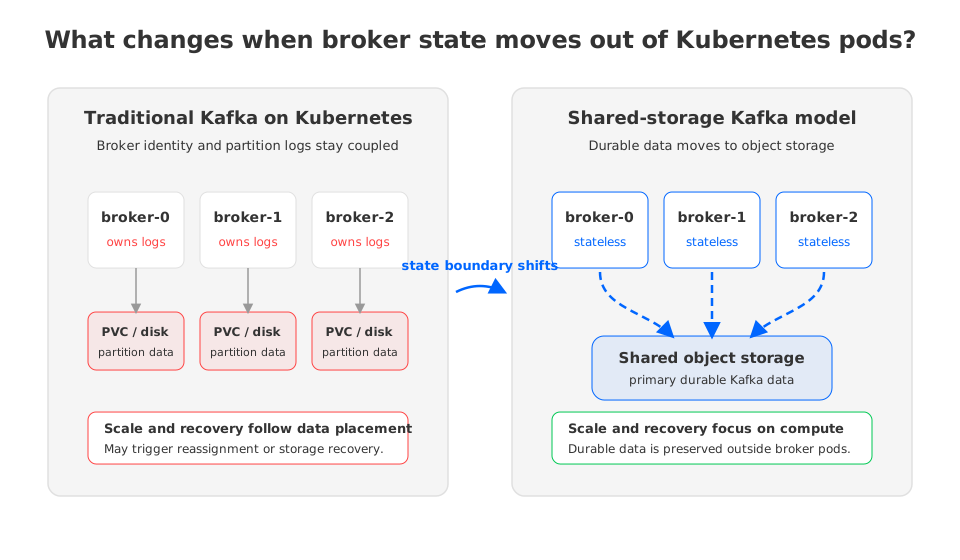
The useful replacement conversation starts with ownership. Who owns the cloud account? Where does the control plane run? Where does durable Kafka data live? What happens when a broker pod dies, a node pool rolls, or a zone fails? These questions separate a Kubernetes-shaped Kafka deployment from a Kubernetes-native operating model.
1Why Kubernetes teams look for Confluent replacements
Confluent is often the default enterprise Kafka platform because it packages Kafka with managed operations, governance, connectors, support, and a mature ecosystem. Platform teams rarely look away from that package for one small reason. The search usually starts when a renewal, data residency requirement, network review, or platform mandate forces the team to ask whether streaming should live closer to the rest of its cloud-native estate.
For Kubernetes platform teams, the pressure often comes from standardization. They already manage application rollouts with Kubernetes, infrastructure with Terraform, access with cloud IAM and Kubernetes RBAC, and observability through common metrics and log pipelines. A separate streaming platform can be acceptable, but it has to defend the separate control boundary, procurement model, and operational workflow. When Kafka becomes a shared internal platform, the cost of exceptions grows.
The replacement must still respect why Confluent was selected in the first place. Kafka compatibility, client behavior, schema workflows, connector dependencies, security controls, and operational support cannot be waved away. A strong platform team does not replace Confluent by asking, "Can we run open-source Kafka ourselves?" It asks, "Which parts of Confluent are we actually using, and which parts can be replaced without pushing hidden work onto application teams?"
That inventory usually reveals three categories: non-negotiable Kafka behavior, ecosystem dependencies such as Schema Registry or Kafka Connect, and the operating model for provisioning, maintenance, monitoring, scaling, and recovery.
2What makes Kafka hard on Kubernetes
Kubernetes has a mature answer for stateful workloads: StatefulSet. The Kubernetes documentation describes StatefulSet as useful for applications that need stable network identity, stable persistent storage, ordered deployment, and ordered rolling updates. That is exactly why Kafka can run on Kubernetes, and it is also the clue that Kafka is being accommodated rather than transformed.
Traditional Kafka binds broker identity to partition logs stored on broker-local or broker-attached disks. PersistentVolumes make this manageable in Kubernetes, but they do not erase the coupling. A broker is not interchangeable compute in the same way a frontend pod is. It has local data placement, partition leadership, replica membership, and recovery responsibilities that survive beyond the lifecycle of the container.
2.1Persistent storage and broker identity
The most visible friction is storage. Kubernetes can provision PersistentVolumes through storage classes, bind them to claims, and reattach them to replacement pods. That helps platform teams automate the mechanics, but the durable Kafka log still belongs to a broker identity. A failed pod is not merely replaced; its relationship to stored partition replicas must remain correct.
This is where many Confluent replacement evaluations become too shallow. A Kubernetes operator can coordinate certificates, configuration, rolling updates, topic resources, and broker scaling. Confluent for Kubernetes, for example, documents operational workflows for scaling Kafka clusters and balancing data. That is valuable automation, but it does not remove the underlying data movement problem when brokers own local replicas.
The difference matters during incidents. If a node is unhealthy, the platform team wants Kubernetes to reschedule work. If the broker owns durable logs on a zonal volume, rescheduling is constrained by where that volume can attach, whether the replacement broker can recover cleanly, and whether replicas elsewhere are caught up. The platform abstraction has to wait for the storage reality.
2.2Scaling and partition movement
Scale-out is the second pain point. Adding broker pods increases potential compute capacity, but existing partitions do not automatically distribute their historical data across the new brokers. Kafka still needs partition reassignment or a balancing workflow before the new capacity carries real load. The request to scale may be declarative; the effect on workload distribution is not instant.
Scale-in is more delicate because it has a safety precondition. A broker that still hosts partition replicas cannot be removed like a stateless application replica. The platform has to move replicas away, verify catch-up, handle leadership changes, and watch network and disk pressure. For clusters with long retention, high partition counts, or uneven traffic, this becomes an operational event rather than a routine replica count change.
| Kubernetes expectation | Traditional Kafka reality | Replacement question |
|---|---|---|
| Replace failed pods quickly | Broker recovery depends on local or attached durable state | Can brokers be treated as replaceable compute? |
| Scale replicas declaratively | Existing partition load may require reassignment | Does scale-out add usable capacity without heavy data movement? |
| Keep storage externalized | PersistentVolumes still preserve broker-owned logs | Where does the durable Kafka log actually live? |
| Standardize platform operations | Kafka balancing and storage workflows remain specialized | Which tasks stay with the platform team after migration? |
This is why "Kafka on Kubernetes" is too broad as an evaluation label. A platform team should ask whether the replacement makes Kubernetes operate Kafka more safely, or whether it only moves the same stateful broker model into a new scheduler.
3Replacement criteria for Kubernetes-native operations
The first criterion is Kafka compatibility, because application teams experience the migration through clients and semantics. Producers, consumers, admin clients, transactions, offsets, compression, authentication, ACLs, quotas, and error handling need explicit tests. A replacement can be operationally elegant and still fail if client behavior changes in subtle ways.
The second criterion is ecosystem continuity. If the current Confluent estate uses Schema Registry, Kafka Connect, managed connectors, Flink, governance, audit logs, or private networking, those dependencies need named replacement paths. Some teams can standardize on open-source equivalents in their own Kubernetes environment. Others may decide that the integrated Confluent platform still reduces the number of systems they own.
The third criterion is the state model. Broker-local storage keeps the operational burden near StatefulSets, PersistentVolumes, and reassignment workflows. Shared storage moves durable log data into an external storage layer, so brokers can behave more like compute processes. Tiered storage is different: it offloads older segments, but the hot local log usually remains central to broker operation.
The fourth criterion is ownership boundary. BYOC can mean a vendor-managed data plane in the customer's cloud, private networking into a managed service, or both control-plane and data-plane components in customer-controlled infrastructure. Security teams need the exact model, not the acronym.
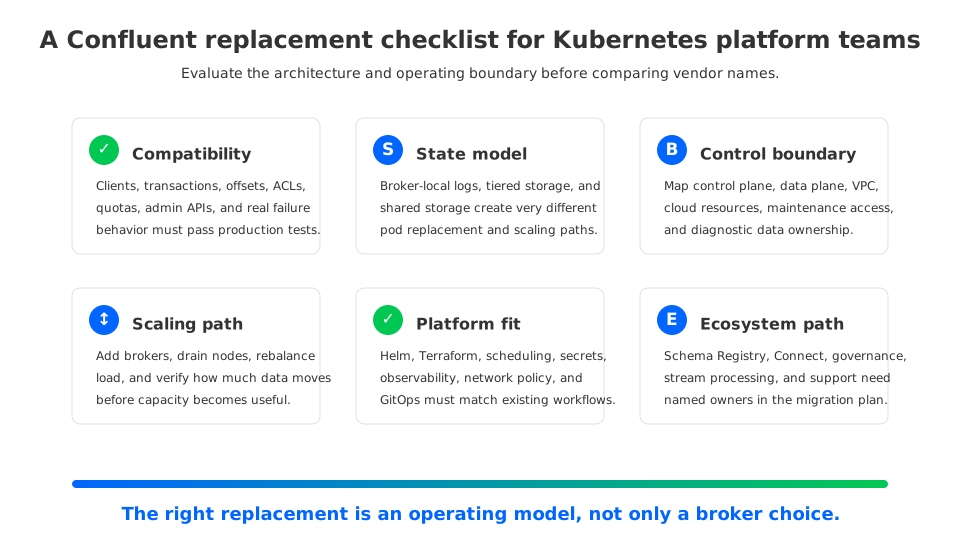
For a platform team, a practical checklist looks like this:
- Compatibility: Test client versions, producer settings, consumer groups, transactions if used, admin operations, and failure behavior instead of relying on protocol claims.
- State management: Identify whether partition data is broker-local, tiered, or primarily stored in shared object storage, then map that to pod replacement, node drain, and zone failure behavior.
- Scaling path: Measure what happens after adding brokers: whether load moves through heavy reassignment, metadata changes, cache warming, or a combination.
- Control boundary: Document where the control plane runs, where the data plane runs, which cloud resources are customer-owned, and what access the vendor needs for maintenance.
- Platform integration: Validate Helm, Terraform, Kubernetes scheduling constraints, observability, secrets, networking, and day-2 operations in the same workflow the platform uses for other services.
Run the checklist before procurement language hardens. Once the requirement becomes "a lower-cost Confluent alternative," teams can underweight the operational criteria that decide whether the migration succeeds.
4How AutoMQ changes Kafka storage on Kubernetes
AutoMQ fits this evaluation as a Kafka-compatible, object-storage-backed streaming system designed around stateless brokers. The point is not only that AutoMQ can be deployed on Kubernetes with Helm or through BYOC deployment on managed Kubernetes platforms such as EKS, GKE, and ACK. The point is that AutoMQ changes where durable Kafka data lives.
In AutoMQ, broker nodes are stateless in the sense that Kafka partition data is offloaded through S3Stream to shared object storage. The WAL layer buffers writes before data is uploaded to object storage, and the durable storage center of gravity moves away from broker-local disks. The AutoMQ documentation also distinguishes this model from Kafka tiered storage: object storage is primary, while WAL is a write buffer rather than a conventional broker-owned local log.
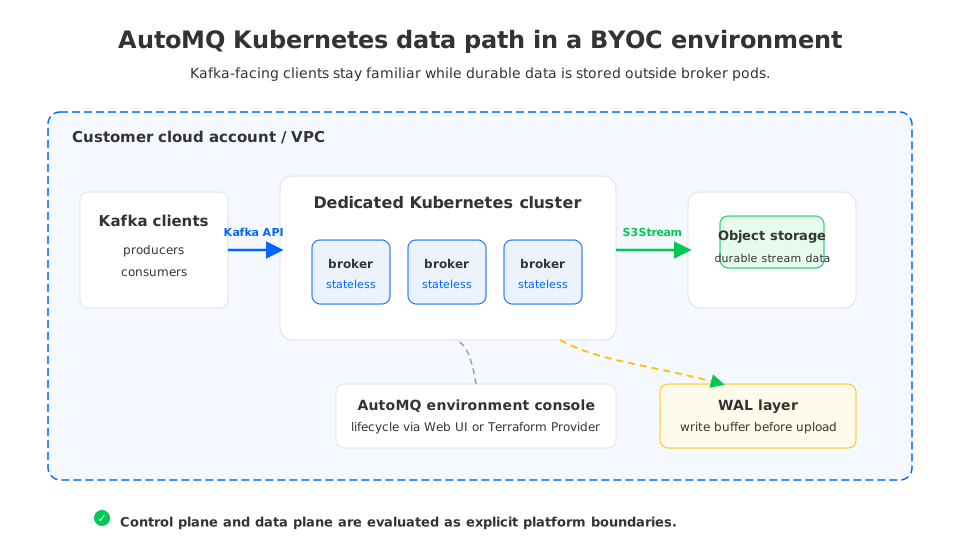
That design changes the Kubernetes conversation. Broker pods still need CPU, memory, networking, scheduling strategy, configuration, security, and observability. Controllers and metadata still matter. But the heaviest state is no longer anchored to each broker pod in the same way, so scaling and recovery can be evaluated as compute operations plus metadata and cache behavior rather than large partition-log relocation projects.
AutoMQ's BYOC model also speaks to platform ownership. Its public documentation describes AutoMQ Cloud BYOC as deploying software services in the user's cloud account so data does not leave the user's VPC. For Kubernetes BYOC, the environment console is deployed outside the Kubernetes cluster, typically on a cloud VM, while AutoMQ data plane instances are deployed into the user's Kubernetes cluster. Users can manage instance lifecycle through the Web UI or Terraform Provider.
There are still design constraints to respect. AutoMQ documentation recommends dedicated Kubernetes clusters and dedicated node pools for BYOC Kubernetes deployments because the system targets high-throughput data transmission and needs resource isolation. Helm deployment requires object storage buckets and, depending on WAL mode, storage classes or cloud storage permissions. Kubernetes-native does not mean casual; it means the responsibilities are explicit and automatable.
The best way to evaluate AutoMQ against Confluent is therefore not "managed service versus self-hosted Kafka." It is "which architecture gives our Kubernetes platform the right control boundary and state model?" If the pain is mostly connector management or governance, Confluent may remain the cleaner answer. If the pain is broker-local state, scaling friction, cloud-account control, and long-retention economics, shared-storage Kafka deserves a serious proof of concept.
5Platform team checklist
Before replacing Confluent, write the decision document in operational language. Start with workload shape, current dependencies, migration constraints, and the platform capabilities the replacement must preserve. List topics by throughput, retention, partition count, consumer fan-out, compliance tier, and business owner. Then map Confluent-specific dependencies: Schema Registry subjects, connector inventory, networking mode, RBAC, audit requirements, support workflows, and any managed stream processing.
Next, run a failure and scaling exercise for each candidate. Drain a Kubernetes node, restart brokers, add capacity, remove capacity, simulate object storage throttling if relevant, and run a consumer replay. Watch not only whether the system survives, but which team has to intervene and which dashboards prove the platform is healthy.
Finally, make the exit path part of the design. A Confluent replacement should preserve Kafka compatibility enough that applications are not trapped again behind a new boundary. The team should know which contracts are portable, which are vendor-specific, and which are intentionally accepted because they reduce operational load.
The Kubernetes platform question is not whether Kafka can be scheduled by Kubernetes. It can. The sharper question is whether the replacement lets Kubernetes act like the platform you already operate: declarative where possible, explicit about state, observable under failure, and honest about who owns the control plane and data plane.
If that is the evaluation you are running, review the AutoMQ Kubernetes and BYOC documentation, then test a workload that looks like production traffic. A useful proof of concept should include pod replacement, scale-out, retention, replay, Terraform-driven lifecycle operations, and a security review of where data and operational access live.
6References
- Kubernetes StatefulSet documentation
- Kubernetes Persistent Volumes documentation
- Apache Kafka documentation: basic operations and partition reassignment
- Confluent for Kubernetes: scale Kafka clusters and balance data
- AutoMQ documentation: deploy a multi-node cluster on Kubernetes
- AutoMQ BYOC documentation: deploy AutoMQ on Kubernetes overview
- AutoMQ documentation: difference with Apache Kafka
- AutoMQ documentation: difference with tiered storage
7FAQ
7.1Is a Confluent Kafka replacement the same as self-managed Kafka on Kubernetes?
No. Self-managed Kafka on Kubernetes is one possible replacement path, but it is not the sole path. A platform team can also evaluate managed BYOC systems, Kafka-compatible shared-storage systems, or operator-driven Kafka distributions. Compare compatibility, ecosystem dependencies, state management, and ownership boundary together.
7.2Why is broker-local storage such a big issue for Kubernetes teams?
Kubernetes is very good at scheduling and replacing compute. Traditional Kafka makes each broker responsible for durable partition replicas, so broker identity and storage placement remain operationally important. StatefulSets and PersistentVolumes help manage that state, but they do not remove the data movement behind scaling, node drains, and broker replacement.
7.3Does a Kubernetes operator solve Kafka statefulness?
An operator can make Kafka operations safer and more repeatable. It can coordinate configuration, rolling updates, certificates, scaling workflows, and resource definitions. It does not automatically change Kafka storage architecture. If brokers still own local partition data, stateful constraints remain underneath the operator workflow.
7.4How is shared-storage Kafka different from Kafka tiered storage?
Tiered storage usually keeps the broker local log as the hot storage layer and offloads older segments to object storage. Shared-storage Kafka makes object storage part of the primary storage architecture, with a WAL or buffering layer for write performance. That distinction affects scaling and recovery because durable data is less tied to individual broker disks.
7.5When should Kubernetes teams consider AutoMQ?
AutoMQ is worth evaluating when a team wants Kafka compatibility, Kubernetes deployment, BYOC control, object-storage-backed durability, and a broker model that reduces traditional stateful operations. It is especially relevant when the Confluent replacement search is driven by scaling friction, retained data growth, cloud-account control, or the desire to standardize streaming infrastructure inside a Kubernetes platform.


