
Table of Contents
Table of Contents
For regulated teams, the Kafka deployment model is rarely a narrow infrastructure preference. It affects where records travel, which cloud accounts hold the storage layer, who can operate the data plane, which logs are available for audit review, and how security teams explain the boundary to internal risk owners. A managed Kafka SaaS service can be the right answer when provider-operated reliability and reduced day-two operations matter most. A bring-your-own-cloud model can be the better fit when the platform team needs more direct control over data path, network boundary, storage, and cloud-native security tooling.
That distinction matters because "managed" is not a single thing. Confluent Cloud is a fully managed data streaming platform operated by Confluent, with documented controls for encryption, networking, identity, audit logs, and compliance programs. BYOC Kafka is a deployment model rather than one product category: the control plane may be vendor-operated, while the data plane runs inside the customer's cloud account or VPC. The practical question is not which model is universally safer. It is which model produces a clearer responsibility boundary for a specific regulated workload.
1Why Deployment Model Matters for Regulated Kafka Workloads
Kafka often sits in the middle of sensitive operational flows: payments, claims, identity events, trading activity, clinical workflows, public-sector records, or cross-border analytics pipelines. The events may be small, but their meaning is not. A topic name, message key, schema field, or consumer error can become part of the security review because it says something about the business process behind the stream.
In less regulated environments, teams usually evaluate Kafka platforms by throughput, latency, managed operations, ecosystem, and price. Those still matter. Regulated teams add a second axis: whether the deployment model gives them enough evidence to answer data residency, access control, incident response, encryption, procurement, and audit questions. That second axis can change the decision even when two platforms both speak the Kafka protocol.
The useful framing is provider assurance versus customer control. Provider assurance asks what the vendor documents, certifies, monitors, and operates. Customer control asks what remains inside the customer's cloud estate, which identity policies apply, where private connectivity terminates, and which storage services hold the records. Both patterns are valid, but they lead to different reviews.
2Managed Kafka SaaS vs BYOC Kafka
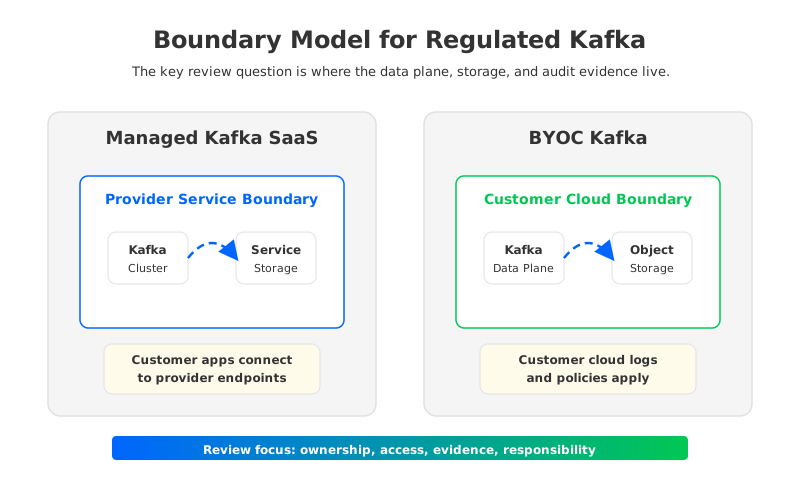
Confluent managed Kafka and BYOC Kafka are easiest to compare as boundary models. In a managed SaaS model, the provider operates the Kafka service as part of its cloud platform, while the customer configures clusters, networking, identities, encryption options, connectors, schemas, and governance features through provider APIs and UI. In a BYOC model, the data plane is deployed into the customer's cloud account or network boundary, while the provider may still deliver automation, upgrades, observability, and lifecycle operations from a control plane.
| Evaluation dimension | Managed Kafka SaaS | BYOC Kafka |
|---|---|---|
| Data plane location | Provider-operated cloud environment, connected to customer networks through supported networking options | Customer cloud account or VPC, depending on vendor architecture |
| Storage ownership | Provider-managed service storage | Customer-controlled cloud storage resources are common in BYOC designs |
| Network boundary | Private networking can reduce public exposure, but traffic enters the provider service boundary | Traffic can remain inside customer networking boundaries for the data plane |
| Operational burden | Lower for the customer; provider operates the service | Shared; customer controls more infrastructure context, vendor automates the platform |
| Audit posture | Stronger reliance on provider documentation, audit logs, and trust artifacts | More customer-native evidence from cloud logs, IAM, network flow logs, and storage policies |
| Procurement fit | SaaS subscription model | Cloud-account-resident deployment with vendor software or service terms |
The table is not a ranking. It shows why the same team may use managed SaaS for one stream and BYOC for another when network path or storage ownership changes the risk tier.
2.1Data Plane Ownership
The data plane is where Kafka records are produced, stored, replicated, fetched, and retained. In a managed Kafka SaaS service, the provider operates the service infrastructure. Customers depend on documented security controls, contractual commitments, audit reports, and platform features to satisfy internal review. Confluent Cloud documents capabilities such as encryption, access controls, network security features, and audit logs, and it also publishes trust and compliance information.
BYOC shifts the review conversation. If the Kafka data plane runs in the customer's cloud account, the customer can inspect and govern the surrounding infrastructure with existing cloud controls. Storage policies, private endpoints, IAM roles, KMS policies, VPC routing, cloud audit logs, and security posture tools can become part of the evidence package. That does not remove the need to review the vendor. It changes the scope from "Can we trust this external service boundary for this data path?" to "Can this vendor-operated platform run within our controlled cloud boundary?"
That extra control also creates extra responsibility. A BYOC model may require the customer to own cloud quotas, networking prerequisites, storage lifecycle policies, key policies, and incident coordination. For some teams, that is the point. For others, it is work they would rather not carry.
2.2Network and Identity Boundaries
Network architecture is where regulated Kafka reviews become concrete. The security team may ask whether clients connect over public internet paths, whether PrivateLink or peering is available, which side initiates connections, which DNS zones are involved, and whether network logs can prove the intended path. Confluent Cloud supports private networking patterns such as AWS PrivateLink, Azure Private Link, Google Cloud Private Service Connect, VPC peering, transit gateway connectivity, and related options, depending on cloud and cluster type. Those options are important because a managed SaaS model still needs a clear customer-to-provider connectivity story.
BYOC changes the default shape of that story. Producers, consumers, brokers, storage, and supporting services can be placed inside customer-owned networking constructs. Identity can often be aligned with the customer's cloud IAM, Kubernetes, secret management, and key management standards, subject to the vendor architecture. The review becomes less about crossing into a third-party data plane and more about validating what the vendor control plane can reach, what it can change, and how those actions are logged.
The identity question is as important as the packet path. Kafka has its own authentication and authorization concepts, while cloud services have IAM policies, security groups, service accounts, and key policies. A regulated platform team should map both layers. Kafka ACLs may control topic access, but cloud IAM may control the object storage that backs the platform.
2.3Audit and Operational Responsibilities
Managed SaaS reduces operational load by moving many platform tasks to the provider. Kafka operations include patching, broker replacement, capacity management, cluster health, incident response, and service upgrades. A provider-operated service lets the customer focus on application ownership and governance rather than broker-level maintenance.
The trade-off is that audit evidence comes from customer-side configuration, provider-side logs, and vendor trust documentation. Confluent Cloud provides audit logs for supported organization, environment, cluster, networking, and security events. Reviewers then decide whether those logs, together with customer-side cloud logs, are enough.
In BYOC, operational responsibility is more shared. The vendor may still automate provisioning, upgrades, scaling, and observability, but the customer owns more of the environment around the data plane. That can improve auditability when the organization already has strong cloud controls, and slow adoption when those controls are fragmented across teams. The model works well when platform, security, cloud infrastructure, and compliance owners agree upfront on which layer produces which evidence.
3Cost and Procurement Implications
The cost comparison between Confluent managed Kafka and BYOC Kafka should not stop at headline cluster pricing. Regulated teams often carry hidden costs in review cycles, connectivity choices, data movement, support boundaries, and cloud procurement. Private connectivity, cross-region traffic, and longer retention can all change the economics of a streaming architecture.
Managed SaaS usually consolidates more Kafka platform cost into the vendor bill. That can simplify procurement when the organization is comfortable buying a hosted service and wants predictable service ownership. It can create review friction when the workload owner must explain why sensitive data leaves the customer cloud boundary, even over private connectivity.
BYOC often shifts some cost components into the customer's cloud bill. Compute, object storage, network interfaces, logs, keys, and supporting infrastructure may appear in cloud cost reports. This can help when procurement wants spend to remain in committed cloud agreements or when FinOps needs workload-level visibility. It can be uncomfortable when the platform team expects a SaaS-like bill and discovers that BYOC requires cloud cost modeling.
The more regulated the workload, the more the cost model should include review and evidence costs. A platform that is lower cost on paper but harder to approve may lose months in governance. The right comparison includes both run-rate cost and time-to-approval cost.
4How AutoMQ BYOC Approaches Data Control
BYOC has become more relevant for Kafka because cloud-native streaming systems no longer have to look exactly like traditional broker-local-disk Kafka. Once storage is separated from broker compute, durable data can live in customer-controlled cloud storage while applications keep Kafka-compatible access. That creates a different security boundary.
AutoMQ fits into that category as a Kafka-compatible streaming platform that uses object storage as the durable storage layer. In its BYOC model, the environment is prepared inside the customer's cloud account and VPC, and Kafka records are stored through customer-side cloud resources such as object storage. AutoMQ's control plane provides lifecycle management and operational automation, while the data path is designed around the customer's cloud environment.
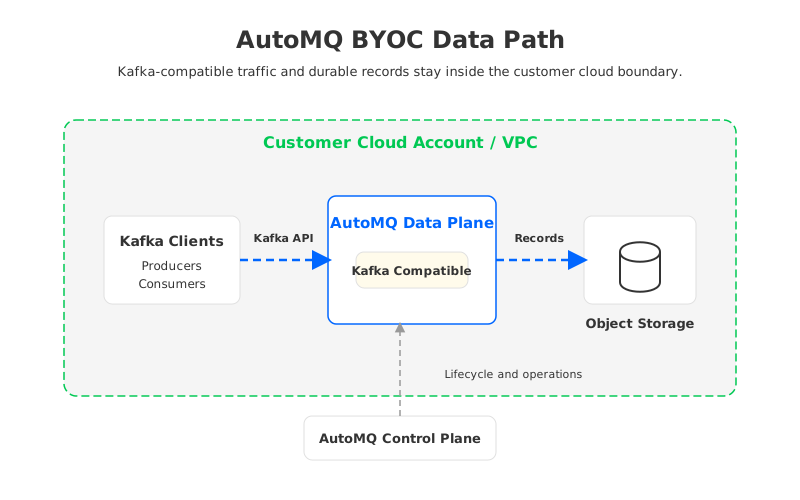
This model is not a compliance guarantee. It is a technical architecture that can make certain control questions easier to answer. Security teams can review where object storage buckets live, which IAM roles access them, how keys are managed, which VPC endpoints are used, and how cloud-native logs capture activity.
The strongest argument for BYOC is not "the vendor touches nothing." Any managed or semi-managed platform needs some operational permissions. The stronger argument is that the sensitive data path can be made more legible to the customer's own cloud governance model.
5Security Review Checklist
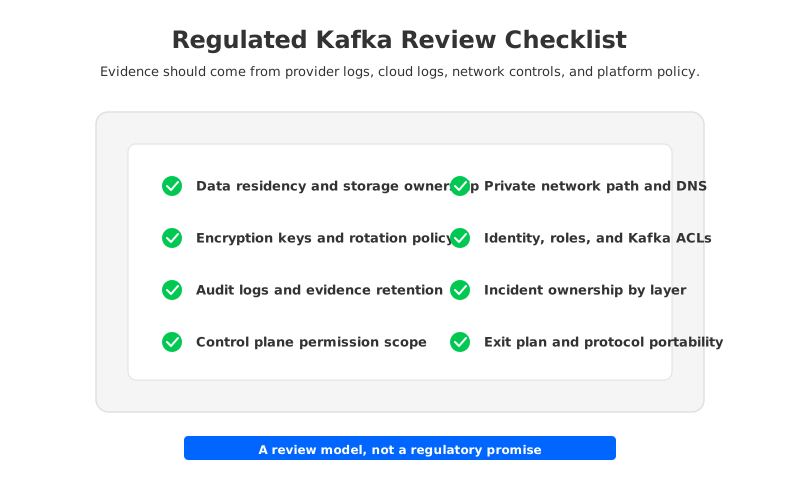
A good review checklist should force the deployment model into the open. It should avoid vague questions like "Is it secure?" and ask questions that produce evidence. The checklist works for Confluent managed Kafka, AutoMQ BYOC, and other Kafka-compatible platforms, but the expected answers will differ by model.
- Data residency and storage: Where are Kafka records stored at rest? Which region, account, bucket, disk, or provider service holds them? What retention settings apply?
- Network path: How do producers and consumers reach brokers or endpoints? Are PrivateLink, Private Service Connect, VPC peering, transit gateways, or customer VPC endpoints used? Which logs prove the path?
- Encryption and keys: Is data encrypted in transit and at rest? Are provider-managed keys, customer-managed keys, or bring-your-own-key options available?
- Identity and authorization: Which identities administer clusters, topics, ACLs, connectors, schemas, and storage? How are emergency access and service accounts governed?
- Control plane permissions: What can the vendor control plane read or modify? Are permissions scoped, logged, and revocable?
- Audit evidence: Which events appear in Kafka audit logs, provider audit logs, cloud audit logs, network flow logs, and storage access logs? How long are those logs retained?
- Incident response: Who detects, triages, and remediates incidents at each layer? What is the escalation path?
- Exit and portability: Can clients continue using standard Kafka protocols and APIs? What is the process for exporting retained data, migrating topics, or changing providers?
Attach this checklist to the architecture decision record before procurement. Deployment model decisions become harder to unwind once producers, consumers, schemas, dashboards, and incident runbooks depend on them.
6Decision Framework
Choose managed Kafka SaaS when the organization values provider-operated simplicity, the workload is approved for a third-party service boundary, and the available networking, encryption, audit, and compliance artifacts satisfy the review. Confluent Cloud is often evaluated in this category because it combines managed Kafka operations with connectors, governance, stream processing, and cloud networking options.
Choose BYOC Kafka when the workload needs stronger alignment with customer-owned cloud controls, when data-plane residency is central to approval, or when the organization wants storage, network, and audit evidence to remain primarily inside its cloud account. BYOC is not free operationally. It asks platform and security teams to own more of the environment, but can make the data path easier to explain to reviewers who care less about Kafka internals than about cloud boundaries.
The practical answer may be mixed. A regulated enterprise can run less sensitive streams on managed Kafka SaaS while reserving BYOC for workloads with stricter data-path, residency, or audit requirements. Kafka is an application interface; the control boundary behind that interface can vary by risk tier.
For teams comparing these models, the next step is not a generic product bake-off. Start with one representative regulated workload, draw the data path, list the identities, mark the storage boundary, and identify the evidence source for each control. If BYOC is part of that evaluation, review how AutoMQ places Kafka-compatible data planes and object storage inside the customer cloud account: AutoMQ docs.
7References
- Confluent Cloud Security Overview
- Confluent Cloud Networking Overview
- Confluent Cloud Audit Logs
- Confluent Trust Center
- AutoMQ Cloud BYOC Environment Overview
- AutoMQ Architecture Overview
- AutoMQ Compatibility with Apache Kafka
- Apache Kafka Security Documentation
- Apache Kafka Protocol Documentation
8FAQ
8.1Is BYOC Kafka automatically compliant with regulations such as HIPAA, PCI DSS, or GDPR?
No. BYOC is a deployment model, not a compliance certification. It can keep the data plane, storage, and network path inside the customer's cloud boundary, which may make certain reviews easier. The organization still needs legal, compliance, and security review.
8.2Is Confluent managed Kafka unsuitable for regulated teams?
No. Regulated teams can use managed SaaS platforms when provider controls, private networking, encryption options, audit logs, contracts, and trust artifacts meet their requirements.
8.3What is the main trade-off between managed Kafka SaaS and BYOC Kafka?
Managed Kafka SaaS reduces customer operational burden by relying more on the provider-operated service. BYOC gives the customer more data-plane control, but requires more involvement from cloud infrastructure, platform, and security teams.
8.4Does Kafka compatibility matter in a regulated deployment decision?
Yes. Compatibility affects migration risk, client behavior, operational tooling, and exit planning. A Kafka-compatible platform can reduce application changes, but security teams should still review authentication, authorization, audit logs, and administrative APIs.
8.5When should a team consider AutoMQ BYOC?
Consider AutoMQ BYOC when Kafka compatibility is required and the review depends heavily on customer-cloud data control: customer VPC networking, customer cloud account resources, object storage, cloud IAM, and cloud-native audit evidence. Evaluate it as a technical deployment option, not as a substitute for compliance review.


