
Table of Contents
Table of Contents
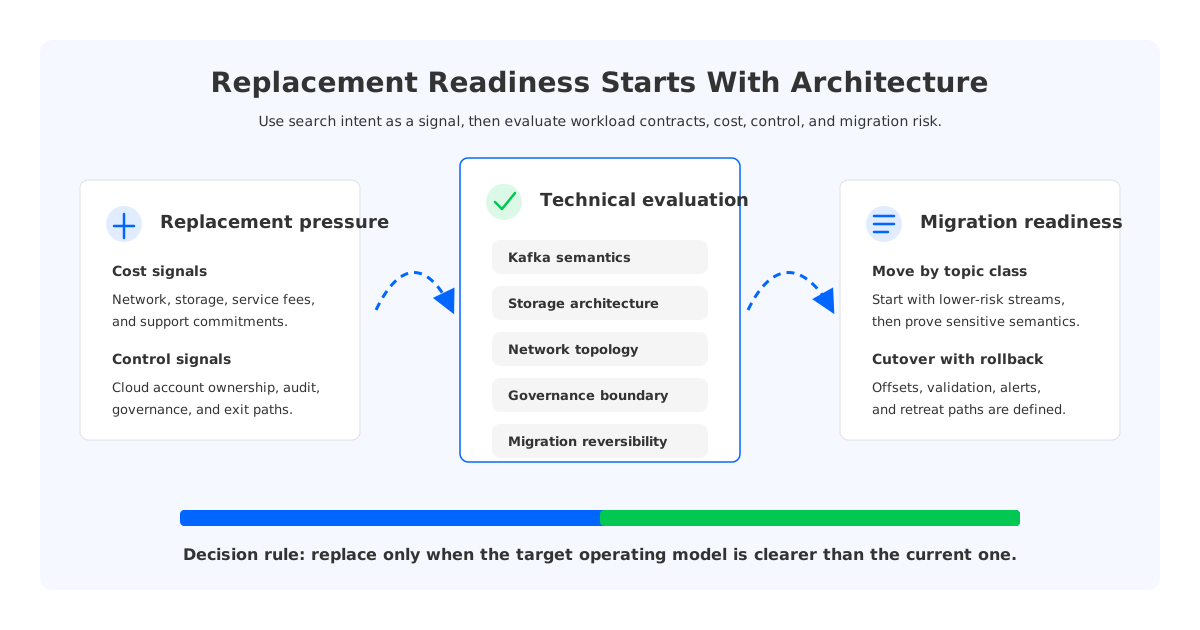
Teams rarely search for confluent alternatives because Kafka itself stopped being useful. They search because the operating model around Kafka has become a strategic decision: who owns the cloud account, who pays for cross-zone traffic, who controls upgrades, who can debug an outage, and how much of the streaming platform is portable if commercial or architectural priorities change. Confluent remains an important Kafka ecosystem vendor, and many organizations choose it for good reasons. Replacement readiness is not about proving that a vendor is wrong; it is about proving that your platform can move without breaking the application contracts that made Kafka valuable in the first place.
The uncomfortable part is that "Kafka-compatible" is not a yes-or-no checkbox. A platform can speak the Kafka protocol while changing how storage, networking, security, billing, and recovery behave underneath. That matters when an estate contains transactional topics, Kafka Connect pipelines, Flink jobs, schema-governed events, strict retention policies, and dashboards that SREs rely on at 2 a.m. The real evaluation is therefore not "which alternative is popular?" It is "which architecture can preserve the workload contract while improving the ownership model?"
1Why teams search for Confluent alternatives
The search usually begins after a platform review, not after a developer complaint. A CTO or platform owner looks at the streaming bill and sees more than broker capacity: managed-service fees, private connectivity charges, cross-AZ data transfer, storage growth, support commitments, and compliance overhead. FinOps sees a cost allocation problem. SRE sees a recovery and observability boundary. Procurement sees renewal leverage. Application teams see risk if a migration changes client behavior.
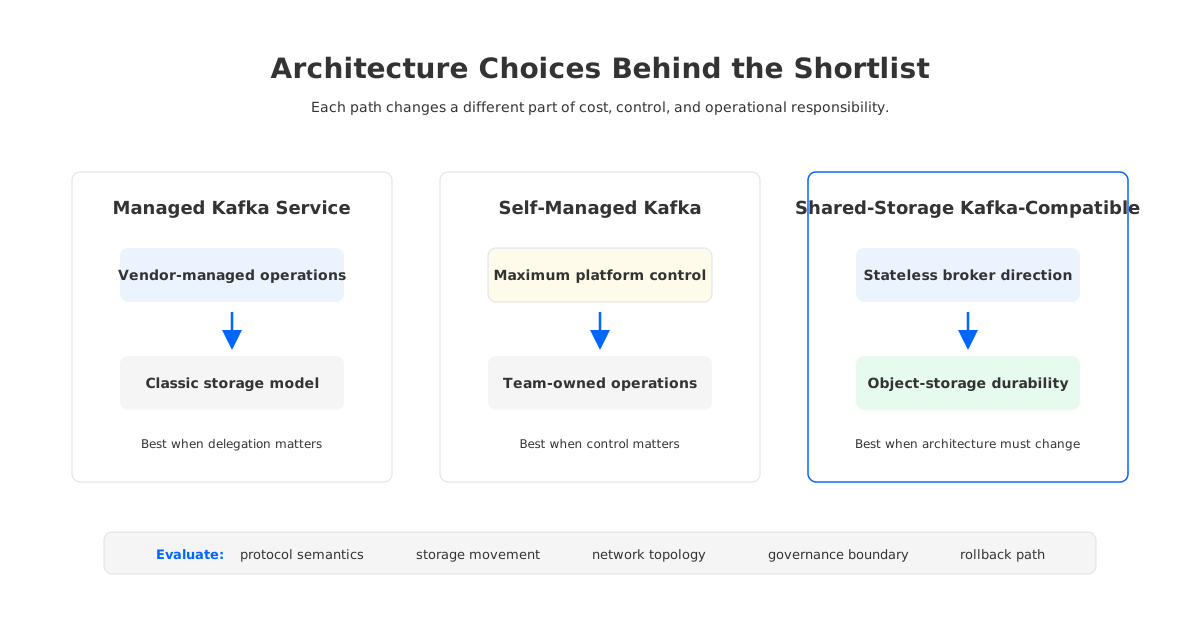
Those perspectives lead to different replacement goals. Some teams want a fully managed Kafka service that reduces day-two operations. Some want a self-managed distribution because governance and source-level control matter more than outsourcing. Others want a cloud-native Kafka-compatible engine that changes the storage layer so the cloud bill changes structurally rather than contractually. Staying with Confluent can also be right when its ecosystem and managed experience outweigh the trade-offs.
The mistake is to flatten those goals into a list of vendors. A useful Confluent alternatives comparison starts with the workload and ownership model:
- Protocol and ecosystem continuity. Existing producers, consumers, Connect workers, stream processors, schema workflows, ACL tooling, and monitoring integrations need a credible path forward.
- Cost structure. The comparison should separate service fees, compute, storage, cross-AZ traffic, private connectivity, egress, observability, and staffing.
- Control boundary. BYOC, self-managed, and fully hosted services place data, metadata, credentials, logs, and operational authority in different places.
- Failure behavior. The target platform must make broker loss, zone impairment, storage throttling, credential rotation, and rollback understandable before migration.
- Migration reversibility. A replacement plan is not mature until cutover, coexistence, offset handling, and retreat paths are written down.
That list already narrows the field. Confluent, Amazon MSK, open-source Apache Kafka, Redpanda, Aiven, AutoMQ, and other Kafka-compatible systems are not interchangeable entries in a shopping table. They represent different answers to the same platform question: how much Kafka compatibility, operational abstraction, cloud control, and architectural change do you want?
2The architecture criteria behind the shortlist
Kafka replacement risk lives below the marketing label. Apache Kafka defines the broker-client protocol and the semantics that applications consume through producers, consumers, transactions, offsets, partitions, topic configuration, and group coordination. The Apache Kafka documentation and protocol guide are useful baselines because they describe the surface area your applications actually depend on. Any alternative should be tested against that surface, not only against a demo producer and consumer.
The first architecture question is whether the candidate keeps Kafka's compute model close to upstream Kafka or reimplements larger parts of the system. Reusing Kafka internals can reduce semantic surprise, but it may also inherit operational limits from classic Kafka storage. Reimplementation can unlock different operating models, but it raises deeper compatibility questions. Neither path is automatically better. The platform team needs to know where the implementation changes.
The second question is where durable truth lives. Classic Kafka persists partition data on broker-attached disks and replicates that data across brokers for fault tolerance. Managed Kafka services can automate much of that model, but the underlying shape still affects storage sizing, rebalance time, and cross-zone network traffic. Cloud-native designs often move durable data toward shared storage or object storage so brokers can become more stateless. That shift can improve elasticity and reduce data movement, while adding object-store request behavior, cache design, and different recovery mechanics.
The third question is how the network is shaped. In cloud deployments, multi-AZ resilience often means data crosses zone boundaries. AWS documents same-Region cross-AZ data transfer charges on its EC2 pricing page, and that line item can become material for high-throughput Kafka clusters. Private connectivity also has its own pricing model; AWS PrivateLink pricing is a reminder that "private" and "free" are not the same thing. A replacement candidate should make producer routing, broker replication, consumer locality, object storage access, and cross-account connectivity visible in the cost model.
3Cost comparison is a model, not a quote
Cost is often the reason a replacement conversation starts, but it is a poor reason to rush. Public pricing pages tell you unit prices; they do not tell you workload shape. A high-throughput Kafka estate with long retention and heavy replay behaves differently from a low-volume governance bus. A serious cost model needs assumptions that platform and finance teams can both inspect.
At minimum, separate the following buckets:
| Cost bucket | What to measure | Why it changes replacement decisions |
|---|---|---|
| Compute | Broker, controller, connector, and proxy capacity | Some alternatives reduce broker state but add other components |
| Storage | Local disks, block storage, object storage, retention, lifecycle | Shared storage can change both capacity planning and recovery behavior |
| Network | Cross-AZ traffic, private connectivity, egress, replication | This is often hidden until the bill is broken down by service |
| Operations | Upgrades, scaling, rebalancing, incident response, audits | Managed services and self-managed platforms move labor to different teams |
| Commercial terms | Subscription, support, committed spend, minimums | Architecture savings can be offset by contract shape |
This table prevents a common error: comparing one vendor's all-in managed price with another platform's raw infrastructure bill. It also prevents the opposite error, where a self-managed option looks inexpensive until labor, on-call load, security review, and upgrade ownership are added. Replacement readiness means the model is honest about cloud cost and human cost.
MSK is a good example of why the distinction matters. Amazon MSK is an AWS managed service for Apache Kafka, and its developer guide describes the managed cluster model. The MSK pricing page then breaks cost into service-specific units. For a team already standardized on AWS operations, that may be attractive. For a team trying to change Kafka's storage and cross-AZ traffic economics, a managed classic architecture may not be enough. The right answer depends on whether the target is operational delegation, architectural change, or both.
4Migration readiness starts with topic inventory
The safest migration plans begin at the topic level. Cluster-level averages hide the workload contracts that can break during cutover. One topic may carry append-only clickstream events and tolerate duplicate processing. Another may back a transactional outbox. A third may be compacted and consumed by a stream processing job. Treating all three as "Kafka traffic" is how replacement projects become incident reviews.
Build the inventory around application semantics:
- Client behavior. Record client versions, producer settings, idempotence, transactions, consumer group patterns, retry behavior, and maximum tolerated lag.
- Topic features. Capture compaction, retention, partition count, message size, timestamp policy, ACLs, quotas, and schema dependencies.
- Data movement. Identify Connect, Debezium, Flink, Spark, MirrorMaker, internal replication, audit exports, and replay-heavy consumers.
- SLOs and recovery. Document latency targets, RPO/RTO expectations, backup assumptions, zone-failure behavior, and downgrade paths.
- Ownership. Map every topic to an application owner, platform contact, business criticality, and cutover approver.
The inventory often changes the migration order. Append-heavy analytics topics may be good early candidates because they prove throughput, retention, and consumer catch-up behavior without touching the most sensitive stateful workflows. Transactional, compacted, or coordination-heavy topics deserve later waves after semantic validation. Internal platform dependencies should be handled conservatively because they can affect every tenant at once.
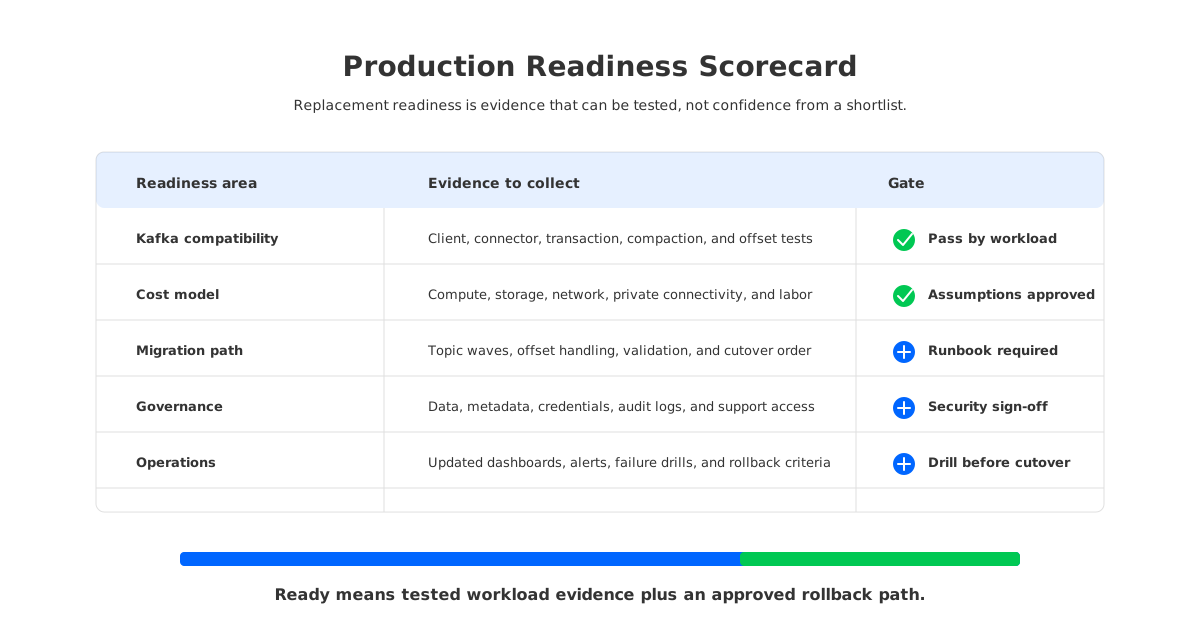
Offset handling is the next hard boundary. A migration can copy bytes and still surprise consumers if offsets, timestamps, compaction state, or group metadata do not line up with the cutover plan. MirrorMaker2 and vendor-specific linking tools can help, but the platform team still needs a written procedure for validation reads, consumer restart order, rollback conditions, and post-cutover monitoring.
5Governance and operating model matter as much as throughput
Kafka platforms become shared infrastructure because they sit between teams. That makes governance part of the architecture. A replacement candidate should be evaluated for access control, auditability, encryption, network isolation, tenant boundaries, schema governance, quota enforcement, and observability export. These controls may be implemented by the Kafka layer, the cloud account, the managed service, or a surrounding platform. The important question is whether the resulting system matches how the organization already operates.
Control-plane location is especially important in regulated environments. Fully hosted services can reduce operational burden, but they place more responsibility in the vendor environment. BYOC models may keep more infrastructure in the customer's cloud account, but their details vary: data plane, metadata plane, management plane, telemetry, support access, and credentials do not always share the same boundary. Self-managed platforms offer maximum control and maximum responsibility. None of these models is inherently wrong; each needs explicit approval from security, platform, and finance stakeholders.
Observability also changes after replacement. Broker disk saturation, ISR shrinkage, controller latency, request queue time, object-store errors, cache hit rate, private endpoint throughput, and cross-zone traffic tell different stories depending on architecture. A strong readiness plan includes updated alerts, runbooks, load tests, and fault drills before production traffic moves.
6How AutoMQ fits the evaluation
After the neutral evaluation is complete, AutoMQ is one option for teams that want Kafka-compatible streaming with a cloud-native storage architecture. AutoMQ's documentation describes compatibility with Apache Kafka clients and ecosystem components, and explains that AutoMQ keeps the Kafka compute layer while changing the storage layer. That makes it relevant when the replacement goal is not only a different commercial model, but a different way to run Kafka-style workloads on cloud infrastructure.
The architectural distinction is shared storage. AutoMQ's S3Stream documentation describes a storage layer that offloads Kafka log storage to object storage and uses WAL and cache components to support stream workloads. Its Kafka compatibility documentation is the first place to check if your evaluation depends on existing clients, connectors, proxies, or monitoring tools. Its inter-zone traffic documentation also addresses the cloud-network-cost question directly by explaining how AutoMQ uses S3-based shared storage and routing to reduce inter-zone traffic.
AutoMQ should still be tested with the same discipline as any other alternative. Run your own workload matrix: client compatibility, transactions, compaction, Connect, Flink, schema workflows, cold reads, burst writes, zone impairment, object storage throttling, credential rotation, and rollback. The benefit of including AutoMQ is that it gives the shortlist a storage-decoupled architecture, not another managed-service packaging of Kafka.
If your team is building a Confluent replacement readiness worksheet, start with the architecture and migration questions above, then run a proof of concept against the topics that represent your real risk. The AutoMQ documentation is a practical next step for testing a Kafka-compatible shared-storage path without turning the evaluation into a vendor slogan.
7A readiness rule for platform teams
Do not replace a Kafka platform because a comparison table looks attractive. Replace it when the target operating model is clearer than the old one. That means the platform team can explain the protocol surface, storage model, network cost, migration path, governance boundary, observability changes, and rollback plan in terms application owners understand.
The strongest alternatives evaluation is not the one with the longest vendor list. It is the one that turns a vague search for confluent alternatives into a small set of architecture choices and a migration plan that can survive production reality. When the workload contract is explicit, the replacement decision becomes less emotional and much easier to defend.
8References
- Apache Kafka: Documentation
- Apache Kafka: Protocol guide
- AWS: What is Amazon MSK?
- AWS: Amazon MSK pricing
- AWS: EC2 data transfer within the same Region
- AWS: AWS PrivateLink pricing
- AutoMQ documentation: Compatibility with Apache Kafka
- AutoMQ documentation: S3Stream shared streaming storage
- AutoMQ documentation: Eliminate inter-zone traffic
9FAQ
9.1What is the safest first step when evaluating Confluent alternatives?
Start with topic inventory and workload classification, not vendor selection. Capture topic features, client versions, latency expectations, retention, compaction, transactions, connectors, stream processing dependencies, and business owners. That inventory tells you which workloads can move early and which need deeper semantic testing.
9.2Is Kafka compatibility enough for a replacement decision?
No. Kafka compatibility is necessary, but it does not cover storage behavior, network cost, governance boundaries, observability, migration tooling, or failure recovery. A production evaluation should test the full operating model, including how the platform behaves during broker loss, zone impairment, cold reads, credential rotation, and rollback.
9.3When should a team stay with Confluent?
Staying with Confluent can be the right choice when its managed experience, governance ecosystem, commercial relationship, operational maturity, or established adoption outweighs the benefits of changing platforms. Replacement makes sense when the target architecture and ownership model warrant migration risk.
9.4How should AutoMQ be compared with managed Kafka services?
Compare AutoMQ as a Kafka-compatible shared-storage architecture, not only as a service package. Managed Kafka services may reduce operational burden while keeping a more traditional Kafka storage model. AutoMQ is relevant when the evaluation includes storage decoupling, stateless brokers, object-storage-backed durability, cloud network cost, and BYOC or software deployment control.


