
Table of Contents
Table of Contents
If you are typing "Confluent substitute" into a search box, you probably do not have a shortlist yet. You may have a Kafka cost concern, a cloud architecture concern, a licensing concern, a data control concern, or a migration concern. Those are different problems, and they lead to different search terms.
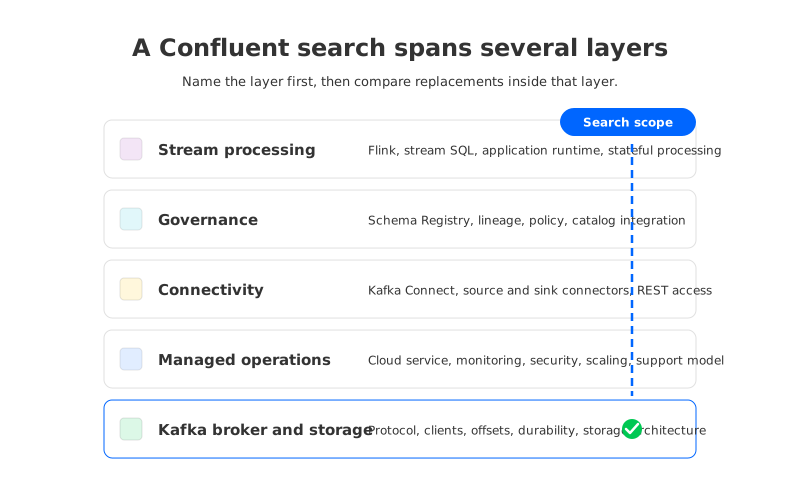
The phrase sounds simple, but Confluent is not a single component. Confluent Cloud is a managed data streaming platform. Confluent Platform is self-managed software built around Apache Kafka with additional services for connectivity, governance, processing, monitoring, and operations. Replacing the Kafka broker is not the same as replacing Schema Registry, replacing managed connectors, or replacing a cloud service contract.
That distinction matters because the riskiest part of a Kafka platform change is rarely the first demo. It is what happens to the client ecosystem, consumer offsets, topic semantics, operational runbooks, monitoring, rollback paths, and the people who get paged at 02:00. A better search starts by naming the layer you want to change and the compatibility contract you want to keep.
1What People Mean by a Confluent Substitute
Most teams start with a broad word because they have a broad discomfort. "Substitute" means "something else that can serve the same purpose," but a streaming platform has more than one purpose. A developer may care about whether existing producers and consumers still work. A platform engineer may care about who operates brokers, how storage scales, and whether a rebalance will compete with production traffic. An engineering manager may care about vendor dependency, cloud control, or the cost curve as retention and throughput grow.
That is why a generic search for a Confluent substitute often returns an awkward mix: managed Kafka services, Kafka-compatible engines, open-source Kafka distributions, connector vendors, stream processing platforms, and broader event streaming tools. Some of those results can be useful. Some are the wrong layer entirely.
Start by splitting the search into three common intents:
- Broker or data-plane replacement. You want a Kafka-compatible system that can receive Kafka producer writes, serve Kafka consumer reads, preserve Kafka topic and offset expectations, and change the infrastructure underneath.
- Managed service replacement. You want a different operational model for hosted Kafka: more control, less lock-in, a BYOC pattern, a different cloud footprint, or a different scaling and billing model.
- Ecosystem or service replacement. You want alternatives for Schema Registry, Kafka Connect, stream governance, Flink, stream SQL, CLI/API management, monitoring, or migration tooling.
The first category is where Kafka compatibility becomes the core filter. The second category adds commercial, compliance, and operational responsibility questions. The third category is more modular: you may replace one service while keeping the broker layer unchanged.
2Substitute vs Alternative vs Replacement
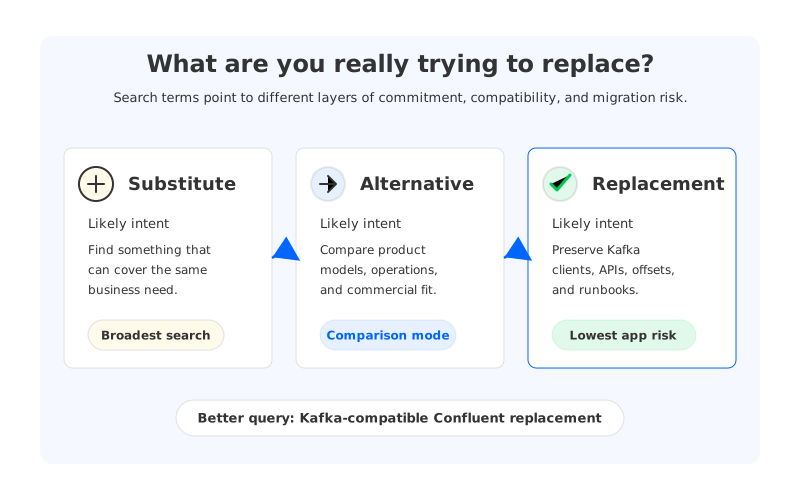
"Substitute," "alternative," and "replacement" are close in everyday language, but they signal different evaluation depths. A substitute can be conceptually broad: anything that solves a similar business problem. An alternative is usually a named product comparison: "What are my options besides Confluent Cloud?" A replacement is more demanding because it implies migration. It asks whether a workload can move without rewriting the application contract.
For Kafka infrastructure, that difference is not semantic trivia. A non-Kafka event streaming product may be a substitute for some use cases if you are building a fresh application. It may even be the right choice when you want a different programming model. But it is not a low-risk replacement for an existing Kafka estate if every producer, consumer, connector, dashboard, alert, and incident runbook assumes Kafka behavior.
Use this simple translation table when you refine your search:
| Search phrase | What it usually means | Best next filter |
|---|---|---|
| Confluent substitute | I know I want another direction, but not which layer | Map the layer first |
| Confluent alternative | I want a comparable vendor or operating model | Compare service scope and ownership |
| Confluent replacement | I may migrate existing workloads | Test Kafka compatibility and migration risk |
| Kafka-compatible replacement | I want application continuity | Verify protocol, clients, semantics, and tooling |
The last phrase is narrower, but it is often more useful for existing workloads. It forces you to ask whether the platform preserves the Kafka contract before you get distracted by a feature checklist.
3The Compatibility Questions That Matter
Apache Kafka is more than a broker binary. The official Kafka documentation describes a protocol, producer and consumer APIs, the Admin API, Kafka Connect, Kafka Streams, and an ecosystem of clients across languages. Confluent's own product documentation builds on that base and adds platform services such as Schema Registry, connectors, REST Proxy, Cluster Linking, ksqlDB, Flink, Control Center, governance, and managed cloud operations.
So compatibility should not be reduced to "can it speak to one Java producer in a test environment?" That is the shallow version. A practical replacement evaluation should cover five compatibility surfaces.
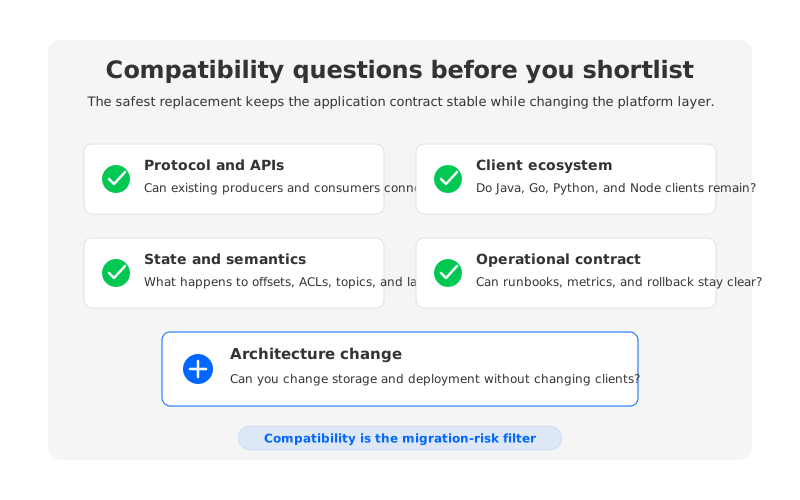
First, verify protocol and API compatibility. Your existing clients should connect through the Kafka protocol with normal producer, consumer, and admin behavior. Pay attention to the Kafka versions and client libraries you actually run, not only the latest library in a clean sample app.
Second, inspect client ecosystem continuity. Java is usually the first client tested, but production environments often include Go services, Python jobs, Node.js applications, C/C++ clients through librdkafka, Logstash, Fluent Bit, Vector, Debezium, Flink jobs, and Kafka UI tools. If a replacement requires a new SDK across the fleet, you are no longer evaluating a low-friction Kafka replacement; you are planning an application migration.
Third, test state and semantics. Consumer group offsets, topic configuration, ACLs, partition counts, retention behavior, transactional expectations, idempotent producer behavior, lag monitoring, and rebalance behavior are where migrations become real. A compatibility claim should be validated with representative workloads, not only a produce-consume smoke test.
Fourth, compare the operational contract. Can your team keep using familiar Kafka operational concepts? Are metrics, alerts, quotas, security, backup, upgrade, and rollback workflows understandable to the people who already operate Kafka? A platform can preserve the Kafka client API while still changing operations substantially; that may be acceptable, but it should be explicit.
Fifth, decide whether you want to change the storage and deployment model. Traditional Kafka ties broker compute to local or block storage. Some platforms keep that shape and improve operations around it. Others preserve Kafka compatibility while changing the storage architecture beneath the broker. This is where a replacement can be more than a vendor swap: it can be an architectural change.
4When AutoMQ Is a Relevant Confluent Replacement
AutoMQ is relevant when your search is specifically about the Kafka broker and data-plane layer, not when you are trying to replace every Confluent service one-for-one. It is a Kafka-compatible streaming platform that preserves the Kafka client ecosystem while changing the underlying storage and deployment model. In public materials, AutoMQ describes itself as fully compatible with Apache Kafka and built on object storage, with compatibility across Kafka clients, connectors, proxies, and ecosystem components.
The key idea is surgical rather than wholesale replacement. Keep the Kafka protocol, client behavior, and ecosystem integration surface. Change the part that creates cloud operational pressure: the storage layer and the coupling between brokers and persistent data. AutoMQ does this by replacing Kafka's local-disk-centered storage model with a shared storage architecture based on object storage, while retaining Kafka compatibility at the application-facing layer.
That makes AutoMQ a fit for searches such as:
- "Kafka-compatible Confluent replacement"
- "Confluent Kafka replacement without client rewrite"
- "Kafka replacement with object storage"
- "Confluent alternative for BYOC Kafka"
- "Kafka-compatible platform with shared storage"
It is not a perfect answer to every "Confluent substitute" query. If your main dependency is Confluent's managed Flink service, stream governance, or a particular managed connector catalog, the evaluation should include those services separately. If your main problem is the broker and storage layer, AutoMQ becomes a useful example of a replacement category: keep Kafka compatibility, but change the infrastructure economics and scaling model underneath.
That category framing is healthier than a vendor-by-vendor checklist. A checklist can tell you whether a product has a box called "connectors." It cannot tell you whether your migration risk sits in the data plane, the control plane, or the surrounding ecosystem.
5Better Search Queries for Your Evaluation
The fastest way to improve search quality is to stop searching for a universal substitute. Search for the layer, the compatibility requirement, and the migration constraint. That gives you results you can evaluate with fewer false positives.
If you are focused on the data plane, use searches like:
Kafka-compatible Confluent replacementConfluent Kafka replacementKafka-compatible broker replacementConfluent alternative without changing Kafka clientsKafka replacement with object storage
If you are focused on managed operations, use searches like:
Confluent Cloud alternative BYOCmanaged Kafka alternative private cloudKafka service replacement AWS GCP AzureConfluent Cloud replacement data control
If you are focused on ecosystem services, name the service directly:
Confluent Schema Registry alternativeKafka Connect managed connector alternativeConfluent Flink alternativestream governance alternative for KafkaCluster Linking alternative Kafka migration
This search discipline also improves internal conversations. Instead of asking "Should we replace Confluent?", ask "Which layers do we want to replace, and which Kafka contracts must remain stable?" That question is more precise, and it is much harder to answer with a sales deck alone.
6A Practical Evaluation Path
For an existing Kafka estate, start with an inventory before you schedule vendor demos. List the client languages, Kafka client versions, security mechanisms, topic configurations, retention patterns, connector dependencies, stream processing jobs, monitoring dashboards, and operational tasks that currently depend on Confluent or Kafka behavior.
Then separate "must preserve" from "can change." Most teams want to preserve application code, producer/consumer behavior, offsets, and basic Kafka operations. They may be willing to change deployment architecture, storage backend, scaling mechanics, billing model, or the management console. That split is the heart of a mature replacement search.
A useful proof of concept should include more than throughput numbers. It should run at least one real producer, one real consumer group, one operational workflow, one failure scenario, one migration or replication path, and one rollback discussion. The goal is not to prove that an empty topic can receive messages. The goal is to expose the parts of the contract your organization actually relies on.
Here is a compact scorecard for early screening:
| Evaluation area | Ask this before the POC |
|---|---|
| Application continuity | Which clients, versions, and frameworks must remain unchanged? |
| Migration state | How will topics, offsets, ACLs, schemas, and connector state move? |
| Operational ownership | Who runs upgrades, incidents, scaling, security, and observability? |
| Architecture delta | Are you changing only the vendor, or also the storage and deployment model? |
| Exit path | What rollback or coexistence pattern exists if the migration stalls? |
The best replacement is not always the platform with the longest product page. It is the one whose compatibility boundary matches your risk boundary. Sometimes that means a managed Kafka service. Sometimes it means a Kafka-compatible shared-storage engine. Sometimes it means replacing only a governance or connector layer and leaving the broker alone.
If your next step is to test a Kafka-compatible replacement rather than a generic substitute, read the AutoMQ compatibility documentation and run a small workload with the Kafka clients you already use. The useful question is not "Can this product look like Kafka in a demo?" It is "Can my Kafka estate keep its application contract while I improve the platform underneath?" For a deeper technical evaluation, you can also talk with the AutoMQ team about compatibility boundaries, shared storage architecture, and migration planning.
7References
- Apache Kafka Protocol
- Apache Kafka Documentation: APIs and Clients
- Apache Kafka Clients wiki
- Confluent Platform Overview
- Confluent Cloud Overview
- AutoMQ Compatibility with Apache Kafka
- AutoMQ Overview
- AutoMQ Difference with Tiered Storage
- AutoMQ Client SDK Guide
8FAQ
8.1Is a Confluent substitute the same as a Kafka replacement?
No. A Confluent substitute may refer to a managed service, a broker engine, connector tooling, governance, stream processing, or a broader event streaming platform. A Kafka replacement is narrower: it should preserve the Kafka-facing contract that applications and operations depend on.
8.2What does Kafka-compatible replacement mean?
It means the replacement speaks the Kafka protocol and preserves expected Kafka client, topic, consumer group, and operational behavior closely enough that existing Kafka applications can move with minimal code change. The exact compatibility boundary should be tested against your client versions and production patterns.
8.3When should I search for a Confluent alternative instead?
Use "Confluent alternative" when you are comparing vendors, managed service models, cloud control, commercial terms, or operational ownership. Use "Kafka-compatible replacement" when your main concern is moving existing Kafka workloads without rewriting clients.
8.4Can AutoMQ replace all Confluent services?
AutoMQ is most relevant as a Kafka-compatible broker and data-plane replacement that changes the storage and deployment model while preserving Kafka compatibility. If you depend heavily on Confluent-specific governance, managed Flink, or connector services, evaluate those layers separately.
8.5What is the first technical test for a replacement?
Run your actual clients, not only a sample producer. Include representative producer settings, consumer groups, offset behavior, topic configurations, security settings, monitoring, and a failure or rollback scenario. Compatibility is only meaningful when it covers the parts of Kafka your systems truly use.


