
Table of Contents
Table of Contents
A CTO does not approve a Kafka platform replacement because a different system looks interesting. Approval comes when the risk envelope is smaller than the renewal, lock-in, control, or cost problem that started the evaluation. That matters for teams considering a move from Confluent to AutoMQ, because the decision is not "Can another product run Kafka traffic?" It is whether the replacement preserves application behavior, gives the organization more data and cloud control, and changes the cost model without creating another operational blind spot.
Confluent Cloud is a managed data streaming platform. It brings Kafka operations, networking, governance, connectors, stream processing, and support into one vendor relationship. Many teams choose it for good reasons. The replacement question appears later, when procurement asks why spend keeps expanding, security asks where the data plane lives, platform engineering wants more direct cloud control, or architecture leaders want an exit path that preserves Kafka semantics.
AutoMQ enters that conversation as a Kafka-compatible streaming platform built around shared storage, stateless brokers, and BYOC deployment. Evaluate that difference through questions, not slogans. Treat reliability, performance, or cost claims as assumptions until they are tied to public documentation, public benchmarks, or your own proof of concept.
1Why CTOs evaluate Confluent replacements differently
Platform engineers often start with compatibility tests: produce, consume, commit offsets, create topics, and watch consumer lag. CTOs start one layer higher. They want to know which risks move from vendor to customer, which costs become predictable, and whether the organization can still meet SLOs after the migration team has gone back to its normal roadmap.
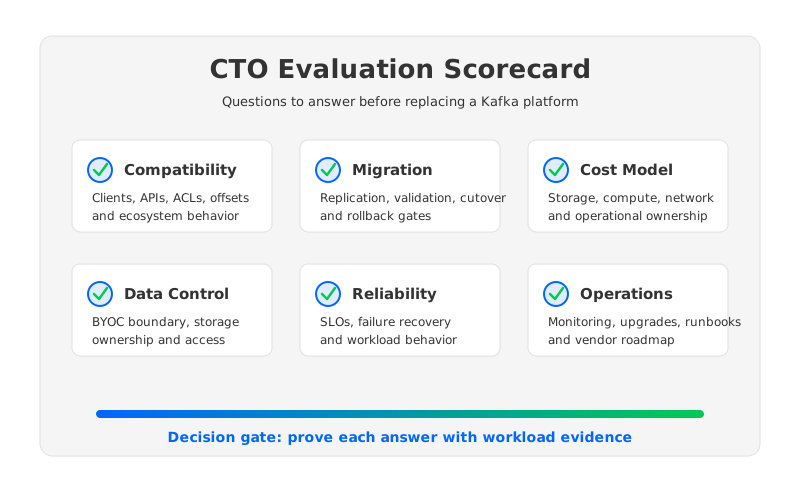
The useful replacement discussion has six gates:
- Compatibility: Does the target platform preserve the Kafka-facing behavior that applications, operators, and security controls depend on?
- Migration: Can topic data, consumers, offsets, schemas, clients, and rollback procedures be handled with explicit validation gates?
- Cost model: Does the replacement change storage, compute, network, and operations economics, or does it merely move spend between invoices?
- Data control: Does the target model improve ownership of cloud resources, network paths, storage, keys, logs, and audit evidence?
- Reliability: Can the team prove failure behavior under its own workload, instead of relying on generic architecture claims?
- Operations: Can the team run the system with clear metrics, alerts, upgrades, incident boundaries, and support ownership?
That framing keeps the conversation honest. Confluent may fit teams that value managed Kafka, connectors, governance, and stream processing. AutoMQ becomes compelling when the core problem is Kafka-compatible streaming at scale, but the organization wants customer-owned infrastructure boundaries and a different storage architecture.
2Compatibility questions
The first CTO question is blunt: what will break? "Kafka-compatible" has to mean more than accepting a producer request. Production Kafka behavior includes client libraries, consumer groups, offsets, transactions, admin APIs, ACL expectations, topic configuration, metrics, error handling, and tooling that has accumulated around the current platform.
Apache Kafka's protocol and documentation are the baseline for this discussion. They define the client-broker surface that application teams expect to remain stable. AutoMQ's own compatibility documentation says it is compatible with Apache Kafka and supports mainstream Kafka clients, while its architecture documentation describes changes below the Kafka interface. Those two ideas must be tested together: the client surface should stay familiar, while the storage and scaling model underneath changes.
A serious Confluent to AutoMQ compatibility plan should answer these:
| CTO question | Evidence to collect |
|---|---|
| Which client versions and languages are in production? | Producer and consumer inventory, dependency scan, staging test matrix |
| Which Confluent-specific services are in use? | Schema Registry, connectors, Flink, Cluster Linking, governance, custom interceptors |
| Which Kafka features matter to the workload? | Transactions, idempotent producers, compaction, ACLs, quotas, topic configs |
| Which operational tools call Kafka APIs? | Terraform, CI jobs, admin scripts, dashboards, alert rules, incident runbooks |
The answer may reveal that the Kafka broker is only one part of the Confluent footprint. If an application depends on managed connectors, Schema Registry workflows, Flink SQL, or provider-specific metrics, those layers need their own replacement or retention plan. AutoMQ can reduce the migration surface at the Kafka protocol layer, but it does not make every adjacent dependency disappear.
3Migration and rollback questions
Migration risk is not mainly the act of copying bytes. The risk is losing track of which cluster is the source of truth, cutting producers before consumers are ready, moving offsets without understanding consumer lag, or discovering during an incident that rollback was never tested. Confluent documents Cluster Linking as a way to mirror topics and support migration or hybrid patterns; Apache Kafka documents MirrorMaker 2 for cross-cluster replication. Whatever toolset you use, CTO-level approval should require a migration design with explicit gates.
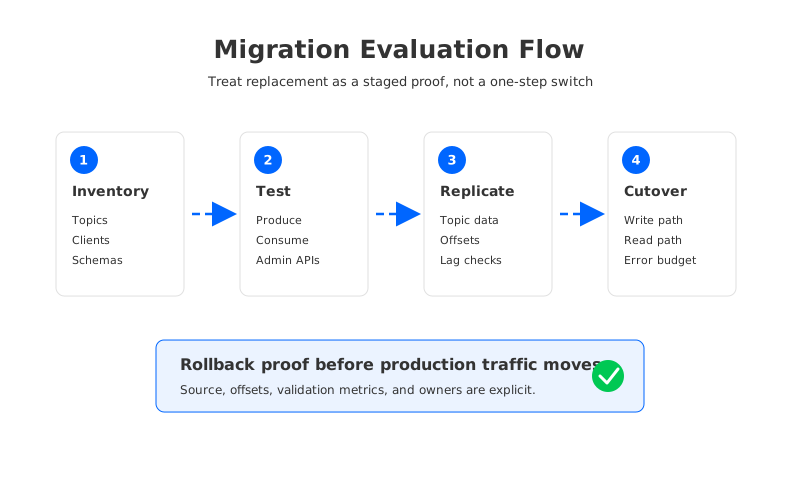
The migration plan should separate five concerns. Inventory topics, partitions, retention, compaction policy, schemas, ACLs, clients, and consumer groups. Run representative client compatibility tests against AutoMQ before production replication begins. Define how data will be replicated and how lag will be measured. Write separate cutover rules for producers and consumers. Prove rollback while Confluent is still a viable source system.
The CTO question is not "Do we have a migration tool?" It is "What condition lets us continue, pause, or reverse the move?" A gate might require zero client errors in staging, bounded replication lag, validated offsets, read-after-cutover tests, and a rollback owner. For critical workloads, test rollback rather than treating it as an emergency procedure.
4Cost and TCO questions
Cost conversations get muddy when teams compare a managed service invoice with raw cloud infrastructure. Confluent Cloud pricing and billing documentation describes usage across dimensions such as cluster capacity, data transfer, storage, networking, and additional services. That bundled model can be valuable because it transfers a large share of operations work to the provider. The trade-off is that spend can grow with throughput, retention, private networking, managed connectors, stream processing, and higher-tier platform features.
AutoMQ changes the cost conversation by changing the architecture. Traditional Kafka ties durable log storage to broker-local disks and uses broker replication for fault tolerance. AutoMQ separates compute from storage: brokers are designed to be stateless, while data is stored in shared object storage through its S3Stream layer. Its BYOC model also places infrastructure costs closer to the customer's cloud account and usage assumptions.
The economic question is therefore not "Which vendor has a lower unit price?" It is "Which cost structure matches this workload?"
| Workload trait | Why it matters in evaluation |
|---|---|
| Long retention | Object storage economics may matter more than broker-local disk capacity. |
| High fan-out reads | Egress and network placement can dominate the bill if consumers sit far from the cluster. |
| Bursty traffic | Stateless broker scaling can reduce the need to hold permanent peak capacity, but the PoC must prove recovery and latency behavior. |
| Mostly Kafka core usage | A broad managed platform bundle may include services the workload does not use. |
| Ecosystem usage | Connectors, governance, and stream processing may justify an integrated platform or require separate migration work. |
Public AutoMQ benchmark material can support an initial hypothesis about performance and cost efficiency, but it should not replace workload-specific testing. A CTO should ask the team to normalize the comparison around the same ingress, egress, retention, partition count, durability policy, availability target, observability overhead, and support model. Any projected savings should be labeled as a model until the PoC runs against representative traffic.
5Data control, BYOC, and security questions
Private networking and data control are related, but they are different questions. Confluent Cloud documents multiple networking patterns, including public access and private connectivity options such as AWS PrivateLink for supported configurations. Those options can make client connectivity private, but the service remains a managed cloud service operated by Confluent.
BYOC changes the boundary that security teams evaluate. AutoMQ Cloud BYOC documentation describes environments deployed in the user's cloud account and network environment. AutoMQ's AWS preparation guidance states that BYOC environment components are deployed inside the customer's AWS account. For regulated or cloud-governed teams, the review shifts from "How do we privately reach the vendor service?" to "Which resources, identities, networks, storage buckets, logs, and metrics exist inside our cloud boundary?"
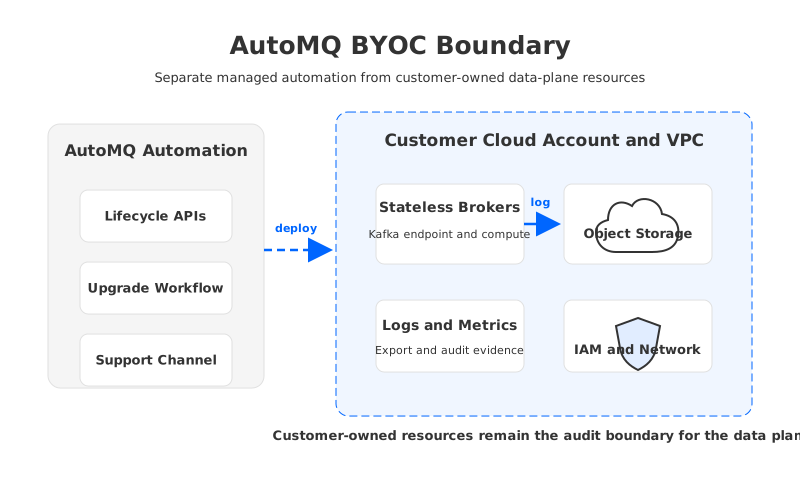
The CTO should ask security and platform teams to answer concrete boundary questions:
- Who owns the object storage bucket or equivalent durable storage location?
- Which IAM principals can read, write, or administer the data plane?
- Where are logs, metrics, and audit trails emitted, retained, and reviewed?
- Which network paths carry producer and consumer traffic?
- Which team owns cloud quota, VPC design, key policy, endpoint policy, and incident escalation?
These questions are not a reason to dismiss managed SaaS. Many enterprises accept provider-operated data planes when the service contract, compliance posture, and network controls match their risk model. BYOC is attractive when the organization's evidence model is built around customer-owned cloud resources and the platform team is prepared to own the surrounding cloud architecture.
6Reliability and operations questions
Architecture diagrams can explain why a system should recover differently; they do not prove your workload will meet its SLO. AutoMQ's stateless broker design is meant to reduce the operational coupling between compute nodes and durable log data. Shared storage can also change the shape of scaling, recovery, and retention work. Those are important advantages, but a CTO should require evidence for the specific workload under review.
Reliability review should include broker failure, rolling upgrade behavior, object storage latency sensitivity, client retry behavior, consumer lag recovery, partition count limits, and control-plane dependency assumptions. It should also include the less glamorous operational work: who watches the dashboards, who receives alerts, who can read logs, who approves upgrades, who handles cloud-account failures, and how support escalation works when the incident crosses vendor and customer boundaries.
Observability is part of compatibility. If the team uses Confluent metrics, cloud billing dashboards, client-side telemetry, and Kafka-level indicators together, the replacement must map those signals into the operating model. AutoMQ documentation and operational materials should be checked for the metrics and logs required by your SRE team, but alert thresholds and dashboards still need calibration with production-like traffic.
7What a practical AutoMQ PoC should prove
The strongest proof of concept is intentionally narrow. It should not migrate every topic or reproduce every historical incident. Choose one representative workload that stresses the reasons you are considering replacement: high retention, high throughput, bursty peaks, cloud-account control, cost pressure, or migration risk.
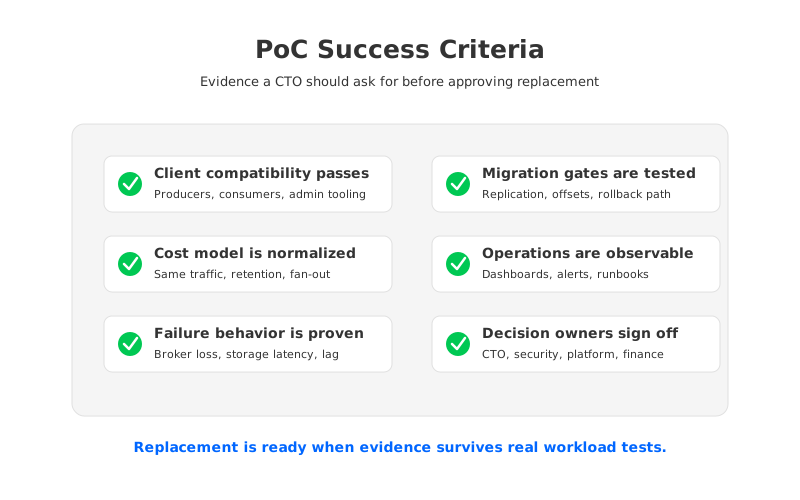
A CTO-ready PoC should produce artifacts architecture, platform, security, finance, and procurement can read:
- A compatibility matrix for clients, topic configs, ACLs, admin operations, and ecosystem dependencies.
- A migration runbook with replication, validation, cutover, and rollback gates.
- A cost model using the same workload assumptions for Confluent and AutoMQ.
- A BYOC security diagram showing cloud accounts, VPCs, object storage, IAM, keys, logs, and metrics.
- A reliability report covering broker failure, scaling, recovery, lag, and latency under representative load.
- An operating model that names owners for upgrades, alerts, incidents, support, and vendor roadmap review.
If the PoC passes, the replacement case becomes grounded rather than aspirational. If it fails, it still creates value by revealing which part of the Confluent footprint is essential: ecosystem services, migration tooling, operational maturity, procurement simplicity, or data-plane abstraction. That is better than learning it after a rushed renewal or production cutover.
The original question was whether AutoMQ can replace Confluent. The better CTO question is whether AutoMQ can preserve the Kafka contract you depend on while giving your organization a better boundary for storage, scaling, cloud control, and cost governance. Start with the scorecard, test the riskiest workload, and use the PoC evidence to decide. To go deeper, review AutoMQ architecture and BYOC documentation, then scope a workload-specific evaluation with your platform and security teams.
8References
- AutoMQ compatibility with Apache Kafka
- AutoMQ architecture overview
- AutoMQ S3Stream shared streaming storage
- AutoMQ stateless broker architecture
- AutoMQ Cloud BYOC getting started
- AutoMQ BYOC AWS VPC preparation
- AutoMQ migration overview
- AutoMQ pricing
- AutoMQ vs. Apache Kafka benchmarks and cost
- Confluent Cloud pricing
- Confluent Cloud billing overview
- Confluent Cloud networking overview
- Confluent Cloud AWS PrivateLink overview
- Confluent Cloud Cluster Linking
- Apache Kafka protocol guide
- Apache Kafka documentation
- Apache Kafka MirrorMaker 2
9FAQ
9.1Is AutoMQ a drop-in replacement for every Confluent deployment?
Not automatically. AutoMQ is designed for Kafka compatibility, so producers and consumers can often keep familiar Kafka client behavior. A Confluent deployment may also include Schema Registry, managed connectors, Flink, governance, Cluster Linking, private networking patterns, and provider-specific observability. Those layers need separate inventory and migration decisions.
9.2What is the main architectural difference between Confluent Cloud and AutoMQ?
Confluent Cloud is a managed data streaming platform operated as a cloud service. AutoMQ focuses on Kafka-compatible streaming with shared storage, stateless brokers, and BYOC deployment options. The practical difference is not only who sells the service; it is where durable data, compute, cloud resources, and operational boundaries sit.
9.3Does AutoMQ always reduce Kafka cost?
No responsible evaluation should say "always." AutoMQ can change the cost structure by using shared object storage and stateless brokers, but the outcome depends on ingress, egress, retention, fan-out, availability targets, cloud pricing, and operational responsibilities. Model the same workload on both platforms, then validate the model in a PoC.
9.4How should teams migrate from Confluent to AutoMQ?
Start with inventory and compatibility testing. Then design topic replication, offset handling, validation metrics, producer and consumer cutover, and rollback gates. Treat migration as incomplete until rollback has been tested and owners have signed off on the operating model.
9.5Who should approve the replacement decision?
The CTO or architecture committee should own the final decision, but evidence must come from platform engineering, SRE, security, finance, procurement, and application owners. Replacement crosses application behavior, cloud architecture, vendor risk, and cost, so one team cannot approve it alone.


