
Table of Contents
Table of Contents
Vendor lock-in is rarely a single clause in a contract. For Kafka teams, it usually shows up as a set of small architectural decisions that were reasonable at the time: a managed connector here, a private network there, a schema policy tied to one control plane, a migration tool that works well in one direction. None of these choices is wrong by itself. The risk appears when the team can no longer change platforms without rewriting applications, reworking security reviews, renegotiating network paths, and rebuilding operational muscle memory.
That distinction matters for Confluent Cloud. Confluent is a mature Kafka platform with a broad ecosystem, and many teams choose it because they want managed Kafka plus integrated services. A lock-in review should not assume that using a commercial service is a mistake. It should ask a more useful question: if requirements, compliance boundaries, cost structure, or cloud strategy change, can the organization still move Kafka workloads on its own timeline?
1What Vendor Lock-In Means for Kafka Platforms
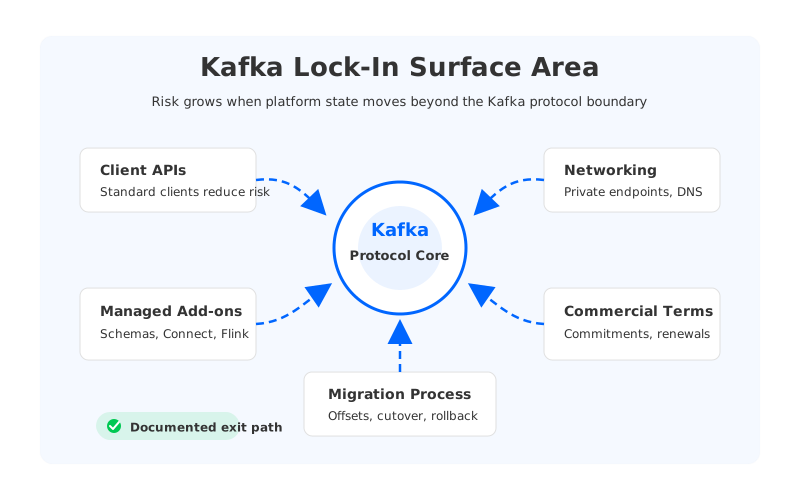
Kafka portability starts with the Apache Kafka protocol, but it does not end there. The official Kafka protocol defines the wire-level requests and responses used by clients and brokers, which is why Kafka producers, consumers, and admin clients can often move between compatible platforms with limited code changes. In practice, however, a production Kafka estate includes more than client calls to Produce, Fetch, OffsetCommit, and metadata APIs.
A real platform usually includes schemas, connectors, ACLs, private network endpoints, observability dashboards, service accounts, billing commitments, disaster recovery procedures, and incident runbooks. Each layer can either preserve optionality or narrow it. The core governance question is whether your architecture has a documented alternative path for each layer, even if you are happy with the current provider.
Think of lock-in as a gradient rather than a binary state:
- Low lock-in: applications use standard Kafka clients, schemas are exportable, connectors are reproducible, offsets can be transferred, and networking is described as infrastructure code.
- Medium lock-in: the data plane remains Kafka-compatible, but operational workflows depend on provider-specific tooling or manual support processes.
- High lock-in: applications, data movement, governance, and network access all depend on one provider's managed control plane, with no tested rollback or parallel-run plan.
This framing keeps the conversation objective. It avoids the unhelpful debate over whether a vendor is "open" or "closed" and focuses instead on measurable exit cost.
2The Five Places Confluent Lock-In Can Show Up
Confluent lock-in is not one feature. It is the combined surface area created by managed services, data movement tools, networking design, commercial terms, and operational habits. The more layers a team adopts without portability standards, the more the exit path becomes a project.
2.1APIs and Managed Add-Ons
The Kafka API is the strongest portability anchor in the stack. If applications use standard Kafka clients and avoid provider-specific client assumptions, moving the broker layer is far easier than moving a proprietary eventing system. Confluent Cloud supports Kafka clients, and Kafka compatibility is also the reason many alternatives can participate in the same ecosystem.
The portability question becomes sharper around managed add-ons. Confluent Cloud documentation covers services such as Schema Registry, managed connectors, Apache Flink, Tableflow, and Cluster Linking. These services can reduce engineering effort, but each one also adds state, configuration, permissions, and operational behavior that may need to be recreated elsewhere.
| Layer | Portability question | Exit-path practice |
|---|---|---|
| Client APIs | Are applications using standard Kafka protocol behavior? | Keep provider-specific assumptions out of application code. |
| Schema Registry | Can subjects, versions, compatibility settings, and schemas be exported? | Treat schema artifacts as source-controlled assets, not console-only state. |
| Connectors | Can connector configs and plugins run outside the managed service? | Store connector configs and test self-managed or alternative runtimes. |
| Stream processing | Are SQL jobs or Flink jobs portable across runtimes? | Separate business logic from provider-specific deployment descriptors. |
| Cluster Linking | Is replication a bridge or a permanent dependency? | Define ownership of mirrored topics, offsets, and cutover rules. |
Schema Registry is a good example. The service is valuable because it gives teams centralized schema governance, compatibility policies, and serializers. But governance becomes hard to move when schema history lives outside normal engineering workflows. A team that can export schema subjects and versions, reproduce compatibility settings, and validate applications against a second registry has a manageable exit path. A team that treats the registry as console state has a discovery project waiting for it.
Connectors create a similar pattern. Managed connectors are operationally convenient because teams do not run workers, patch plugins, or size connector infrastructure. The trade-off is that configuration, plugin versions, networking assumptions, and secret handling can become tied to the provider's runtime. The mitigation is to keep the connector inventory reproducible and to know which connectors are standard Kafka Connect plugins versus provider-specific managed integrations.
2.2Networking, Data Paths, and Pricing Commitments
Network design is where Kafka lock-in becomes visible to security and platform committees. Confluent Cloud supports public networking and several private networking options, including PrivateLink-style patterns, peering, transit gateways, and dedicated network constructs depending on cloud and region. These are serious enterprise features. They also require routing decisions, DNS behavior, firewall rules, private endpoints, approval workflows, and often separate ownership between networking and data platform teams.
Once private connectivity is in place, the Kafka cluster is no longer an isolated service. It becomes part of a cross-team dependency graph. Moving the workload may require recreating private endpoints, changing DNS, updating firewall policies, revisiting data residency reviews, and proving that client applications still meet security controls. That work can dominate migration even when Kafka clients remain compatible.
Data paths deserve the same scrutiny. A team may use Cluster Linking for cross-region replication, disaster recovery, cloud migration, or data sharing between clusters. It can be an effective bridge, especially when the source and destination are both supported by the service. The lock-in question is whether linking is being used as a temporary migration mechanism or as a long-lived operational dependency that hides data ownership boundaries.
Pricing commitments add a non-technical dimension. Enterprise Kafka contracts often include usage commitments, discounts, support terms, and marketplace procurement paths. These terms can be rational for a stable estate, but they change the cost of optionality. Procurement teams should ask what usage can be reduced, what minimums remain, and what timeline is required before a platform change produces financial flexibility.
2.3Migration and Operational Processes
Migration risk is not limited to copying topic data. Kafka teams have to preserve ordering expectations, consumer group progress, producer cutover, ACL semantics, topic configuration, retention, observability, and rollback paths. The broker endpoint may be the visible part of the change, but the operating model is what keeps the change safe.
Operational lock-in often appears in quiet places:
- Runbooks: incident response steps reference provider consoles, support workflows, or managed metrics that do not exist elsewhere.
- Access control: service accounts, API keys, ACLs, and RBAC mappings are documented in one system but not reproducible.
- Observability: alert thresholds depend on provider-specific metrics rather than Kafka-level health signals.
- Release process: platform changes require console actions that cannot be reviewed like code.
- Disaster recovery: replication is configured, but failover ownership and reverse migration are not tested.
The exit path is healthier when these processes are externalized. Topic definitions, ACLs, connector configs, schema policies, network routes, and alert rules should be recoverable from versioned artifacts. A provider console can remain the operational interface, but it should not be the sole record of how the platform works.
3Kafka Portability Checklist
Portability work is easiest before a migration is urgent. The most useful checklist is not a generic "avoid vendor lock-in" policy. It is a concrete set of artifacts that an architecture committee can request during design review.
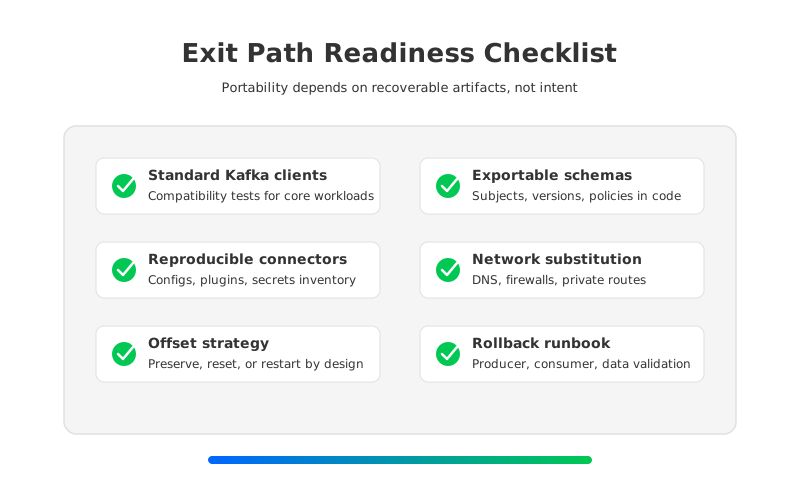
Start with the application boundary. Producers and consumers should use standard Kafka clients and avoid coupling business logic to provider-specific headers, side channels, or operational assumptions. Where teams use serializers, they should be able to explain how schemas are registered, versioned, validated, and exported.
Then move outward to platform state. Topic configuration, retention settings, partition counts, ACLs, service accounts, connector configs, schema compatibility policies, and replication rules should have an auditable source outside the provider console. This does not mean every action must be automated from day one. It means the team can reconstruct the platform without relying on screenshots or institutional memory.
For migration planning, the committee should ask for evidence in four areas:
- Data continuity: how topic data will be replicated, validated, and cut over without losing records or violating ordering assumptions.
- Consumer progress: how offsets and consumer group state will be preserved, reset, or deliberately restarted.
- Network substitution: how clients will reach the alternative endpoint through approved private connectivity.
- Rollback: how producers and consumers return to the prior platform if validation fails.
These questions are intentionally plain. They are also hard to answer if the platform has accumulated unmanaged dependencies. A good exit path does not require every workload to be portable tomorrow. It requires the team to know which workloads are portable, which are not, and what would be needed to change that status.
4How BYOC and Kafka-Compatible Storage Improve Optionality
The deepest lock-in question is data control. In a fully hosted SaaS model, the provider operates the service and the customer's workloads connect to it. That model can be efficient, but the data plane, network boundary, operational control plane, and commercial relationship are tightly related. In a bring-your-own-cloud model, more of the infrastructure boundary remains inside the customer's cloud account, VPC, Kubernetes environment, and object storage account.
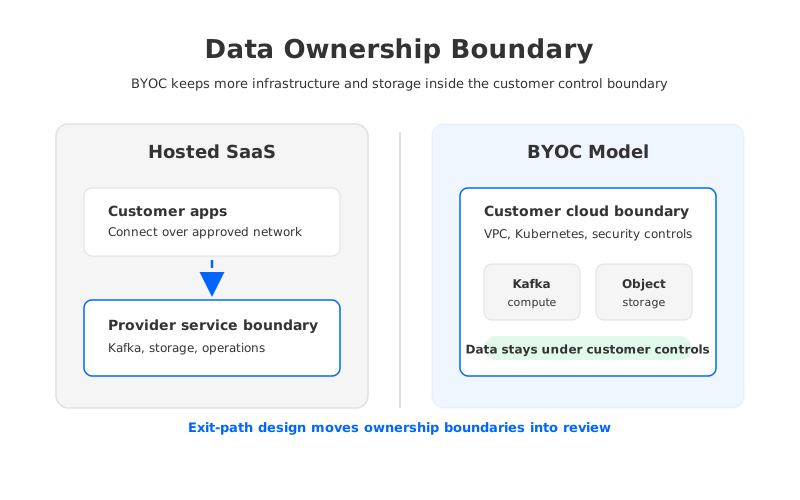
This is where AutoMQ fits into the exit-path discussion. AutoMQ is a Kafka-compatible cloud-native streaming platform that uses object storage as the durable storage layer while keeping Kafka protocol and ecosystem compatibility as a design goal. From an optionality perspective, that combination matters for three reasons.
First, Kafka compatibility keeps the application boundary familiar. Existing Kafka clients, common ecosystem tools, and operational concepts remain relevant, so platform teams can evaluate alternatives without forcing application teams into a full messaging rewrite. Compatibility does not remove migration work, but it changes the type of work from application replacement to platform transition.
Second, BYOC deployment changes the control boundary. AutoMQ BYOC is designed for deployment in the customer's cloud environment, with resources such as VPC, Kubernetes, and object storage prepared in the customer's account. For security and compliance teams, data governance can align with existing cloud controls instead of a separate hosted-service boundary.
Third, object-storage-backed architecture can reduce the long-term penalty of moving compute. In traditional Kafka, brokers carry both compute responsibility and local durable log ownership. Moving, replacing, or rebalancing brokers can involve significant data movement. AutoMQ separates broker compute from durable object storage, which can make scaling, reassignment, and recovery less dependent on copying large local disks between brokers. For an exit-path review, the important idea is not that object storage makes migration effortless. It is that durable data is less entangled with a fixed broker fleet.
That makes AutoMQ a useful option for teams that want Kafka semantics but also want more control over where data lives and how infrastructure is operated. It should be evaluated like any platform: protocol compatibility, operational maturity, migration tooling, security model, cost structure, and support model. The point is to design the dependency so it can be governed.
5Design Review Questions for CTOs and Platform Teams
A lock-in review works best when it is attached to normal architecture governance rather than saved for a crisis. The following questions are practical enough for a design review and concrete enough for procurement and security stakeholders to understand.
| Area | Question to ask | Evidence to request |
|---|---|---|
| API | Can applications run against another Kafka-compatible endpoint? | Client versions, compatibility tests, unsupported feature list. |
| Schemas | Can schema history and compatibility policy be restored elsewhere? | Export files, registry config, CI validation. |
| Connect | Can each connector run in another Kafka Connect runtime? | Connector inventory, plugin source, config templates. |
| Network | Can private connectivity be recreated for an alternative endpoint? | IaC modules, DNS plan, firewall review. |
| Data | Can topics and offsets be migrated with a rollback path? | Replication plan, validation queries, cutover runbook. |
| Commercial | When does a platform change become financially actionable? | Commitment terms, renewal dates, usage baselines. |
The answers do not need to be perfect. They need to be explicit. A CTO can accept a deliberate dependency when the business value is clear and the exit cost is understood. The dangerous version is an accidental dependency that no one sees until the renewal deadline, security review, or cloud strategy shift arrives.
6References
- Apache Kafka Protocol
- Confluent Cloud Cluster Linking documentation
- Confluent Cloud Schema Registry documentation
- Confluent Cloud connectors documentation
- Confluent Cloud networking documentation
- Confluent Cloud for Apache Flink documentation
- Confluent Tableflow documentation
- AutoMQ compatibility with Apache Kafka
- AutoMQ Cloud getting started and BYOC overview
- AutoMQ architecture overview
- AutoMQ migration overview
7FAQ
7.1Is Confluent vendor lock-in always a problem?
No. A managed platform can be the right choice when it reduces operational burden and matches the organization's governance model. Lock-in becomes a problem when the exit cost is unknown, unmanaged, or discovered too late for the business to respond.
7.2Does Kafka compatibility eliminate lock-in?
Kafka compatibility reduces application-level lock-in, but it does not cover every layer. Schemas, connectors, networking, observability, access control, replication, and commercial commitments still need their own portability plan.
7.3What is the first thing a Kafka team should document?
Start with platform state that cannot be inferred from application code: topics, ACLs, schema subjects, connector configs, private network paths, service accounts, and replication rules. If those artifacts are reproducible, the rest of the exit-path conversation becomes much more concrete.
7.4How does BYOC help with Kafka optionality?
BYOC can keep infrastructure and data boundaries closer to the customer's own cloud account and governance controls. It does not remove all provider dependency, but it can make data ownership, network design, and migration planning easier to reason about.
7.5Where does AutoMQ fit in a Confluent exit strategy?
AutoMQ fits when teams want a Kafka-compatible platform with BYOC deployment options and object-storage-backed architecture. It should be evaluated as part of a broader portability plan, alongside application compatibility, migration tooling, security controls, operations, and support requirements.


