
Table of Contents
Table of Contents
The Confluent vs Amazon MSK decision usually starts as a Kafka platform question, but it becomes a control question fast. AWS architecture teams want to know who owns the network path, where data sits, how scaling is performed, which operational tasks remain with the platform team, and how the bill behaves when throughput or retention grows. Confluent Cloud and Amazon MSK both run Kafka workloads for serious production teams, yet they place different parts of the system inside different control boundaries.
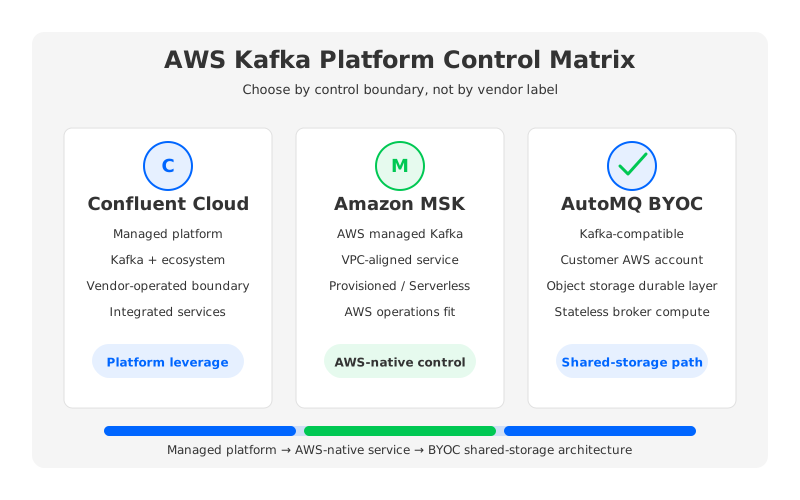
Confluent Cloud is attractive when the team wants a managed data streaming platform with Kafka, connectors, stream governance, Flink, Cluster Linking, and a polished operational experience under one vendor. Amazon MSK is attractive when the team wants Kafka running as an AWS managed service, inside AWS constructs, with more direct alignment to VPCs, IAM, CloudWatch, AWS procurement, and account-level governance. Neither answer is automatically right. The better question is which form of control your organization values enough to own the tradeoff.
1Quick Comparison Table
For AWS teams, the surface-level comparison is simple: Confluent offers a broader managed streaming platform, while MSK keeps more of the Kafka estate inside AWS. The hard part is that "more control" can mean several different things. A security team may define it as private network ownership. A FinOps team may define it as visibility into infrastructure line items. An SRE team may define it as the ability to tune brokers, partitions, storage, and recovery behavior.
| Decision area | Confluent Cloud | Amazon MSK | What it means for AWS teams |
|---|---|---|---|
| Primary operating model | SaaS data streaming platform | AWS managed Kafka service | Confluent abstracts more of the platform; MSK exposes more AWS-native choices. |
| Kafka scope | Kafka plus platform services such as connectors, governance, Flink, and linking | Managed Apache Kafka with MSK Connect and MSK Replicator options | Confluent may reduce integration work; MSK may fit teams standardizing on AWS services. |
| Pricing model | Usage across Kafka capacity, networking, storage, connectors, processing, governance, and support dimensions | Broker, storage, data transfer, serverless, and feature-specific AWS pricing dimensions | Compare workload assumptions, not vendor labels. |
| Network boundary | Public and private networking options through Confluent Cloud constructs | Runs in AWS VPC subnets with AWS networking controls | MSK usually gives clearer AWS account ownership; Confluent can reduce service operation work. |
| Scaling model | Cluster type and capacity model depend on Confluent Cloud tier | Provisioned, Serverless, and Express options | Provisioned control and serverless abstraction solve different problems. |
| Data control | Hosted Confluent Cloud data plane | AWS managed service in the customer AWS environment | Data governance teams should map the real data path, not the marketing category. |
This table is a starting point, not a procurement answer. A team running hundreds of self-service data products may value Confluent's platform-level experience more than broker-level control. A regulated AWS-first enterprise may accept more operational responsibility because VPC, IAM, logging, and procurement fit existing controls. The rest of the decision comes down to pricing, networking, and scaling behavior under your actual workload.
2Cost And Pricing Model
Cost comparison is where many Confluent vs MSK evaluations get messy. Confluent's official pricing page describes a bill built from resource consumption across Kafka clusters, networking, storage, connectors, Flink processing, governance, and support or commitment terms. Amazon MSK pricing is split across MSK deployment choices such as Provisioned, Serverless, and Express, plus broker instances, storage, and AWS data transfer where applicable. The categories do not line up one-to-one.
That mismatch matters because Kafka cost is rarely caused by a single line item. A workload with high write throughput, long retention, heavy consumer fan-out, and multiple private network paths can look reasonable in a small test and expensive at scale. A workload with predictable throughput and strict AWS governance may be easier to budget on MSK Provisioned. A workload with unpredictable traffic may fit a serverless or elastic model better, but the team still has to check quotas, supported regions, authentication rules, and operational limits.
For a useful comparison, build the model around workload behavior:
- Write and read throughput: include producer ingress, consumer egress, replication, reprocessing, and burst windows. Kafka read fan-out can quietly dominate cost when many services replay the same topics.
- Retention and storage growth: include retained bytes, compaction, tiering behavior where used, and the operational impact of storage expansion.
- Network topology: include PrivateLink-style paths, VPC connectivity, cross-region replication, public egress, and data transfer between services.
- Operational labor: include sizing, partition planning, upgrades, incident response, security reviews, and migration testing.
- Commercial commitments: include marketplace procurement, annual commitments, enterprise discounts, and support terms.
Confluent can be cost-effective when the organization would otherwise build and operate many surrounding services itself. MSK can be cost-effective when the team already has strong AWS platform operations and wants direct control over infrastructure assumptions. The expensive mistake is comparing Confluent's managed platform bill to MSK broker pricing while ignoring the services and labor that move from vendor to internal team.
3Control, Networking, And Data Path
Network control is often the decisive difference for AWS architects. Confluent Cloud supports public and private networking patterns, including cloud-specific private connectivity options documented by Confluent. Those options are important for enterprise adoption, but the network is still mediated through Confluent Cloud concepts such as Confluent networks and cluster connectivity choices. The customer can design secure access, yet the platform boundary remains a hosted service boundary.
Amazon MSK starts from a different place. AWS documentation describes MSK as a fully managed service that provides control-plane operations for creating, updating, and deleting clusters while applications continue to use Kafka data-plane operations. In MSK Provisioned, the team chooses broker count, broker type, storage volumes for Standard brokers, and related infrastructure settings. MSK clusters are placed into VPC subnets, which makes the design familiar to AWS networking, security, and compliance teams.
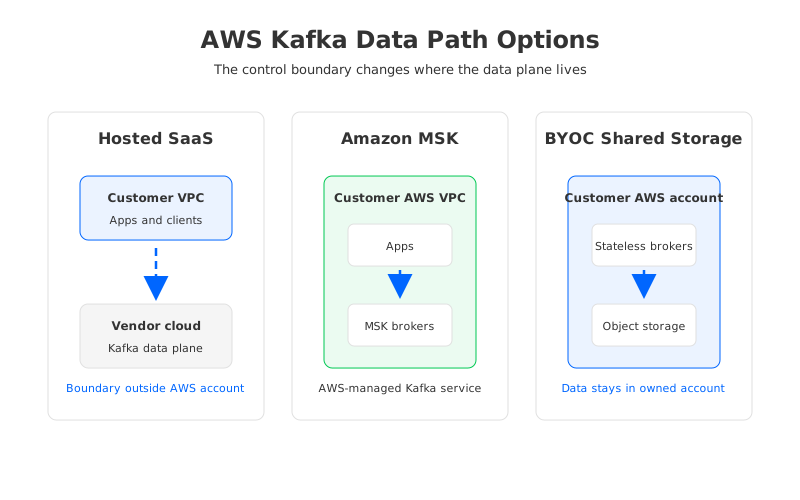
This AWS-native control is useful, but it is not free. The platform team must understand Kafka-level design choices that Confluent hides more aggressively: partition count, broker sizing, throughput headroom, storage behavior, upgrades, quotas, client configuration, and the failure modes of a busy cluster. MSK reduces the burden of running Apache Kafka infrastructure from scratch; it does not remove the need to operate Kafka as a distributed system.
Data path ownership should be documented explicitly during vendor evaluation. Ask where broker compute runs, where durable log data is stored, which account owns network interfaces, how private DNS works, who can observe traffic, which metrics are available, and how incident response crosses vendor or AWS support boundaries. The right answer is the one that matches your organization's control model.
4Scaling And Operational Ownership
Scaling is where Confluent and MSK reveal their operating philosophies. Confluent Cloud emphasizes managed capacity, cluster types, and platform services that reduce the amount of broker-level work a customer performs. That can be valuable when the platform team is small or when the business wants engineers focused on data products rather than Kafka operations. The tradeoff is that some tuning and infrastructure choices are intentionally abstracted away.
MSK gives AWS teams several operating modes. MSK Provisioned provides manual configuration and scaling of Apache Kafka clusters, including broker types, storage volumes for Standard brokers, and broker counts. MSK Serverless is designed for teams that want to run Kafka without managing and scaling cluster capacity, with automatic provisioning and throughput-based pricing. MSK Express brokers, under MSK Provisioned, add automatically scaling pay-as-you-go storage and AWS-documented improvements in throughput, scaling speed, and recovery versus Standard brokers, with some feature constraints that teams must verify.
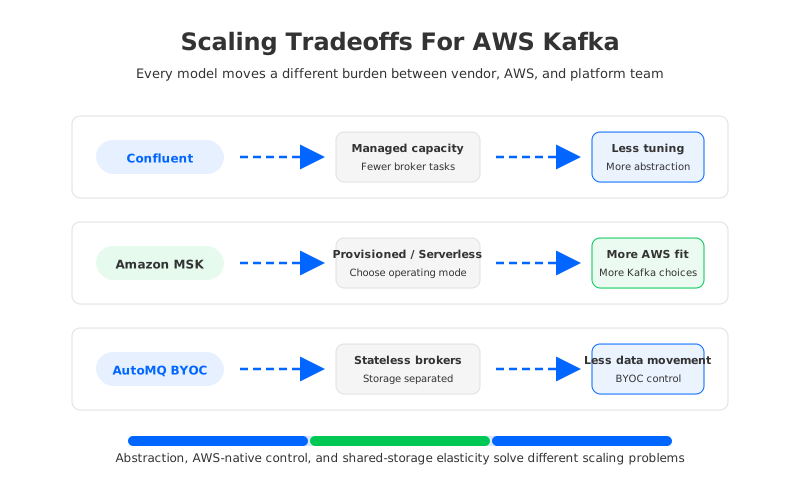
The practical question is not whether abstraction is good or bad. It is whether the abstraction matches the workload. Predictable, high-throughput Kafka estates often benefit from explicit capacity planning because the team can tune for known traffic and retention. Spiky workloads may benefit from serverless or elastic capacity, provided the application fits the service constraints. Teams with strict SRE standards may prefer a model that exposes enough detail to diagnose incidents quickly, even if that means owning more operational work.
Procurement should also care about scaling ownership. A platform that is easy to start can still become hard to govern when usage expands across many teams. A platform that exposes more knobs can still become expensive if every team overprovisions. Good Kafka governance includes quotas, topic lifecycle policies, retention standards, consumer replay rules, and a cost allocation model regardless of the vendor.
5When Neither Confluent Nor MSK Fits
There is a class of AWS Kafka workload where Confluent and MSK both feel slightly misaligned. The team wants Kafka compatibility and managed operations, but it also wants data and infrastructure to stay inside its AWS account. It wants storage economics closer to object storage, but it does not want to spend its life rebalancing local broker disks. It wants scaling to be less coupled to data movement, but it still needs Kafka clients and ecosystem behavior to remain familiar.
That requirement set is not unusual. It tends to appear in platform teams serving many internal application groups, FinOps teams facing long-retention cost pressure, SRE teams tired of broker rebalancing windows, and security teams that prefer customer-account data paths. Confluent may feel too far outside the AWS account boundary. MSK may feel too close to traditional broker-and-disk operations, even with Serverless and Express improving parts of the experience.
The decision point is architectural: do you want Kafka as a hosted platform, Kafka as an AWS managed service, or Kafka-compatible streaming with a different storage architecture?
6Where AutoMQ Fits For AWS Kafka Workloads
AutoMQ is relevant after that architectural question is on the table. AutoMQ is a Kafka-compatible cloud-native streaming platform that uses object storage as the durable storage layer and stateless brokers for compute. In the AWS context, its BYOC model is designed to run in the customer's cloud account, so the organization can keep infrastructure, VPC-level controls, and data governance aligned with its existing AWS operating model.
The key distinction is storage ownership. Traditional Kafka designs tie broker compute to local durable log storage, which makes scaling, replacement, and recovery sensitive to data movement. AutoMQ separates broker compute from durable object storage. That does not make Kafka operations disappear, and it does not remove the need for migration testing. It changes the control surface: durable data can live in AWS object storage while brokers become a more elastic compute layer.
For AWS teams, AutoMQ is worth evaluating when three requirements show up together:
- Kafka compatibility matters because application teams cannot rewrite producers, consumers, and ecosystem integrations around a different eventing API.
- Customer-account control matters because security, compliance, and procurement want data paths and cloud resources governed through existing AWS processes.
- Shared-storage economics matter because retention, replay, and scaling pressure make broker-attached storage an uncomfortable long-term base.
That makes AutoMQ a third path rather than a direct replacement category for every Confluent or MSK use case. Confluent remains strong when the priority is a complete managed data streaming platform. MSK remains strong when the priority is AWS-native managed Kafka. AutoMQ becomes interesting when the team wants Kafka compatibility, AWS account control, object storage as the durable layer, and stateless broker elasticity in the same design.
7Choose By Workload
A good platform decision should be boring to defend in architecture review. It should name the workload pattern, the control boundary, the operating model, and the cost model. The following framing is more useful than asking which vendor is "better."
| Workload pattern | More likely fit | Why |
|---|---|---|
| Team wants broad managed streaming services and integrated governance | Confluent Cloud | The value is in the platform around Kafka, not only brokers. |
| AWS-first organization wants managed Apache Kafka in VPC-aligned infrastructure | Amazon MSK | The service fits AWS governance, procurement, monitoring, and network patterns. |
| Unpredictable Kafka traffic with lower desire to manage capacity | MSK Serverless or Confluent elastic options | Verify region, quota, authentication, and workload limits before committing. |
| High-throughput AWS Kafka with desire for faster scaling than Standard brokers | MSK Express or alternative shared-storage designs | Compare feature support, Kafka version needs, and operational constraints. |
| Long retention, AWS account control, and less broker-data coupling | AutoMQ BYOC | Object storage and stateless brokers change the scaling and storage control model. |
The decision should end with a short proof plan. Run a representative workload, include private networking, model retention and replay, test scaling events, and rehearse failure handling. For Kafka, architecture diagrams matter, but controlled load tests and operational drills matter more.
8References
- Confluent Cloud pricing
- Confluent Cloud cluster types
- Confluent Cloud networking overview
- Amazon MSK pricing
- What is Amazon MSK?
- What is MSK Provisioned?
- What is MSK Serverless?
- Amazon MSK Express brokers
- AutoMQ documentation
- What is AutoMQ Cloud
- AutoMQ overview
9FAQ
9.1Is Confluent Cloud better than Amazon MSK for AWS Kafka?
It depends on the control model. Confluent Cloud is often stronger when the team wants a complete managed streaming platform with integrated services. Amazon MSK is often stronger when the team wants Kafka aligned with AWS networking, accounts, monitoring, and procurement.
9.2Is Amazon MSK lower cost than Confluent Cloud?
Not by default. MSK and Confluent expose different pricing dimensions, so the answer depends on throughput, retention, read fan-out, networking, operational labor, and contract terms. Compare a realistic workload model instead of a single unit price.
9.3When should an AWS team choose MSK Serverless?
MSK Serverless is worth evaluating when applications need on-demand Kafka capacity and the team wants AWS to manage cluster capacity scaling. Check supported regions, quotas, authentication requirements, and workload limits before standardizing on it.
9.4When should an AWS team evaluate AutoMQ?
Evaluate AutoMQ when Kafka compatibility, AWS account control, object storage economics, and stateless broker elasticity are all important. It is a third path for teams that do not want a fully hosted SaaS boundary or a traditional broker-and-disk operating model.
9.5What is the most important question in a Confluent vs MSK evaluation?
Ask where your organization wants control to live. If the answer is platform services and managed experience, Confluent deserves close evaluation. If the answer is AWS-native infrastructure and VPC-level governance, MSK deserves close evaluation. If the answer is AWS account ownership plus shared-storage Kafka architecture, include AutoMQ in the proof.


