
Table of Contents
Table of Contents
Searches like "Confluent MSK Redpanda WarpStream" usually come from teams that know they need a production event streaming platform. The question is no longer whether Kafka is useful. The question is which managed Kafka option belongs on the shortlist, and what kind of architecture each vendor actually represents.
That distinction matters because these platforms are not interchangeable wrappers around the same broker model. Confluent Cloud is a managed data streaming platform built around Apache Kafka and the Confluent ecosystem. Amazon MSK is an AWS-native managed service for Apache Kafka. Redpanda is a Kafka API-compatible platform with cloud, BYOC, and self-managed deployment choices. WarpStream is a Kafka-compatible system that uses stateless Agents and object storage. AutoMQ is a Kafka-compatible BYOC and software option that uses stateless brokers with object-storage-backed shared storage.
Those choices shape who owns the data plane, how scaling works, where the cloud bill appears, how much Kafka compatibility risk remains, and what migration will feel like after procurement.
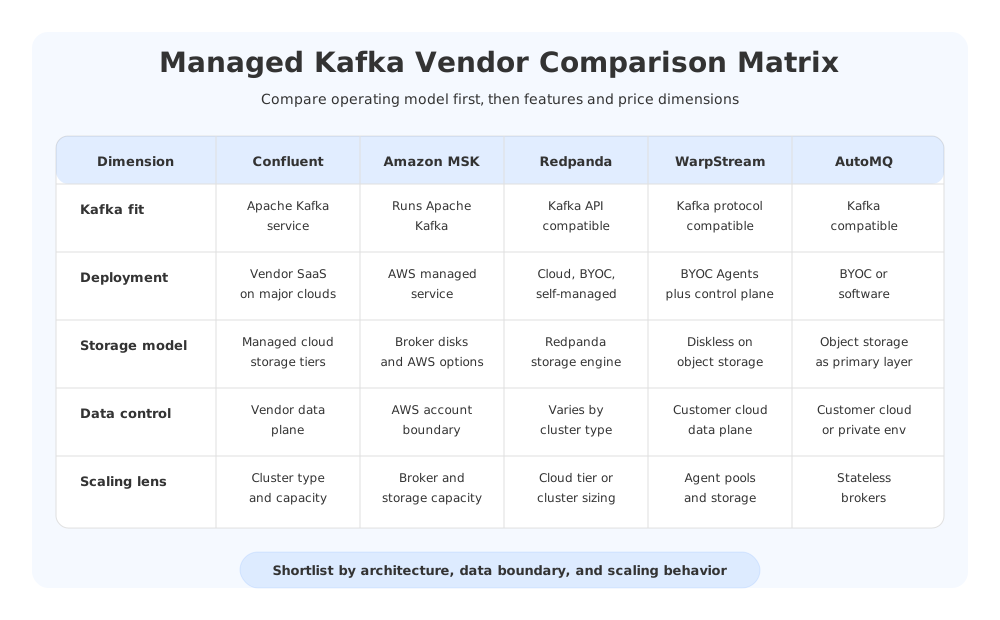
1Quick comparison table
| Option | Core architecture model | Deployment model | Kafka compatibility lens | Data control lens | Cost and scaling lens |
|---|---|---|---|---|---|
| Confluent Cloud | Managed data streaming platform based on Apache Kafka | SaaS across major clouds | Strong fit for Kafka users who also want managed ecosystem services | Data plane is operated by Confluent, with private networking and governance options depending on configuration | Pricing and scaling depend on cluster type, capacity, networking, storage, and managed platform features |
| Amazon MSK | AWS managed Apache Kafka service | AWS service, including provisioned and serverless options | Runs Apache Kafka, which helps teams preserve Kafka client and broker semantics | Data remains within AWS service boundaries and VPC connectivity patterns | Scaling follows MSK capacity, broker, storage, and serverless abstractions |
| Redpanda | Kafka API-compatible streaming platform with its own engine | Cloud, BYOC, and self-managed options | Kafka protocol and client compatibility should be validated for workload-specific APIs and tooling | Varies by cloud and BYOC deployment model | Scaling follows Redpanda cluster and cloud tier choices |
| WarpStream | Kafka-compatible diskless Agents using object storage | BYOC-style Agents in the customer's cloud, with managed control plane | Kafka protocol compatibility is central, but compatibility scope should be checked against official docs | Data plane and object storage live in the customer's cloud environment | Scaling focuses on Agent pools, object storage, and cloud infrastructure dimensions |
| AutoMQ | Kafka-compatible stateless brokers with object-storage-backed shared storage | BYOC and software deployment in customer-controlled environments | Designed for Kafka compatibility while changing the broker storage architecture | Data plane can run in the customer's cloud, VPC, or private environment | Scaling emphasizes stateless broker elasticity and object storage as the durable layer |
The table is a starting point. A platform team should still run a proof of concept against its own clients, partitions, retention, connectors, compliance boundary, and recovery expectations.
2How each option approaches Kafka compatibility and architecture
Kafka compatibility has several layers. At the client layer, teams care about whether existing producers, consumers, Kafka Streams applications, replication flows, connectors, ACLs, quotas, and observability tools behave as expected. At the operations layer, teams care about broker configuration, partition placement, rebalancing, storage lifecycle, upgrades, and recovery after failure.
Confluent Cloud sits closest to the "managed Kafka platform" category. The buyer is often also evaluating Schema Registry, connectors, Flink, governance, private networking, and operational automation. For organizations that want a broad data streaming platform with fewer infrastructure tasks, this can be attractive. The tradeoff is that architecture decisions move into Confluent's cluster types, feature tiers, pricing dimensions, and account boundaries.
Amazon MSK is different because it is AWS-native and centered on managed Apache Kafka. Teams standardized on AWS identity, networking, procurement, CloudWatch, IAM, and VPC patterns often put MSK on the shortlist early. MSK can reduce the work of provisioning and maintaining Kafka infrastructure while keeping the deployment inside AWS operating models. The tradeoff is that the architectural center of gravity is AWS, which may matter for multi-cloud strategy, cross-cloud data movement, or teams that want the same managed Kafka posture outside AWS.
Redpanda should be treated as a Kafka API-compatible alternative rather than a hosted Apache Kafka distribution. That distinction is the point of the category. Redpanda aims to preserve Kafka client compatibility while replacing parts of the implementation. The compatibility review should be concrete: client libraries, transactions, idempotent producers, consumer groups, admin APIs, connectors, and monitoring integrations should be tested.
WarpStream and AutoMQ represent a separate architectural shift: they move durable storage away from broker-local disks and toward object storage. WarpStream documents a diskless model based on Agents and object storage. AutoMQ uses stateless brokers with object-storage-backed shared storage. The underlying motivation is similar: if compute can scale separately from durable data, then broker replacement, elasticity, and storage economics follow a different pattern than traditional Kafka clusters tied to local disks.
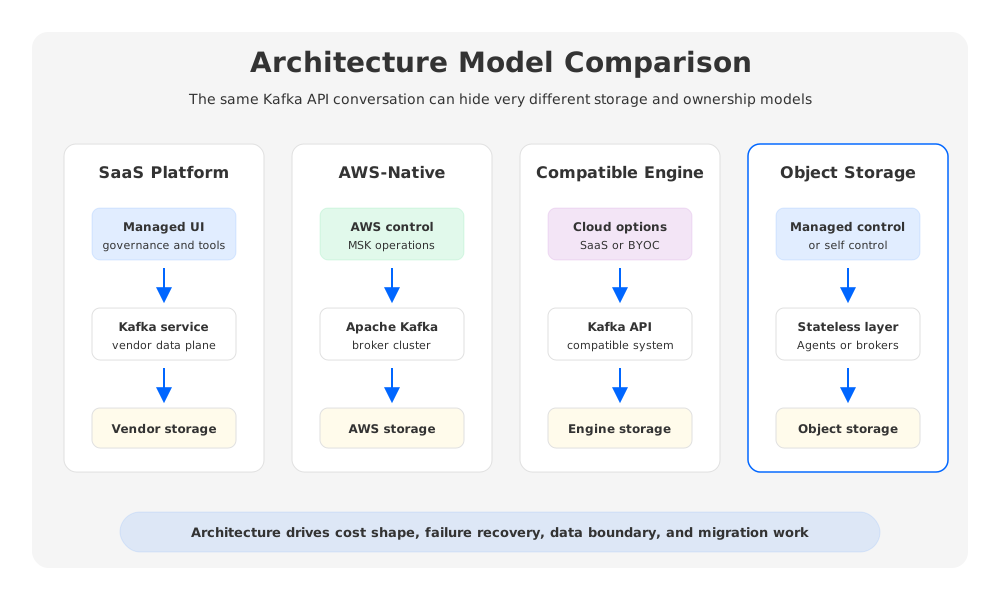
This is why "managed Kafka competitors" is a broad search term. A buyer comparing Confluent, MSK, Redpanda, WarpStream, and AutoMQ is not comparing five versions of the same service. They are comparing SaaS, cloud-native managed Apache Kafka, Kafka-compatible alternative engines, and object-storage-backed streaming architectures.
3Deployment model and data control comparison
Deployment model is often where shortlist conversations become real. Security teams ask where data resides. Platform teams ask who can access the data plane. FinOps asks where the bill lands. Procurement asks whether the platform is a SaaS subscription, a cloud marketplace purchase, an infrastructure footprint in the company's account, or licensed software.
Confluent Cloud is usually easiest to understand as a vendor-operated SaaS platform. Customers configure clusters, networking, access, and features, while Confluent operates the service. This can reduce operational burden and speed adoption, especially when the organization also wants adjacent streaming services. It also means the evaluation must include private connectivity, data residency, key management, support model, and how the platform integrates with internal governance.
Amazon MSK keeps the decision inside AWS. For AWS-first teams, that can simplify networking, billing, and identity conversations. MSK also offers different operating modes, so the evaluation should separate MSK Provisioned from MSK Serverless and from adjacent services such as MSK Connect or MSK Replicator. The AWS-native model is useful when the Kafka platform should align with existing AWS landing zones, but it can be less natural when the same architecture must run consistently across multiple clouds or private environments.
Redpanda spans more than one deployment model. Redpanda Cloud can be consumed as a managed service, while BYOC and self-managed options change the responsibility boundary. That flexibility can be useful, but it also means buyers should not compare "Redpanda" as a single operating model. They should compare the exact deployment option under consideration.
WarpStream is commonly evaluated by teams that want the data plane in their cloud account while reducing broker-local disk operations. The Agent model changes the operational surface: the customer's cloud infrastructure and object storage become central to the data path, while the managed control plane handles coordination. This model can fit organizations that want data control and cloud-account ownership, but it requires careful review of network paths, object storage permissions, observability, and compatibility scope.
AutoMQ fits teams that want Kafka compatibility with a BYOC or software deployment model and an object-storage-backed architecture. In this model, the durable layer can remain in customer-controlled object storage, and the broker layer is designed to be stateless. That is useful when data locality, cloud-account ownership, private networking, or platform standardization matters as much as managed operations.
4Cost and scaling comparison
Cost comparison is difficult because each option exposes different pricing units. A fair evaluation should avoid a single headline price and instead map workload drivers to each architecture.
For Confluent Cloud, cost analysis should include cluster type, throughput, storage, networking, connectors, stream processing, support, and any governance features in scope. The value is not only broker hosting; it is the managed platform around Kafka. A team that uses many integrated services may view that as consolidation. A team that needs only raw Kafka throughput may evaluate the same bill differently.
For Amazon MSK, the cost model is tied to AWS infrastructure and service abstractions. Provisioned clusters involve broker instance choices, storage, data transfer, and operational configuration. Serverless changes the capacity model and may fit variable workloads, but it should be tested against throughput, partition, retention, and latency requirements. Because MSK lives in AWS, FinOps teams also need to examine cross-AZ traffic, VPC connectivity, storage, and surrounding services.
For Redpanda, cost and scaling depend on whether the buyer chooses managed cloud, BYOC, or self-managed deployment. The evaluation should include cloud infrastructure, service tier, support, storage behavior, and operational staffing. If the main reason is a Kafka-compatible alternative engine, the proof of concept should include both cost and compatibility evidence.
For WarpStream and AutoMQ, object storage changes the cost conversation. Durable data is not tied to broker-local disks in the same way as traditional Kafka clusters, so scaling compute and retaining data can be reasoned about separately. This can be valuable for workloads with high retention, bursty traffic, or a need to reduce the operational impact of broker replacement. However, object storage is not free. Evaluations should include request costs, data retrieval patterns, networking, cache behavior, observability, and the effect of workload shape on end-to-end latency.
The useful FinOps artifact is not a generic vendor comparison. It is a workload-specific model:
- Write throughput and read fanout by topic group
- Retention by topic class, including compacted topics
- Partition count growth and expected rebalance behavior
- Cross-AZ, cross-region, and internet egress paths
- Connector and stream processing dependencies
- Support, marketplace, and internal operations cost
This model prevents false precision. It also reveals when a "managed Kafka" decision is really a decision about storage architecture, network topology, or platform ownership.
5Migration and operational ownership
Migration risk is where Kafka compatibility becomes practical. The more a workload uses the core producer and consumer APIs, the easier the migration usually is. The more it depends on specific broker configs, admin APIs, transactional behavior, security integrations, connectors, monitoring assumptions, or operational scripts, the more carefully each option must be tested.
For Confluent Cloud, migration may be straightforward for teams already using Confluent tooling or willing to adopt Confluent's managed ecosystem. The work often centers on network connectivity, identity, schema governance, topic configuration, data replication, and client cutover.
For Amazon MSK, migration from self-managed Kafka in AWS can be operationally familiar because the target is still Apache Kafka in an AWS-managed context. The work often centers on version selection, cluster sizing, IAM or SASL/TLS configuration, network routing, storage, replication tooling, and cutover planning.
For Redpanda, WarpStream, and AutoMQ, the migration review should separate Kafka client compatibility from operational compatibility. Existing applications may connect with Kafka clients, but platform teams should still test admin workflows, monitoring, security, failure behavior, consumer group stability, and throughput.
Operational ownership also changes after migration. SaaS reduces infrastructure work but requires trust in the provider's operating model. AWS-native services align with AWS practices but remain bounded by AWS. BYOC and software models preserve more data-plane control but leave more infrastructure, permissions, and environment design in the customer's hands. Object-storage-backed models reduce dependence on broker-local durable disks, but make object storage a first-class dependency.
6Where AutoMQ is the best fit
AutoMQ is not the right answer for every managed Kafka shortlist. It fits when the buyer has two requirements that traditional managed Kafka services may not fully satisfy: keep the data plane in a customer-controlled environment, and avoid coupling Kafka durability to broker-local disks.
That typically appears in a few scenarios. A regulated platform team may need Kafka-compatible streaming while keeping data in its own cloud account, VPC, or private environment. A FinOps team may want to evaluate object-storage-backed retention without giving up Kafka clients. An infrastructure team may want stateless broker elasticity so broker replacement and scaling do not imply the same data movement profile as a local-disk cluster. A CTO may want BYOC and software rather than committing every workload to a third-party SaaS boundary.
The natural AutoMQ evaluation questions are concrete:
- Can existing Kafka clients and operational tools work with limited change?
- Does object-storage-backed shared storage match the workload's latency, retention, and recovery needs?
- Can the team operate or co-operate the deployment inside its cloud, Kubernetes, network, and security standards?
- How does the architecture behave during broker replacement, traffic growth, and retention expansion?
- Which responsibilities remain with the customer under BYOC or software deployment?
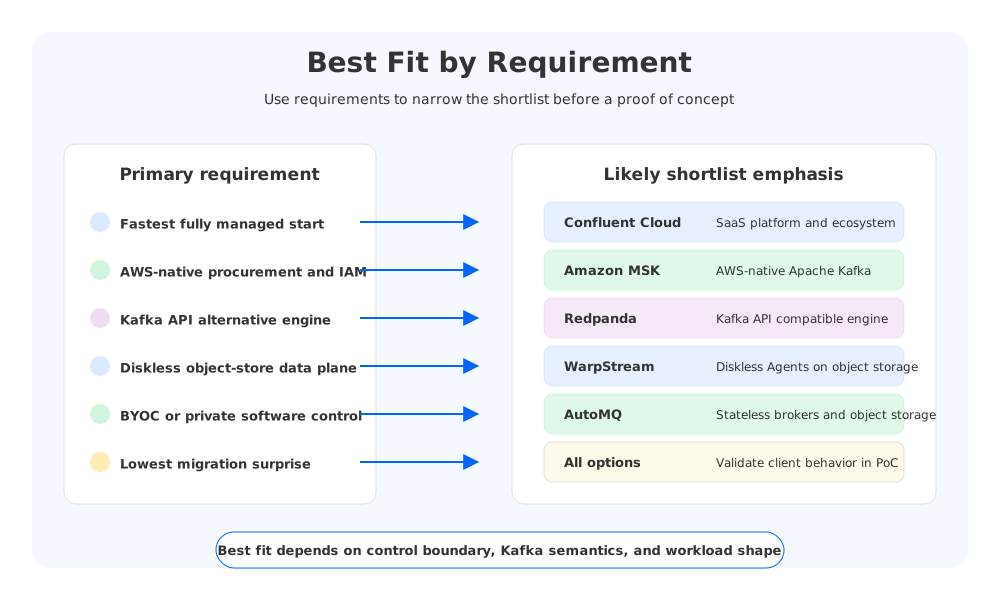
Those questions keep the comparison fair. AutoMQ should be evaluated as an architecture choice, not as a generic claim that one vendor is universally better than another. For teams that want a SaaS-first streaming platform, Confluent may be more natural. For AWS-only teams that want managed Apache Kafka inside AWS, MSK may be the first comparison. For teams evaluating Kafka-compatible alternative engines, Redpanda belongs in the proof of concept. For teams focused on diskless Agents and object storage, WarpStream deserves review. AutoMQ belongs on the shortlist when Kafka compatibility, customer-controlled deployment, stateless brokers, and object-storage-backed storage are central requirements.
7References
- Confluent Cloud documentation
- Confluent Cloud cluster types
- Amazon MSK Developer Guide
- Amazon MSK Serverless
- Redpanda architecture documentation
- Redpanda Cloud BYOC documentation
- WarpStream overview
- WarpStream protocol and feature support
- AutoMQ documentation
- AutoMQ GitHub repository
8FAQ
8.1Is Confluent the same kind of managed Kafka option as Amazon MSK?
No. They represent different operating models. Confluent Cloud is a vendor-operated streaming platform with Kafka and additional ecosystem services. Amazon MSK is an AWS managed service for Apache Kafka. The right comparison depends on whether the team wants a broader SaaS platform or an AWS-native managed Kafka service.
8.2Are Redpanda, WarpStream, and AutoMQ Apache Kafka distributions?
They should be evaluated as Kafka-compatible systems, not identical Apache Kafka distributions. Redpanda provides a Kafka API-compatible engine. WarpStream provides a Kafka-compatible architecture using Agents and object storage. AutoMQ provides a Kafka-compatible stateless broker architecture backed by object storage. Test compatibility against clients, APIs, security, and operational tooling.
8.3When should Amazon MSK be on the shortlist?
Amazon MSK is a strong candidate when the organization is AWS-first, wants managed Apache Kafka, and prefers AWS-native networking, identity, billing, monitoring, and procurement. It is less direct when the same Kafka operating model must span multiple clouds or private environments.
8.4When should object-storage-backed Kafka-compatible platforms be considered?
They are worth considering when retention, elasticity, broker replacement, and data-plane control are major concerns. Object storage can change the relationship between compute and durable data, but teams still need to test latency, request patterns, network paths, and operational dependencies.
8.5How should platform teams compare managed Kafka vendors fairly?
Start with architecture and responsibility boundary, then test compatibility and cost with a real workload model. A useful evaluation includes client behavior, partition count, retention, read fanout, network topology, security, observability, failure recovery, and migration operations. Vendor feature lists matter, but they should not replace workload-specific proof.


