
Table of Contents
Table of Contents
Searching for Confluent vs Redpanda usually means the Kafka platform is already under review. The team may be facing a renewal, a throughput ceiling, a cost question, or a mandate to bring more data infrastructure back into its own cloud account. At that point, a benchmark chart is useful, but it is not sufficient. Kafka is an application contract, an ecosystem, and an operating model; changing it touches more than broker performance.
Confluent and Redpanda represent two different answers to the same problem. Confluent extends Apache Kafka into a broad managed data streaming platform with cluster types, managed connectors, stream governance, Schema Registry, Flink, and a large client ecosystem. Redpanda keeps the Kafka API while replacing the JVM-based Kafka broker implementation with its own engine, Raft replication, and a simpler deployment surface. Both can be the right answer when their assumptions match your workload.
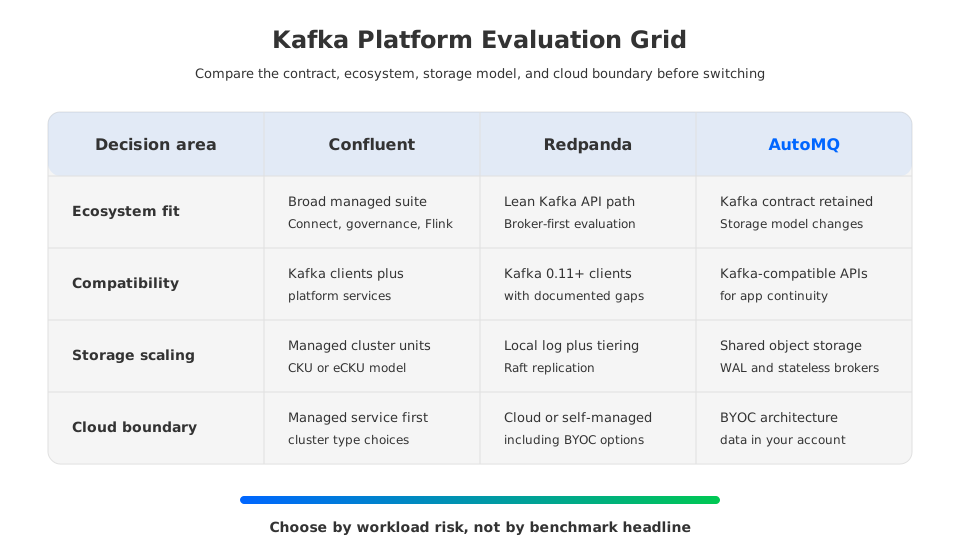
The decision gets sharper when you compare the parts that are hard to change later: API compatibility, adjacent services, storage architecture, scaling behavior, cloud ownership, and rollback paths. AutoMQ enters this comparison as a third architecture pattern rather than a direct copy of either platform: a Kafka-compatible shared-storage system that keeps Kafka-facing semantics while moving durable log storage to object storage with a WAL layer and stateless brokers.
1Quick answer by use case
If your team is comparing Redpanda as a Confluent alternative, start with the workload shape instead of the vendor name. A small team that depends heavily on managed connectors and governance has a different problem from a platform team running high-throughput topics with long retention and strict cloud control requirements.
| Workload or constraint | Confluent is often stronger when... | Redpanda is often stronger when... | Also compare shared-storage Kafka when... |
|---|---|---|---|
| Managed ecosystem | You want a broad managed platform around Kafka, including connectors, governance, stream processing, and enterprise support. | You want Kafka API compatibility with a leaner broker and a narrower operational surface. | You want to keep Kafka semantics but change the storage and scaling model underneath. |
| Client compatibility | Your applications already use Confluent-supported clients and platform services. | Your applications use standard Kafka clients and can pass Redpanda's documented compatibility exceptions. | Your migration goal is to preserve Kafka clients while reducing broker-local state. |
| Cloud control | You are comfortable with Confluent Cloud's managed control plane and cluster model. | You want Redpanda Cloud deployment choices such as Serverless, Dedicated, or BYOC. | You need BYOC plus object-storage economics for retained streams. |
| Scaling pain | You value managed elasticity and Confluent's cluster type choices. | You want Redpanda's performance-oriented architecture and operational simplicity. | Partition reassignment, broker recovery, or storage growth is the main bottleneck. |
This table is intentionally workload-based. "Confluent vs Redpanda" is not a universal ranking; it is a question about which risks you want the platform to absorb and which risks you are prepared to operate yourself.
2Kafka compatibility and ecosystem fit
The first gate is compatibility, because it defines how much of the migration reaches application teams. Confluent Cloud documents support for building applications with Apache Kafka client libraries, including Java and clients derived from librdkafka such as C/C++, Python, Go, .NET, and JavaScript. Redpanda documents compatibility with Kafka clients version 0.11 or later, while also listing exceptions such as specific SASL/SCRAM behavior, HTTP Proxy administrative scope, and quota limitations.
That distinction matters. Compatibility is not a slogan; it is a test matrix. A platform can speak the Kafka protocol and still differ in behavior around edge APIs, admin operations, quotas, transaction support, proxy behavior, schema workflows, or operational tooling.
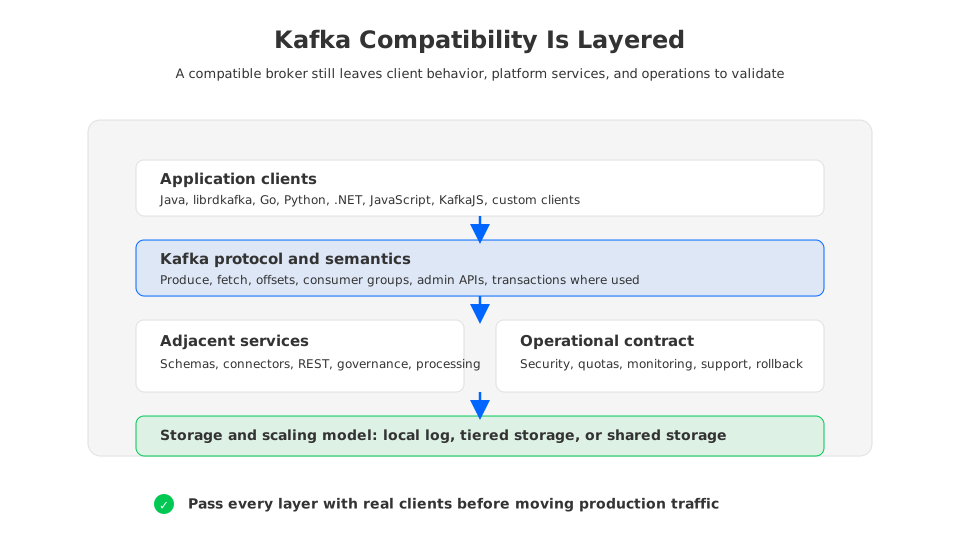
For platform engineering teams, the practical inventory should include:
- Client libraries and versions, including Java, librdkafka-derived clients, KafkaJS, and any less common language clients in production.
- Producer behavior such as compression, batching, idempotence, transactions,
acks, partitioning, and error handling. - Consumer behavior such as group rebalances, committed offsets, reset policies, lag monitoring, and replay expectations.
- Adjacent services including Schema Registry, Kafka Connect, REST interfaces, stream processing, governance, private networking, RBAC, audit logs, and support processes.
Confluent has an advantage when the surrounding platform is part of the reason you bought Confluent in the first place. Managed connectors, stream governance, Schema Registry, and managed Flink can reduce platform work, especially when the data team values an integrated suite more than a minimal broker footprint. Redpanda is attractive when the core requirement is Kafka API compatibility with a different broker implementation and a smaller operational shape.
The risk is assuming the broker comparison answers every ecosystem question. It does not. If your current Confluent estate includes managed connectors, schema governance, RBAC workflows, private networking, and operational dashboards, each of those needs a migration owner. The broker can be compatible while the platform around it still requires redesign.
3Performance, storage, and scaling model
Performance claims are tempting because they compress a messy decision into one number. Kafka teams should resist that shortcut. Throughput and latency depend on message size, partitions, replication, consumer fan-out, retention, compaction, client settings, cloud networking, disk choices, and failure conditions. A platform that performs well in a single benchmark can still be a poor fit if its storage model does not match your retention and scaling needs.
Redpanda's architecture is built around its own transaction log, Kafka API access, Raft replication, and a thread-per-core design. Its documentation describes Tiered Storage as a model that offloads log segments to object storage while recent reads continue from local storage and historical reads can come from object storage through the same API. This is a meaningful architectural departure from Apache Kafka's traditional implementation, but it still keeps local storage central for the hot path.
Confluent Cloud abstracts more of the broker operation behind managed cluster types. Its documentation describes Basic, Standard, Enterprise, Dedicated, and Freight clusters, with eCKUs for elastic cluster types and CKUs for Dedicated clusters. That model can reduce direct operational burden, but it also means capacity, limits, networking choices, and pricing are evaluated through Confluent's managed service boundaries.
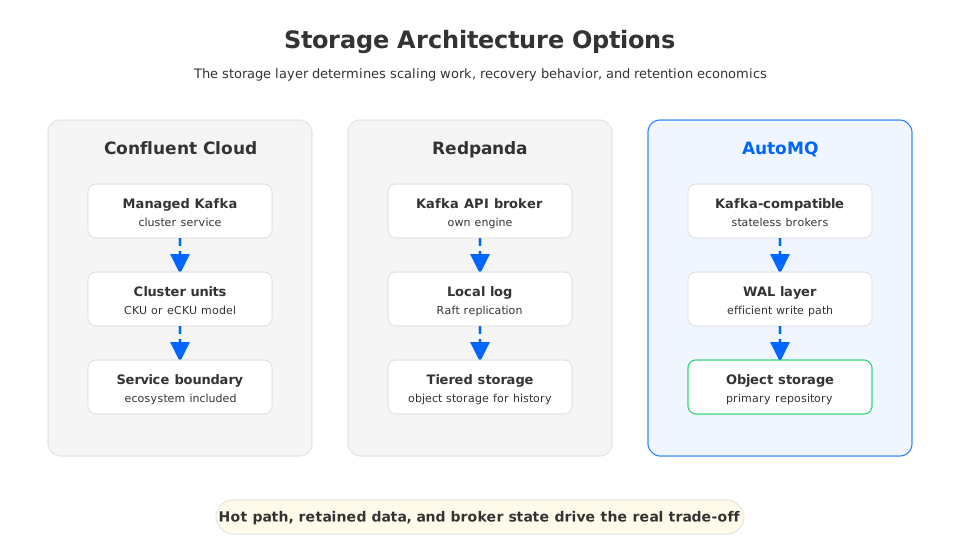
AutoMQ belongs in the comparison after this storage discussion because it changes a different layer. Instead of asking teams to choose between a broad managed Kafka platform and a Kafka-compatible broker replacement, AutoMQ keeps the Kafka-facing contract while replacing broker-local log storage with S3Stream. Its architecture uses object storage as the primary data repository, a WAL layer for write efficiency, and stateless brokers above the storage layer.
This is not the same as tiered storage. Tiered storage usually keeps the local log as the hot path and offloads older segments to object storage. Shared storage makes object storage part of the primary architecture and reduces the amount of durable data anchored to each broker. The practical effect is most visible during scaling and recovery: adding or replacing brokers should be less dominated by moving large local logs, although teams still need to test leader movement, cache behavior, WAL pressure, and object storage latency.
4Cloud cost and operational ownership
Cost comparisons between Confluent and Redpanda can go wrong when they focus only on the visible subscription line. A Kafka platform creates cost through compute, storage, network, replication, retention, managed service units, support tier, private networking, cross-region data movement, and the staff time required to operate it. The right comparison uses a workload bill of materials, not a per-GB guess.
Confluent Cloud's cluster model makes some operational work part of the managed service. You pay for the abstraction, the ecosystem, and the service boundary. Redpanda can be consumed through Redpanda Cloud deployment options including Serverless, Dedicated, and BYOC, or operated in self-managed environments. Those choices move the responsibility boundary: more control can mean more visibility and data locality, but also more design work around networking, security, quotas, upgrades, and failure response.
For a serious financial comparison, model these dimensions for the same workload:
- Ingress, egress, retained data, partition count, consumer fan-out, and peak-to-average traffic ratio.
- Required deployment model: public managed service, private networking, dedicated tenancy, or BYOC.
- Feature dependencies: connectors, schema workflows, governance, stream processing, and support requirements.
- Failure behavior: multi-AZ replication, disaster recovery, restore time, and rollback plan.
- Operational labor: upgrades, monitoring, incident response, capacity planning, and security review.
Shared-storage Kafka changes the cost conversation because storage retention can move toward object storage economics while brokers scale more with compute and traffic. That does not make the evaluation automatic. Object storage request patterns, WAL choice, cache efficiency, and read amplification all need workload testing. The benefit is architectural: storage capacity is less tightly coupled to broker count, which is valuable when retention grows faster than throughput.
5Migration risk and rollback planning
The cleanest Confluent-to-Redpanda evaluation is the one that can be abandoned safely. That sounds pessimistic, but it is how experienced SREs think. A streaming platform is usually in the write path for many applications; the team needs a reversible plan before it needs a victory slide.
Start by separating migration risks into three groups. Application risks cover clients, serialization, offsets, transactions, ordering, and error handling. Platform risks cover networking, authentication, authorization, quotas, observability, connectors, schema governance, and support. Data risks cover retention, mirroring, replay, backfill, duplicate processing, and consumer progress.
The rollback plan should answer five questions before production traffic moves:
- Which cluster is the authority for writes during each phase?
- How are consumer offsets translated, reset, or intentionally replayed?
- What happens to schema subjects, connector state, and downstream jobs during cutover?
- Which metrics decide whether the migration pauses or rolls back?
- How long can dual-write, mirror, or bridge infrastructure run without creating unclear ownership?
Teams sometimes treat Kafka compatibility as if it removes migration work. It removes one class of work when it is real: application rewrites. It does not remove the need to validate semantics under your own client mix, load pattern, security model, and failure scenarios.
6Where AutoMQ fits in the comparison
AutoMQ is relevant when the reason for leaving Confluent is broader than price, and the reason for considering Redpanda is broader than raw performance. Many teams are trying to answer a deeper architecture question: can we keep Kafka as the application contract while changing the infrastructure model that makes cloud Kafka expensive or hard to scale?
That is the shared-storage path. AutoMQ is Kafka-compatible, runs in a BYOC model, and uses object storage plus WAL-backed stream storage to reduce the dependence on broker-local disks. In a comparison table, it should not be described as "Confluent plus fewer features" or "Redpanda with another engine." It is a third option for teams that want Kafka protocol compatibility, cloud account control, object-storage retention, and stateless broker operations.
The trade-off is also clear. Shared storage makes object storage behavior, WAL configuration, cache design, and cloud infrastructure part of the streaming system's reliability model. A good evaluation therefore tests both sides of the promise: Kafka clients should remain boring, and the storage layer should behave predictably under write bursts, catch-up reads, broker replacement, and object storage turbulence.
For architects, the final decision can be framed this way:
| If the main requirement is... | Give more weight to... |
|---|---|
| A full managed data streaming suite | Confluent's ecosystem depth and service integration |
| Kafka API compatibility with a performance-oriented broker | Redpanda's documented compatibility and architecture |
| Kafka semantics with cloud-native storage economics | AutoMQ's shared-storage and BYOC model |
| Lowest migration surprise | A proof of compatibility using real clients, offsets, schemas, and failure drills |
The useful question is not "Which vendor wins?" It is "Which architecture removes the bottleneck we actually have without creating a worse one?"
If your current comparison began with a renewal or a cost spike, bring it back to workload evidence before choosing a platform. Run the same producers and consumers, mirror enough data to test offsets and replay, exercise broker loss, and model retention under realistic traffic. AutoMQ's architecture documentation is a good next read if the bottleneck is broker-local storage, slow scaling, or a need to keep Kafka compatibility inside your own cloud account.
7References
- Confluent Cloud Kafka cluster types
- Confluent Cloud client applications
- Redpanda Kafka compatibility
- Redpanda architecture
- Redpanda Cloud overview
- Apache Kafka documentation
- AutoMQ architecture overview
- AutoMQ S3Stream shared streaming storage
8FAQ
8.1Is Redpanda a drop-in replacement for Confluent?
Not for the whole Confluent platform. Redpanda documents Kafka client compatibility with Kafka 0.11 or later, subject to listed exceptions, so it can be a Kafka API replacement for many workloads. Confluent may also include managed connectors, Schema Registry, governance, Flink, support workflows, and private networking patterns that need separate migration planning.
8.2Is Redpanda more Kafka-compatible than other alternatives?
Redpanda publishes a clear Kafka compatibility page, including validated clients and unsupported Kafka features. The right answer for your team depends on the specific clients, APIs, admin operations, security settings, and ecosystem services you use. Treat compatibility as a test plan rather than a checkbox.
8.3How should we compare Confluent Cloud pricing with Redpanda Cloud pricing?
Compare the same workload across ingress, egress, retained storage, partitions, consumer fan-out, availability, private networking, support, and managed services. Confluent's CKU and eCKU model is different from Redpanda Cloud deployment choices such as Serverless, Dedicated, and BYOC, so a simple per-unit comparison can hide important costs.
8.4Where does AutoMQ fit if we are already comparing Confluent and Redpanda?
AutoMQ fits when the team wants Kafka compatibility but the main pain is broker-local storage, scaling friction, retention cost, or cloud account control. It uses shared storage with object storage and a WAL layer, so it changes the storage architecture rather than only changing the managed service wrapper or broker implementation.
8.5What should we test before switching from Confluent to Redpanda?
Test real client versions, producer settings, consumer groups, committed offsets, transactions if used, schema workflows, topic administration, authentication, authorization, monitoring, connector dependencies, broker failure, and rollback. A small benchmark is helpful, but a migration rehearsal with production-shaped traffic is more valuable.


