
Table of Contents
Table of Contents
Kafka platform decisions used to start with a familiar fork: operate Apache Kafka yourself, or move the operational burden to a managed service. That fork is still real, but it no longer describes the whole market. Teams now compare Confluent Cloud, WarpStream, and AutoMQ because cloud cost, elastic capacity, and data-control requirements are pushing Kafka architectures beyond the traditional broker-with-local-disk model.
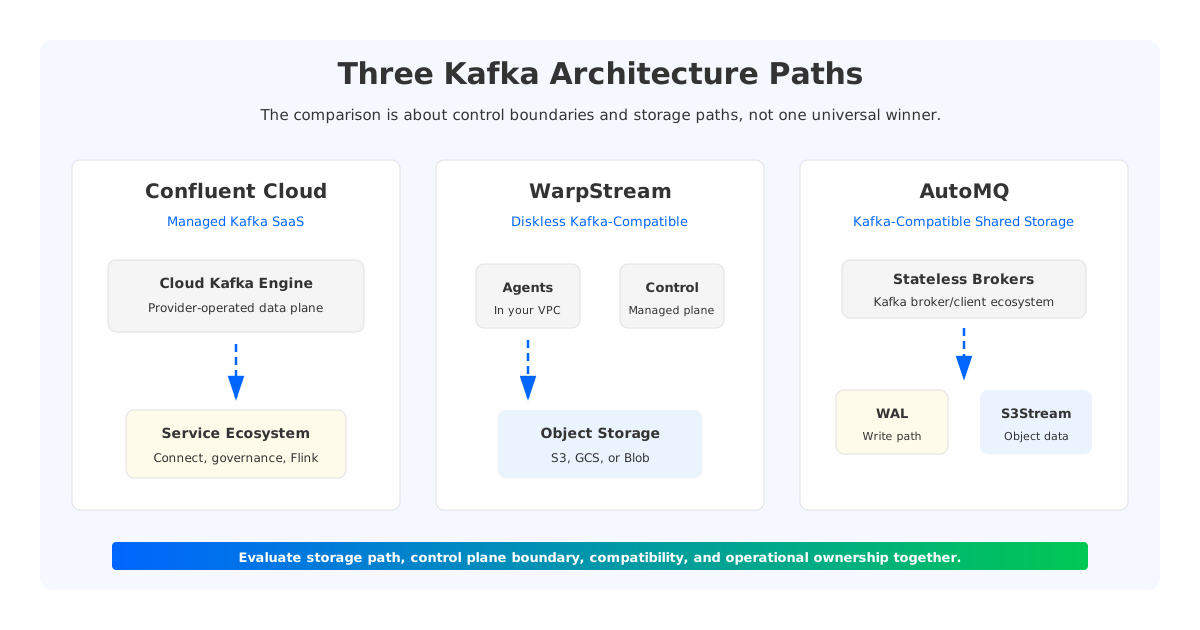
The tricky part is that these three names do not represent three versions of the same idea. Confluent Cloud is a broad managed data streaming platform with Kafka, governance, connectors, and stream processing in one service model. WarpStream is a diskless, Apache Kafka-compatible data streaming platform built directly on cloud object stores such as S3. AutoMQ is a Kafka-compatible shared storage platform that keeps the Kafka broker and client ecosystem familiar while moving the storage model toward object storage and stateless brokers.
That distinction matters for architects. A workload that needs the richest managed ecosystem may value a different boundary than a workload that must keep data in its own cloud account. A workload with strict p99 write-latency objectives should not evaluate shared storage the same way as a workload dominated by retained event history and bursty catch-up reads. The useful question is not "which one is better?" It is: which architecture matches the workload's storage path, control boundary, and operational model?
1Why Kafka Teams Are Comparing These Platforms
The common problem domain is cloud Kafka economics and operations. Traditional Kafka couples compute and storage inside brokers. That design is well understood, battle-tested, and compatible with a large ecosystem, but it creates cloud-specific pressure: brokers own local disks, partitions are placed on specific machines, and scaling storage or throughput often requires broker-level rebalancing. Managed services can hide much of that work, yet the underlying tradeoff between local broker state and elastic cloud infrastructure still shapes cost and operations.
Confluent addresses the problem from the managed platform side. Its documentation positions Confluent Cloud as a fully managed data streaming platform with Kafka, stream processing, governance, and managed connectors. WarpStream and AutoMQ approach the same pressure from the storage architecture side. WarpStream describes itself as diskless and Kafka-compatible, with data stored in object storage and an Agent-based architecture. AutoMQ keeps a Kafka-compatible broker model while separating compute from storage through S3Stream, WAL options, and stateless brokers.
This is why "Confluent vs WarpStream" can be an imprecise search query. Since Confluent announced its acquisition of WarpStream in 2024, WarpStream also represents a Confluent-owned BYOC direction rather than only an external alternative. The comparison is still useful because architects need to distinguish Confluent Cloud's managed SaaS boundary from WarpStream's object-storage-backed BYOC pattern and AutoMQ's Kafka-compatible shared-storage broker model.
2Architecture Overview
The fastest way to compare these platforms is to map the path of a write and the ownership boundary around the data plane. In Kafka, a producer acknowledgment is not a marketing concept; it is a durability and latency contract. Once the write path changes, everything around scaling, failure recovery, retained data, and network cost changes with it.
2.1Managed Kafka SaaS
Confluent Cloud is the most platform-oriented choice in this set. Its cluster documentation distinguishes cluster types such as Basic, Standard, Enterprise, Dedicated, and Freight, and its feature set extends beyond brokers into managed connectors, Schema Registry, stream governance, and Flink. The platform value is strongest when a team wants a managed Kafka-compatible experience plus surrounding data streaming services under one provider-operated model.
The tradeoff is that the architecture is deliberately abstracted behind a service boundary. Customers still choose cluster type, networking, capacity model, and surrounding services, but they do not generally own the broker storage implementation or internal data-plane mechanics in the same way they would with a BYOC or self-managed deployment. For organizations that want a single commercial and operational interface, this is a strength. The question becomes whether the workload's constraints fit that boundary:
- Does the team prioritize managed ecosystem breadth over direct infrastructure control?
- Are governance, connectors, stream processing, and managed Kafka best evaluated as one platform?
- Is the data residency model acceptable when the service provider operates the data plane?
- Do cluster type and capacity units match the team's scaling and budget model?
When those answers are yes, Confluent Cloud is often evaluated less as "Kafka hosting" and more as a managed data streaming platform.
2.2Object-Storage-Backed Kafka Approaches
Object-storage-backed Kafka approaches start from a different observation: cloud object storage is durable, elastic, and operationally separate from compute. If Kafka brokers can stop being the long-term storage authority, broker lifecycle, rebalancing, and retained data economics can change. That idea is attractive, but implementation details decide whether it is suitable for a given workload.
WarpStream's official documentation describes a diskless, Apache Kafka-compatible data streaming platform built directly on top of cloud object stores such as S3. Its architecture uses Agents running in the customer's cloud environment while a managed control plane coordinates the service. AutoMQ also uses object storage as the durable foundation, but it presents a Kafka-compatible broker architecture rather than an Agent-only mental model. AutoMQ's architecture centers on stateless brokers, S3Stream for object-storage-backed log data, and WAL choices for the write path.
The two shared-storage directions are therefore not interchangeable. A useful comparison looks at mechanics:
| Dimension | Confluent Cloud | WarpStream | AutoMQ |
|---|---|---|---|
| Primary model | Managed data streaming platform | Diskless Kafka-compatible platform on object storage | Kafka-compatible shared storage with stateless brokers |
| Data-plane boundary | Provider-operated managed service | Agents and object storage in customer cloud, managed control plane | Brokers and storage infrastructure can align with customer cloud deployment patterns |
| Kafka ecosystem posture | Strong Confluent platform ecosystem | Kafka protocol compatibility focus | Kafka broker/client ecosystem compatibility focus |
| Storage direction | Abstracted inside managed service | Object storage as primary backing store | Object storage plus S3Stream and WAL design |
| Evaluation risk | Fit to service boundary and pricing model | Fit to Agent boundary and latency profile | Fit to WAL choices and operational ownership |
Tables like this should not be read as a scorecard. They are a forcing function: if your team cannot fill in the write path, failure domain, and operational owner for each row, the shortlist is not ready.
3Cost, Latency, and Operational Tradeoffs
Cost conversations around Kafka often drift into vague claims because storage, compute, networking, and operations are mixed together. Shared storage can improve the shape of the cost model by separating retained data from broker-local capacity, but it does not remove the need to examine traffic. A low-retention, latency-sensitive payments stream and a high-retention analytics event log stress very different parts of the system.
The same caution applies to latency. Object storage is not local NVMe, and shared-storage systems compensate in different ways. WarpStream's diskless architecture changes the broker storage path around object storage and Agents. AutoMQ uses a WAL layer and S3Stream so that the write path and long-term object storage path are not treated as the same thing. Confluent Cloud abstracts these mechanics behind the managed service, so evaluation moves toward cluster type, service limits, network path, and observed workload behavior.
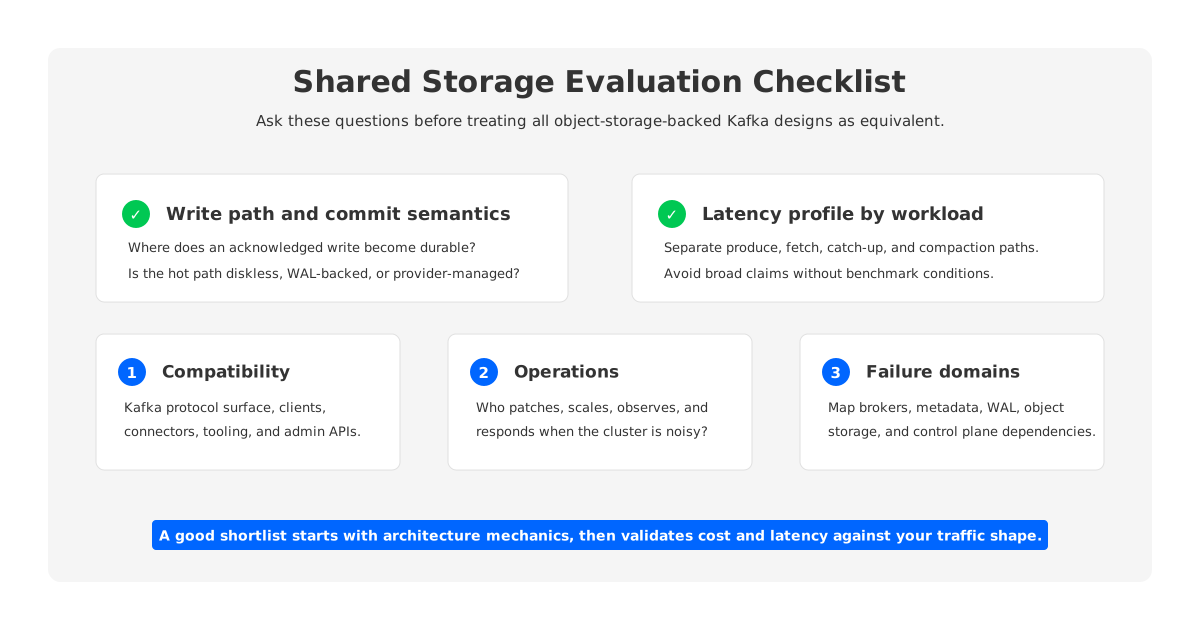
The evaluation should separate at least five paths:
- Produce path: where the acknowledgment happens, what becomes durable at that point, and which component is on the critical latency path.
- Fetch path: whether consumers read from hot broker state, object storage, cached segments, or a provider-managed layer.
- Catch-up path: how the system behaves when consumers read older retained data at high throughput.
- Scaling path: whether adding capacity requires data movement, partition reassignment, or mainly compute scheduling.
- Recovery path: what must be rebuilt after broker, zone, object storage, metadata, or control-plane disruption.
This is also where Confluent's platform maturity has a different kind of value. A managed ecosystem can simplify procurement, support, governance, connectors, and stream processing. Shared-storage systems are compelling when the pain is specifically tied to broker-local state: retained data growing faster than compute demand, partition movement slowing down scaling, or cloud teams wanting storage to live in object storage rather than attached disks. The workload decides which tradeoff is worth paying for.
4Data Control and BYOC Boundaries
BYOC is often treated as a checkbox, but it is really a boundary diagram. Which account holds the data? Which component touches object storage? Which control plane can observe metadata? Who patches the data-plane processes? These questions matter more than the label on the pricing page.
WarpStream's BYOC story is built around Agents running in the customer's cloud and object storage in the customer's environment, with a managed service coordinating the system. The boundary still needs scrutiny: the managed control plane, metadata model, support access, networking, and upgrade workflow are part of the architecture.
AutoMQ's BYOC-oriented positioning is different because it keeps the Kafka-compatible broker model in view. The broker remains a recognizable part of the architecture, but it is designed to be stateless relative to traditional Kafka storage responsibilities. Object storage becomes the durable storage foundation, while WAL choices and S3Stream shape the write and storage paths.
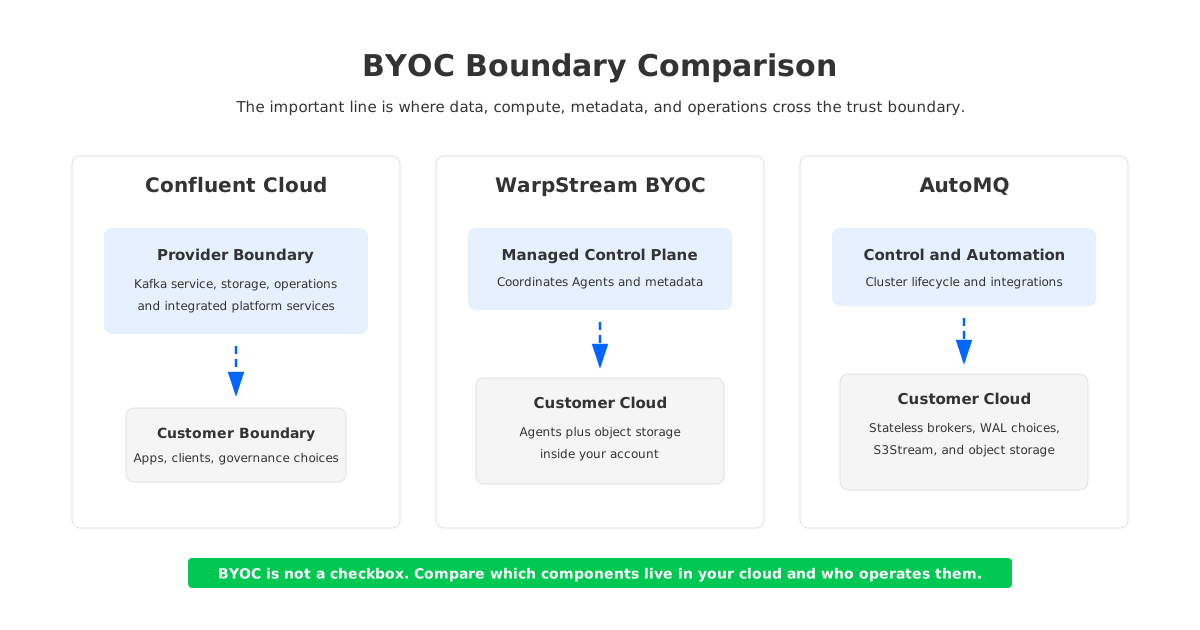
Confluent Cloud sits on the other side of the boundary discussion. It is strongest when the customer wants a managed service rather than customer-account data-plane ownership. That does not make it less secure or less enterprise-ready; it means the control model is different.
For regulated teams, the right comparison is usually not "SaaS or BYOC" in the abstract. It is a mapping exercise:
- Data residency: where event data and retained logs live.
- Control plane: what metadata and operational telemetry leave the customer environment.
- Encryption and identity: who manages keys, roles, network paths, and access policies.
- Operations: who can deploy, patch, restart, inspect, and scale data-plane components.
- Exit path: how data is exported, mirrored, or migrated if the platform changes.
Kafka's value is partly ecosystem inertia: clients, Connect jobs, schemas, operational runbooks, and team muscle memory. The more a platform preserves Kafka-compatible behavior, the easier it is to reason about migration and exit. The more a platform bundles adjacent services, the more carefully teams should evaluate coupling.
5How to Choose by Workload Pattern
A useful shortlist starts with the workload, not the vendor category. If the workload is a central enterprise streaming platform with many teams, governance requirements, managed connectors, and stream processing needs, Confluent Cloud deserves serious consideration because the product surface matches the organizational problem.
If the workload is dominated by retained event history, bursty analytics consumption, or cost pressure from broker-local storage, object-storage-backed Kafka becomes more interesting. WarpStream is worth evaluating when an Agent-based diskless model and a managed control plane fit the team's BYOC expectations. AutoMQ is worth evaluating when the team wants a Kafka-compatible shared storage platform that keeps the broker/client ecosystem visible while changing the storage and scaling model.
Here is the practical decision frame:
| Workload pattern | Likely evaluation emphasis | Platform direction to test first |
|---|---|---|
| Enterprise streaming hub with governance and many integrations | Managed ecosystem, support model, organizational standardization | Confluent Cloud |
| BYOC data locality with diskless object-storage economics | Agent boundary, object storage behavior, managed control plane | WarpStream |
| Kafka-compatible shared storage with broker familiarity | Stateless brokers, WAL path, S3Stream, Kafka tooling fit | AutoMQ |
| Latency-critical transactional streams | Produce acknowledgment path and failure recovery | Test all candidates under production-like load |
| High-retention event history and bursty reads | Object storage path and catch-up behavior | WarpStream or AutoMQ, depending on boundary fit |
The most common evaluation mistake is to ask for a single benchmark number before defining the traffic shape. Kafka performance is sensitive to message size, partitions, durability model, producer acknowledgments, batching, compression, consumer fan-out, retention, and cloud network path. Once those categories are clear, the shortlist becomes less ideological and more operational.
6References
- Confluent Cloud cluster types documentation
- Confluent Cloud cluster management documentation
- Confluent announcement: Confluent acquires WarpStream
- WarpStream official documentation
- WarpStream Agent deployment documentation
- AutoMQ architecture overview
- AutoMQ object storage configuration
- AutoMQ Cloud overview
7FAQ
7.1Is WarpStream still a Confluent alternative?
It depends on what you mean by alternative. Confluent announced its acquisition of WarpStream in 2024, so WarpStream is no longer best understood only as an independent competitor. Architects still compare WarpStream with Confluent Cloud because the deployment and storage models are different: Confluent Cloud is a managed streaming platform, while WarpStream is a diskless object-storage-backed Kafka-compatible platform with a BYOC-oriented architecture.
7.2Is shared storage the same as tiered storage?
No. Tiered storage usually keeps local broker storage in the hot path and moves older segments to remote storage. Shared-storage or diskless designs make object storage much more central to the architecture. The exact write path still differs by implementation, which is why WAL, Agent, cache, and object-storage behavior must be evaluated directly.
7.3Does object storage make Kafka latency worse?
Not automatically, and not uniformly. Object storage changes the storage path, but platforms use different techniques to manage the produce path, reads, caching, and recovery. A useful benchmark must separate produce latency, fetch latency, catch-up reads, and failure recovery instead of reducing the architecture to one latency claim.
7.4When should a team choose Confluent Cloud?
Confluent Cloud is a strong fit when the team values a managed data streaming platform with Kafka, governance, connectors, stream processing, support, and operational abstraction. It is especially relevant when platform integration and managed operations matter more than direct ownership of the broker storage architecture.
7.5When should a team evaluate AutoMQ?
AutoMQ is worth evaluating when the team wants Kafka-compatible shared storage while preserving the broker/client ecosystem. Its architecture uses object storage, S3Stream, WAL choices, and stateless brokers to change the cloud Kafka storage and scaling model without asking teams to abandon Kafka tooling and mental models.


