
Table of Contents
Table of Contents
A connector cutover looks small on a migration plan because the moving parts have ordinary names: source connector, sink connector, offset, task, topic, credential, consumer group. The risk is that each object belongs to a different operational boundary. Data engineering owns the connector configuration, an application team owns the schema contract, SRE owns the Kafka cluster, and analytics may notice the incident first when the sink stops receiving fresh data.
That is why connector cutover sequencing kafka is a search phrase with real production intent. The person searching it is trying to decide when it is safe to move a source or sink from one streaming environment to another without duplicating data, losing commits, breaking downstream jobs, or burning the rollback bridge behind them.
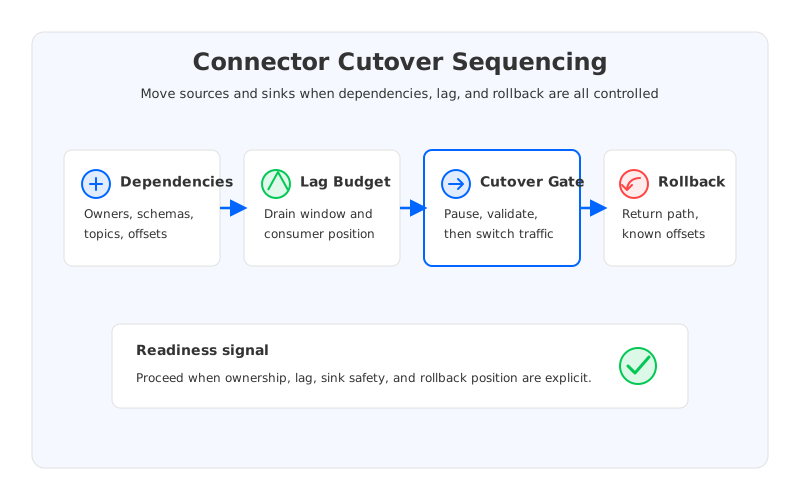
The useful question is not "How do we switch the connector?" It is "What has to be true before switching the connector is the least dangerous action?" Once framed that way, the cutover becomes a sequencing problem across dependencies, lag, infrastructure capacity, and rollback ownership.
1Why Connector Cutover Sequencing Fails in Kafka Projects
Connector migrations fail when teams treat the connector as an isolated process. In Kafka, a source connector reads from an upstream database, file system, SaaS API, queue, or CDC stream, then writes records to topics. A sink connector consumes from Kafka, writes to a target system, and often commits progress only after the target accepts the data. The connector process is visible, but the actual contract is spread across topics, offsets, schemas, credentials, and sink idempotency.
Kafka Connect makes operation repeatable by storing connector configuration, task status, and offsets in Kafka-backed internal topics. That lets the worker group rebalance tasks and continue from persisted state. It also means a cutover plan must respect where that state lives and how the next environment interprets it. Moving a connector definition without understanding offset state is like moving a bookmark without checking whether both books have the same page numbers.
The highest-risk cutovers tend to share a few patterns:
- The source system can continue producing while the team validates the target path, so lag and duplicate windows become business questions rather than platform details.
- The sink does not provide a clean idempotent write model, so replaying records after rollback may produce visible duplicates or conflicting updates.
- The connector depends on secrets, network routes, schemas, ACLs, transforms, and target-side quotas that were tested separately but never exercised as one path.
- The team has a rollback command but no rollback state, which means they can restart the old connector without knowing the offset and target consistency point it should resume from.
None of those issues are fixed by a faster restart. A cutover should move only after the dependency graph is explicit, the lag budget is measurable, and the rollback path has a known data position.
2The Production Constraint Behind the Problem
Traditional Kafka operations already put pressure on connector migrations because storage, compute, and data placement are tightly coupled at the broker layer. When a cluster is broker-local, capacity planning is not only about ingest throughput. It is also about where partitions live, how much local storage remains, how quickly data can be moved during reassignment, and whether a failure during migration creates extra recovery traffic.
Connector cutovers amplify that pressure because two paths may exist at once. The old connector may still be draining while the target connector runs in validation mode. Operators need enough retained data to replay from a known offset without creating an unbounded backlog.
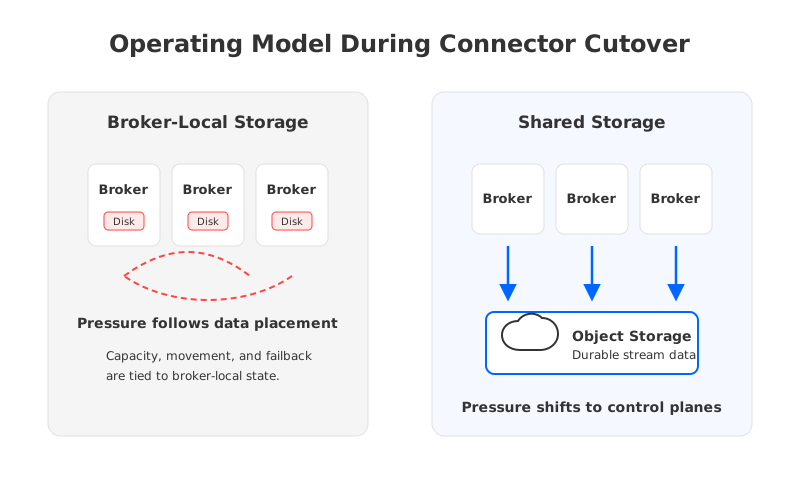
This is where cloud cost becomes part of reliability engineering. If a cutover causes extra cross-zone traffic, storage growth, or broker replacement work, the team may shorten validation windows to reduce cost and noise. That decision can be rational and still dangerous.
The better constraint is to make the cutover window boring. The connector team should spend its attention on semantic questions, not broker capacity anxiety: Is the sink idempotent? Are offsets comparable? Can the old path be reactivated without corrupting the target?
3Build the Dependency Graph Before Setting a Cutover Time
A practical connector cutover starts with dependency ownership. The connector is rarely the source of truth for the full migration. It references topics, schemas, converters, transforms, secrets, network endpoints, target tables, and observability dashboards. Each item needs an owner and a validation signal before the team chooses a cutover window.
The dependency graph should cover record movement, control state, platform boundaries, and business validation. Record movement includes source position, topics, partitioning, serialization, and sink write semantics. Control state includes connector configuration, internal Connect topics, task status, offsets, and consumer group identity. Platform boundaries include ACLs, TLS material, service accounts, network access, and quotas.
The trap is to treat these areas as independent checks. They interact. A connector may authenticate successfully and still write records with a schema version the sink rejects. A consumer group may show healthy lag while the target system applies writes slowly. A rollback may restart the old process after the target has already made irreversible side effects.
The cutover sequence should therefore be written as a dependency order, not a meeting agenda:
| Phase | Primary question | Exit signal |
|---|---|---|
| Shadow | Can the target path run without taking ownership of production output? | Target connector starts, observes input, and exposes metrics without business impact. |
| Drain | Can the old path reach an acceptable position? | Lag and source position are within the approved window for the workload. |
| Gate | Is the switch safer than waiting? | Owners approve data state, sink state, credentials, and rollback position. |
| Commit | Can the team declare the target path authoritative? | Downstream validation and monitoring confirm the target path is healthy. |
| Holdback | Can rollback still happen if late defects appear? | Old path, offsets, and retention remain available for the agreed holdback window. |
This table is intentionally operational. A connector cutover is ready when the team can point to evidence, not when the calendar says the window has started.
4Lag Is a Business Budget, Not a Single Metric
Consumer lag is often the first signal teams watch during a connector migration, but lag by itself does not define safety. A sink connector can have low Kafka lag and still be unsafe if the target system accepts writes out of order, applies them with hidden delay, or fails idempotency checks. A source connector can show stable throughput while the upstream database log retention is close to expiring. Lag matters because it is a proxy for recoverability, not a universal health score.
The cutover plan needs a lag budget. That budget should define how far the old connector may be behind, how much replay the target path can tolerate, how long the source can retain unread changes, and how long downstream systems can accept stale data. For user-facing sinks, the budget may be close to zero; for analytical sinks, controlled delay can enable stronger reconciliation.
The important detail is that the budget must include rollback. If the target connector is promoted and then fails, the team needs to know whether the old connector can resume from a position that will not create unacceptable duplicates or gaps. That depends on source semantics, sink idempotency, Kafka retention, and offset management. A rollback plan that says "restart the old connector" is incomplete until it says where to restart and how to verify target state.
There is a useful rule of thumb: if the team cannot explain the rollback position in one sentence, the cutover is not ready. "The old sink remains paused at this consumer group position, the target table has accepted records through this source timestamp, and replay from that point is idempotent." That statement is more valuable than a long runbook with no data invariant.
5Architecture Options and Trade-offs
Connector cutover architecture is often discussed as a tooling choice: connector runtime, mirror tool, deployment pipeline, observability dashboard. Those choices matter, but they sit on top of the streaming platform's operating model. The platform determines how much capacity must be prepared, how data durability is maintained, how quickly brokers can be replaced, and how much cloud networking is consumed when the migration creates temporary parallel paths.
The comparison below helps evaluate the platform layer before the connector window is scheduled.
| Evaluation area | What to inspect | Why it affects connector cutover |
|---|---|---|
| Kafka compatibility | Connect protocol behavior, client compatibility, ACLs, and offset semantics | Connector cutover should not require application rewrites or connector-specific surprises. |
| Storage model | Broker-local disks, tiering behavior, or shared object storage | Storage placement affects replay windows, broker recovery, and capacity headroom during migration. |
| Elasticity | How compute and storage scale during temporary dual-running | Cutovers often create uneven load; the platform should absorb that without manual partition movement. |
| Network cost | Cross-zone replication, consumer traffic, and private connectivity | Validation paths can create traffic that changes the migration economics. |
| Governance | Secrets, identities, schemas, audit trails, and environment boundaries | Connector ownership crosses teams, so governance has to be visible and repeatable. |
| Recovery | Broker failure handling, retention policy, and rollback mechanics | The rollback plan depends on durable data and known state, not only process restart. |
This framework leads to a sharper platform requirement: preserve Kafka APIs and connector behavior while reducing the coupling between broker lifecycle and durable stream data. When broker replacement, storage growth, or partition movement becomes part of every migration discussion, connector teams inherit infrastructure problems that distract from data correctness.
6How AutoMQ Changes the Operating Model
AutoMQ fits into this discussion as a Kafka-compatible streaming system built around shared storage and stateless broker operation. The point is not that a connector cutover becomes risk-free. It does not. The point is that the platform can reduce the broker-local state the migration has to reason about while keeping Kafka protocol compatibility at the application boundary.
In a shared-storage design, durable stream data is backed by object storage, and brokers are treated more like elastic compute. Capacity planning can focus on throughput and retention instead of local disk placement. Broker recovery and scaling are less entangled with where durable data lives. Migration teams can spend more time validating connector semantics because the infrastructure layer is less likely to require disruptive data movement at the same moment.
AutoMQ documentation describes this architecture as a cloud-native Kafka-compatible approach that separates compute from storage, uses object storage for durability, and supports customer-controlled deployment models. For connector cutovers, those properties matter when the team wants Kafka-compatible clients, elastic capacity during temporary dual-running, and clearer governance boundaries.
The product still belongs after the evaluation framework, not before it. If a team has not mapped connector dependencies, offset state, sink idempotency, and rollback ownership, changing the streaming platform will not save the migration. Once those questions are mapped, the platform choice determines how much incidental complexity surrounds the cutover. AutoMQ is most relevant when the pain is operating Kafka-compatible streaming under cloud cost, elasticity, and recovery constraints.
For teams evaluating that path, test one connector family with production-like data contracts before moving a broad estate. Use the same converters, schemas, ACLs, and sink targets as production. Then compare capacity preparation, failover behavior, rollback state, cloud traffic, and manual broker work.
7Production Readiness Checklist
The final readiness check should be strict because connector cutovers fail between teams. A green deployment pipeline is not enough. A healthy connector task is not enough. A low lag number is not enough. The cutover is ready when the data path, control path, and rollback path agree.
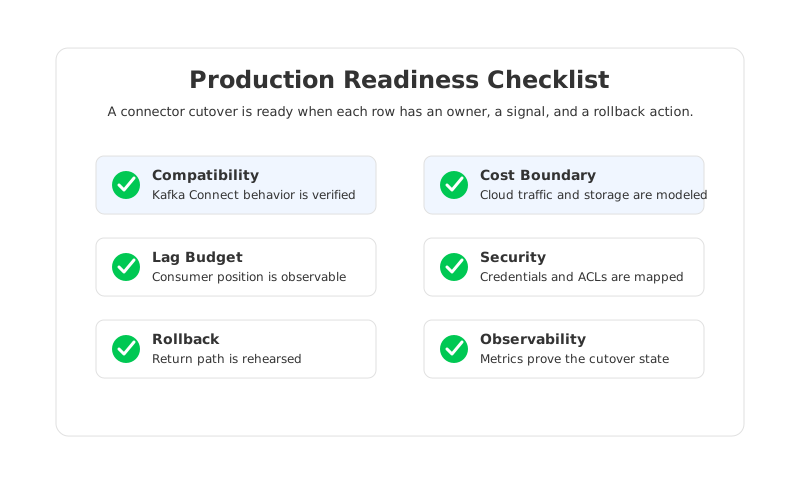
Use this checklist as the final gate:
- Compatibility: connector version, converter, transforms, topic names, partitions, ACLs, and client settings have been tested against the target Kafka-compatible environment.
- Offset state: source and sink positions are documented, and the team knows which state is authoritative at each phase.
- Lag budget: acceptable delay, replay volume, and source retention are defined for the workload rather than copied from another migration.
- Sink safety: idempotency, duplicate handling, ordering expectations, and target-side quotas have been tested under realistic task parallelism.
- Rollback: the old path can be resumed from a known position, and the downstream owner knows how reconciliation will be performed.
- Observability: dashboards show connector task status, consumer lag, write errors, target freshness, and business validation signals in one place.
- Governance: secrets, network routes, audit trails, and ownership are mapped before the window starts.
The most useful cutover runbooks are short because the hard thinking has already happened. They state the invariant, the evidence, the owner, and the next action. If an invariant is broken, the team knows whether to hold, roll forward, or roll back.
Connector cutover sequencing is not about making migration ceremony heavier. It refuses to let a small process switch carry invisible data risk. When dependencies, lag, and rollback are explicit, the team can move connectors with the same discipline it applies to database changes and incident response.
If your team is evaluating Kafka-compatible infrastructure for connector migration, recovery, or cloud cost control, review AutoMQ's architecture and deployment model or talk with the AutoMQ team: contact AutoMQ.
8References
- Apache Kafka documentation: Kafka Connect
- Apache Kafka documentation: Consumer configuration and consumer groups
- AutoMQ documentation: AutoMQ overview
- AutoMQ documentation: Technical advantage overview
- AutoMQ documentation: AutoMQ Cloud environment overview
- AWS documentation: Amazon S3 user guide
9FAQ
9.1What is connector cutover sequencing in Kafka?
Connector cutover sequencing is the ordered process of moving a Kafka source or sink connector from one production path to another while controlling dependencies, offsets, lag, validation, and rollback. The sequence matters because connector state is connected to Kafka topics, consumer groups, schemas, credentials, and target-side write semantics.
9.2Is low consumer lag enough to approve a connector cutover?
No. Low lag is useful, but it does not prove that the sink is applying records correctly, that duplicates are safe, or that rollback can resume from a known position. Treat lag as one readiness signal inside a broader data correctness and recovery check.
9.3How should rollback be designed for a connector migration?
Rollback should name the old path, the offset or source position it will resume from, the target state that has already been affected, and the reconciliation method. Restart commands are not enough because rollback is a data-state problem before it is a process-control problem.
9.4Where does AutoMQ fit in connector migration planning?
AutoMQ is relevant after the team has defined compatibility, lag, governance, and rollback requirements. Its Kafka-compatible shared-storage architecture can reduce broker-local storage coupling and make elastic capacity, recovery, and cloud operating boundaries easier to reason about during migration.


