
Table of Contents
Table of Contents
Connector fleet observability Kafka teams search for is usually born from a bad week, not from a dashboard refresh project. A payment sink starts falling behind, a CDC source retries the same batch until its task dies, and nobody can tell whether the owner is the data integration team, the application team, or the platform team. The Kafka cluster may be healthy, but the business flow is not. That gap is where connector observability becomes a platform problem rather than a plugin problem.
Kafka Connect gives teams a common runtime for source and sink connectors, task parallelism, offset handling, and distributed workers. That runtime is useful because it standardizes integration work that would otherwise become many custom ingestion services. It also concentrates operational risk. When dozens or hundreds of connectors share the same Kafka substrate, the signals that matter are not limited to CPU, broker disk, or topic throughput. Platform teams need to see whether data is moving, whether retries are masking data loss risk, and whether the right team owns the next action.
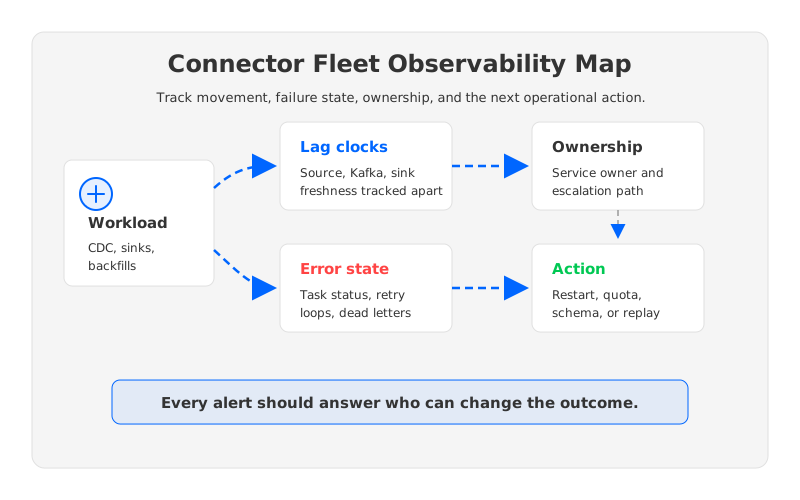
1Connector lag is not one number
Consumer lag is the familiar starting point because it measures the distance between produced records and consumed records for a Consumer group. For connector fleets, that number is only one layer of the story. A sink connector can show downstream back pressure while the Kafka topic itself looks fine. A source connector can ingest from a database slowly while its produced topic has no Consumer lag yet. A CDC pipeline can be technically alive while application teams are reading data that is hours behind the source of truth.
The practical model is to split lag into three related clocks:
- Source freshness tells you how far the connector is behind the upstream system. For CDC, this might be database log position, event timestamp delay, or snapshot progress.
- Kafka movement tells you whether records are reaching topics and whether downstream Consumer groups are keeping pace with committed offsets.
- Sink delivery tells you whether the target system has accepted the records, rejected them, or slowed the task through retries and rate limits.
This split matters because the owner changes with the clock. Source freshness often belongs to the database or application owner. Kafka movement belongs to the streaming platform. Sink delivery may belong to analytics, search, security, warehouse, or application teams. A single "connector lag" chart hides that boundary, so incidents become meetings instead of fixes.
2Errors need state, not only counts
Connector errors are also easy to under-specify. An error counter that increases once per retry can make a transient downstream timeout look catastrophic. The opposite failure is worse: a connector retries forever, the error rate looks tolerable, and the data path is no longer making useful progress. The signal that matters is not raw error volume. It is the relationship between error type, task state, retry behavior, and offset movement.
A production connector view should separate at least four states:
| Signal | What it answers | Typical owner |
|---|---|---|
| Task status | Is the worker running, paused, failed, or restarting? | Connector platform |
| Error class | Is the failure caused by auth, schema, target throttling, source outage, or data shape? | Depends on class |
| Offset progress | Are committed offsets moving while errors occur? | Platform plus app owner |
| Dead-letter volume | Are records being routed away from the normal path? | Data owner |
These signals should be correlated, not parked in separate dashboards. A task that is running, retrying, and not committing offsets is operationally different from a task that is running, routing malformed records to a dead-letter topic, and still moving. The first is a throughput or availability problem. The second is a data quality and ownership problem.
3Ownership is an observability dimension
The most expensive connector incident is the one with no obvious owner. Kafka platform teams see topic throughput. Database teams see replication slots or change logs. Application teams see stale derived data. Security teams see audit gaps. Each team has partial evidence, and all of them can be right.
Ownership metadata should be treated as first-class telemetry. Every connector should carry service owner, business domain, escalation channel, data classification, expected freshness, upstream dependency, downstream dependency, and rollback contact. These fields sound administrative until an incident crosses team boundaries. Then they decide whether a page reaches someone who can act or someone who can only forward it.
There is a useful rule for connector fleet observability: every alert should answer "who can change the outcome?" If an alert cannot identify that person or team, the alert is incomplete even when its metric expression is correct. The fix may be a Kafka worker restart, a sink quota change, a schema correction, a database failover, or a data contract review. The dashboard should not force responders to infer ownership from connector names.
4The storage model behind connector-heavy operations
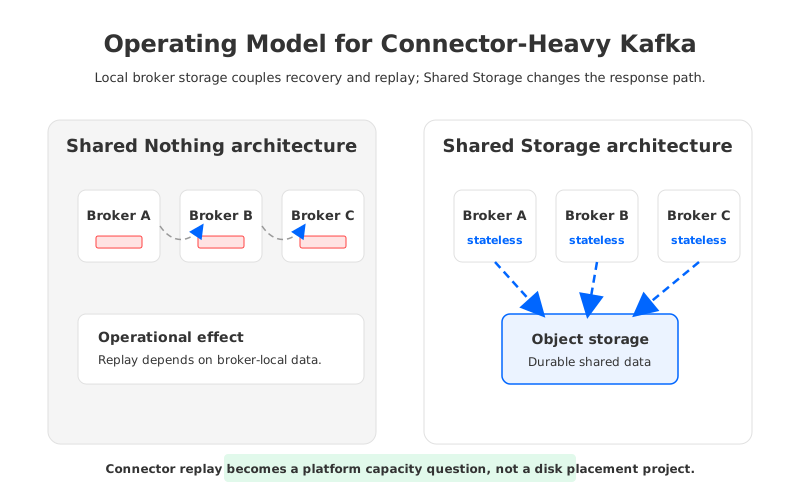
Connector fleets stress Kafka in a specific way. They create many small but steady flows, long retention requirements for replay, bursts during backfill, and many Consumer groups whose lag patterns do not line up cleanly. Traditional Kafka clusters built on a Shared Nothing architecture bind each broker to local persistent storage. That model can work well, but it makes storage, compute, and recovery tightly coupled.
The coupling shows up during backfills and failures. A connector replay may increase read pressure on historical data while production traffic still writes hot data. A broker replacement may require data movement or partition rebalancing. A retention change for one integration domain can increase disk pressure that affects unrelated connectors. Even when these events are planned, they consume operational attention because the local disk layout is part of the availability model.
Tiered Storage helps move older data to object storage, but it does not fully remove the local broker from the persistence path. Recent data and broker-local responsibilities still matter. For connector-heavy platforms, the harder question is not whether historical data can be offloaded. It is whether the platform can absorb replay, scaling, and worker churn without turning every capacity event into a storage-placement exercise.
5A neutral evaluation checklist for platform teams
Teams evaluating connector observability often start with tools, but the durable decision is architectural. A good dashboard can expose a weak operating model. It cannot fix one. Before picking a monitoring surface, platform teams should ask what the system can do when the dashboard says something is wrong.
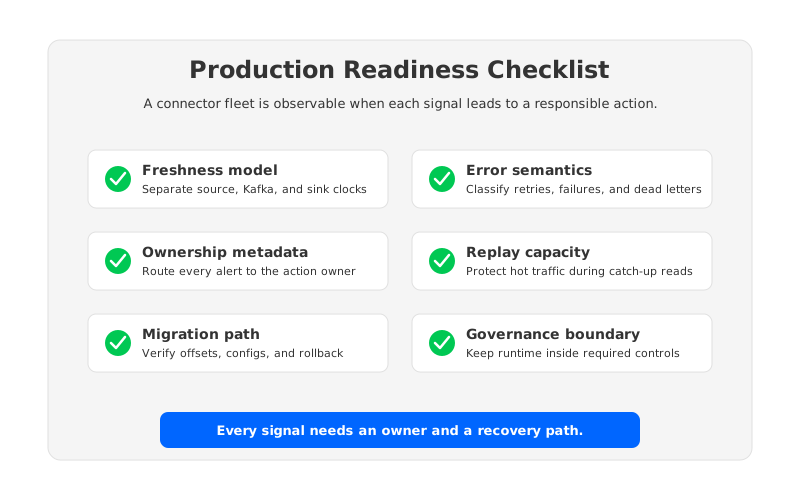
Use this checklist as a readiness review:
- Freshness model: Do you track source, Kafka, and sink progress separately, and can you explain which clock matters for each business flow?
- Error semantics: Do alerts distinguish retriable errors, terminal task failures, schema problems, auth problems, and dead-letter routing?
- Ownership metadata: Does every connector have an accountable owner, escalation path, data classification, and expected recovery action?
- Replay capacity: Can the platform support catch-up reads and backfills without destabilizing unrelated hot traffic?
- Storage elasticity: Can retention and replay needs grow independently from broker compute sizing?
- Migration and rollback: Can connectors move between clusters or runtimes while preserving offset visibility and rollback options?
- Governance boundary: Can teams run connectors inside the network, identity, and compliance boundary required by their data?
The checklist exposes why connector observability is not only a metrics problem. Metrics tell you what happened. Architecture decides whether the response is a worker restart, a quota change, a cluster resize, or a migration plan.
6How AutoMQ changes the operating model
Once the evaluation shifts from dashboards to operating model, AutoMQ becomes relevant as a Kafka-compatible streaming platform built around Shared Storage architecture. The important point is not that connector teams need a different API. They usually do not. The point is that connector fleets benefit when brokers are no longer the place where persistent data is tied to local disks.
In AutoMQ, stateless brokers work with object-storage-backed durability through S3Stream and WAL storage. This changes several connector operations. Replay pressure can be treated more like a storage and cache access pattern than a broker disk placement problem. Broker replacement and scaling are less entangled with partition data movement. Retention growth is not the same as pre-provisioning more local disks across the cluster.
For connector fleets, that means the observability conversation can move up a level. Teams still need connector task status, error classes, offset progress, and owner metadata. But the platform response becomes less dominated by broker-local storage constraints. A backfill plan can ask how much read pressure and object storage access the workload creates, not which broker owns the historical log segments. A failed broker recovery can focus on service restoration instead of copying persistent partition data back into place.
AutoMQ BYOC also matters for connector governance. Many connector workloads sit near sensitive systems: production databases, security telemetry, identity events, payment records, or customer analytics. Running the control plane and data plane inside the customer's cloud boundary gives platform teams a cleaner way to align connector operations with VPC networking, private connectivity, and internal access controls. That does not remove the need for good connector ownership, but it keeps the runtime closer to the systems that own the data.
7A practical alert model
Good connector alerts should be fewer and sharper. Page on states that require time-bound human action. Route lower-severity signals to owners who can fix configuration, schema, or quota problems during working hours. The goal is not to reduce alert volume for its own sake. The goal is to make every page defensible.
A connector fleet can start with this alert model:
- Freshness breach: Page when source-to-sink freshness exceeds the business SLA and offset progress is stalled or too slow to recover.
- Failed task with no automatic recovery: Page the platform owner and connector owner when task state is failed and restart policy cannot recover it.
- Retried error loop: Alert when the same error class repeats while offsets do not move.
- Dead-letter surge: Notify the data owner when dead-letter volume crosses the agreed threshold, even if the connector continues to run.
- Backfill risk: Warn before replay or snapshot work consumes capacity reserved for production flows.
This model also helps write runbooks. Each alert should include connector name, owner, environment, topic, task state, source freshness, sink status, last successful offset movement, error class, and suggested first action. Without those fields, responders spend the first minutes rebuilding context the system already had.
8Migration readiness for connector-heavy platforms
Connector migration is harder than moving producers and consumers because connectors often encode operational state outside ordinary application code. They have connector configs, task assignments, offsets, schema behavior, source credentials, sink credentials, and retry rules. Some source connectors also depend on upstream log positions or snapshots. Treating them as stateless deployment units is a good way to create a rollback problem.
The migration plan should start with inventory. Group connectors by source type, sink type, business owner, SLA, offset state, data classification, and rollback path. Then test one group at a time. The first migration candidate should be important enough to reveal real issues but not so critical that rollback pressure hides what the team is learning.
For Kafka-compatible infrastructure, compatibility reduces application change, but it does not remove operational validation. Validate connector plugin versions, worker settings, internal topics, offset handling, network access, authentication, and schema behavior. Then run the old and target paths long enough to compare freshness, error behavior, and sink results. The observability model from earlier becomes the migration acceptance test.
If your connector estate is large enough that lag, retry loops, and ownership handoffs have become weekly work, evaluate the architecture as well as the dashboard. You can start from the AutoMQ Cloud entry point here: https://go.automq.com/home?utm_source=blog&utm_medium=cta&utm_campaign=rpb-0054
9References
- Apache Kafka documentation: https://kafka.apache.org/documentation/
- AutoMQ architecture overview: https://docs.automq.com/automq/architecture/overview.md
- AutoMQ Kafka Connect documentation: https://docs.automq.com/automq-cloud/kafka-connect/overview.md
- Amazon S3 data durability documentation: https://docs.aws.amazon.com/AmazonS3/latest/userguide/DataDurability.html
10FAQ
10.1What is connector fleet observability in Kafka?
Connector fleet observability is the practice of monitoring Kafka Connect workers, connectors, tasks, offsets, errors, freshness, ownership, and downstream delivery as one operating system. It goes beyond broker health because a connector can fail the business flow while the Kafka cluster remains healthy.
10.2Is Consumer lag enough for Kafka connector monitoring?
No. Consumer lag is useful, but connector fleets also need source freshness, sink delivery state, task status, retry behavior, dead-letter volume, and ownership metadata. A sink connector can be blocked by a downstream service while ordinary topic metrics look acceptable.
10.3How should teams assign connector ownership?
Assign ownership by the team that can change the outcome. A platform team may own the worker runtime, but a schema error, source database outage, or sink quota limit may belong elsewhere. Each connector should include owner, escalation channel, upstream dependency, downstream dependency, and expected recovery action.
10.4Where does AutoMQ fit in a connector observability strategy?
AutoMQ fits after the team has defined the observability and ownership model. Its Kafka-compatible API, Shared Storage architecture, stateless brokers, and AutoMQ BYOC deployment model can reduce the amount of connector operational work tied to broker-local storage and customer network boundaries.


