
Table of Contents
Table of Contents
Kafka connector governance becomes a real search problem after the connector estate stops looking like a neat integration layer. One source connector brings database changes into Kafka. A sink connector sends normalized events to a warehouse. Then product analytics, fraud detection, AI feature generation, billing, and compliance teams all ask for slightly different versions of the same data path. The platform still calls this "integration," but operationally it has become a distributed production system.
The dangerous part is that every new connector can look reasonable in isolation. A team adds a private sink because the shared one is too slow to change. Another team keeps a connector running in a separate cluster because it needs a different retention window. A third team duplicates a CDC feed to avoid touching a sensitive pipeline. None of these choices is reckless by itself, yet the estate becomes harder to secure, observe, replay, and scale with every exception.
Good connector governance is not a documentation exercise. It is the set of architectural rules that decides which data paths are allowed to exist, who owns them, how they recover, and what infrastructure assumptions they are allowed to make.
1Why Kafka Connector Governance Matters Now
Kafka Connect gives teams a standardized way to run source and sink connectors around Kafka. That standardization keeps integration code out of every application team and gives operators common concepts such as connector configuration, tasks, offsets, and worker clusters. The moment those connectors carry production data contracts, though, the governance problem moves beyond whether a connector can run.
Platform teams now have to decide whether a connector is a shared infrastructure service, an application-owned integration, a temporary migration path, or a regulated data boundary. Those categories need different controls: a shared CDC source may require schema ownership and replay guarantees, while a low-risk metrics sink may need simpler change control.
The pressure is stronger in cloud deployments because each exception can add storage, network, and operational cost. A connector that writes to a new topic creates another retention policy. Governance needs to cover the whole path, not only the connector process.
The recurring failure pattern looks like this:
- Ownership drifts. The team that requested the connector is not always the team paged when it fails, especially when the connector becomes a shared dependency.
- Configuration becomes policy by accident. Retention, topic naming, schema compatibility, and access rules get embedded in one-off connector configs instead of platform standards.
- Replay paths are discovered late. Teams find out during an incident whether offsets, source snapshots, and downstream idempotency were designed together.
- Cost attribution gets blurry. Connector throughput, retained history, and derived topics spread across teams, while the platform budget absorbs the infrastructure side effects.
- Migration gets harder. Each private connector path becomes another contract to preserve when the Kafka platform changes.
That is why a governance model has to be architectural.
2The Production Constraints Behind Connector Sprawl
Connector sprawl is rarely caused by connector technology itself. It usually appears when teams do not have a shared rule for the boundary between data integration and data products. If a connector only moves data from a source system into Kafka, its contract is mostly about capture correctness, offset management, and throughput. If the same estate publishes derived data, masks fields, enriches payloads, or feeds AI systems, the contract expands.
The first governance question is whether a connector is allowed to create a new data contract. If it is, the platform needs schema ownership, downstream notification, rollback handling, and a replay plan. If it is not, the connector should be constrained to a narrow transport role.
The second question is where operational state lives. Connectors have configuration, task state, offsets, credentials, and sometimes source-system snapshots or downstream delivery state. Kafka also has topic data, consumer offsets, ACLs, and transaction-related metadata. Governance has to define how these pieces move together during failover, migration, or incident recovery.
The third question is how much infrastructure elasticity the connector estate expects. A CDC connector may surge during snapshotting or recovery, while a sink connector may create catch-up pressure after throttling. If broker, storage, and worker capacity are tightly coupled, teams must plan for the worst combined moment.
| Governance area | What platform teams decide | Failure mode if ignored |
|---|---|---|
| Ownership | Who approves, operates, and pays for each connector path. | Incidents bounce between application, data, and platform teams. |
| Contract scope | Whether the connector creates transport, transformed, or product-ready data. | Downstream teams depend on fields or topics nobody owns. |
| Security boundary | How credentials, ACLs, private networking, and PII rules are enforced. | Sensitive data travels through unreviewed topics or sinks. |
| Replay model | How offsets, snapshots, retention, and idempotency work together. | Recovery requires manual rebuilds or duplicate writes. |
| Scaling model | How workers, brokers, storage, and network paths absorb bursts. | Connector recovery collides with Kafka capacity limits. |
| Change control | How connector versions, schema changes, and sink changes are released. | A small config edit becomes a platform-wide data incident. |
This table is useful because it separates governance from tool preference. Kafka Connect, custom ingestion services, stream processors, and managed connectors can all fit production systems. The core issue is whether the platform can explain the contract before the next connector is approved.
3Why Traditional Kafka Can Amplify Connector Sprawl
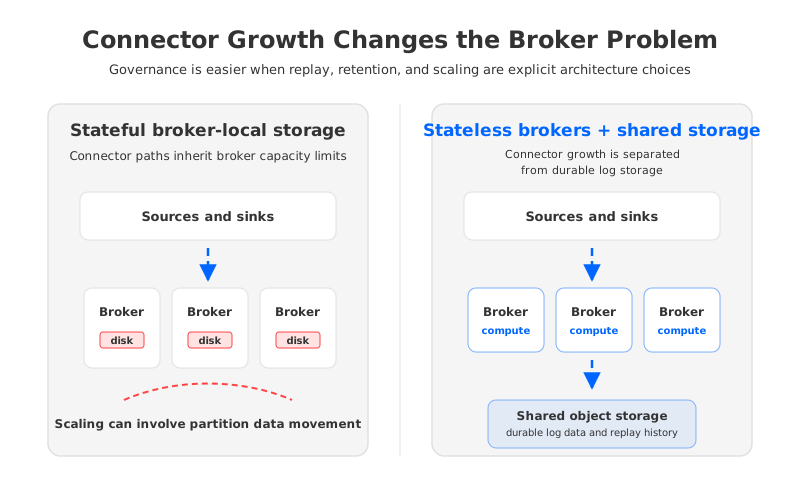
Traditional Kafka's shared-nothing architecture makes data placement explicit. Brokers store partition logs on local disks, replicate those logs across brokers, and serve reads from broker-owned storage. This model gives operators direct control over topic partitions, replication, and retention. It also means integration growth is not abstract: more connector paths often mean more topics, more retained history, more replication, and more broker capacity pressure.
Connector-heavy platforms stress Kafka in a specific way. Source connectors increase write load and may require long retention for replay. Sink connectors increase read fan-out and can create lag when target systems throttle. Derived connector paths multiply topics and access rules. During recovery, several connectors may read historical data and write catch-up traffic at the same time. The platform feels this as a storage, network, and partition-management problem.
Tiered storage can reduce pressure from older log segments by moving colder data to object storage. That helps with long retention and historical reads, but it does not fully remove the operational coupling between active broker capacity, hot data, partition placement, and connector recovery windows.
The governance implication is straightforward: if each new connector creates its own topic, retention rule, and recovery assumption, the Kafka cluster gradually inherits those one-off decisions. Retrofitting governance into a sprawling connector estate is much harder than rejecting unclear contracts at creation time.
4A Vendor-Neutral Connector Governance Framework
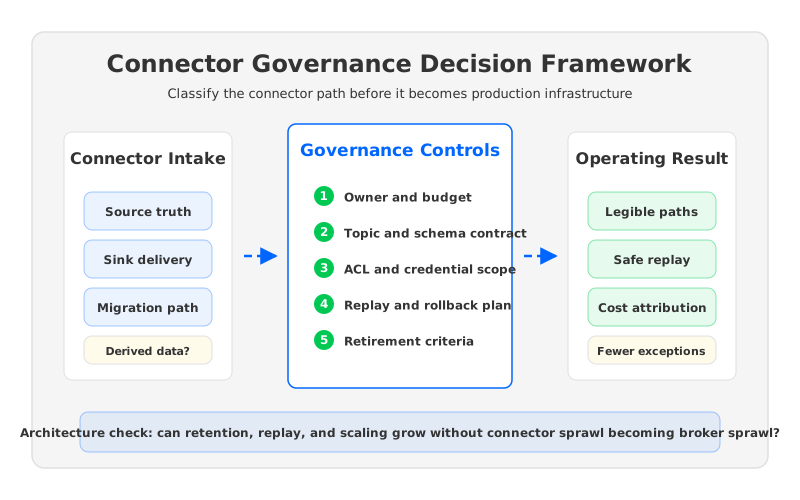
The cleanest governance model starts with classification. Every proposed connector path should be assigned a purpose before a worker is deployed. That purpose determines the review path, operating requirements, and infrastructure expectations.
Four categories cover most estates:
- Source-of-truth ingestion. These connectors bring authoritative changes into Kafka. They need strong source ownership, schema rules, offset discipline, and replay plans.
- Operational sink delivery. These connectors move events into search indexes, data warehouses, object storage, monitoring systems, or downstream services. They need idempotency, backpressure handling, and target-system failure rules.
- Migration and backfill paths. These connectors are temporary but risky. They need time-bounded ownership, clear cutover criteria, and explicit cleanup dates.
- Derived-data publication. These paths publish enriched, masked, or product-ready streams. They should be governed as data products, not casual connector side effects.
Classification is only the first layer. The platform also needs a lifecycle control plane. Connector creation should require a named owner, topic contract, credentials boundary, expected throughput profile, retention requirement, and failure policy. Connector changes should be reviewed according to blast radius. Connector retirement should be normal because stale connectors are often the quietest source of risk.
For production teams, the practical decision flow is simple but strict:
- Define whether the connector moves source truth, derived data, temporary migration data, or sink delivery.
- Bind the connector to explicit topics, schemas, ACLs, and ownership metadata.
- Decide how replay works before production traffic starts.
- Model scaling pressure across connector workers, brokers, storage, and downstream systems.
- Establish retirement criteria so temporary exceptions do not become permanent infrastructure.
This is where many teams realize that "governance" is mostly a platform architecture problem. The approval workflow is visible, but the hard work is making sure Kafka can honor the contract when traffic spikes, a source system changes, or a sink falls behind.
5Where AutoMQ Changes the Operating Model
After the governance model is clear, the next question is whether the Kafka architecture makes those rules easier or harder to enforce. If broker-local storage is the bottleneck for retention, replay, and scaling, connector governance keeps bumping into infrastructure limits.
AutoMQ is a Kafka-compatible, cloud-native streaming platform that separates broker compute from shared storage on object storage. Brokers are designed to be stateless from the perspective of long-lived log storage, while durable data is kept in a shared storage layer. AutoMQ documents this as a shared-storage architecture, with write-ahead log options and S3Stream shared streaming storage as core parts of the design.
That architecture does not remove the need for connector governance. It changes which constraints dominate the discussion. Longer retention and replay-heavy recovery no longer have to be planned only around broker-local disk capacity. Broker scaling can be evaluated more independently from durable log storage.
For connector-heavy environments, the distinction matters in three places:
- Replay and recovery. Governance can require longer replay windows without tying every historical byte to broker-local disks. Teams still need idempotent sinks and offset discipline, but retained history becomes less entangled with broker storage sizing.
- Elasticity. Connector recovery and backfills can be planned around stateless broker scaling and shared storage behavior rather than large local-data movement events.
- Deployment boundary. AutoMQ can be evaluated by teams that want Kafka-compatible APIs while keeping deployment and data control within their own cloud environment, depending on the selected deployment model.
This is not a reason to approve every connector request. It is a reason to separate two decisions that often get mixed together: whether a connector path should exist, and how expensive or disruptive that path will be to operate.
6Production Readiness Checklist
The best time to catch pipeline sprawl is before a connector becomes a dependency. A lightweight request form is useful only if it asks the questions that affect production behavior.
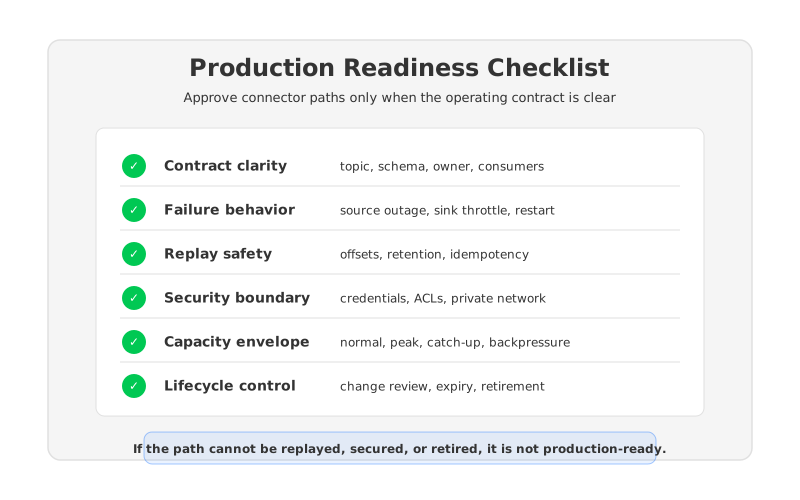
Use the following checklist for any connector path that touches production data:
- Contract clarity. Name the source system, target topics or sinks, schema owner, expected consumers, and whether the connector publishes raw, transformed, or product-ready data.
- Failure behavior. Define what happens when the source is unavailable, the sink throttles, the connector restarts, or the Kafka cluster is recovering.
- Replay safety. Verify offsets, retention, snapshots, and idempotency together. A replay plan that only covers Kafka offsets is incomplete if the sink cannot tolerate duplicates.
- Security and privacy. Bind connector credentials, Kafka ACLs, network paths, and sensitive-field handling to the same review process.
- Capacity envelope. Record normal throughput, peak throughput, catch-up behavior, retention, and downstream backpressure expectations.
- Lifecycle control. Require change review, observability, owner rotation, and retirement criteria. Temporary connectors should have expiration dates.
This checklist is intentionally operational. It asks whether the platform can operate the path after the original requester has moved on.
7Decision Table for Platform Teams
Platform teams usually have three choices when connector sprawl is already visible: tighten governance on the existing Kafka estate, redesign parts of the integration architecture, or evaluate a different Kafka-compatible operating model. The right move depends on where the pain is concentrated.
| If the dominant problem is... | Prefer this action | Why |
|---|---|---|
| Unclear ownership and stale connectors | Governance cleanup on the current estate | Architecture changes will not fix missing owners or undefined lifecycle rules. |
| Too many derived topics from connector-side transformations | Redesign contracts and move complex logic into explicit processing jobs | Derived data should be governed as a data product, not hidden inside connector configuration. |
| Replay and retention pressure from source and sink recovery | Revisit storage architecture and retention strategy | Longer replay windows need durable storage economics that match operational expectations. |
| Scaling events tied to broker-local data movement | Evaluate cloud-native Kafka-compatible architecture | Decoupling broker compute from shared storage can reduce the operational coupling that makes recovery windows painful. |
| Migration risk across many private connector paths | Classify and retire exceptions before platform migration | A smaller, governed connector estate is easier to move than a larger undocumented one. |
Kafka connector governance is not about saying no to integration. It is about making every approved integration legible enough to operate. If your platform team is evaluating whether the underlying Kafka architecture is part of the bottleneck, review AutoMQ's shared-storage architecture and deployment options as one Kafka-compatible path to compare against your current model: AutoMQ Architecture and S3Stream Shared Streaming Storage.
8References
- Apache Kafka Documentation
- Apache Kafka Connect Documentation
- Apache Kafka Consumer Documentation
- Apache Kafka Authorization and ACLs
- AutoMQ Architecture Overview
- AutoMQ S3Stream Shared Streaming Storage
9FAQ
9.1What is Kafka connector governance?
Kafka connector governance is the operating model for approving, owning, securing, observing, changing, replaying, and retiring connector paths around Kafka. It covers the connector process, the Kafka topics it touches, the schemas and ACLs it depends on, and the downstream systems that rely on its data.
9.2Is connector governance only about Kafka Connect?
No. Kafka Connect is an important part of the connector ecosystem, but governance also applies to custom ingestion services, CDC tools, sink integrations, stream processing outputs, and temporary migration paths. The common question is whether a data path is safe to operate as a production dependency.
9.3How do teams reduce connector sprawl?
Start by classifying every connector path by purpose: source-of-truth ingestion, sink delivery, migration/backfill, or derived-data publication. Then attach ownership, schema, ACL, replay, capacity, and lifecycle rules to each category. Retire stale paths aggressively; governance that never deletes anything only slows the growth of sprawl.
9.4When should connector-side transformation be avoided?
Avoid connector-side transformation when the output becomes a shared data product, requires complex state, needs auditability, or affects multiple downstream consumers. Use an explicit processing layer with versioned logic, observability, and ownership instead.
9.5Where does cloud-native Kafka architecture help?
Cloud-native Kafka architecture helps when connector governance is constrained by retention, replay, scaling, and broker-local storage pressure. A shared-storage Kafka-compatible model such as AutoMQ can make those constraints easier to reason about while preserving Kafka APIs.


