
Table of Contents
Table of Contents
Teams rarely search for kafka connector observability because a dashboard is missing. They search for it after a shared integration platform has become important enough that a connector failure looks like a business incident. A Snowflake sink falls behind, a CDC source restarts from the wrong position, a schema change breaks downstream parsing, or an object storage sink keeps retrying while the Kafka cluster itself looks healthy. The uncomfortable part is that every owner can be telling the truth: Kafka is up, the connector worker is alive, the database is accepting reads, and the warehouse is available. The pipeline is still broken.
That is why connector health telemetry has to be treated as a platform design problem, not as a set of connector-local metrics. Kafka Connect already exposes worker and task metrics, and the Kafka ecosystem gives teams familiar concepts such as offsets, consumer groups, lag, and topic-level throughput. The difficult work is turning those signals into a shared operating model for producers, connectors, stream processors, warehouse teams, and SREs.
1Why Teams Search for kafka connector observability
The search usually starts when Kafka becomes the integration layer between many teams. One group owns application events, another owns CDC, another owns governance, and another owns the sink into analytics or AI systems. Connectors sit at the boundary between those teams, which makes them easy to underestimate. They are operational software, but they are also contracts: topic names, schemas, offsets, retry rules, dead-letter queues, credentials, and external system quotas all meet inside the connector runtime.
The first observability mistake is to monitor the connector in isolation. Worker CPU, task state, and restart count matter, but they do not explain whether a source connector is reading the expected change volume or whether a sink connector is applying records at the right business boundary. A healthy connector task can be stuck behind a rate limit, while a failed task can be harmless during a planned pause.
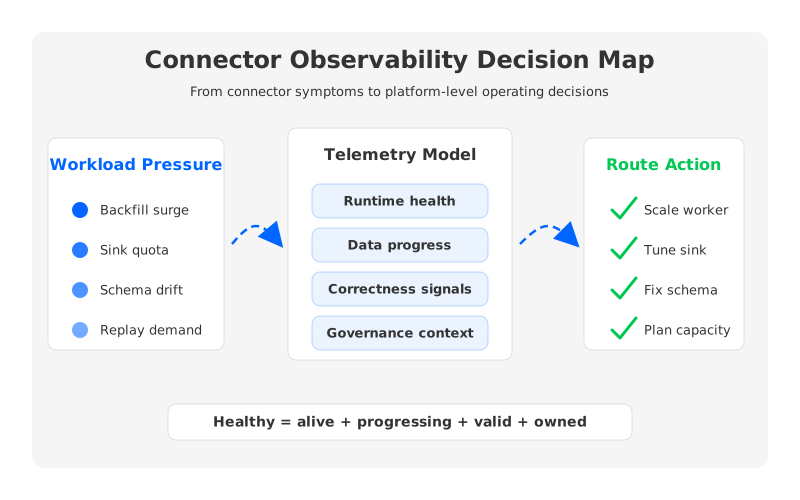
Useful telemetry separates four questions that often get mixed together:
- Is the runtime alive? Worker availability, task status, rebalance behavior, restart count, and error rate show whether the connector process can run.
- Is data making progress? Source offsets, sink offsets, consumer group lag, throughput, retry backlog, and commit latency show whether the pipeline is advancing.
- Is the data still valid? Schema compatibility, transformation errors, serialization failures, and dead-letter queue volume show whether records still match downstream expectations.
- Is the platform boundary under control? Credential expiry, network path, external quota, ownership tags, and deployment approvals show whether the connector can be operated safely by more than one team.
Those questions are broader than a connector dashboard. They force the platform team to define what "healthy" means across Kafka, the connector runtime, the external system, and the owning team. Without that definition, alerting becomes noisy in one direction and blind in another: too many task-state alerts during safe restarts, too few data-quality alerts when records are silently routed to a dead-letter topic.
2The Integration Constraint Behind the Pipeline
Traditional Kafka operations were built around brokers that own local durable log segments. That Shared Nothing architecture is well understood and still a strong fit for many environments. It also shapes the operational pressure around a shared connector platform. When retention grows because sink teams need replay windows, broker-local storage grows. When throughput grows because more connectors share a cluster, broker CPU, disk, network, and partition placement become tied together.
Connector workloads make that coupling more visible than ordinary application traffic. A backfill can create a write surge from a source connector. A replay can create heavy reads for a sink connector. A stuck downstream system can push records into retry paths, dead-letter topics, or long-lived lag. A platform team may be trying to solve a connector problem, but the underlying bottleneck can sit in broker disk, cross-zone replication traffic, partition skew, or consumer group behavior.
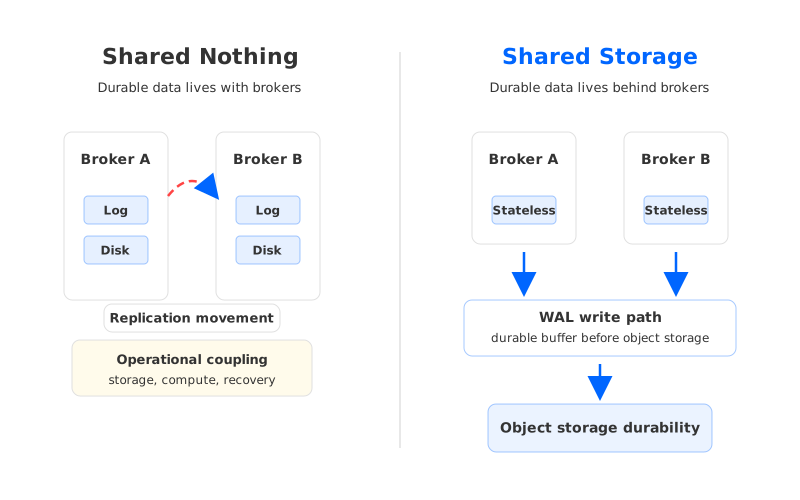
The operational constraint is not that Kafka cannot run connectors. It can, and Kafka Connect is a standard way to integrate external systems. The constraint is that a shared integration platform turns connector health into a cluster-wide capacity and governance question. A task restart is local; a replay window is not. A source connector may be owned by one team, but the retained topic data, broker capacity, and downstream read fanout are shared platform resources.
Observability therefore needs architecture signals alongside connector signals. A connector platform should show how a task maps to topics, partitions, consumer groups, external endpoints, credentials, and replay policies. It should also show which part of the streaming layer is under pressure. If storage, compute, and network are hidden behind a single cluster health label, the team cannot tell whether to add workers, tune connector parallelism, adjust topic retention, or revisit the cluster architecture.
3Connector, Schema, Replay, and Stream Processing Trade-Offs
Connector health is also a data contract problem. A source connector can emit records according to its own configuration while downstream consumers fail because the schema changed in a way nobody approved. A sink connector can keep retrying because a warehouse table changed shape. A stream processing job can amplify the issue by consuming from the source topic, writing enriched records to another topic, and creating a second set of connector dependencies downstream. The connector is the visible symptom, but the contract spans the whole pipeline.
A production telemetry model should make those dependencies explicit. Connector metrics belong beside schema compatibility status, consumer group lag, dead-letter queue volume, and downstream write acknowledgement. For some teams, the natural unit is the connector. For others, it is the data product: source topic, transformations, sink connector, owning team, and service-level objective.
The trade-offs are clearest during replay. Retention and replay make Kafka valuable for recovery, backfill, and downstream rebuilds, but they also create operational load. Long retention increases storage pressure. Heavy replay increases read pressure. Multiple sink teams replaying at once can make connector health look bad even when each connector is behaving according to its configuration.
| Telemetry layer | Signal to collect | Why it matters |
|---|---|---|
| Connector runtime | Worker status, task state, rebalance count, task restart history | Separates process failure from expected rolling operations |
| Data progress | Source offset, sink offset, consumer group lag, write throughput, retry backlog | Shows whether records are moving at the expected pace |
| Data correctness | Serialization errors, schema compatibility, transform failures, dead-letter queue volume | Detects pipelines that are alive but producing unusable output |
| Platform capacity | Broker throughput, partition skew, storage growth, network saturation, replay read pressure | Prevents connector incidents from being misdiagnosed as worker-only issues |
| Governance | Owner, credential expiry, change approval, endpoint policy, retention policy | Turns shared connectors into accountable platform assets |
The operating implication is substantial. A connector team should not have to infer broker pressure from scattered infrastructure charts, and an SRE should not have to inspect connector configs to understand which business pipeline is at risk. Good telemetry gives both teams the same map with different levels of detail.
4Evaluation Checklist for Data Platform Teams
Before choosing tooling or changing infrastructure, define the evaluation boundary. A connector platform is not only a Connect cluster. It includes Kafka compatibility, topic design, schema governance, security, cloud network paths, migration behavior, and team ownership. The strongest evaluation starts with current failure modes and asks whether the platform gives operators the right control points.
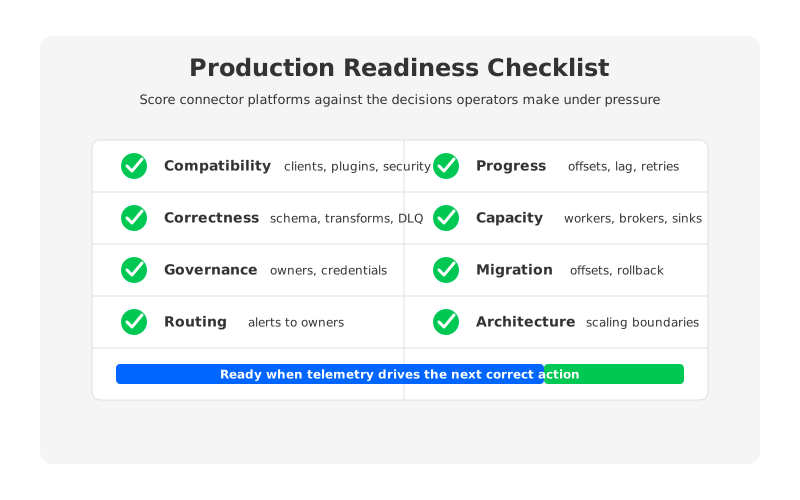
Use this checklist as a practical starting point:
- Compatibility: Validate the Kafka client versions, connector plugins, converter settings, security protocols, transactions, consumer group behavior, and offset expectations that matter to the estate. Compatibility is not a yes-or-no label; it is a workload-specific test matrix.
- Progress semantics: Define how source offsets, sink commits, consumer lag, and dead-letter routing are interpreted during steady state, backfill, and recovery. Alert rules should understand the difference between planned replay and stuck progress.
- Capacity isolation: Decide whether connector workers, Kafka brokers, external systems, and stream processors have separate scaling levers. If one lever controls too many resources, the platform will overprovision for rare peaks or underperform during incidents.
- Governance boundary: Attach owners, credentials, endpoints, schema subjects, retention policies, and change approval records to each production connector. A shared integration platform without ownership metadata becomes a shared blame platform.
- Migration and rollback: Test how connector offsets, topic data, schemas, and consumers move during a cluster migration. A rollback plan that ignores offsets is not a rollback plan; it is a second migration under stress.
- Observability workflow: Put connector metrics, Kafka metrics, external system metrics, logs, and incident annotations in one routeable workflow. The real test is whether the on-call engineer can decide who owns the next action.
This framework keeps product evaluation honest. A managed connector feature may reduce worker operations while leaving the Kafka storage model unchanged. A managed Kafka service may reduce broker maintenance while leaving connector ownership and schema governance to the customer. A cloud-native Kafka-compatible platform may change the cluster operating model while still requiring teams to validate connector plugins, downstream quotas, and alert routing.
5How AutoMQ Changes the Operating Model
After the neutral checklist is defined, AutoMQ becomes relevant as a Kafka-compatible cloud-native streaming platform that changes the storage and elasticity layer underneath familiar Kafka APIs. Connector metrics do not disappear. Shared Storage architecture changes which parts of the platform are coupled to broker-local data, and that changes how teams reason about connector spikes, replay windows, and recovery.
AutoMQ replaces traditional broker-local durable storage with a Shared Storage architecture built around stateless brokers, WAL storage for the write path, and object-storage-backed durability. Producers, consumers, topics, partitions, and offsets remain in the Kafka-compatible operating model, while durable stream data is no longer bound to a specific broker's local disk. For connector-heavy environments, that distinction matters because retention and replay capacity no longer have to make every broker operation feel like a storage migration.
The architectural shift does not remove the need for connector telemetry. It makes the telemetry easier to interpret. If a sink connector falls behind, the platform team can look at connector task health, consumer group lag, WAL behavior, object storage access, cache behavior, broker compute, and downstream quota as separate signals. If retention grows for replay or audit, the team can evaluate object-storage-backed durability separately from broker fleet sizing.
AutoMQ's commercial deployment models also matter for shared integration platforms. AutoMQ BYOC is designed for customer-controlled cloud boundaries, while AutoMQ Software targets customer-operated private environments. For regulated teams, connector observability is also about where data, credentials, logs, and administrative actions live. A platform that keeps Kafka compatibility while fitting the customer's cloud boundary can reduce the organizational change required to improve the operating model.
Migration deserves the same sober treatment. AutoMQ provides Kafka Linking in commercial editions for migration scenarios that need byte-to-byte data synchronization and consumer progress handling. That can be valuable when connector offsets, downstream consumers, and rollback paths matter as much as topic data. It should still be tested with the actual connector plugins, source systems, sink systems, schemas, and security settings in production.
6A Practical Connector Health Scorecard
The end state is not a prettier dashboard. It is a platform where connector health telemetry helps teams make decisions before incidents spread. A production scorecard should combine connector runtime state, data progress, correctness, capacity, and governance into routeable outcomes. "Connector failed" routes to the connector owner. "Progress stalled because downstream quota is exhausted" routes to the sink owner and platform team.
Start with five scorecard questions:
- Can we tell whether each connector is alive, progressing, and producing valid data?
- Can we map each connector to topics, consumer groups, schemas, credentials, owners, and downstream systems?
- Can we distinguish connector worker pressure from Kafka broker pressure and external system pressure?
- Can we replay or backfill without hiding the impact on shared capacity?
- Can we migrate or roll back without losing the meaning of offsets and consumer progress?
Those questions are operational. They do not ask whether the platform has a long feature list. They ask whether the platform helps the team make the next correct decision under pressure. For Kafka connector observability, that is the difference between monitoring software and running a shared integration platform.
When connector health is the signal that your Kafka estate has become a shared integration platform, evaluate both telemetry and architecture. Review AutoMQ's Kafka-compatible Shared Storage model, then test it against the connector workloads that create the most operational pressure in your environment: start with AutoMQ.
7References
- Apache Kafka documentation: Kafka Connect
- Apache Kafka documentation: Kafka Connect monitoring
- Confluent Platform documentation: Monitoring Kafka Connect
- Prometheus documentation: Metric and label naming
- AutoMQ documentation: Apache Kafka compatibility
- AutoMQ documentation: Shared Storage architecture
- AutoMQ documentation: Monitoring and alerts with Prometheus
8FAQ
8.1What is Kafka connector observability?
Kafka connector observability means monitoring runtime health, data progress, correctness, platform capacity, and governance together. It goes beyond task status by asking whether records are moving correctly through Kafka, connector workers, schemas, external systems, and owning teams.
8.2Which metrics matter most for Kafka Connect?
Task state, worker availability, restart count, error rate, offset progress, consumer group lag, retry backlog, dead-letter queue volume, throughput, and external acknowledgement latency are usually the core signals. The exact set depends on whether the connector is a source, sink, CDC pipeline, object storage pipeline, or warehouse integration.
8.3How is connector lag different from consumer lag?
Consumer lag measures how far a consumer group is behind the latest records in Kafka. Connector lag can also include source-system read lag, retry backlog, external write delays, and data-quality failures. A connector can be running while business progress is stalled.
8.4Does Shared Storage architecture replace connector monitoring?
No. Shared Storage architecture separates durable data from broker-local disks, but connector runtime health, offsets, schemas, retries, and external dependencies still need direct telemetry. The benefit is clearer separation between connector pressure, broker compute pressure, storage behavior, and replay capacity.
8.5Where does AutoMQ fit in a connector observability strategy?
AutoMQ fits after a team has defined telemetry and operating requirements. It is a Kafka-compatible cloud-native streaming platform with Shared Storage architecture, stateless brokers, WAL storage, and object-storage-backed durability. Teams should evaluate it when connector-heavy workloads need Kafka compatibility, independent compute and storage scaling, clearer recovery behavior, and customer-controlled deployment boundaries.


