
Table of Contents
Table of Contents
Teams usually search for connector migration gates kafka after the first migration plan becomes too neat. The platform looks Kafka-compatible on paper. Producers can be pointed at a new bootstrap endpoint. Consumers can be moved group by group. Then the connector estate appears: JDBC sources with fragile polling windows, Debezium tasks with history topics, sinks that batch into warehouses, schema dependencies, secret rotation, dead-letter topics, and years of offset state that no one wants to rediscover during a cutover.
Connector migration is where a streaming platform move stops being a broker replacement and becomes a production systems exercise. The risk is not only whether the new platform accepts Kafka protocol traffic. The risk is whether every source and sink can preserve ordering assumptions, replay boundaries, failure semantics, credentials, observability, and rollback paths while the business keeps writing and reading data.
That is why the right unit of planning is a gate, not a checklist item. A gate is a decision point with evidence: this part of the connector system is ready to move, this part is not, and this is the smallest reversible step that can prove it.
1Why teams search for connector migration gates kafka
Connector-heavy Kafka estates carry state in more places than the broker log. Kafka Connect has internal topics for connector configuration, offsets, and task status. CDC tools can add their own schema history topics or source-position metadata. Sink connectors may keep external checkpoints in target systems. Consumers that sit downstream of sink topics may depend on the exact timing of writes, compaction, tombstones, and retries.
This creates a migration problem with two different clocks. The infrastructure team wants a predictable window for moving traffic. The data integration team wants proof that every connector can resume from the right point after a pause, replay, or failure. Both clocks matter, but the second one is usually harder because it is tied to business data contracts rather than cluster topology.
A practical migration gate therefore answers four questions before traffic moves:
- Can the connector start on the target platform without semantic drift? The test should include connector configuration, required internal topics, ACLs, serialization, schema compatibility, and any transaction or idempotent producer assumptions.
- Can it stop and resume from a known point? Offsets, source positions, sink acknowledgements, and dead-letter behavior should be tested with planned restarts and unplanned task failures.
- Can operators see the same failure signals? Lag, task state, retry rate, throughput, consumer group health, and target-system errors should be visible in dashboards and alerts before the connector owns production traffic.
- Can the team roll back without data loss or duplicate damage? Rollback does not mean "go back somehow." It means a documented, tested path that defines which system is authoritative at every step.
These gates feel conservative, but they are what let teams move quickly later. Once the high-risk connector classes are categorized and tested, the rest of the migration becomes a controlled sequence rather than a heroic weekend.
2The operational constraint behind connector-heavy platforms
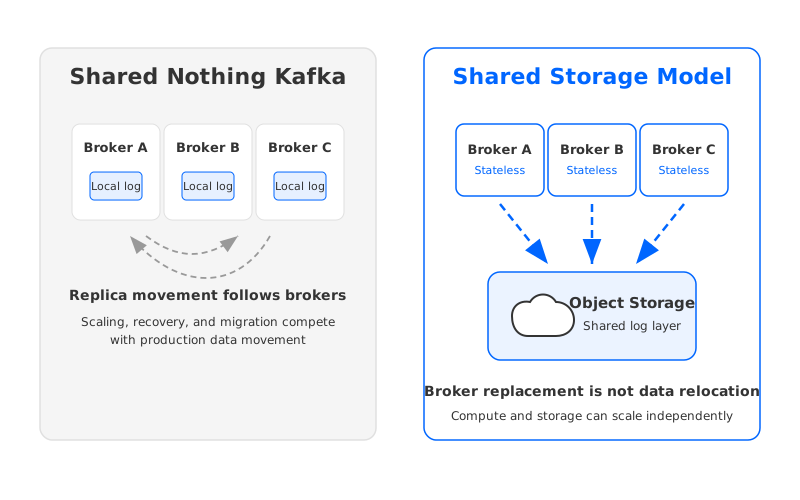
Traditional Kafka was designed around a shared-nothing broker model. Each broker owns local log segments, participates in replication, and uses local disks as part of the durability path. This model is robust and well understood, but it shapes migration behavior in a very specific way: moving capacity, changing broker layout, or replacing a cluster often means moving data between brokers and carefully managing replica placement.
For connector-heavy environments, this storage model shows up as operational pressure. Connectors are long-lived clients. They often create steady write and read streams rather than short bursts. When a migration requires dual writes, mirrored topics, replay windows, or temporary overprovisioning, the broker-local storage layer becomes part of the migration budget. Teams need enough disk headroom, network capacity, and broker CPU to run the existing workload and the migration workload at the same time.
The constraint is not only cost. Broker-local storage also affects failure recovery. If a broker or availability zone fails during a migration, replicas may need to catch up while connectors are already under controlled replay. Every extra data movement path competes for the same resources that production traffic needs.
Cloud deployment makes this trade-off sharper. A Kafka cluster spread across availability zones can incur inter-zone traffic when replicas, leaders, consumers, or connectors cross zone boundaries. The exact cost depends on the cloud provider and deployment pattern, but the mechanism is straightforward: data that crosses a billable network boundary becomes part of the operating model. Connector migrations frequently amplify that traffic because they introduce extra readers, writers, mirror paths, or validation jobs.
None of this means shared-nothing Kafka is wrong. It means connector migration gates should account for the architecture underneath the API. Compatibility at the client protocol layer is necessary, but the migration will be governed by storage movement, network topology, recovery behavior, and the amount of operational slack available during the transition.
3Failure handling, schema, and replay trade-offs
Connector failures are rarely binary. A source connector can keep running while silently lagging behind the source database. A sink connector can acknowledge Kafka records before the target system makes them queryable. A CDC connector can preserve offsets while a schema change makes downstream consumers reject messages. The broker migration plan can be flawless and still fail the business outcome if these behaviors are not tested as first-class gates.
The most useful way to classify connectors is by replay tolerance. Some pipelines can replay hours of data because writes are idempotent and downstream consumers deduplicate by primary key. Others cannot tolerate even small duplicate windows because the sink triggers payments, notifications, or irreversible side effects. A connector migration strategy that treats both classes the same is pretending that all Kafka topics have the same business semantics.
| Gate | Evidence to collect | Common failure found |
|---|---|---|
| Compatibility | Connector version, Kafka client settings, internal topics, ACLs, serialization, schema registry access | Connector starts but internal topics or credentials are incomplete |
| Resume | Planned restart, task failure, offset restore, source-position validation | Task resumes from an unexpected point or stalls on history metadata |
| Replay | Duplicate-window test, idempotency check, target reconciliation query | Sink accepts duplicates or changes event order under retry |
| Rollback | Authority boundary, DNS or bootstrap switch plan, topic freeze rule | Teams can roll back clients but not external sink state |
| Observability | Lag, task state, retry count, throughput, dead-letter rate, target errors | Existing dashboards show broker health but not connector correctness |
Schema handling deserves its own gate because connector migrations often surface hidden coupling. A schema registry endpoint, converter setting, or subject naming strategy may be treated as plumbing until a sink connector writes a different envelope shape. CDC pipelines are even more sensitive because source schema evolution, tombstones, compaction, and transaction boundaries can all affect what downstream systems consider a valid change stream.
The replay gate should include a small but representative dataset with known outcomes. A CDC source can emit inserts, updates, deletes, schema changes, and a transaction that spans multiple rows. The target system should then be reconciled against expected state, not only checked for "records arrived."
4Evaluation checklist for platform teams
A platform move should not begin with the question "Which Kafka-compatible endpoint can my clients reach?" It should begin with the question "Which operational guarantees does this connector estate depend on?" The answer usually spans API compatibility, storage architecture, cloud networking, security boundaries, and team ownership.
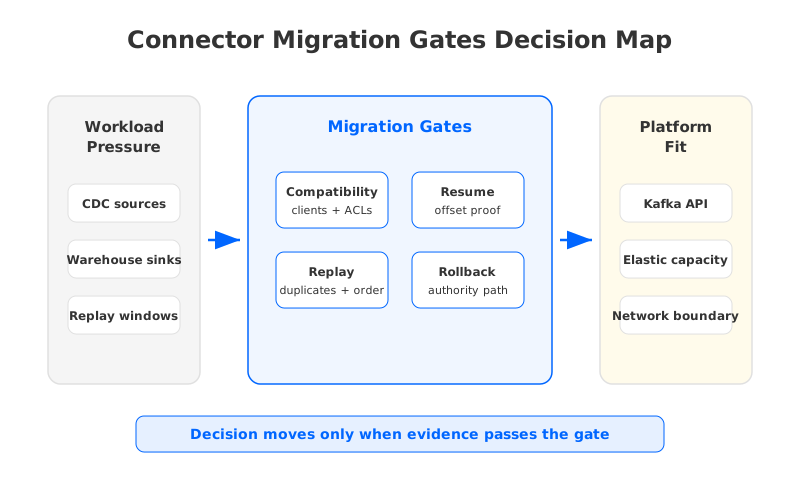
Use the following checklist as a gate design tool rather than a one-time audit:
| Evaluation area | Gate question | Pass signal |
|---|---|---|
| API and client compatibility | Do connector clients, producers, consumers, and admin operations behave as expected? | Test connectors run against the target endpoint using production-like configs |
| State and offsets | Are Connect internal topics and CDC metadata accounted for? | Restart and resume tests show deterministic source and sink positions |
| Cost and capacity | Can the migration run without starving production traffic? | Headroom model includes dual reads, validation jobs, replay, and retention overlap |
| Network topology | Are cross-zone, PrivateLink, VPC, and target-system paths explicit? | Traffic paths are mapped before cutover, including rollback paths |
| Governance | Are ACLs, secrets, audit logs, and schema ownership preserved? | Security review covers both Kafka resources and external systems |
| Observability | Can teams detect connector correctness failures, not only broker failures? | Dashboards and alerts include connector lag, task state, retries, DLQ, and sink errors |
| Rollback | Is there a tested path back to the previous authority? | Rollback runbook defines write freeze, offset handling, and target reconciliation |
The key is to keep the gate tied to evidence. "The connector is compatible" is not evidence. "The connector recovered from a killed task, resumed from offset X, wrote the expected rows to the target, and emitted the expected lag and retry metrics" is evidence. That level of specificity is what separates migration planning from migration hope.
5How AutoMQ changes the operating model
Once the migration gates expose where risk comes from, the architecture requirement becomes clearer. Connector-heavy platforms need Kafka-compatible behavior, but they also need a storage model that reduces unnecessary data movement during scaling, recovery, and migration windows. This is where cloud-native Kafka-compatible systems with shared storage deserve evaluation.
AutoMQ is a Kafka-compatible streaming platform that separates broker compute from durable storage. Instead of binding long-term log durability to broker-local disks, AutoMQ uses object storage as the shared persistence layer and keeps brokers stateless in the operating model. The practical implication for migration planning is not "connectors need no testing." They still need rigorous gates. The implication is that capacity changes, broker replacement, and recovery paths are less entangled with moving large volumes of broker-local data.
That shift matters during connector migration. A connector estate often needs temporary overlap: old and new paths, validation consumers, replay jobs, and extended retention while teams prove correctness. When compute and storage scale independently, the platform team can reason about these temporary workloads without treating every broker adjustment as a storage relocation event. AutoMQ's architecture also targets reduced cross-AZ traffic by keeping broker access and storage paths aligned with cloud object storage patterns, which is relevant when migration validation multiplies reads and writes across zones.
Deployment boundaries matter as much as storage mechanics. Many connector systems sit inside private networks near databases, warehouses, SaaS endpoints, or compliance-controlled data stores. AutoMQ supports deployment models such as BYOC and software deployment, so teams can evaluate Kafka-compatible migration without assuming that sensitive connector traffic must leave their controlled network boundary.
AutoMQ should still be evaluated through the same gates as any other platform. Test the connector versions you actually run. Validate internal topics and ACLs. Kill tasks. Reconcile sink state. Measure lag under replay. The difference is that shared storage and stateless brokers give platform teams another dimension to optimize: they can reduce the operational coupling between connector migration and broker-local storage movement.
6A practical migration sequence
The safest connector migration plans start narrow and become boring. Pick one low-risk connector class first, preferably a sink with idempotent writes and a target system that supports reconciliation. Move it through every gate with test data realistic enough to exercise schema evolution, retries, tombstones, and offset recovery.
After that first pass, group connectors by risk rather than team ownership. CDC sources with schema history and strict source-position semantics belong together. Idempotent analytics sinks belong together. Side-effecting sinks belong in their own class.
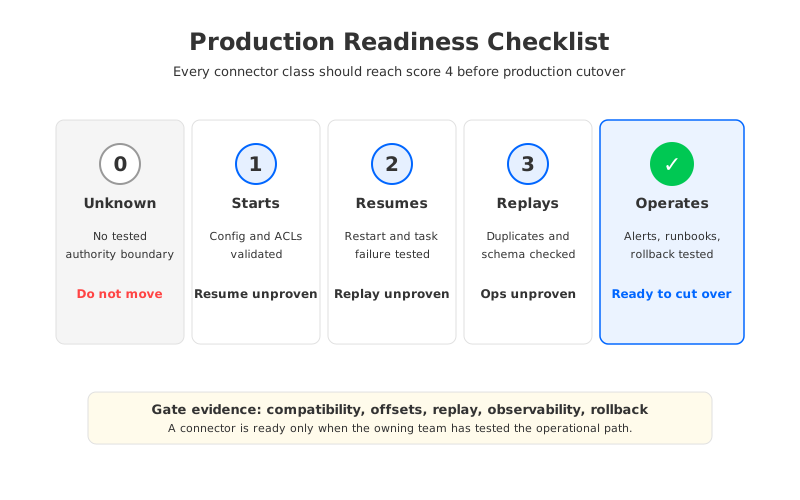
The readiness scorecard should be simple enough to use in an incident review:
| Score | Meaning | Action |
|---|---|---|
| 0 | Unknown | Do not migrate. Build a test case and identify the authority boundary. |
| 1 | Starts | Connector can start on the target platform, but resume and rollback are unproven. |
| 2 | Resumes | Restart and task-failure tests pass with known offsets or source positions. |
| 3 | Replays | Duplicate, retry, schema, and target reconciliation tests pass. |
| 4 | Operates | Dashboards, alerts, runbooks, and rollback have been tested by the owning team. |
A platform team can require every connector class to reach score 4 before production cutover, while allowing individual connectors to move once their class gate is proven.
Connector migration gates are not bureaucracy. They are a way to protect the parts of Kafka that users rarely see but always depend on: offsets, ordering, replay, schema, and operational ownership. When those gates are explicit, a Kafka-compatible platform move becomes a series of reversible decisions. When they are implicit, the migration is really a bet that every connector behaves the way the spreadsheet says it does.
If your next platform decision includes connector-heavy CDC or sink workloads, start with the gates before choosing the cutover date. AutoMQ's Kafka-compatible shared-storage architecture is worth evaluating in that process, especially when migration risk is tied to broker storage movement, cloud network cost, and customer-controlled deployment boundaries. The next useful step is to review the AutoMQ deployment overview and map it against your connector gate scorecard.
7References
- Apache Kafka documentation: Kafka Connect
- Apache Kafka documentation: Consumer configuration
- Apache Kafka documentation: Transactional messaging semantics
- Apache Kafka documentation: KRaft
- Apache Kafka documentation: Tiered Storage
- AutoMQ documentation: Compatibility with Apache Kafka
- AutoMQ documentation: Architecture overview
- AutoMQ documentation: Eliminate inter-zone traffic
- AWS documentation: Global network FAQs
- AWS documentation: AWS PrivateLink concepts
8FAQ
8.1What are connector migration gates in Kafka?
Connector migration gates are evidence-based checkpoints used before moving Kafka Connect, CDC, source, or sink workloads to a new Kafka-compatible platform. A gate usually proves compatibility, offset handling, replay behavior, observability, and rollback for a connector class.
8.2Is Kafka protocol compatibility enough for connector migration?
No. Kafka protocol compatibility is necessary, but connector migration also depends on internal topics, ACLs, schemas, offsets, source-position metadata, retries, target-system semantics, and operational visibility.
8.3Should Kafka Connect internal topics be migrated?
They must at least be accounted for. Some migrations move internal topics, while others recreate connectors and restore offsets or source positions through controlled procedures. The right approach depends on connector type, risk tolerance, and rollback design.
8.4How should CDC connectors be tested before migration?
Test inserts, updates, deletes, schema changes, task failures, restarts, and replay windows. Then reconcile the target system against expected state rather than only checking that messages arrived.
8.5Where does AutoMQ fit in a connector-heavy Kafka migration?
AutoMQ fits after the team has defined neutral migration gates and wants to evaluate whether shared storage, stateless brokers, Kafka compatibility, and customer-controlled deployment boundaries can reduce operational risk during the move.


