
Table of Contents
Table of Contents
Connector secrets rotation looks like a security task until the first rotation touches production traffic. The password, token, certificate, or API key is a small string, but it sits inside a chain that includes Kafka Connect workers, source databases, sink services, schema registries, identity providers, audit systems, and downstream consumers that expect ordering and replay behavior to stay stable. For regulated teams, the rotation window is also an evidence window: the platform has to prove who changed the secret, which connector picked it up, whether tasks restarted, and whether any records were duplicated, skipped, or written with stale credentials.
That is why the search term connector secrets rotation kafka tends to come from teams already operating Kafka at scale. They are not asking whether secrets should rotate. They are trying to understand how to rotate secrets when connector tasks are stateful, external systems enforce their own credential lifetimes, and the streaming platform is part of a compliance boundary. A clean answer has to cover security, but it also has to cover offsets, backpressure, replay, rollback, and the cost of running spare capacity during controlled maintenance.
1Why Connector Rotation Is Harder Than Credential Hygiene
The uncomfortable part of connector secret rotation is that the connector does not own the full transaction. A source connector reads from an external system and commits progress into Kafka Connect offsets. A sink connector reads from Kafka and writes into a database, object store, warehouse, or SaaS API that may acknowledge writes differently from Kafka. When credentials change, the rotation can interrupt either side of that bridge. The failure mode is not limited to authentication failure; it can appear as task rebalance churn, partial batch writes, retries that amplify load, or lag that hides until the next SLA review.
Kafka Connect gives teams a framework for running source and sink connectors, distributed workers, connector configurations, and task status. It does not remove the need to design a rotation control plane around secrets, connector lifecycle, and audit evidence. A regulated platform usually needs at least four boundaries to line up:
- The secret manager must hold current and previous versions long enough for staged rollout and rollback.
- Connector workers must receive the updated reference without leaking secret values into logs or configuration history.
- Source and sink systems must accept a predictable overlap period or a planned cutover.
- Observability must distinguish authentication failure from normal task restart, rebalance, or downstream throttling.
The fourth point is where many teams underestimate the problem. A connector task that restarts during rotation can look healthy after a few seconds, while a sink system may still be rejecting a subset of writes with a scoped permission error. In regulated environments, the audit question comes later: can the team reconstruct exactly what happened without reading through leaked credentials or stitching together logs from five systems?
2The Operating Model Behind Connector-Heavy Kafka
Traditional Kafka deployments bind broker compute and durable log storage to broker-local disks. That model can work well, but it shapes how platform teams plan maintenance. If connector traffic spikes during rotation, the Kafka cluster may need broker headroom, local disk headroom, and network headroom at the same time. If the cluster is already close to a storage or partition movement threshold, a security operation can become a capacity event.
The issue is not that broker-local storage prevents secret rotation. The issue is that it adds another operational dependency to an already sensitive workflow. Connector tasks can create bursty read and write patterns during retries, backfills, and restarts. In a shared-nothing Kafka architecture, a credential rotation window can collide with broker recovery, cross-zone traffic, or local disk pressure in ways the security team did not model.
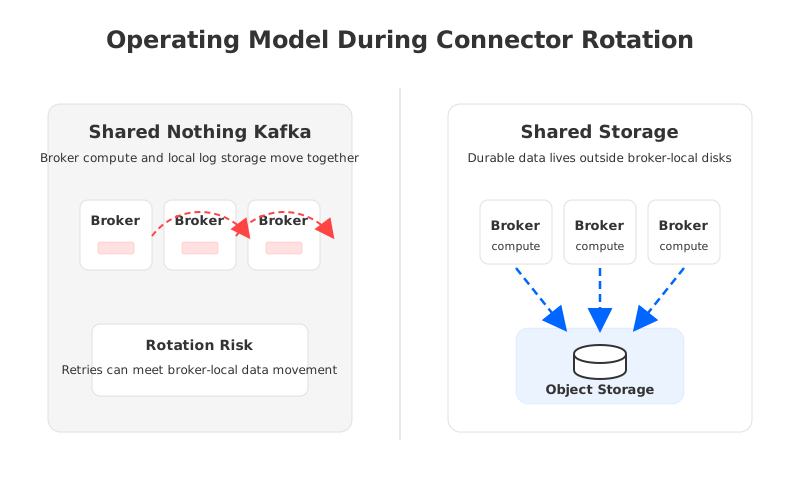
A healthier operating model treats connector rotation as a controlled change across two planes. The data plane must keep accepting and replaying records with stable Kafka semantics. The control plane must coordinate secret versions, connector restarts, worker configuration, audit logs, and rollback. These planes should influence each other through explicit signals, not through accidental resource contention.
The practical checklist starts with a boring question: what exactly changes during rotation? A connector that reads a secret by reference from a provider has a narrower audit surface than one with raw values embedded in connector properties. Certificate replacement has a different blast radius again because the rollout may involve truststore and keystore changes, not a single password update.
3A Rotation Architecture That Survives Audits
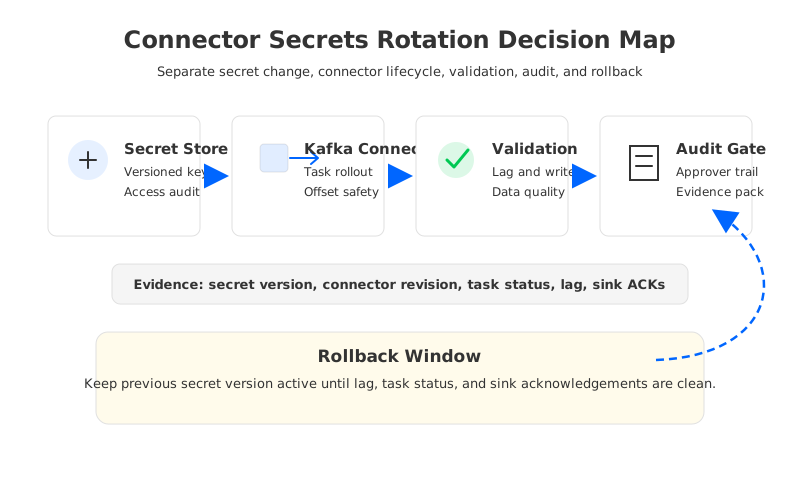
A robust connector secrets rotation design has three layers: secret versioning, connector lifecycle control, and replay-safe validation. These layers should be designed as one workflow because a gap in any one of them becomes a production risk. Secret versioning without connector lifecycle control creates drift. Lifecycle control without replay validation creates false confidence. Replay validation without audit evidence creates a compliance gap.
The rotation workflow usually follows this order:
- Create the next secret version in the managed secret store and grant it the same least-privilege scope as the current version.
- Validate the next secret outside Kafka Connect with a small, audited connectivity check against the source or sink system.
- Update the connector configuration or secret reference through a controlled deployment path.
- Restart or roll tasks in a way that keeps task status, offsets, and lag observable.
- Watch connector errors, consumer lag, producer errors, sink acknowledgements, and downstream data quality signals.
- Retire the previous secret after the rollback window closes and evidence has been captured.
This sequence is intentionally conservative because rotation is a production change, not a background housekeeping job. Every transition should remain visible and reversible until the platform has evidence that the next secret is working across every task and external dependency.
| Layer | Rotation Question | Failure Signal | Evidence to Keep |
|---|---|---|---|
| Secret store | Which version is active and who changed it? | Secret fetch denied, wrong version, expired token | Secret version history, IAM or RBAC audit trail |
| Kafka Connect | Which tasks picked up the change? | Task restart loop, connector failed state, rebalance churn | Connector config revision, task status timeline |
| Kafka data plane | Did records continue to flow and replay safely? | Lag growth, commit gaps, producer retries | Offset history, lag charts, broker metrics |
| External system | Did the source or sink accept the rotated credential? | Auth rejection, partial writes, throttling | API audit logs, database login history, sink acknowledgements |
The table is useful because it prevents a common mistake: declaring success when the connector status turns green. Green task status is necessary, but it is not sufficient. For a sink connector, the stronger signal is that downstream writes are accepted, idempotency expectations still hold, and consumer lag returns to its expected range. For a source connector, the stronger signal is that it resumes from the intended position without silent gaps or unexpected repeats.
4Failure Handling, Schema, and Replay Trade-Offs
Secret rotation exposes the difference between retryable and unsafe failures. A short authentication error during a sink connector restart may be retryable if the sink is idempotent and the connector can resume from the last committed offset. The same error can be unsafe if the sink performs non-idempotent side effects before acknowledging the batch. Source connectors have a different shape: they may read from databases, object stores, APIs, or change data capture logs where the source position and Kafka offset have to remain aligned.
Schema handling adds another layer. A connector rotation can happen during a schema rollout, a table change, or an application deployment that changes message shape. When those changes overlap, the team loses the ability to isolate cause. A strict platform should avoid bundling credential rotation with schema evolution, and the runbook should state whether schema compatibility checks are frozen, monitored, or separately approved during the window.
There is also a replay question that auditors and SREs ask in different language. Auditors ask whether the pipeline preserved data integrity. SREs ask whether they can replay safely after the connector recovers. Both questions point to the same design requirements: stable offsets, durable records, observable lag, and a documented rollback path. A connector platform that treats rotation as a stateless config push misses the point. The secret is stateless; the pipeline is not.
The safest rotation plan is the one that can explain failure before failure happens. If the rollback path depends on someone remembering which task restarted first, the plan is not operationally mature enough for regulated streaming.
The cost dimension often appears late, but it affects the runbook. Teams may keep extra connector workers online, hold duplicate credentials longer, or run shadow validation jobs against external systems. They may also overprovision Kafka brokers to absorb retry spikes. That spare capacity has a price, especially when local broker storage and compute scale together.
5Evaluation Checklist for Platform Teams
The neutral way to evaluate Kafka-compatible infrastructure for connector rotation is to separate connector semantics from cluster operations. Connector semantics ask whether the platform can run the source and sink plugins, preserve offsets, support the required authentication modes, and expose task status. Cluster operations ask whether the underlying streaming layer can absorb restarts, retries, backfills, and maintenance without creating unrelated data movement or capacity risk.
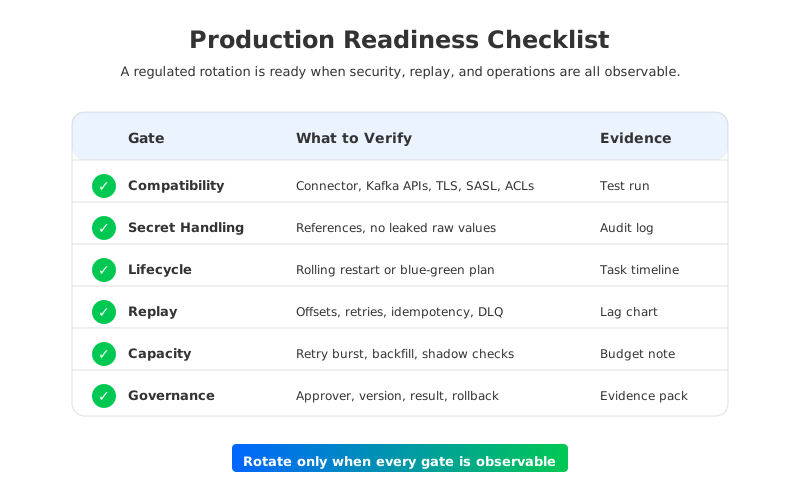
Use this checklist before approving a regulated connector rotation design:
- Compatibility: Confirm that the connector runtime, Kafka protocol, client libraries, ACLs, TLS, SASL, and schema dependencies match the applications already in production.
- Secret handling: Prefer secret references and managed secret stores over embedding raw values in connector configs. Check that logs, config history, and support bundles do not expose secret material.
- Lifecycle control: Define whether tasks roll one at a time, restart as a group, or run in blue-green mode. Tie the decision to source and sink behavior, not to deployment convenience.
- Replay and rollback: Document how offsets, retries, dead-letter queues, idempotency, and downstream acknowledgements behave when the next secret fails.
- Capacity and cost: Model retry bursts, backfills, and shadow validation. Treat spare headroom as part of the rotation budget, not as an afterthought.
- Governance: Capture the approver, secret version, connector revision, task timeline, and validation result in a place auditors can read without privileged production access.
The checklist deliberately avoids vendor-specific shortcuts. What matters is whether the architecture reduces hidden coupling between a security change and the streaming data plane.
6How AutoMQ Changes the Operating Model
Once the evaluation framework is clear, AutoMQ becomes relevant as an architectural option rather than a slogan. AutoMQ is a Kafka-compatible streaming platform that separates broker compute from durable storage by using shared object storage as the storage foundation. For connector-heavy environments, the key implication is operational: broker nodes can be treated as more stateless compute, while durable stream data lives outside broker-local disks.
That distinction changes how teams think about a connector rotation window. If connector retries or validation jobs create temporary pressure, the platform team wants elastic compute and predictable storage behavior instead of a broker-local storage event. If a broker fails during the same window, the recovery path should avoid large local-disk reconstruction that competes with connector traffic. In multi-zone deployments, cross-zone traffic should also be visible and minimized because regulated pipelines often run long-lived, high-throughput data movement.
AutoMQ's shared storage architecture, Kafka compatibility, and cloud deployment model can fit that operating model. Existing Kafka clients and many ecosystem integrations can continue to use Kafka APIs, while platform teams evaluate whether stateless brokers, object-storage-backed durability, independent compute and storage scaling, and cross-zone traffic controls reduce rotation risk. AutoMQ also documents Kafka Connect support in AutoMQ Cloud, which matters for teams that want connector operations governed alongside Kafka-compatible infrastructure rather than treated as a separate island.
This does not make connector secrets rotation automatic. Teams still need a runbook, a secret manager, connector-level validation, and external-system rollback. The architectural improvement is that a security operation no longer has to carry as much broker-local storage risk.
For teams evaluating a migration, the safest path is to test the rotation workflow before moving the highest-risk connectors. Pick a connector with real authentication complexity but bounded business impact. Force a failed credential, measure task recovery, lag, replay, and rollback, then repeat the test during a controlled compute scaling event. The result will tell you more than a feature matrix because it exercises the boundary where security, connector lifecycle, and streaming durability meet.
If your team is building regulated Kafka-compatible pipelines and wants to evaluate this operating model, start with the AutoMQ documentation and test a connector rotation runbook against a non-production workload: Explore AutoMQ.
7References
- Apache Kafka Documentation: Kafka Connect
- Apache Kafka Documentation: Security
- AWS Secrets Manager Documentation: What is AWS Secrets Manager?
- AutoMQ Documentation: Compatibility with Apache Kafka
- AutoMQ Documentation: Shared Storage Architecture Overview
- AutoMQ Documentation: Kafka Connect Overview
- AutoMQ Documentation: Security Overview
- AutoMQ Documentation: Inter-Zone Traffic Overview
8FAQ
8.1What is connector secrets rotation in Kafka?
Connector secrets rotation is the controlled replacement of credentials used by Kafka Connect source or sink connectors. The credentials can include passwords, API keys, tokens, TLS certificates, or secret references. In production, the rotation has to preserve connector task health, offsets, replay behavior, audit evidence, and external-system access.
8.2Should connector secrets be stored directly in connector configs?
Raw secret values should not be embedded directly in connector configs when a managed secret reference is available. Direct values are harder to rotate, harder to audit, and easier to expose through logs, configuration history, or support artifacts. A reference-based pattern keeps connector configuration and secret material under separate controls.
8.3How often should regulated teams rotate connector secrets?
The rotation interval depends on internal policy, regulatory requirements, external-system constraints, and credential type. The stronger engineering practice is to make rotation routine enough that it can be tested without drama. A long interval with no practiced rollback path is riskier than a moderate interval backed by automation, audit trails, and replay validation.
8.4Can Kafka Connect rotate secrets without task restarts?
Some deployments can refresh certain secret references without a full connector replacement, but teams should verify the exact connector, worker configuration provider, authentication method, and external system behavior. A regulated runbook should assume that task restarts or rolling updates may occur and should monitor lag, task status, and external acknowledgements accordingly.
8.5Where does AutoMQ fit in connector secrets rotation?
AutoMQ does not replace secret management or connector validation. It fits at the streaming infrastructure layer: Kafka-compatible APIs, shared storage, stateless broker design, and cloud-native operations can reduce the amount of broker-local storage risk that surrounds a connector rotation window. Teams still need to validate connector behavior end to end.


