
Table of Contents
Table of Contents
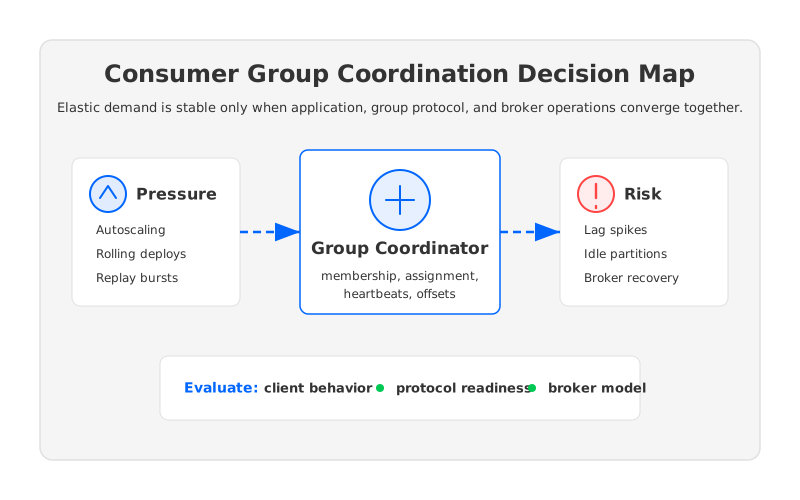
Consumer group coordination hides when traffic is steady. A few consumers join a group, partitions are assigned, offsets are committed, and the application keeps moving. The mechanism becomes harder to ignore when the same workload starts behaving elastically: Kubernetes rolls pods during a deploy, an autoscaler adds consumers during a backlog spike, a spot interruption removes instances, or a connector task restarts while another application is replaying historical data. At that point, the group coordinator is not a background implementation detail. It is the place where application elasticity, partition ownership, offset safety, and broker health meet.
That is why teams search for consumer group coordination kafka after the first visible incident, not during the first architecture review. The symptom may be consumer lag during deployment, repeated group rebalances, idle partitions after a member leaves, or uneven downstream throughput even though the Kafka cluster still has spare broker capacity. No single tuning parameter fixes these symptoms. Coordination problems sit across the client, group protocol, topic design, broker recovery, and cloud operating model.
1Why Consumer Group Coordination Becomes an Elasticity Problem
Kafka consumer groups exist because a topic is divided into partitions and a group needs a consistent way to assign those partitions to consumer instances. Each partition is consumed by at most one active member in the same group, which gives teams parallelism without losing per-partition ordering. The group coordinator tracks membership, assignment, heartbeats, and offset commits through Kafka's group management machinery. When membership changes, the group must converge on an updated assignment before every partition has a clear owner again.
That convergence step is where elastic workloads expose hidden assumptions. In a fixed deployment, consumer membership changes mostly during planned releases or failures. In an elastic deployment, membership changes become normal operating events. Autoscalers react to lag, batch jobs appear for a replay window, processors scale with upstream demand, and maintenance events remove capacity from one availability zone. Each change is reasonable on its own, but together they turn coordination into a control loop that must remain stable under pressure.
Four details matter more than teams expect:
session.timeout.msand heartbeat behavior determine how quickly a failed member is detected, but aggressive detection can remove healthy consumers during pauses, GC pressure, or overloaded processing loops.max.poll.interval.msprotects the group from consumers that stop making progress, but long record processing can make a healthy application look dead to the coordinator.- Partition assignment strategy controls how disruptive a rebalance is. Cooperative and incremental approaches reduce unnecessary revocation, while older eager behavior can pause more work than the incident requires.
- Static membership can reduce disruption during controlled restarts, but it does not remove the need to reason about failures, rollbacks, and deployment automation.
The Kafka 4.0 consumer rebalance protocol changes part of this picture. It moves more assignment logic to the broker side and avoids the global synchronization barrier that made classic rebalances disruptive at scale. That is an important protocol improvement, but it does not remove the platform questions around capacity, failure recovery, multi-AZ traffic, or governance. A faster rebalance still runs inside an infrastructure model, and that model determines whether elastic consumers are supported by stable broker behavior or amplified by broker-level operational work.
2The Production Constraint Behind the Problem
The practical constraint is simple: the consumer group wants to change quickly, while the platform underneath Kafka often changes slowly. A consumer can be added in seconds, but a traditional broker cluster may still be sized around peak throughput, local disk capacity, and partition distribution. If consumer elasticity increases read demand, fetch locality and broker load matter. If a broker fails during the same window, recovery may involve moving partition data, rebuilding replicas, or waiting for storage-bound work to settle. The consumer group sees this as uneven progress even when the application code is unchanged.
This is the part of Kafka operations that tends to surprise cloud platform teams. Consumer group coordination is a protocol-level mechanism, but its quality of service depends on the broker fleet behaving predictably during the same events that trigger rebalances. A group rebalance during a quiet period is one problem. A group rebalance during broker replacement, partition reassignment, or cross-AZ network pressure is a different problem. The application sees both as "consumer lag," yet the root causes sit in different layers.
The platform team therefore needs to evaluate two loops at the same time. The first loop is the consumer loop: poll, process, commit, heartbeat, and rebalance. The second loop is the infrastructure loop: scale brokers, recover failures, rebalance partitions, manage storage, and route traffic across zones. Elastic workloads are stable when these loops do not fight each other. They are fragile when autoscaling overlaps with storage recovery or manual capacity work.
3Architecture Options and Trade-Offs
The first layer of defense is still application design. Teams should size partitions for expected parallelism, keep poll loops responsive, use backpressure instead of letting processing time explode, and test rebalance behavior during deployments. These practices matter because Kafka cannot coordinate around an application that stops polling for long periods or commits offsets without a clear processing contract. A mature team also measures rebalance rate, assignment duration, lag recovery time, and offset commit failures instead of treating consumer lag as one undifferentiated number.
Client and protocol choices are the next layer. Cooperative assignment, static membership, and the Kafka 4.0 consumer protocol can reduce disruption, especially for large groups and rolling deployments. They also require discipline: a mixed fleet of clients, libraries, and framework defaults can behave differently across services. The group protocol is only as consistent as the applications that join the group.
Infrastructure is the layer teams postpone until the pain becomes visible. Traditional Kafka's Shared Nothing architecture binds durable log data to broker-local storage. That model is proven and widely understood, but it creates operational coupling: broker identity, storage capacity, partition placement, replica movement, and recovery work are tightly connected. When demand changes quickly, the platform has to decide whether to scale consumers only, scale brokers too, move partitions, or accept hot spots until the next maintenance window.
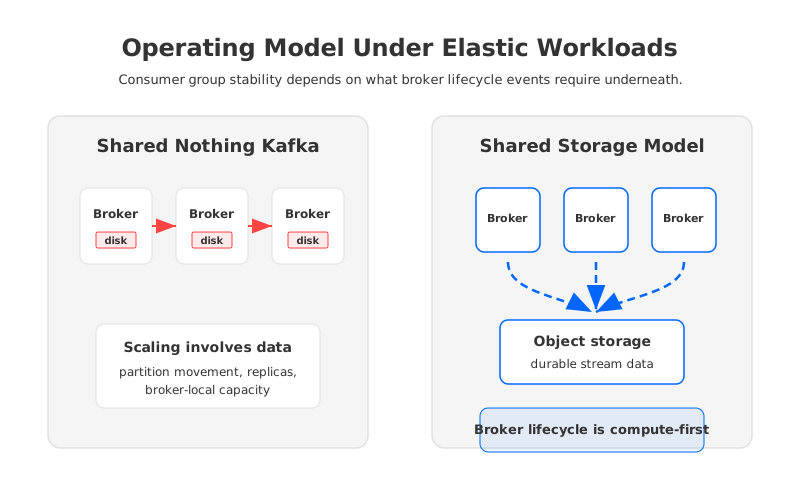
The difference is not that one architecture has a group coordinator and another does not. Kafka-compatible systems still need Kafka-compatible consumer group semantics. The difference is what happens around the coordinator when the workload changes. A Shared Nothing cluster tends to make broker scaling and recovery storage-aware operations. A Shared Storage architecture separates broker compute from durable data, so broker replacement and scaling can be treated more like compute lifecycle events.
That distinction matters for elastic consumers because coordination is about convergence. If consumers converge quickly but brokers are still moving data, the system is only half elastic. If brokers can be added, removed, or replaced without treating local disks as the source of truth, the platform has a better chance of keeping consumer rebalances as application events instead of turning them into cluster recovery events.
4Evaluation Checklist for Platform Teams
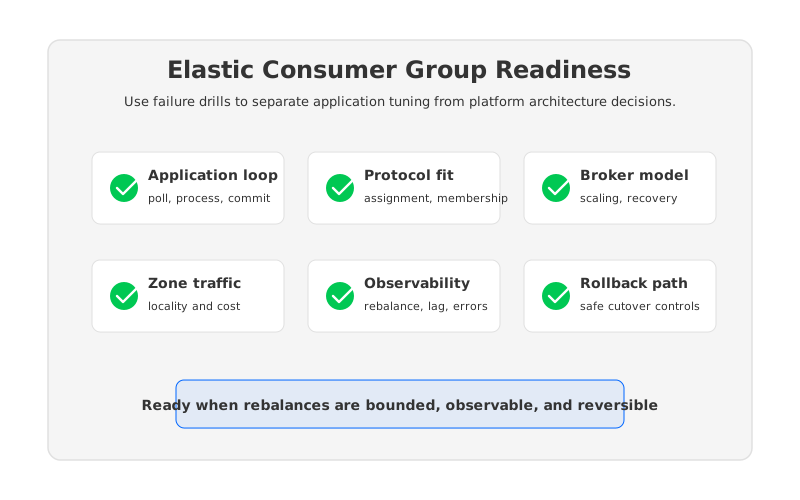
The right question is not "Which setting stops rebalances?" Rebalances are normal. The better question is whether rebalances are bounded, observable, and independent from unrelated infrastructure churn. A consumer group can tolerate membership changes when each change has a predictable blast radius and a clear recovery path. It becomes risky when every deploy, scale-out, or broker event creates another investigation.
| Evaluation area | What to inspect | Why it matters under elastic load |
|---|---|---|
| Group protocol and assignment | Client versions, assignment strategy, static membership, Kafka 4.0 consumer protocol readiness | Reduces unnecessary partition revocation and keeps rebalances from pausing more work than needed |
| Poll and processing contract | max.poll.interval.ms, processing time distribution, commit mode, retry behavior | Prevents healthy but slow consumers from being removed or committing unsafe offsets |
| Partition and workload shape | Partition count, skew, hot keys, replay patterns, connector task parallelism | Determines whether added consumers can actually absorb work |
| Broker operating model | Storage coupling, broker replacement time, partition movement, load balancing | Controls whether consumer elasticity is blocked by broker-side recovery or redistribution |
| Multi-AZ traffic and locality | Producer, broker, and consumer placement across zones | Prevents elastic read/write patterns from turning into avoidable network cost or latency |
| Observability | Rebalance duration, member count changes, lag recovery, coordinator errors, broker load | Separates application coordination issues from infrastructure symptoms |
| Governance and migration | Client compatibility, rollback plan, deployment policy, ownership boundaries | Keeps consumer changes auditable across teams and cloud environments |
This checklist also prevents a common mistake: tuning consumers before understanding the platform boundary. If the problem is a slow processing loop, fix the application. If the problem is partition skew, fix the topic and key strategy. If the problem is broker recovery under bursty demand, changing session.timeout.ms only hides the real issue. Good Kafka operations separate these causes before changing defaults.
5How AutoMQ Changes the Operating Model
Once the evaluation reaches the broker operating model, AutoMQ becomes relevant as an architecture choice rather than a tuning shortcut. AutoMQ is a Kafka-compatible cloud-native streaming platform that keeps Kafka protocol compatibility while replacing broker-local durable storage with a Shared Storage architecture on object storage. In this model, brokers are closer to stateless compute nodes, and durable stream data is no longer tied to a specific broker disk.
That does not mean AutoMQ changes how Kafka applications think about consumer groups. Applications still use Kafka clients, group IDs, offsets, commits, and partition assignment semantics. The value is that platform events around the group can become less storage-bound. When broker compute is separated from durable data, scaling and replacement can avoid the traditional pattern where a broker lifecycle event implies a large local-data movement event. For elastic workloads, that reduces the chance that consumer coordination and broker recovery amplify each other.
The same logic applies to multi-AZ operations. Traditional Kafka durability relies on replica placement across brokers, which often creates inter-zone replica traffic and makes client placement a cost and latency concern. AutoMQ's documentation describes a storage model designed to reduce inter-zone traffic by using shared object storage and traffic orchestration instead of broker-to-broker replica copying as the persistent-data path. For elastic consumer fleets, this can make read fan-out, replay jobs, and autoscaling easier to reason about.
AutoMQ's fit is strongest when the platform team already knows the consumer group mechanics but wants a cleaner cloud operating model around them:
- Consumer applications need Kafka compatibility, not a replacement client ecosystem.
- Broker scaling and replacement should be compute lifecycle work, not local-disk recovery work.
- Multi-AZ deployments need clearer control over traffic paths and availability boundaries.
- Platform teams want automation and governance without moving data out of their cloud boundary.
There are still engineering decisions to make. You need to validate client compatibility, benchmark representative workloads, test failure scenarios, and confirm deployment boundaries for your cloud account or private environment. Shared Storage changes the infrastructure assumptions around Kafka; it does not remove the need for disciplined consumer design. The right goal is to keep Kafka semantics familiar while reducing the operational work that makes elastic consumer groups hard to run in production.
6A Practical Readiness Model
A useful readiness review starts with a failure drill rather than a settings spreadsheet. Pick one important consumer group and run three controlled scenarios: a rolling deployment, a sudden scale-out while lag is growing, and a broker or zone-level maintenance event. Measure stable-assignment time, lag recovery, and whether unrelated broker recovery work appears in the same window. These tests reveal whether the system is elastic or merely autoscaled.
Then map every finding to the layer that owns it. Application teams own processing time, retry behavior, and offset safety. Data platform teams own topic design, partitioning guidance, client defaults, and observability. Infrastructure teams own broker scaling, storage, zone topology, and network cost controls.
The final step is to decide which bottlenecks need tuning and which require a platform change. If most incidents come from long processing batches, redesign the application. If incidents come from local broker storage, partition movement, or slow recovery during elastic load, evaluate a Kafka-compatible architecture that decouples compute from durable storage. AutoMQ is one such option for teams that want to keep Kafka semantics while running the broker fleet more like cloud infrastructure.
If your team is testing elastic Kafka workloads and wants to compare the operating model against a shared-storage Kafka-compatible architecture, try the AutoMQ interactive demo: Explore AutoMQ with a guided deployment and operations walkthrough. The useful test is not whether a demo looks familiar. It is whether your own rebalance, recovery, and scaling drills become easier to reason about.
7References
- Apache Kafka Documentation: Consumer Rebalance Protocol, https://kafka.apache.org/40/operations/consumer-rebalance-protocol/
- Apache Kafka Documentation: Consumer Configs, https://kafka.apache.org/documentation/#consumerconfigs
- Apache Kafka Documentation: Design, https://kafka.apache.org/42/design/design/
- Apache Kafka KIP-848: The Next Generation of the Consumer Rebalance Protocol, https://cwiki.apache.org/confluence/pages/viewpage.action?pageId=217387038
- AutoMQ Documentation: What Is AutoMQ, https://docs.automq.com/automq/what-is-automq/overview?utm_source=blog&utm_medium=reference&utm_campaign=rpb-0168-consumer-group-coordination
- AutoMQ Documentation: Difference with Apache Kafka, https://docs.automq.com/automq/what-is-automq/difference-with-apache-kafka?utm_source=blog&utm_medium=reference&utm_campaign=rpb-0168-consumer-group-coordination
- AutoMQ Documentation: Eliminate Inter-Zone Traffic, https://docs.automq.com/automq/eliminate-inter-zone-traffics/overview?utm_source=blog&utm_medium=reference&utm_campaign=rpb-0168-consumer-group-coordination
- AWS Documentation: Understanding and Managing Amazon S3 Storage Classes, https://docs.aws.amazon.com/AmazonS3/latest/userguide/storage-class-intro.html
8FAQ
8.1Is consumer group coordination a Kafka client problem or a broker problem?
It is both. The client controls polling, processing, commits, and membership behavior, while the broker-side group coordinator manages membership and assignment state. Production incidents often involve a third layer: the platform around the brokers. Broker recovery, partition movement, or zone traffic can make a healthy client look broken.
8.2Will Kafka 4.0's consumer protocol remove rebalance issues?
It should reduce important classes of disruption, especially the classic global synchronization behavior that made large-group rebalances painful. It does not replace responsive consumers, balanced partitions, client compatibility work, or predictable broker operations under elastic load.
8.3How many consumers should a Kafka consumer group have?
The upper bound is usually the number of partitions that the group needs to consume, because a single partition has only one active owner inside the group. Extra consumers may help during deployment transitions, but they will not increase steady-state parallelism for that topic. The better question is whether partition count, key distribution, and processing time let the group absorb spikes without constant churn.
8.4Does Shared Storage change Kafka consumer semantics?
It should not change the semantics that Kafka applications depend on when the platform is Kafka-compatible. Consumers still use group IDs, offsets, commits, and partition assignment. Shared Storage changes the broker operating model around those semantics by separating durable data from broker-local disks.
8.5When should a team evaluate AutoMQ for this problem?
Evaluate AutoMQ when consumer group incidents are tied to cloud operating constraints rather than only application code. Signals include storage-bound broker recovery, manual partition rebalancing, high inter-zone traffic concerns, or a need to keep Kafka compatibility while making broker compute more elastic.


