
Table of Contents
Table of Contents
Searches for consumer group rebalancing kafka usually start after an incident has made the abstract mechanics of Kafka feel very concrete. A deployment rolled through too many consumers at once. A slow consumer exceeded its poll interval. A broker was restarted during peak traffic, and the group entered a loop of revoked partitions, reassigned partitions, lag growth, and confused ownership. The first instinct is to tune the consumer. That is often the right first move, but it is not the whole operating model.
Consumer group rebalancing is a client-facing event, yet its blast radius is shaped by the platform below it. Kafka assigns topic partitions across the active members of a Consumer group. When membership or subscribed topic metadata changes, the group coordinator and clients cooperate to produce a new assignment. Applications feel that as paused work, ownership changes, offset decisions, and a temporary change in lag. Platform teams feel the same event through broker load, storage placement, capacity headroom, observability noise, and recovery runbooks.
The useful question is not "How do we avoid every rebalance?" Production systems change membership by design. The better question is: when consumer group rebalancing happens, does the platform turn it into a client coordination event, or does it also expose deeper broker-local storage constraints?
1Why teams search for consumer group rebalancing kafka
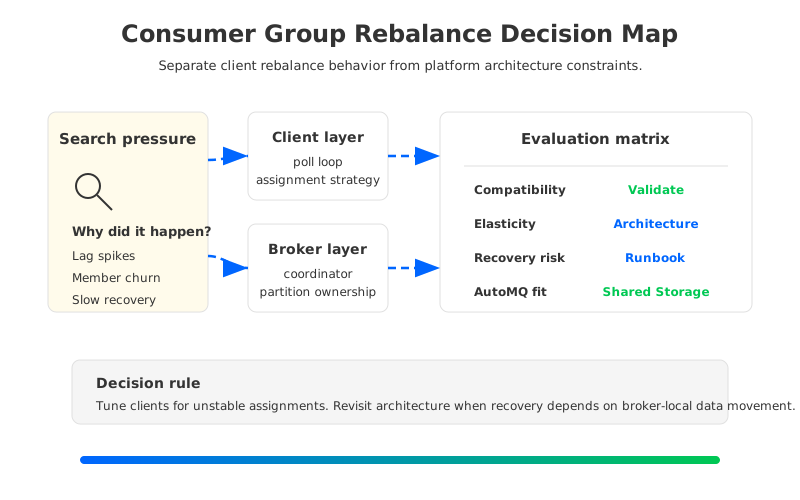
Kafka consumer group rebalancing is easy to explain at the whiteboard and hard to own during a production change. The mental model is familiar: consumers in the same group split partitions so each partition is processed by one group member at a time. That gives Kafka a practical scaling boundary. Add consumers and the group can spread work across more processes, up to the number of partitions. Remove consumers and the remaining members take over.
The pressure appears when the assignment boundary meets real application behavior. A consumer does not only fetch records. It calls databases, writes to search indexes, updates caches, invokes model features, commits offsets, and handles retries. If processing time, heartbeat behavior, deployment cadence, or downstream failures cause members to leave and rejoin, a group can spend too much time coordinating and too little time processing.
Four signals deserve attention before changing platform architecture:
- Membership churn: Consumers join and leave repeatedly during deployments, autoscaling events, or downstream stalls. This points to client lifecycle and timeout configuration before it points to storage.
- Assignment disruption: Work stops long enough for lag to grow, even when brokers are otherwise healthy. This often calls for assignment strategy review, cooperative rebalancing where appropriate, and rollout discipline.
- Coordinator pressure: Group operations concentrate on broker-side coordinators, especially in estates with many groups, high churn, or heavy offset commit activity.
- Recovery coupling: The team cannot separate a consumer rebalance from broker replacement, partition movement, storage catch-up, or cluster resizing. That is when the platform architecture becomes part of the rebalance story.
The last signal is the most interesting for architecture teams. It means the problem is no longer a client setting buried in one service. It has become a question about how Kafka capacity, data placement, and failure recovery are coupled.
2The production constraint behind the problem
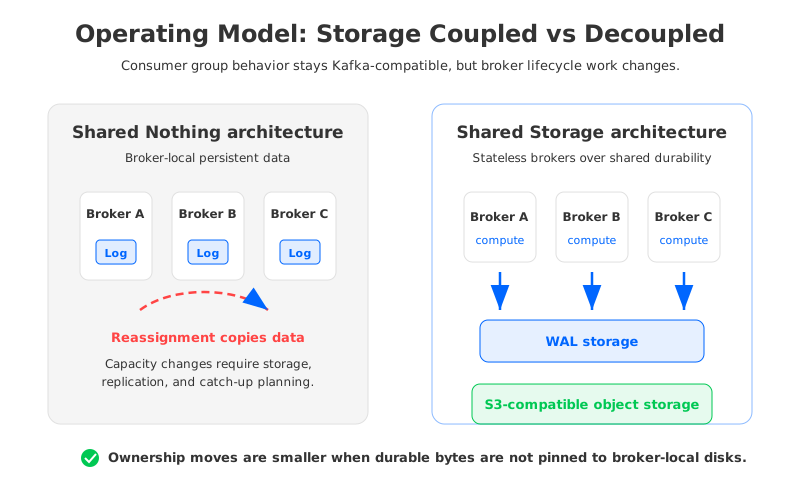
Traditional Kafka runs as a Shared Nothing architecture. Each broker owns local or attached persistent log data for the partitions assigned to it, and replication across brokers provides durability and availability. This design is proven and widely understood. It also means that many operational actions have a storage dimension: adding capacity, removing capacity, replacing a failed node, moving replicas, and balancing leaders all need to respect where the durable bytes live.
Consumer group rebalancing does not directly copy topic data. A group assignment changes which consumer reads which partition; it does not move the partition itself. The operational trap is that consumer behavior rarely happens in isolation. Rebalances often occur during deployments, broker maintenance, scaling events, hot partition mitigation, connector restarts, or incident recovery. In a broker-local storage model, those neighboring events may require replica movement, catch-up, throttling, and extra capacity planning.
That coupling changes the way teams handle risk. If consumer lag rises during a client rollout, the clean answer may be to slow the rollout and tune the consumer. If lag rises while the cluster is also moving partition replicas or recovering a broker, the answer becomes less clean. The platform team has to protect client progress, broker IO, network throughput, storage balance, and failover readiness at the same time.
The main architectural constraint is not that Shared Nothing architecture is broken. It is that broker-local persistence makes compute elasticity and storage placement move together. When the workload is stable, that coupling may be acceptable. When traffic, retention, membership, and recovery windows change at different speeds, the coupling becomes more visible.
3Architecture options and trade-offs
There are several valid ways to reduce the pain around Kafka consumer group rebalancing. A serious evaluation should keep them separate, because each one addresses a different layer of the system.
| Option | What it improves | What it does not remove |
|---|---|---|
| Client tuning | Heartbeats, poll intervals, batch size, commit behavior, and deployment stability. | Broker-local storage placement and cluster resizing work. |
| Assignment strategy changes | How partitions are revoked and assigned during group changes. | Application processing bottlenecks, downstream stalls, and broker lifecycle coupling. |
| Operational discipline | Rollout sequencing, autoscaling guardrails, replay windows, and incident runbooks. | The underlying cost and recovery profile of broker-local durable data. |
| Tiered Storage | Long-retention pressure by moving older log segments to remote storage. | The broker's responsibility for active partitions and the hot write path. |
| Shared Storage architecture | Broker lifecycle, scaling, and replacement when durable data is decoupled from broker-local disks. | The need to validate client behavior, offset commits, and group assignment semantics. |
This table is intentionally conservative. Client tuning matters. Cooperative assignment strategies can reduce disruption for some workloads. Tiered Storage can help long-retention topics. None of these should be dismissed because the architecture team is excited about stateless brokers. The mistake is treating all improvements as if they solve the same problem.
The first boundary is Kafka compatibility. If applications depend on Kafka clients, Consumer groups, offsets, transactions, Kafka Connect, or existing monitoring tools, the target platform has to preserve the contract those applications use. "Kafka-compatible" should be tested against the clients and behaviors in your estate, not accepted as a slogan.
The second boundary is cost and elasticity. In a broker-local design, capacity planning usually reserves room for throughput, retained bytes, replica movement, and failure recovery. If the team keeps extra brokers because shrinking would require risky data movement, the cost problem is architectural rather than purely financial. A cloud-native evaluation should ask whether compute can scale according to traffic while durable storage scales according to retention.
The third boundary is governance. Rebalancing incidents create evidence: which application owned the group, which deployment caused churn, which offsets were committed, which alert fired, and which team approved rollback. If that evidence is scattered across application dashboards, broker logs, cloud billing data, and ticket comments, the organization will keep solving the same incident from scratch.
4Evaluation checklist for platform teams
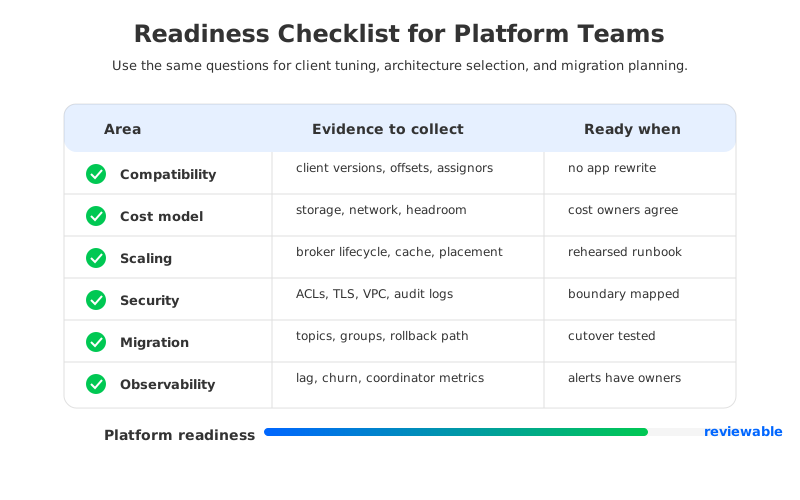
Before introducing a different Kafka-compatible platform, run the same review you would use for a major production migration. The purpose is not to prove that the existing cluster is bad. The purpose is to identify whether the pain belongs to the consumer application, the operational process, or the storage architecture.
Start with the current failure pattern. If group instability happens during every application deployment, fix rollout behavior before changing storage. If group instability happens when downstream sinks slow down, review backpressure, retry policy, and offset commit timing. If the same groups become painful whenever the platform drains brokers, expands capacity, or moves partitions, include broker lifecycle in the design review.
A practical review should answer these questions:
- Which Consumer groups are most sensitive to reassignment, and why?
- Which clients rely on eager assignment, cooperative assignment, static membership, transactions, or manual commits?
- What happens to lag and duplicate processing during a controlled consumer rollout?
- What happens when a broker is replaced while the same group is catching up?
- How much headroom is reserved for replica movement, failover, and replay?
- Can the team shrink compute after a traffic drop without moving large amounts of retained data?
- Are ACLs, TLS, network routes, offset topics, and monitoring ownership documented before migration?
- Does rollback mean switching clients back, resetting offsets, restoring a topic, or all three?
Those questions make architecture decisions less emotional. If the evidence points to client behavior, tune the clients. If the evidence points to operating discipline, improve runbooks and deployment controls. If the evidence points to storage-coupled recovery, a stateless broker model deserves a test.
5How AutoMQ changes the operating model
Once the neutral evaluation is complete, AutoMQ becomes relevant as a Kafka-compatible streaming platform built around Shared Storage architecture. It preserves Kafka protocol and ecosystem semantics while moving durable stream storage out of broker-local disks and into S3-compatible object storage through S3Stream. AutoMQ Brokers operate as stateless brokers for durable data ownership, with WAL (Write-Ahead Log) storage protecting the write path and object storage serving as the primary durable layer.
That does not change the application-level meaning of a Consumer group. Consumers still need correct poll loops, commit policies, idempotent processing where required, and observability. What changes is the platform work around the group. When durable partition data is not pinned to a broker's local disk, broker replacement, scaling, and partition reassignment can focus more on ownership, metadata, traffic, and cache behavior than on copying retained log data between nodes.
This distinction matters during the same events that usually expose rebalance pain. If a consumer group falls behind during a deployment, AutoMQ does not magically make the application faster. If the platform also needs to add brokers, remove brokers, or isolate a slow node, stateless brokers reduce the amount of storage relocation work tied to that action. The incident runbook can separate "who owns this partition" from "where do the durable bytes live" more cleanly.
AutoMQ's Self-Balancing capability fits the same model. In a Shared Nothing architecture, balancing often has to account for data movement as a heavy operation. In AutoMQ's Shared Storage architecture, balancing can be treated more as a continuous scheduling problem over stateless brokers, traffic, cache pressure, and partition leadership. The improvement is not that rebalancing disappears. The improvement is that more balancing work becomes operationally smaller.
The cost model changes for related reasons. Traditional Kafka clusters often carry extra broker and storage headroom for recovery, reassignment, and retention growth. Shared storage lets teams evaluate compute and storage separately: broker capacity follows traffic, while durable object storage follows retained data. Cloud networking and object storage pricing still need review for the target cloud and region, but the team is no longer forced to size every broker as both a compute node and a long-term data holder.
Migration planning remains a real project. AutoMQ Linking can help when teams need byte-level topic copy, Consumer group progress synchronization, producer cutover control, and rollback discipline during migration. That is useful for teams whose rebalance concerns are tied to a broader platform move. It does not remove the need to rehearse client behavior, validate offsets, test representative groups, and define the point at which the target platform becomes the recovery baseline.
For regulated or cloud-bound teams, deployment boundaries matter as much as mechanics. AutoMQ BYOC runs the control plane and data plane inside the customer's cloud account and VPC, while AutoMQ Software addresses private data center deployments. If the rebalancing problem sits inside a governance program, this boundary can be as important as the storage architecture because the evidence, data path, and operational controls remain under customer-owned infrastructure.
The result is a cleaner operating question. Do you need to tune a consumer group, or do you need to stop tying every platform recovery action to broker-local persistent data? The first answer is client engineering. The second answer is architecture.
6FAQ
6.1Does stateless broker architecture eliminate Kafka consumer group rebalancing?
No. Consumer group rebalancing is part of Kafka's group coordination model. Stateless brokers change the platform lifecycle around scaling, replacement, and partition ownership; they do not remove the need for correct consumer configuration and processing behavior.
6.2Should I tune consumers before evaluating a different architecture?
Yes. Validate poll intervals, heartbeat behavior, assignment strategy, deployment cadence, offset commits, and downstream backpressure first. If the recurring pain is tied to broker replacement, scaling, or storage movement, include platform architecture in the review.
6.3Is Tiered Storage the same as Shared Storage architecture?
No. Tiered Storage moves older log segments to remote storage while brokers still handle active partitions and local storage responsibilities. Shared Storage architecture moves the primary durable stream data out of broker-local disks so broker lifecycle operations are less tied to retained bytes.
6.4What should a proof of concept measure?
Measure controlled consumer rollouts, member churn, lag recovery, broker replacement, partition reassignment, cold and hot reads, offset behavior, security parity, and rollback. A steady-state throughput test alone will not reveal rebalance risk.
If your team is investigating consumer group rebalancing kafka because client tuning keeps colliding with broker lifecycle work, test the architecture boundary directly. Start an AutoMQ BYOC evaluation here: https://go.automq.com/home?utm_source=blog&utm_medium=cta&utm_campaign=consumer-group-rebalancing-kafka-stateless-brokers.
7References
- Apache Kafka Documentation: https://kafka.apache.org/documentation/
- Apache Kafka Consumer Rebalance Protocol: https://kafka.apache.org/42/operations/consumer-rebalance-protocol/
- Apache Kafka Tiered Storage: https://kafka.apache.org/41/operations/tiered-storage/
- AutoMQ Kafka compatibility: https://docs.automq.com/automq/what-is-automq/compatibility-with-apache-kafka?utm_source=blog&utm_medium=content&utm_campaign=consumer-group-rebalancing-kafka-stateless-brokers
- AutoMQ WAL storage: https://docs.automq.com/automq/architecture/s3stream-shared-streaming-storage/wal-storage?utm_source=blog&utm_medium=content&utm_campaign=consumer-group-rebalancing-kafka-stateless-brokers
- AutoMQ Self-Balancing: https://docs.automq.com/automq/architecture/technical-advantage/continuous-self-balancing?utm_source=blog&utm_medium=content&utm_campaign=consumer-group-rebalancing-kafka-stateless-brokers
- AutoMQ Linking migration overview: https://docs.automq.com/automq-cloud/migrate-to-automq/overview?utm_source=blog&utm_medium=content&utm_campaign=consumer-group-rebalancing-kafka-stateless-brokers
- AutoMQ BYOC environment overview: https://docs.automq.com/automq-cloud/manage-environments/overview?utm_source=blog&utm_medium=content&utm_campaign=consumer-group-rebalancing-kafka-stateless-brokers


