
Table of Contents
Table of Contents
A shared Kafka platform usually starts with a good intention: give every application team the same durable event backbone instead of asking each team to run its own cluster. The trouble begins when the consumers stop looking alike. One service reads every message within seconds. Another runs a nightly backfill. A machine learning pipeline fans out the same topic into feature jobs, audit jobs, and offline reprocessing. The platform is still "shared," but the blast radius is no longer evenly shared.
That is why teams search for consumer isolation patterns kafka. They are not looking for a textbook definition of consumer groups. They are trying to answer a harder production question: how do you let many consumers share the same streaming substrate without allowing one slow, noisy, or experimental workload to distort capacity planning for everyone else?
1Why Consumer Isolation Is Harder Than It Looks
Kafka already has a strong isolation primitive at the application protocol level. A consumer group gives each group its own offsets, lets members divide partitions, and allows independent replay without changing what other groups have committed. That model is one reason Kafka became the default backbone for event-driven systems. Each team can decide where it is in the log.
The hard part is that offset isolation is not the same as platform isolation. Consumers still share broker CPU, network bandwidth, page cache, disk I/O, request queues, quotas, security rules, schema contracts, and operator attention. A consumer group that falls behind can retain data longer than expected. A replay job can turn old segments into hot reads. A connector can create retry storms. A tenant that needs stricter governance can force the whole platform to adopt controls that other teams do not need.
For platform teams, the problem has three layers:
- Progress isolation: one consumer's lag, retry behavior, or offset reset should not corrupt another consumer's progress.
- Resource isolation: a heavy reader, backfill, or downstream outage should not starve unrelated workloads.
- Operational isolation: changes to credentials, quotas, topics, connectors, and recovery procedures should be scoped tightly enough that one team can move without waiting for everyone else.
Those layers overlap, but they should not be confused. Incidents often happen because a design isolates progress and assumes the rest will follow.
2The Production Constraint Behind Shared Consumers
The most common mistake is treating consumer isolation as a naming convention problem. Teams create separate group IDs, assign topic prefixes, and call the design multi-tenant. That helps with ownership, but it does not change what happens when a high-volume topic accumulates many independent readers. Every additional consumer group can add read traffic. Every replay can pull data that brokers thought was cold. Every retention increase can preserve segments that storage plans expected to age out.
Traditional Kafka amplifies this because brokers own both serving and local persistence. The same broker handles client requests, replica traffic, disk flushes, segment retention, leader movement, and recovery from local data. When one consumer pattern changes the read profile, the impact appears as broker-level pressure rather than a clean tenant-level bill. Operators then compensate with over-provisioned brokers, stricter quotas, separate clusters, or manual balancing.
Here is the uncomfortable trade-off. A single shared cluster improves reuse and governance, but it also concentrates operational coupling. Many isolated clusters reduce blast radius, but they multiply capacity buffers, upgrades, network rules, observability dashboards, and on-call procedures. Neither extreme is automatically wrong. The question is which isolation boundary matches the failure mode you are trying to contain.
3Pattern 1: Isolate by Consumer Group and Quota
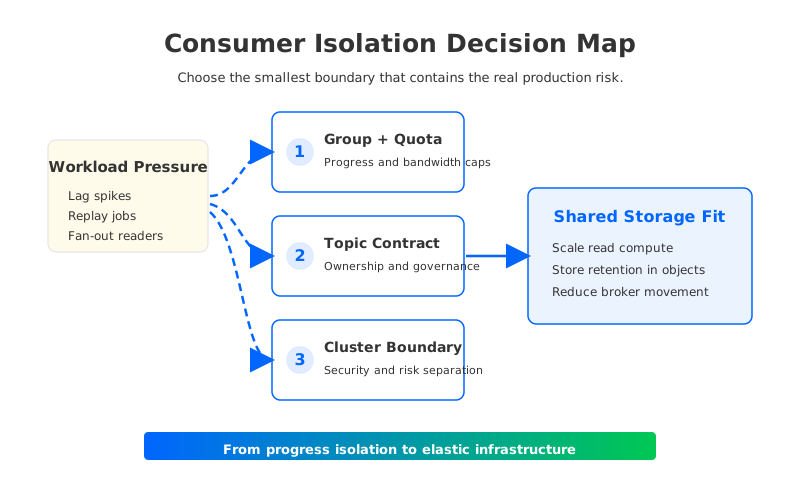
The lightest isolation pattern keeps workloads on the same topics and cluster, then separates them by consumer group, client ID, ACL, and quota. This is usually the right first step for application teams consuming the same event stream for different purposes. The log stays shared. Consumer progress stays independent. Platform owners get a manageable number of topics instead of a custom pipeline for every team.
This pattern works when the main risk is accidental interference, not structural contention. Quotas can cap fetch bandwidth. ACLs can prevent unauthorized reads. Monitoring can track lag by group and alert on abnormal growth. A platform team can also standardize consumer configuration, such as max.poll.records, session timeout, fetch sizing, and retry policy.
The limit appears when one consumer's resource profile is legitimate but too large for a shared pool. A fraud analytics team may need a continuous fan-out. A compliance team may need long replay windows. An AI feature pipeline may need periodic backfills that are expected, not abusive. Quotas protect neighbors, but they do not make a large workload disappear. They only decide who waits.
| Isolation Pattern | Best Fit | Main Risk | Operator Signal |
|---|---|---|---|
| Group and quota isolation | Many teams reading common topics | Heavy readers contend for shared broker resources | Lag, fetch throttle time, broker network and disk pressure |
| Topic or namespace isolation | Different ownership and governance domains | Topic sprawl and uneven retention policies | Topic growth, ACL drift, schema ownership conflicts |
| Dedicated cluster isolation | Regulated, mission-critical, or extreme workloads | Duplicated capacity and operational overhead | Cluster count, upgrade burden, cost per workload |
| Storage-compute isolation | Shared platform with elastic read and retention needs | Requires architecture change and migration planning | Capacity elasticity, recovery time, data movement volume |
The table is not a maturity ladder. It is a map of boundaries. You choose the smallest boundary that contains the real failure mode.
4Pattern 2: Isolate by Topic, Namespace, or Data Product
When consumers operate under different ownership rules, topic-level isolation becomes more useful. Topic names, schemas, ACLs, retention, and lifecycle policies can represent a data product boundary. This gives producers and consumers a clearer contract: who owns the stream, what compatibility rules apply, how long the data is retained, and which teams can replay it.
The benefit is governance clarity. A payments topic can carry stricter access rules than a clickstream topic. A customer audit stream can keep longer retention than operational telemetry. A platform team can map namespaces to cost centers, alert policies, and schema review workflows. This is where consumer isolation starts to look less like Kafka tuning and more like platform engineering.
The cost is sprawl. If every consumer asks for its own topic copy, you have isolated ownership by duplicating data. If every domain asks for custom retention, you have created a storage planning problem. If every namespace gets custom connector rules, you have created an operations problem. Topic isolation is powerful, but it should represent a durable contract, not a workaround for a noisy reader.
5Pattern 3: Isolate by Cluster
Dedicated clusters are the cleanest boundary for some workloads. A regulated domain may need strict network separation. A latency-sensitive service may need its own upgrade calendar. A workload with unusual retention or replay behavior may justify its own capacity model. In these cases, a hard boundary can be worth the duplicated infrastructure.
The weak point is economics. Kafka clusters are not free to keep warm. Traditional deployments need broker headroom for peak write traffic, replication, recovery, and local disk growth. Splitting consumers across many clusters can reduce blast radius while increasing unused capacity. It also creates secondary work: separate monitoring, access control, disaster recovery tests, bootstrap endpoints, and often separate connector fleets.
Cluster isolation is a deliberate exception. Use it for workloads whose risk profile justifies a separate operating model. Avoid using it as the default answer to every consumer conflict, because cluster count becomes its own reliability problem.
6Pattern 4: Isolate Compute Without Duplicating the Log
The more interesting pattern is separating the resources that serve consumers from the storage system that preserves the log. In a traditional Shared Nothing architecture, brokers combine compute and local storage. Data placement, broker recovery, partition movement, and capacity planning are tightly connected. That coupling is why consumer-heavy workloads often turn into storage-heavy operational work.
In a Shared Storage architecture, brokers can be treated more like stateless serving nodes while durable data lives in object storage behind a write-ahead log layer. The platform still exposes Kafka-compatible APIs, but the operating model changes. Adding serving capacity does not require copying every historical segment onto new broker-local disks. Replacing a broker does not require recovering its local log before the cluster can use the data again. Retention planning shifts toward object storage economics rather than broker disk sizing.
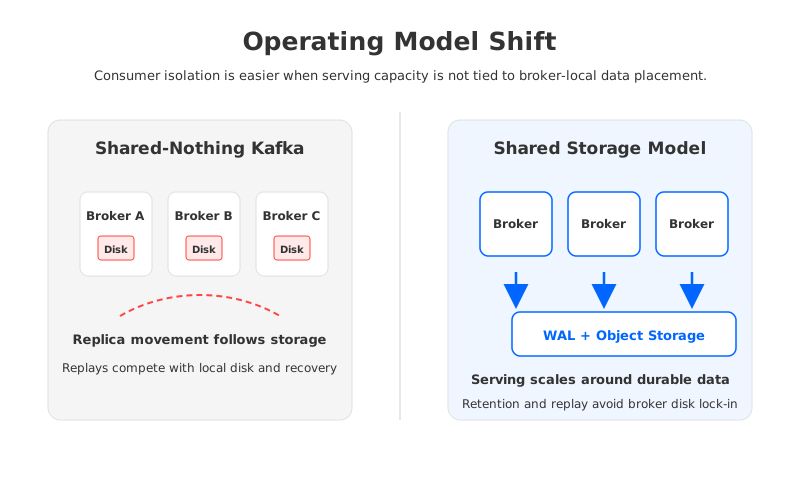
This is where AutoMQ becomes relevant, after the evaluation framework rather than before it. AutoMQ is a Kafka-compatible cloud-native streaming system that uses Shared Storage architecture and stateless brokers to decouple serving capacity from durable storage. For consumer isolation, the point is not a slogan about being cloud native. The important point is that read fan-out, replay, and retention pressure no longer have to be managed only by adding broker-local disk and moving partition replicas around.
That architecture does not remove the need for quotas, ACLs, topic contracts, or consumer discipline. It changes the cost of enforcing them. If a backfill needs more serving capacity, the platform can scale brokers around Shared Storage architecture. If retention grows for an audit consumer, the data is not trapped inside a fixed broker disk plan. If a deployment spans availability zones, AutoMQ's architecture is designed to reduce cross-AZ traffic by changing how data is persisted and served in the cloud.
7A Practical Evaluation Checklist
Consumer isolation decisions get clearer when you ask operational questions before architecture questions. Start with the failure mode. Is the risk a slow team falling behind, a large team consuming too much bandwidth, a regulated team needing stronger boundaries, or a platform team unable to scale read-heavy workloads economically? The right pattern follows from that answer.
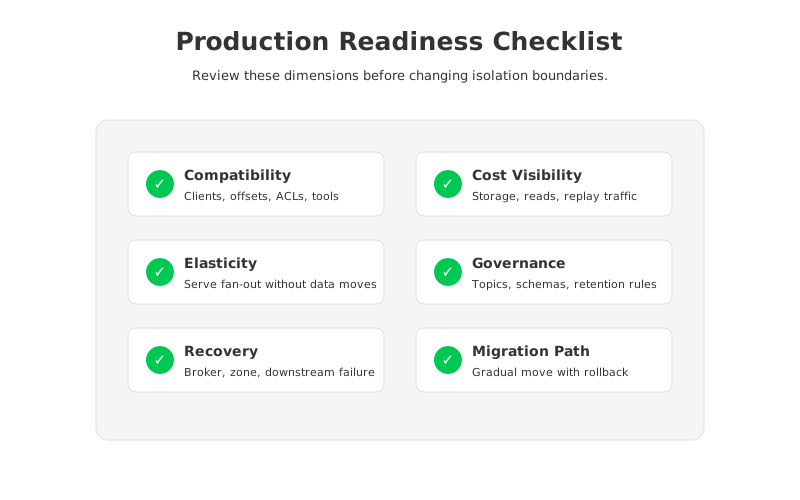
Use this checklist when reviewing a shared streaming platform:
- Compatibility: Can existing Kafka clients, group management, offset commits, ACLs, and monitoring workflows keep working during the change?
- Cost visibility: Can the platform attribute storage, read traffic, replay, and connector usage to the teams that create them?
- Elasticity: Can the system add serving capacity for consumer fan-out without long data movement windows?
- Governance: Are topic ownership, schema rules, retention policies, and access controls mapped to durable team boundaries?
- Recovery: If a broker, zone, or downstream consumer fails, does the platform know which boundary contains the failure?
- Migration and rollback: Can teams move consumers gradually, validate lag and offsets, and reverse the path if production behavior differs from the test?
The compatibility question deserves special attention. Consumer isolation work often fails because teams optimize the infrastructure and break the workflow. Kafka clients are embedded in applications, libraries, connector tasks, dashboards, and runbooks. A Kafka-compatible platform should preserve those semantics while improving the operating model underneath.
8Migration Notes for Platform Teams
Do not start by moving every consumer. Start by classifying consumer groups by behavior. Continuous low-lag services, batch replay jobs, connector tasks, audit readers, AI feature pipelines, and one-off debugging consumers all deserve different treatment. The labels matter because they reveal which patterns are structural and which are temporary.
A practical migration plan usually looks like this:
- Inventory consumer groups, client IDs, topics, retention settings, and peak lag windows.
- Identify consumers whose read pattern drives broker or network pressure.
- Decide whether the right boundary is quota, topic contract, dedicated cluster, or Shared Storage architecture.
- Move one representative workload first and compare lag, throttle time, broker pressure, and recovery behavior.
- Keep rollback simple by preserving client compatibility and avoiding unnecessary application rewrites.
The last point is easy to underestimate. A consumer isolation project should not become a surprise application rewrite. If the platform can preserve Kafka client behavior while changing the storage and scaling model underneath, teams can evaluate infrastructure risk without rewriting business logic.
9How AutoMQ Fits the Decision
AutoMQ fits best when the platform team wants Kafka compatibility but is constrained by the economics and operations of broker-local storage. Its Shared Storage architecture, stateless broker model, object-storage-backed durability, independent compute and storage scaling, and cloud deployment boundaries are all relevant to consumer isolation. They matter most for shared platforms with many reader types, replay pressure, cost visibility goals, or teams that need to scale serving capacity without treating every broker change as a data movement event.
The neutral test is simple: if your consumer isolation problem can be solved with better group IDs and quotas, solve it there. If it requires separate ownership contracts, solve it with topics and governance. If it requires hard regulatory separation, use cluster boundaries. But if the root problem is that every isolation decision becomes a broker storage, network, and recovery decision, the architecture itself is carrying too much coupling.
For teams evaluating that last category, AutoMQ provides a concrete path to keep Kafka-compatible application behavior while changing the storage and operations model underneath. You can review the architecture and deployment model or start a technical discussion through the AutoMQ Console path: Schedule an AutoMQ demo.
10References
- Apache Kafka documentation: Consumers and consumer groups
- Apache Kafka documentation: Consumer configuration
- Apache Kafka documentation: Kafka Connect
- AutoMQ documentation: Architecture overview
- AutoMQ documentation: Compatibility with Apache Kafka
11FAQ
11.1What is consumer isolation in Kafka?
Consumer isolation is the practice of separating consumer progress, resource usage, and operational ownership so that one consumer group does not create unacceptable risk for others on the same streaming platform. Kafka consumer groups isolate offsets, but platform teams often need additional isolation through quotas, ACLs, topic contracts, cluster boundaries, or architecture changes.
11.2Are separate consumer groups enough for isolation?
Separate consumer groups are enough when the main requirement is independent offset progress. They are not enough when consumers share constrained broker resources, create large replay traffic, require different governance rules, or force retention policies that affect the rest of the platform.
11.3When should a team use a dedicated Kafka cluster?
A dedicated cluster makes sense when the workload needs a hard security, compliance, latency, or operational boundary. It is less attractive as a default isolation pattern because every new cluster adds capacity buffers, monitoring, upgrades, disaster recovery tests, and cost management work.
11.4How does Shared Storage architecture help consumer isolation?
Shared Storage architecture helps by separating durable log storage from broker serving capacity. That makes it easier to scale compute for read fan-out, replay, or backfill workloads without tying every capacity change to broker-local disk placement and partition data movement.
11.5Does AutoMQ replace Kafka consumer group design?
No. AutoMQ keeps Kafka-compatible client behavior, so teams still need sound consumer group design, quotas, topic ownership, and observability. AutoMQ changes the infrastructure model underneath those practices by using Shared Storage architecture and stateless brokers to reduce the operational coupling created by broker-local storage.


