
Table of Contents
Table of Contents
A content moderation pipeline becomes important long before anyone calls it infrastructure. At first it is a queue of user reports, model scores, policy matches, and reviewer decisions. Then the product grows, the model team adds more signals, trust and safety asks for audit trails, and the support team wants explanations for why an item was removed or restored. That is usually when someone searches for content moderation signals kafka: not because Kafka is unfamiliar, but because the moderation workflow has become too important to hide behind ad hoc queues and batch exports.
The hard part is not moving an event from one service to another. The hard part is preserving enough context for a human or AI-assisted reviewer to make a decision while the system is under bursty, emotionally charged, and compliance-sensitive load. A post can receive hundreds of reports in minutes. A model can change confidence thresholds after retraining. A legal hold can require retained evidence while product teams still expect low-latency decisions. Kafka-compatible streaming is a natural fit for this shape of work, but the infrastructure choice has to be evaluated against review operations, not abstract message throughput.
1Why teams search for content moderation signals kafka
Moderation signals rarely arrive as one clean stream. A production system may combine user reports, automated classification scores, account reputation, geo or language context, reviewer actions, appeals, safety policy versions, and downstream enforcement events. Some signals are latency sensitive because a harmful item should not wait in a batch. Others are evidence records that may be read days later by a policy analyst or compliance team.
Kafka helps because it gives teams durable ordered logs, consumer groups, replay, and a familiar protocol surface. That matters when the same moderation event must feed a reviewer queue, a model-feedback loop, a trust dashboard, and an audit store without coupling all of those systems to one database transaction. Consumer offsets let each downstream system advance independently. Topic retention gives engineers a replay window when a classifier bug or policy rule needs correction. Kafka Connect can move selected streams into search, lakehouse, warehouse, or operational stores without every team writing its own exporter.
The design mistake is treating all moderation events as one topic because they share a domain name. A reviewer assignment event, a model-score event, and a legal-evidence event have different owners, schemas, retention needs, and access boundaries. Putting them into one stream may look simpler during implementation, but it pushes complexity into every consumer. A better starting point is to separate streams by operational contract: latency, ordering, retention, privacy scope, and replay behavior.
2The production constraint behind the problem
Content moderation is one of the more awkward workloads for a traditional Kafka operating model because traffic is uneven and the long tail matters. A gaming or social platform may see normal background activity for hours, then a sudden surge around a viral post, live event, policy controversy, coordinated abuse campaign, or model rollout. During that surge, the business question is not whether brokers are busy. It is whether the human review queue, automated enforcement path, and evidence trail still agree about the state of each item.
Traditional Kafka's Shared Nothing architecture gives each broker local ownership of partitions and storage. That design has served many workloads well, but it ties capacity planning to broker-local disks, partition placement, replication, and reassignment behavior. When throughput grows, operators need to think about broker CPU, network, disk, replica placement, and the time required to move data. When retention grows, they need to think about local storage and tiering. When a broker fails or a cluster needs rebalancing, the operational work is not separate from where the data lives.
For moderation pipelines, that coupling shows up in several practical ways:
- Bursts become capacity reservations. Teams often size brokers for peak report storms because under-provisioning can delay review queues at the worst time.
- Audit retention becomes a storage problem. Keeping evidence and decision history for longer periods increases the pressure on local disks or tiered storage configuration.
- Cross-zone placement becomes a cost and latency variable. Multi-AZ deployments improve availability, but replication, producer routing, and consumer reads can create traffic that has to be understood before the bill arrives.
- Migration becomes operationally sensitive. A moderation stream cannot casually lose offsets, duplicate enforcement events, or break reviewer state during a platform change.
None of these problems mean Kafka is the wrong abstraction. They mean the Kafka-compatible platform has to be evaluated as a production moderation system rather than a generic event bus.
3Architecture options and trade-offs
The first architecture option is self-managed Apache Kafka. It gives teams maximum control over versions, broker configuration, network layout, storage, security integration, and operational tooling. That control is valuable when a platform team already has strong Kafka expertise. The trade-off is ownership: the same team is responsible for capacity planning, upgrades, partition movement, broker failures, connector operations, and cost management.
The second option is managed Kafka. It reduces the operational surface by moving some broker lifecycle work to a cloud or service provider. This can fit teams that want Kafka semantics without running every broker task. The evaluation still cannot stop at "managed." Platform teams need to inspect storage pricing, network paths, connector boundaries, private connectivity, version compatibility, and burst scaling behavior.
The third option is a Kafka-compatible shared storage architecture. In this model, brokers are less tightly bound to persistent local disks, and durable stream data is stored in a shared storage layer such as object storage, often with a write-ahead log layer on the hot path. The main evaluation question changes from "how many broker-local copies do we need?" to "how does the platform preserve Kafka semantics while separating compute from durable storage?" That shift matters for moderation because burst handling, retention, and recovery can be planned separately.
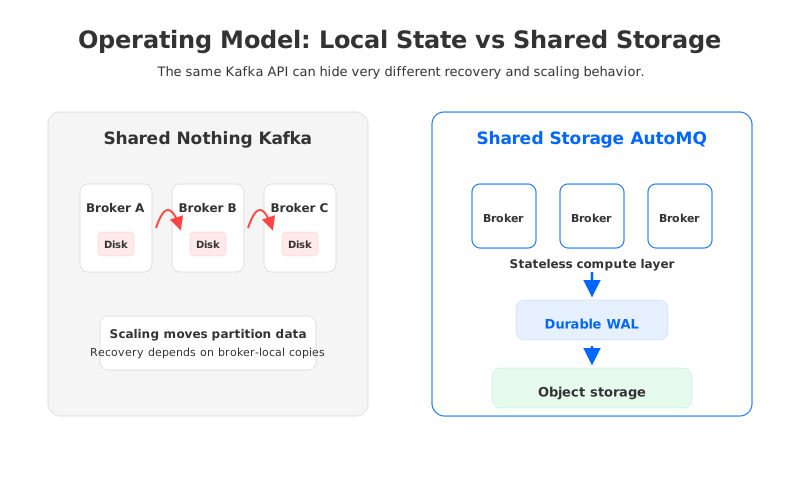
There is no free abstraction here. Shared storage has to deal with object storage latency, request efficiency, failure recovery, and metadata correctness. A serious platform must explain its WAL design, broker failover behavior, client compatibility, observability model, and deployment boundaries. The value is not that storage has disappeared. The value is that storage is no longer pinned to individual broker machines in the same way, which changes the operational math for scaling and recovery.
4Evaluation checklist for platform teams
A practical evaluation should start with the moderation workflow, not the product category. Write down the signals that enter the system, the teams that consume them, the decisions they drive, and the recovery behavior required when something goes wrong. The point is to expose the contracts hidden inside the word "moderation." Once those contracts are visible, infrastructure trade-offs become much easier to discuss.
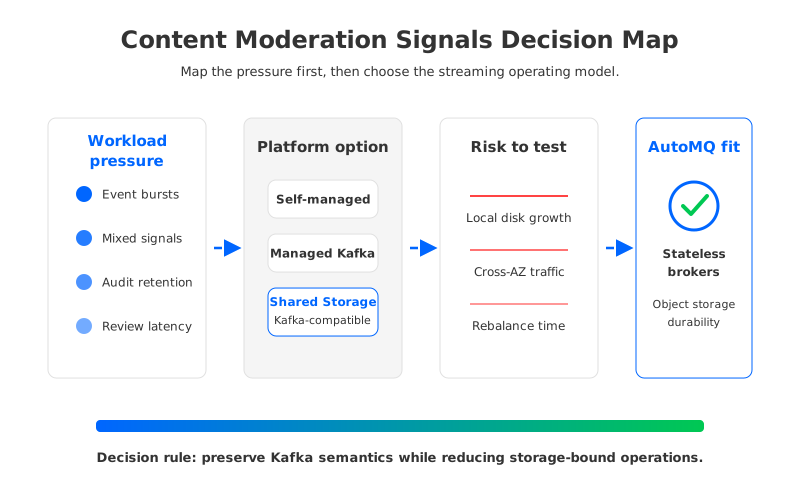
Use the following decision matrix as a working checklist rather than a procurement scorecard:
| Evaluation area | What to test | Why it matters for moderation |
|---|---|---|
| Kafka compatibility | Producers, consumers, transactions where used, offset behavior, Connect jobs, security configuration, and monitoring tools. | Moderation systems usually involve many teams; client rewrites increase migration risk. |
| Cost model | Broker compute, local or object storage, request charges, retention growth, read fanout, private connectivity, and cross-zone traffic. | Audit history and replay windows can make storage and network costs grow faster than write throughput. |
| Elasticity | How the platform handles bursty writes, consumer lag, partition movement, and scale-down after a surge. | Review queues need headroom during incidents without turning every incident into permanent over-provisioning. |
| Governance | Schema evolution, access control, encryption, PII boundaries, legal hold, and topic ownership. | Moderation events often contain sensitive user, policy, and enforcement context. |
| Recovery | Broker failure, zone impairment, replay after bad model output, connector restart, and consumer offset repair. | The system must support both infrastructure recovery and decision-quality recovery. |
| Migration | Dual-run plan, offset preservation or remapping, rollback path, and validation queries. | A failed migration can duplicate enforcement actions or break reviewer continuity. |
| Observability | Consumer lag, reviewer queue age, model-score freshness, connector health, broker health, and error budgets. | Kafka metrics alone do not prove the moderation workflow is healthy. |
The table forces one important conversation: platform metrics and moderation metrics are not the same thing. A broker cluster can look healthy while reviewer backlog grows because a downstream enrichment service is slow. A consumer group can show stable lag while the wrong policy version is attached to decisions. Good architecture connects Kafka-level signals with product-level review outcomes.
5How AutoMQ changes the operating model
Once the evaluation is framed around compatibility, elasticity, cost, governance, and migration risk, AutoMQ enters the discussion as an architecture category rather than a slogan. AutoMQ is a Kafka-compatible streaming platform that keeps the Kafka protocol surface while replacing the traditional broker-local storage model with Shared Storage: stateless brokers, a WAL layer for the immediate write path, and object storage for durable stream data.
That distinction matters for content moderation signals because the busiest part of the system is not always the longest-lived part of the data. A burst of report events may need low-latency ingestion and quick routing to reviewers, while the evidence trail may need durable retention and later replay. In a broker-local model, those needs compete inside the same broker sizing problem. In a shared storage model, compute and durable storage can be reasoned about more independently.
AutoMQ's Kafka compatibility is also relevant because moderation platforms are rarely greenfield systems. Existing producers may use Kafka clients, existing consumers may depend on consumer groups and offsets, and data integration may already use Kafka Connect. Compatibility does not remove the need for testing, but it changes the migration scope: teams can evaluate endpoint changes, client behavior, topic configuration, and connector paths without planning an application rewrite as the default assumption.
The shared storage design also changes how teams think about cross-AZ traffic. Traditional Kafka deployments often replicate broker-to-broker and may route client traffic across zones depending on placement and configuration. AutoMQ documents an approach for reducing inter-zone transfer by using shared object storage and zone-aware routing patterns. For a moderation workload with high fanout and retained audit data, that is worth modeling because network traffic can become a major cost center even when broker CPU looks ordinary.
The architecture is still a system that must be tested. Platform teams should evaluate WAL options against latency requirements, object storage configuration against durability and cost goals, and observability against the moderation workflow. The useful claim is not "storage is solved." The useful claim is narrower and more testable: by moving durable stream data into shared storage and making brokers stateless, the system reduces the amount of operational work tied to broker-local data placement.
6Production readiness scorecard
Before a moderation signal pipeline becomes critical, give it a readiness score that covers both Kafka mechanics and review operations. The score should be owned jointly by platform engineering, trust and safety, security, and the application teams that produce or consume enforcement events.
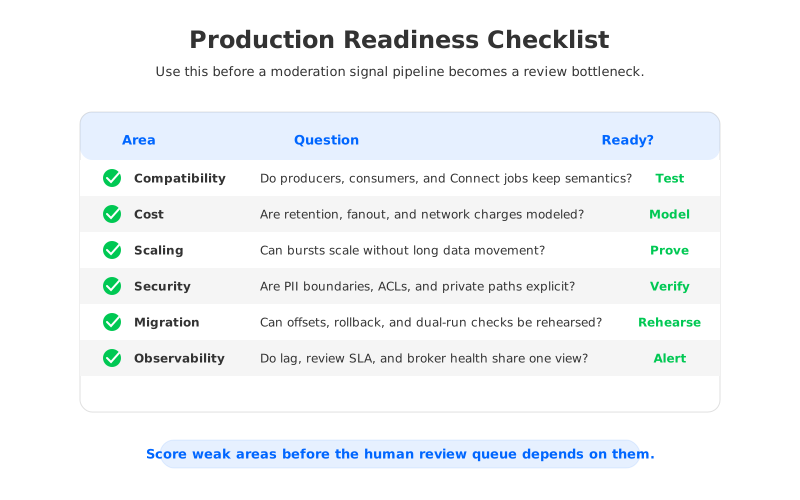
Start with a small set of concrete checks:
- Trace one item end to end. Pick a user item and follow every event from model score to reviewer decision, enforcement action, appeal, and audit export.
- Replay a bad-policy scenario. Assume a classifier emitted incorrect labels for a known window and verify how consumers replay, correct, and reconcile the affected decisions.
- Test a burst without changing retention. Produce a realistic surge and verify that scale-up behavior does not accidentally change audit guarantees.
- Rehearse migration rollback. Move a narrow topic group first, validate offsets and downstream state, then prove the rollback path before expanding scope.
- Join platform and product metrics. Put broker health, consumer lag, connector status, reviewer queue age, and decision latency on one incident dashboard.
The readiness score is most useful when it exposes uncomfortable ownership questions. Who approves a schema change that affects reviewer context? Who can pause a consumer that is issuing enforcement actions? Who confirms a replay did not double-count a policy violation? Kafka can provide the durable log, but production safety comes from the contracts around that log.
For teams evaluating Kafka-compatible infrastructure for moderation signals, the next useful step is a workload model: write throughput, read fanout, retention windows, topic count, partition strategy, private networking, and migration constraints. AutoMQ's documentation is a good place to validate whether a shared storage Kafka-compatible model fits that profile: review the AutoMQ architecture docs and use the checklist above to test your own pipeline assumptions.
7References
- Apache Kafka documentation: https://kafka.apache.org/documentation/
- Apache Kafka consumer configuration reference: https://kafka.apache.org/documentation/#consumerconfigs
- Apache Kafka Connect documentation: https://kafka.apache.org/documentation/#connect
- Apache Kafka semantics documentation: https://kafka.apache.org/documentation/#semantics
- AutoMQ architecture overview: https://docs.automq.com/automq/architecture/overview?utm_source=blog&utm_medium=reference&utm_campaign=content-moderation-signals-kafka
- AutoMQ compatibility with Apache Kafka: https://docs.automq.com/automq/what-is-automq/compatibility-with-apache-kafka?utm_source=blog&utm_medium=reference&utm_campaign=content-moderation-signals-kafka
- AutoMQ inter-zone traffic overview: https://docs.automq.com/automq/eliminate-inter-zone-traffics/overview?utm_source=blog&utm_medium=reference&utm_campaign=content-moderation-signals-kafka
- AutoMQ migration guide: https://docs.automq.com/automq/migration/migrating-from-apache-kafka-to-automq?utm_source=blog&utm_medium=reference&utm_campaign=content-moderation-signals-kafka
- Amazon S3 pricing: https://aws.amazon.com/s3/pricing/
- AWS PrivateLink pricing: https://aws.amazon.com/privatelink/pricing/
8FAQ
8.1Is Kafka a good fit for content moderation signals?
Kafka is a strong fit when moderation events need durable ordering, replay, independent consumers, and integration with downstream analytics or review systems. It is less attractive when the workflow is a small synchronous request path with no replay or fanout requirement. Most production moderation systems eventually need both: synchronous product decisions for the user path and asynchronous streams for review, audit, analytics, and model feedback.
8.2How should teams split moderation topics?
Split topics by operational contract rather than by org chart. Model-score events, user reports, reviewer assignments, enforcement decisions, appeal outcomes, and audit exports often need different retention, access control, schema ownership, and consumer behavior. A clean topic design makes governance easier because sensitive evidence streams can have stricter ACLs and longer retention without forcing every consumer into that contract.
8.3What Kafka metrics matter most for moderation?
Consumer lag is necessary but not enough. Track producer error rate, broker health, partition imbalance, connector status, and consumer group stability, then connect those metrics to reviewer queue age, decision latency, model-score freshness, and enforcement error rates. The operational goal is not a pretty Kafka dashboard. The goal is to know whether users, reviewers, and policy teams are seeing a consistent decision pipeline.
8.4When should AutoMQ be considered for moderation pipelines?
Consider AutoMQ when Kafka compatibility is required but broker-local storage, cross-zone traffic, retention growth, or slow partition movement are becoming operational concerns. The fit is strongest when teams want to keep Kafka clients and ecosystem tools while evaluating a shared storage model with stateless brokers. As with any infrastructure change, validate latency, migration, security boundaries, and observability against the actual moderation workflow before committing production traffic.


