
Table of Contents
Table of Contents
Searching for context lake ingestion kafka usually means the team has moved past a prototype. The problem is no longer whether a model can retrieve useful context from a lakehouse, vector index, feature store, or operational database. The harder question is whether fresh context can arrive with enough ordering, replayability, governance, and operational headroom to support production AI systems. Batch jobs can still feed training refreshes and offline analytics, but agent workflows, retrieval-augmented generation, personalization, fraud scoring, and support automation tend to expose stale data faster than a weekly pipeline can hide it.
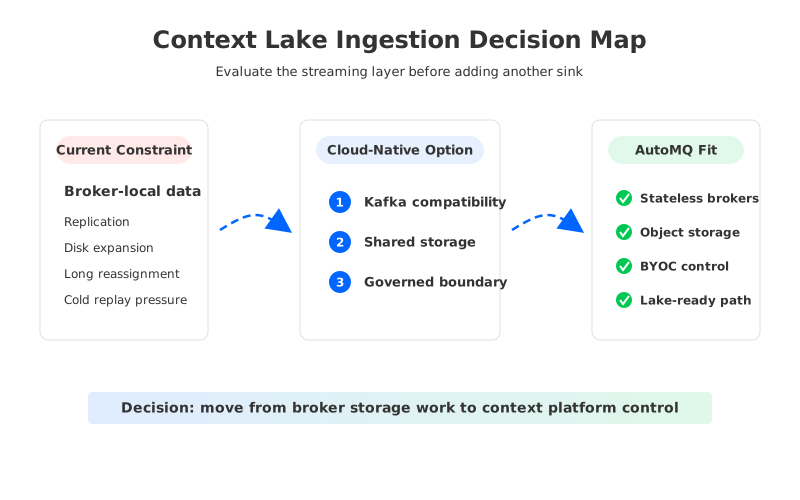
Kafka enters the search because it already solves several uncomfortable parts of this job. It gives platform teams durable logs, topic-level contracts, partitioned parallelism, offset-based replay, Consumer group coordination, and a large ecosystem of connectors and stream processors. Yet a context lake pipeline stresses Kafka in a specific way: it asks the streaming layer to connect low-latency application events with governed analytical storage while keeping enough operational slack for uneven AI traffic. The architecture decision is not "Kafka or no Kafka." It is what kind of Kafka-compatible streaming layer can absorb context ingestion without turning storage, networking, and migration work into the platform team's bottleneck.
1Why teams search for context lake ingestion kafka
The first production pressure is freshness. An AI assistant that answers from last night's customer state will fail in ways that are hard to explain to users. The second pressure is traceability. When an agent takes an action, teams need to know which events, prompts, retrieval results, and policy checks shaped that action. The third pressure is reprocessing. Embedding models, ranking logic, privacy rules, and schema expectations change, and each change can require replaying historical context into downstream systems. These pressures make a durable event log useful, but they also increase the cost of every architectural shortcut.
The streaming layer should therefore be evaluated as a control point, not as a transport detail. A context ingestion design needs to answer four questions before choosing a deployment model:
- What freshness target matters for each context class? A fraud signal, a support ticket update, and a training corpus refresh do not need the same end-to-end latency.
- Which systems need replay from the same ordered history? The answer determines retention, partitioning, compaction, and downstream backfill design.
- Who owns governance at ingestion time? Schema validation, encryption, access control, and audit events should be designed before the pipeline fans out.
- How much operational variance can the team tolerate? AI traffic often has bursty demand, uneven consumer lag, and large reprocessing windows.
That framing keeps the conversation grounded. Kafka-compatible streaming is valuable because it can preserve context history while many consumers move at different speeds. It becomes expensive when the storage and broker operating model cannot flex with the workload.
2The production constraint behind the problem
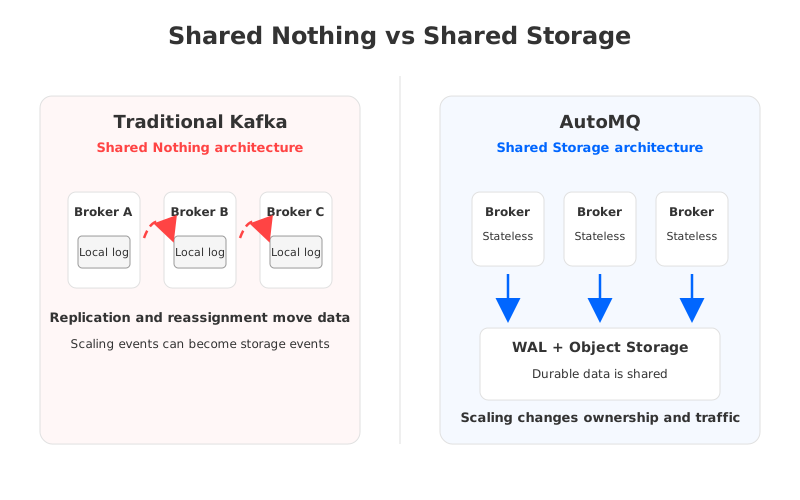
Traditional Kafka runs on a Shared Nothing architecture: each Broker owns local storage, each Partition has replicas, and brokers move data across the cluster to preserve durability and rebalance load. This model is proven and widely understood. It also ties capacity planning to broker-local disks and replica placement. When context ingestion grows, the team has to think about storage expansion, broker replacement, partition reassignment, catch-up reads, and inter-AZ traffic as part of the same operational event.
That coupling shows up during AI platform work because context pipelines are rarely steady. A product launch can spike behavioral events. A model update can trigger a replay into an embedding pipeline. A compliance request can extend retention for selected topics. A new downstream consumer can begin reading from older offsets and create cold-read pressure. Each case is legitimate, but in a broker-local design it can also become a data movement problem.
Kafka's own feature set gives teams powerful tools for this environment. Consumer groups coordinate parallel readers. Offsets give downstream systems a precise position in the log. Transactions and idempotent producers support stronger write guarantees where applications need them. KRaft removes ZooKeeper from Kafka metadata management. Kafka Connect provides a standard integration layer for sources and sinks. Tiered Storage can offload older log segments to remote storage while recent data remains local. These capabilities matter, and a serious platform evaluation should treat them as baseline expectations rather than optional extras.
The constraint is that none of those capabilities fully removes the operational gravity of broker-local storage. Tiered Storage can reduce pressure from historical segments, but the broker still depends on local disks for the active log. Partition reassignment still has to account for data ownership and local capacity. Multi-AZ replication can still create network traffic that appears outside the broker line item. For a context lake pipeline, this means the event log may preserve correctness while the platform team spends its energy managing the storage shape underneath it.
3Architecture options and trade-offs
There are several defensible ways to build context lake ingestion with Kafka. The right answer depends on workload shape, cloud boundary requirements, and the team's tolerance for operational control. A self-managed Kafka cluster gives maximum configuration freedom and deep ecosystem compatibility, but it also places capacity planning, upgrades, broker failures, and storage growth on the platform team. A managed Kafka service reduces some operations work, but it may still preserve the same core storage assumptions and billing surfaces. A Kafka-compatible cloud-native streaming platform changes the evaluation by asking whether the broker should remain the durable storage owner at all.
The trade-off is not one-dimensional. A platform team should compare options across the operating model, not by looking for a single feature checkbox.
| Evaluation area | Why it matters for context lake ingestion | What to verify |
|---|---|---|
| Kafka compatibility | Existing producers, consumers, connectors, stream processors, and schemas should keep working with minimal change. | Protocol support, client compatibility, transaction behavior, offset semantics, and tooling support. |
| Storage model | Replays, retention changes, and catch-up reads are storage-heavy operations. | Whether persistent data is broker-local, tiered, or stored in shared object storage. |
| Elasticity | AI workloads can spike during launches, incidents, and model refreshes. | Whether scaling requires data movement, broker-local disk expansion, or long reassignment windows. |
| Network cost | Multi-AZ production deployments can generate inter-zone traffic through replication and client routing. | Cloud provider data-transfer rules, rack-aware client settings, and broker routing behavior. |
| Governance | Context used by AI systems often includes regulated or sensitive data. | Encryption, IAM boundaries, auditability, schema control, and deployment ownership. |
| Migration risk | Existing Kafka estates often contain long-lived topics and stateful consumers. | Topic sync, offset preservation, rollback path, and cutover procedure. |
The table also exposes a common mistake: treating lake ingestion as a connector problem only. Kafka Connect or a sink connector can move records into object storage, a warehouse, or a table format, but it does not decide how the streaming platform absorbs storage growth, failover, scaling, or historical replay. Connector design matters; it is not a substitute for streaming architecture design.
4Evaluation checklist for platform teams
A practical evaluation starts with the workloads that will break first. List the topics that feed user-facing AI decisions, the topics that feed offline context refresh, and the topics that exist mainly for audit or replay. Then map each class to retention, ordering, schema, fan-out, and recovery requirements. This exercise often reveals that the ingestion layer is serving several jobs at once: it is a freshness path, a governance checkpoint, a backfill engine, and a migration boundary.
Use this checklist before committing to a platform shape:
The checklist is intentionally operational. Architecture diagrams are useful, but production confidence comes from watching a pipeline fail in controlled conditions and then recover with predictable data boundaries.
5How AutoMQ changes the operating model
Once the evaluation reaches storage ownership, AutoMQ becomes relevant as a Kafka-compatible cloud-native streaming platform built around Shared Storage architecture. It preserves Kafka protocol and semantic compatibility while moving persistent log storage away from broker-local disks and into S3-compatible object storage through S3Stream. Brokers still handle Kafka requests, leadership, caching, and scheduling, but durable data is no longer tied to a particular broker's local disk.
That shift changes the operating model for context lake ingestion in three ways. First, broker replacement and scaling become less entangled with data copying. If persistent data sits in shared object storage and brokers are stateless, the cluster can rebalance ownership and traffic without treating every broker change as a large storage migration. Second, retention and replay become closer to object-storage economics and operational behavior. The team still needs to design retention and compaction carefully, but it is no longer forced to provision broker-local disks for the full long-tail context history. Third, multi-AZ architecture can reduce the replication traffic pattern that traditional Kafka creates between brokers, especially when paired with zone-aware routing and object-storage-backed durability.
The write path is the part worth understanding before adopting the model. AutoMQ uses WAL (Write-Ahead Log) storage as a durable write buffer and then uploads data to S3 storage in near real time. AutoMQ Open Source uses S3 WAL. AutoMQ BYOC and AutoMQ Software can use additional WAL storage options such as Regional EBS WAL or NFS WAL, depending on latency, durability, and deployment requirements. That distinction matters for AI workloads because not every context stream has the same latency budget. A support copilot event and an offline corpus refresh should not force the same WAL choice.
For context lake ingestion, AutoMQ's fit is strongest when the team wants Kafka compatibility, customer-controlled deployment boundaries, and a storage model that does not make broker disks the center of every capacity discussion. AutoMQ BYOC keeps the control plane and data plane inside the customer's cloud account or VPC boundary, which is important when context data contains customer records, prompts, tool traces, or regulated attributes. AutoMQ Software serves private data center deployments where the same Kafka-compatible architecture needs to run under customer-operated infrastructure.
AutoMQ also provides features that connect to the context lake pattern without turning the article into a product checklist. Kafka Linking supports migration scenarios where topic data and consumer progress need careful handling. Self-Balancing helps the cluster adapt traffic distribution as brokers and workload patterns change. Table Topic can write streaming data into Apache Iceberg tables for lake-oriented analytics paths. These capabilities are useful because they sit around the core architectural change: persistent streaming data belongs in shared storage, while brokers focus on compute and traffic.
6A readiness scorecard for your next design review
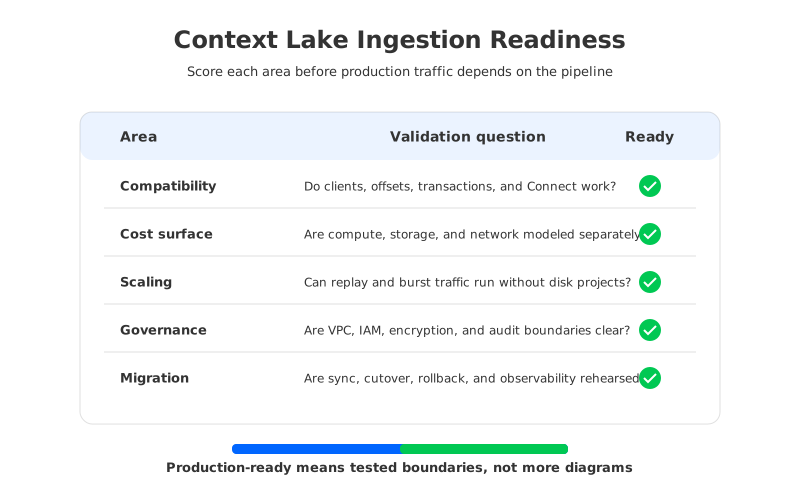
Before selecting a Kafka-compatible platform for context lake ingestion, give the design a score from 1 to 5 in each row. A low score does not mean the architecture is wrong. It means the team has found a risk that should be tested before production traffic depends on it.
| Readiness area | Score 1 looks like | Score 5 looks like |
|---|---|---|
| Freshness | End-to-end lag is inferred from batch completion times. | Lag is measured per topic, connector, sink, and AI context class. |
| Replay | Historical reprocessing is a manual incident. | Replay windows, offsets, schema versions, and sink idempotency are rehearsed. |
| Storage | Retention changes require broker disk resizing. | Storage growth is modeled separately from broker compute. |
| Governance | Access rules differ across producers, logs, and sinks. | Identity, encryption, audit, and schema rules are enforced at ingestion boundaries. |
| Migration | Cutover depends on a maintenance window and manual offset mapping. | Topic sync, consumer progress, producer routing, and rollback are documented. |
| Recovery | Broker or sink failures are handled case by case. | Failover, restart, backfill, and data validation runbooks are tested. |
The scorecard forces one architectural truth into the room: context lake ingestion is not valuable because it moves records into a lake. It is valuable when fresh, governed, replayable context can move through AI systems without each growth event becoming a broker-storage project. If that is the bar your platform team is trying to meet, start by testing the storage model, not by adding another sink.
For teams evaluating a Kafka-compatible streaming platform with shared storage and customer-controlled deployment boundaries, the next step is to review AutoMQ's architecture and run a workload-specific proof of concept: explore AutoMQ BYOC.
7FAQ
7.1Is Kafka required for context lake ingestion?
Kafka is not required for every ingestion path. It becomes useful when the team needs ordered events, durable replay, multiple consumers, backpressure handling, and a broad connector ecosystem. If the pipeline is a low-frequency file import with no replay or fan-out requirement, batch ingestion may be enough.
7.2How is context lake ingestion different from a normal data lake ingestion pipeline?
Context lake ingestion usually serves AI applications that need fresher and more traceable context than a batch-only pipeline can provide. It often combines application events, documents, feedback, profiles, and audit records, then routes them to multiple downstream systems such as lakehouse tables, vector indexes, and model monitoring workflows.
7.3Does Tiered Storage solve Kafka storage growth for AI context?
Tiered Storage can help by offloading older log segments to remote storage, but it does not fully remove broker-local storage from the active log path. Teams still need to evaluate scaling, reassignment, local disk behavior, and cold-read performance for their workload.
7.4When should a team consider AutoMQ for this pattern?
Consider AutoMQ when Kafka compatibility is required but broker-local storage is becoming the limiting factor for retention, scaling, replay, migration, or multi-AZ cost control. It is especially relevant when the team wants shared object storage, stateless brokers, and customer-controlled cloud or private deployment boundaries.
8References
- Apache Kafka documentation
- Apache Kafka Connect documentation
- Apache Kafka Tiered Storage documentation
- AutoMQ Kafka compatibility documentation
- AutoMQ Shared Storage architecture documentation
- AutoMQ S3Stream and WAL storage documentation
- AutoMQ Kafka Linking documentation
- AutoMQ Table Topic documentation
- AWS data transfer pricing
- AWS PrivateLink pricing
- Amazon S3 pricing


